
13 best B2B prospecting tools for sales teams in 2026

3 questions
Which group of tools fits your problem
No email required.
QUESTION 1 / 3
Do you struggle to find contacts or to know which ones to write to?
QUESTION 2 / 3
How many seats do you need and does the tool sell you fewer?
QUESTION 3 / 3
Do you sell into Europe and does that change who you can use?
🎯
Signals and timing
Your problem is timing
You already hold more contacts than you can write to, so another database adds rows and not replies. What moves the number is knowing which twenty accounts entered a buying window, and why.
- We monitor over 30 signals and start the message from the one that fired
- $99 a month flat for the account, with no seat minimum
- Common Room suits you better if your pipeline starts in a community
- Leadfeeder suits you better if the movement happens on your own site
🔍
Lookup and reveal
Your problem is reach
You know the accounts and the titles, and the addresses stop you. Buy the research layer and the reveal layer separately so you can swap either one without losing the other. Then come to us for the part that tells you when to send.
- Sales Navigator for research at $119.99 per license a month
- Lusha for reveals in the browser, starting free
- LeadMagic for the same job through an API, from $49.99 a month
- Apollo if you'd rather buy the database and the sending together
🌍
European coverage
Your constraint is the contract
Your customers ask where the data sits, so the shortlist narrows before anyone compares features. Ask each vendor to name the contracting entity and the sub-processors in writing.
- Gojiberry, a French company, for signals and outreach
- Cognism for phone-verified European contact data, priced by quote
- Leadfeeder, a German entity, for site identification
- PhantomBuster, a French SAS, for automation
Three different products share this page. Some hand you a database to filter. Some hand you a workflow to enrich and route. And some tell you which accounts moved this week, so you write to twenty companies instead of two thousand. Buy the wrong one and you'll blame the tool.
So here are thirteen tools sorted by the job they do, each priced from the vendor's own page in August 2026: the number, the billing period, the seat minimum. The grouping follows Google's own answer on this query rather than our preference.
Twenty accounts moved in your market this week
Start free on your marketTable of contents
- What can you do with a B2B prospecting tool?
- How we checked these prices
- The 13 best B2B prospecting tools
- Which tools publish a price and which send you to a sales call
- Where your prospect data lives
- Run the math for a team of three
- How to prospect in B2B without a big budget?
- How to choose the good one in three questions
- What people ask before they pick a prospecting tool
What can you do with a B2B prospecting tool?
B2B prospecting means finding the companies that fit what you sell, working out who decides inside them, and starting a conversation. Three jobs sit under that sentence: choosing which accounts deserve your week, finding a way to reach the right person there, and picking the moment to write. Every tool below automates at least one of the three, and none of them automates all three well.
There's a fourth job no software touches, which is knowing what to say. A tool can tell you a company just hired a head of revenue operations. You still decide whether that matters to your product. It's also worth knowing that the list you buy starts rotting the day you export it, because B2B data decays at roughly 2.1% a month, so a database you bought in January is meaningfully wrong by summer.
How we checked these prices
We opened every vendor's own pricing page in August 2026 and recorded three things per tool: the entry price, the billing period, and any seat minimum. Where a vendor publishes plans but hides the upper tiers, we say which tiers you can read and which ones need a call. Where a vendor publishes nothing, that's the finding, and we wrote it down rather than borrowing a number from a competitor's blog. For company location we used each vendor's own legal pages and, for the French and British entities, the public company registers.
One thing you won't find here: a scorecard of measured match rates. We haven't run a controlled reveal test across thirteen tools on one identical list, and an invented percentage would be worth less than this sentence admitting it. When we run that test, the numbers land on this page. We pay for the plans we use, no vendor read a word of this before publication, and Gojiberry is our own product, which is why it sits first in its group rather than first on the page.
The 13 best B2B prospecting tools
Buying signals and intent
These tools answer a timing question rather than a coverage question. They watch for events that suggest a company entered a buying window, then hand you the account with the reason attached. Teams that already own a database and still get silence usually belong here. Our guide to 13 intent signals to find high-intent leads without cold outreach lists the events worth watching, and our roundup of Trigify alternatives covers the rest of the signal-tracking market.
Gojiberry
Gojiberry is an AI-powered multichannel prospecting platform. It tracks more than 30 buying-intent signals across socials and the web, surfaces the leads who are in-market right now, and triggers personalized outreach across channels. Fresh funding, a relevant hire, a role change and engagement with a competitor each open a different message, and the ICP filter screens the account before anything goes out.
It fits a founder or a sales team of two to ten who already know who they sell to and want the tool to answer when rather than who. If your ICP is still fuzzy, the filter has nothing sharp to work with and you'll get less out of it.
Here's the difference inside this group: we close the loop. Common Room aggregates signals and hands them to your stack, and Leadfeeder names the companies on your own site. We start the outreach from the signal itself, so the reason you're writing and the moment you write come from the same event. What we don't do matters just as much. We're not a contact database, so we won't build you a 50,000-row export. We're not a bulk email sender and we're not a CRM. Teams that need those keep them and put us in front.
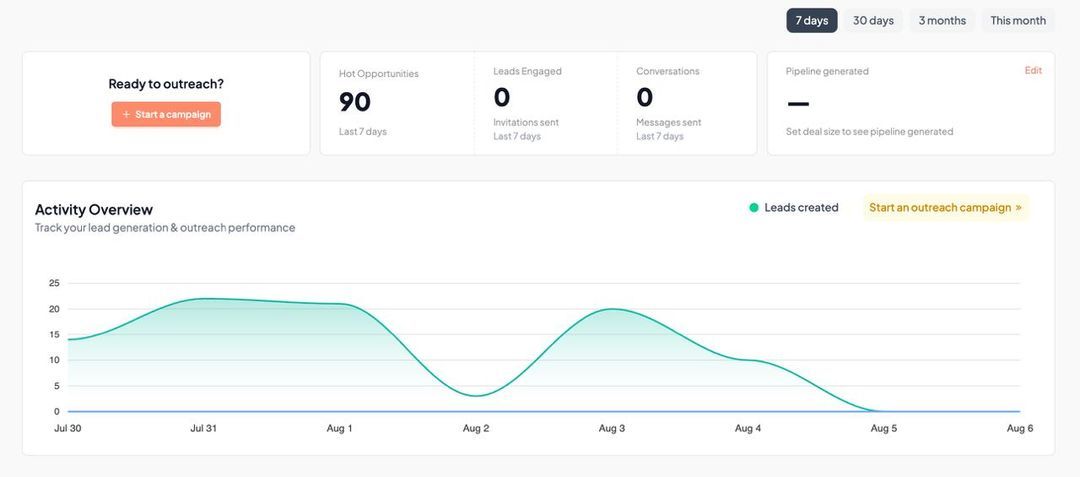
Price
Free plan, then $99 a month on Pro. Custom above that.
Seat minimum
None. The price covers the account, with 2 social senders.
Where the company sits
France.
Common Room
Common Room pulls signals from communities, product usage, your website and social platforms into one view per person and per account. It resolves the same human across a Slack workspace, a GitHub repo, a social profile and your product, scores the account, then pushes it out to the rest of your stack.
It suits revenue operations teams at software companies with a real community or a product-led motion, and it needs somebody to own the configuration. Small teams rarely have that person, and the plan sizing assumes they do.
Nothing else in this group resolves identity across community sources the same way. If your pipeline starts in an open-source repo or a Slack group, nothing else here stitches those identities together as well. The entry tier is the only one with a public number, and at $30,000 a year it's a different conversation from the rest of this page.
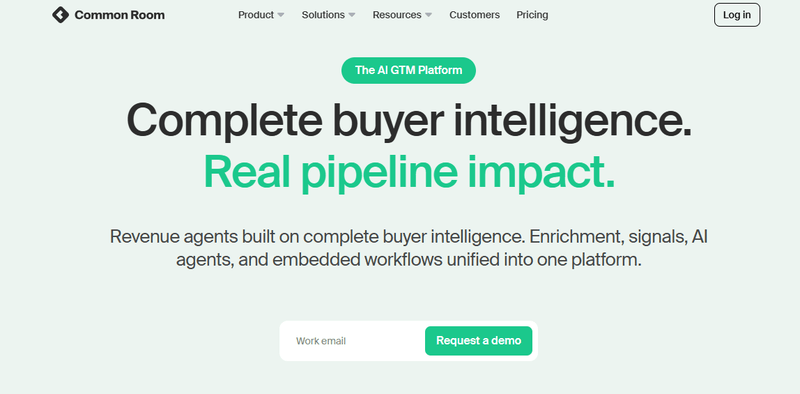
Price
Essential at $2,500 a month on annual billing, so $30,000 a year. Advanced and Enterprise go through sales.
Seat minimum
Essential includes 5 seats and up to 100,000 contacts.
Where the company sits
United States.
Leadfeeder
Leadfeeder names the companies that visit your website through reverse IP lookup, shows which pages they read, and pushes the account into your CRM. It counts a company once a month however often it comes back, and it filters out bots and consumer connections.
It fits teams that already get real B2B traffic and watch it leave without a form fill. Anyone browsing from home stays invisible to it, so how much of your traffic it can name varies a lot by market and by how remote your buyers are.
Its whole premise sets it apart: it reads your own first-party traffic instead of a database or a public feed. The corporate history is worth knowing too, since the company merged with Echobot in 2022, traded as Dealfront from 2023, then unified back under the Leadfeeder name on 24 March 2026.
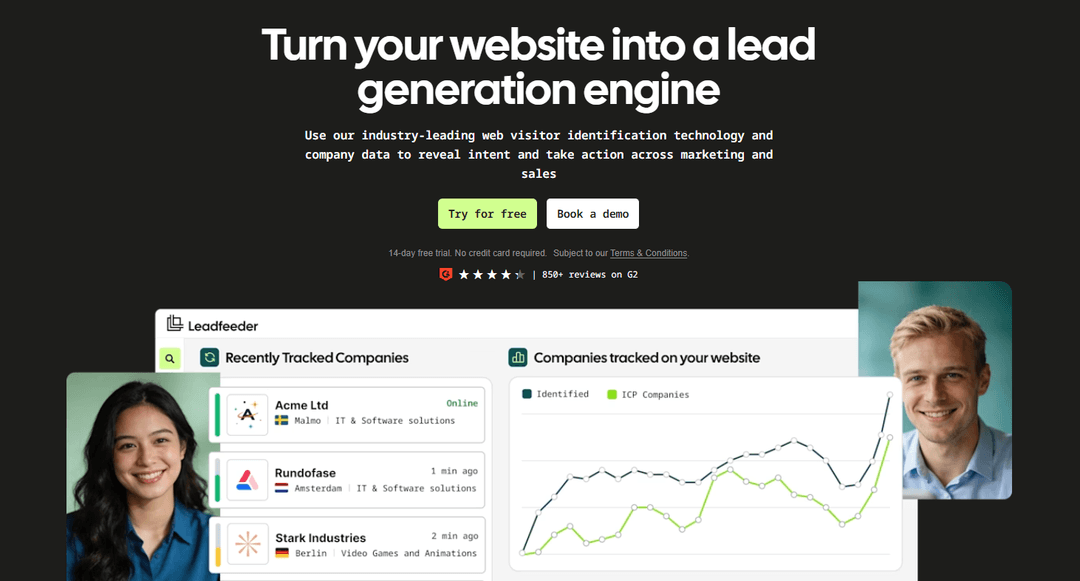
Price
Free plan up to 100 identified companies a month. Discover from €79 a month on annual billing, €113 month to month. Activate €369 annual. Scale €599, annual only. Enterprise on quote.
Seat minimum
None. Every plan includes unlimited users.
Where the company sits
Germany, as Dealfront Group GmbH. The product started in Helsinki.
All-in-one for mid-market
Apollo
Apollo bundles a large contact database with sequencing, a dialer and reporting behind one seat price. You filter a list, reveal the contacts, and send from the same screen, which is why it ends up as the default first purchase for so many teams.
It fits an outbound team of three to twenty who want one login rather than four. Solo founders often find the interface heavier than the job needs, and anyone working the phone watches the credit meter closely, since a mobile number costs several times what an email costs.
One thing no other tool on this page manages: find, enrich and send on a single subscription. Everything else on this page expects you to bring at least one other tool. Our Apollo pricing breakdown walks through where the credits go.
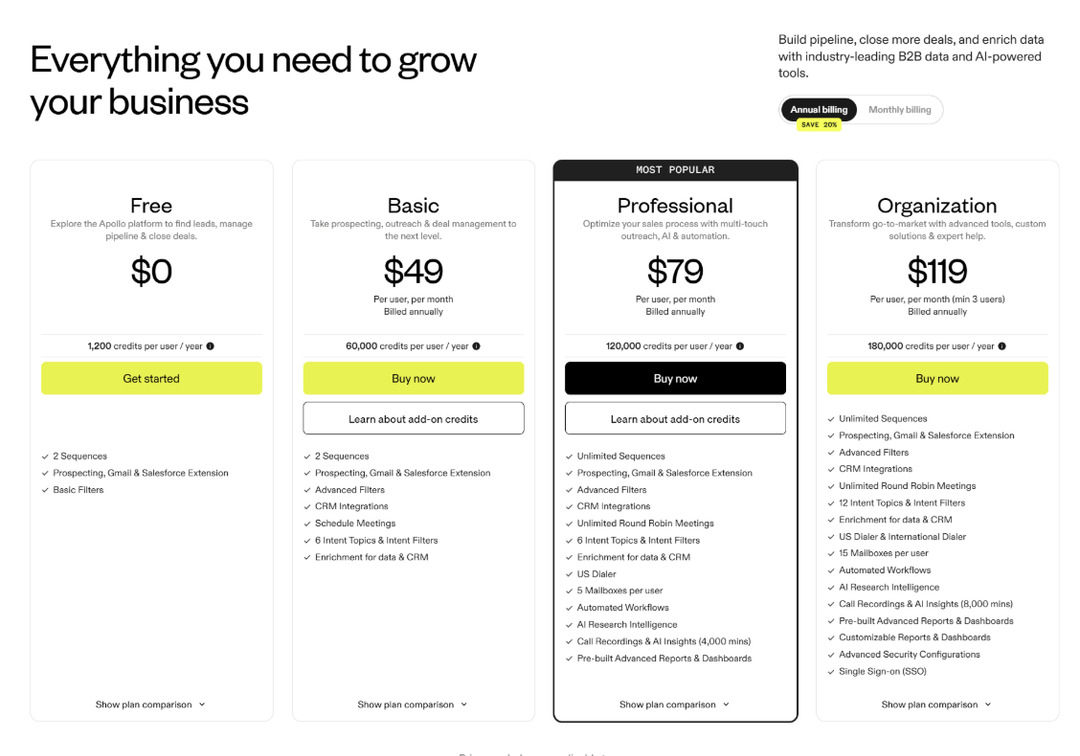
Price
Free plan. Basic $49 per user a month on annual billing, $59 monthly. Professional $79 annual, $99 monthly. Organization $119 annual, $149 monthly.
Seat minimum
None on Basic and Professional. Organization needs 3 users.
Where the company sits
United States.
Enterprise data
ZoomInfo
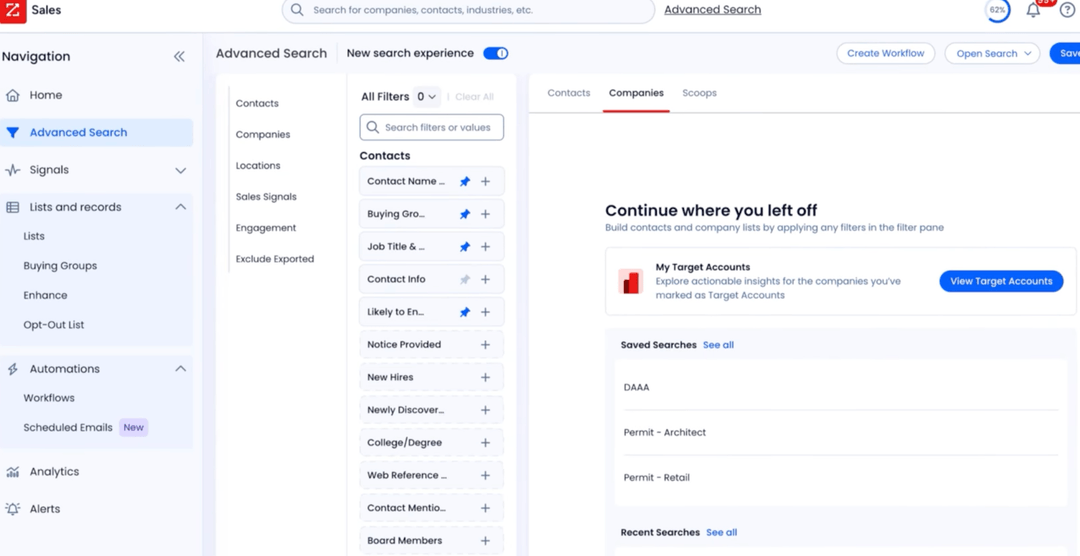
ZoomInfo sells the deepest commercial B2B dataset in the market, with org charts, direct dials, intent topics and a stack of modules layered on top. Large sales organizations buy it for coverage and for the workflows their operations team builds around it.
It fits companies with a procurement process and a data budget. A two-person team can't buy it in any practical sense, and that's a positioning choice rather than an accident.
Its edge is depth in North America. What it won't do is show you a price. ZoomInfo publishes a free Lite tier and no list price for any paid plan, sells on annual contracts, and buyers consistently report a three-seat floor. If that rules it out, our page on alternatives to ZoomInfo covers the cheaper end of the same job.
Price
No published price on paid plans. Every quote goes through a call. A free Lite tier exists.
Seat minimum
Not published. Buyers report 3 seats on the entry tier.
Where the company sits
United States.
European coverage
Cognism
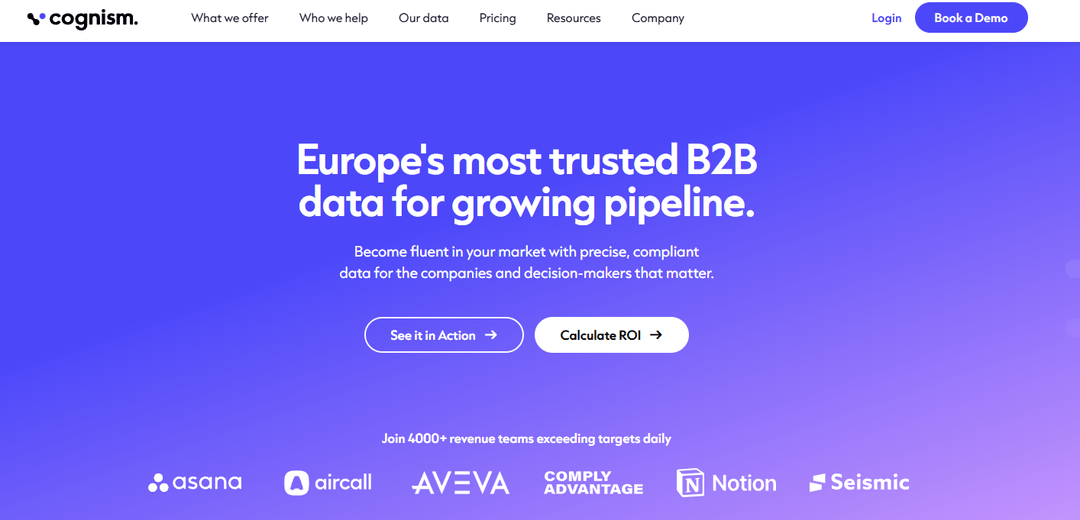
Cognism built its name on European contact data, phone-verified mobile numbers and a compliance-first posture that includes do-not-call screening across European lists. Teams selling into DACH, France and the Nordics reach for it when a US database comes back thin.
It fits a team that calls, sells across several European markets, and has a compliance officer in the room. It expects an annual contract and a conversation before you see anything at all.
Against Ocean.io the gap is verification: Cognism confirms mobile numbers by phone rather than inferring them, and it screens against European do-not-call registers. That's the whole reason a European enterprise buyer signs the contract, and it's also why the contract exists in the first place.
Price
No published price. Cognism quotes every deal through sales on an annual contract, with no self-serve trial.
Seat minimum
Not published.
Where the company sits
United Kingdom, as Cognism Limited in London.
Ocean.io
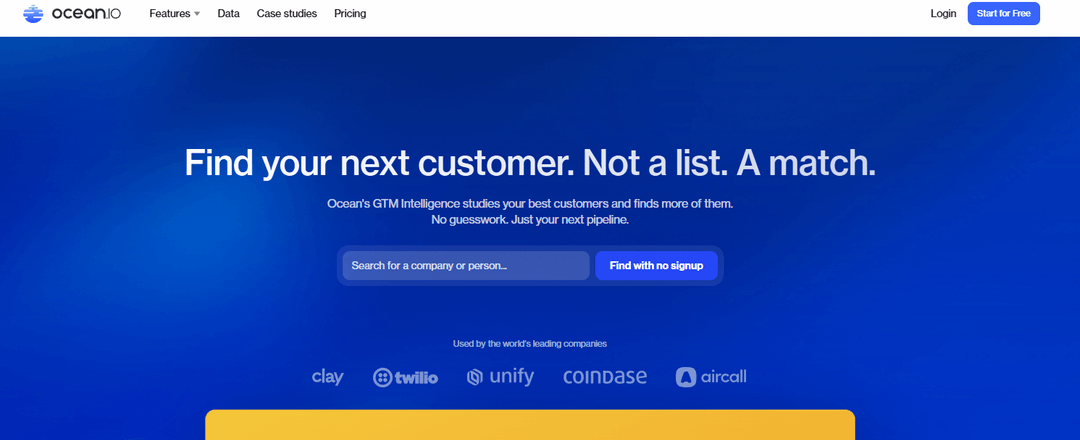
Ocean.io starts from your best customers instead of from a filter. You give it three to five seed domains, it returns companies that look and behave like them, and then it reveals verified emails and direct phone numbers for the people inside.
It fits a team selling into a niche that filters badly by industry code, and it prices in a way a small team can start with. The database is smaller than the giants, so coverage thins out in some segments and you'll want to test yours before you commit.
Cognism has no equivalent to the lookalike search, and it charges by seat where this one doesn't. You pay for credits rather than for people, which changes the math the moment your team grows past two.
Price
Credits from $0.063 each with a 9,000-credit minimum, which the page shows as $47.25 a month and $567 for the year. Pay-as-you-go costs more per credit.
Seat minimum
None. Every plan includes unlimited users.
Where the company sits
The site names Ocean Global, Inc. in San Francisco, so the United States.
Enrichment workflows
Clay
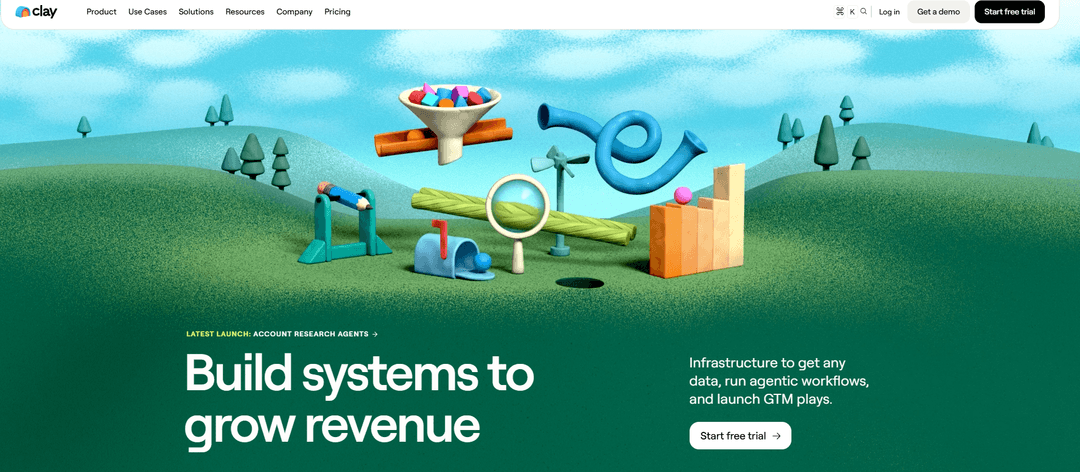
Clay gives you a spreadsheet that calls more than a hundred data providers. You build a table, run a waterfall so a second provider tries when the first comes back empty, add an AI column that researches each row, then push the result into your sequencer.
It fits an operations person who enjoys building systems, and it pays back the hours you put in. A founder who wants leads by Thursday will find the learning curve steep and the credit model unforgiving, since a failed lookup still spends.
The model is unusual: Clay orchestrates other vendors instead of selling you its own database. Note the March 2026 change, which closed the old Starter, Explorer and Pro tiers to new customers. Our Clay pricing guide covers the credit system in detail.
Price
Free plan. Launch $185 a month, Growth $495 a month. Annual billing takes about 10% off, so $167 and $446. Enterprise on quote.
Seat minimum
None. Seats are unlimited and usage sets the price.
Where the company sits
United States.
Your buyers moved this week
Gojiberry watches over 30 buying signals and hands you the accounts worth a message, with the reason they moved. Try it free before you pay anything.
See who to write toAI agents and automation
11x
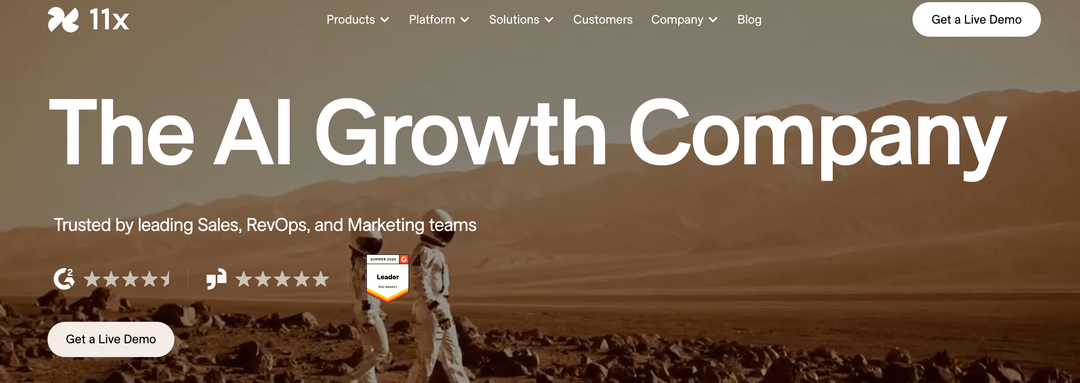
11x sells digital workers rather than software seats. Alice runs the outbound motion end to end, mailboxes and warmup and inbox rotation included, and Julian answers inbound calls and books the meeting. The company charges per lead rather than per send.
It fits an organization replacing or extending sales development headcount, on a budget that compares against salaries instead of against tool subscriptions. Reviewers report a real setup period and hands-on management of deliverability afterward.
Set against PhantomBuster: 11x owns the whole motion, infrastructure included, and you bring nothing but a CRM license. The Growth tier is public and everything above it goes through sales. Our page on 11x alternatives compares the rest of the AI sales development market.
Price
Growth from $3,750 a month on annual billing, covering 2,000 new prospects a month. Pro and Enterprise go through sales.
Seat minimum
Growth includes up to 5 end users.
Where the company sits
United States, as 11x AI Inc. in San Francisco, with a London office.
PhantomBuster
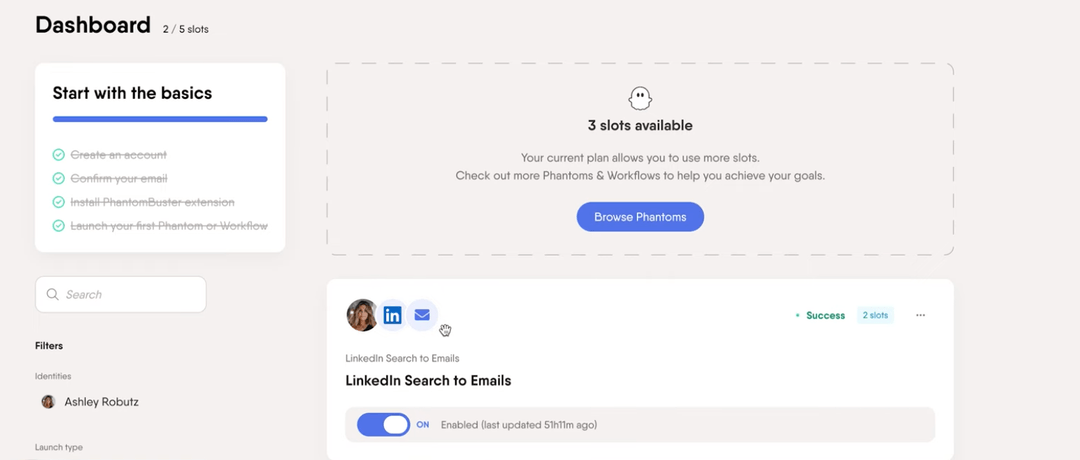
PhantomBuster runs more than a hundred ready-made automations that extract, enrich and act on data across the web. You chain them into a workflow, schedule it, and the platform bills you for the hours your automations spend running.
It fits a growth or operations person who's comfortable assembling their own pipeline, and agencies that build one flow and reuse it across clients. Three separate quotas of execution hours, slots and email credits take some planning, and hitting any of them stops the work until the cycle resets.
Where 11x sells the finished worker, this one hands you the parts at roughly a twentieth of the entry price. It also bills execution time rather than seats or contacts, which is unusual and easy to misjudge in month one.
Price
Start $69 a month, Grow $159, Scale $439. Annual billing takes about 20% off, so $56, $128 and $352. A 14-day trial, no permanent free plan.
Seat minimum
None. The plan sets execution hours and slots rather than users.
Where the company sits
France, as The Phantom Company SAS registered in Paris.
Profile research and contact finding
Sales Navigator
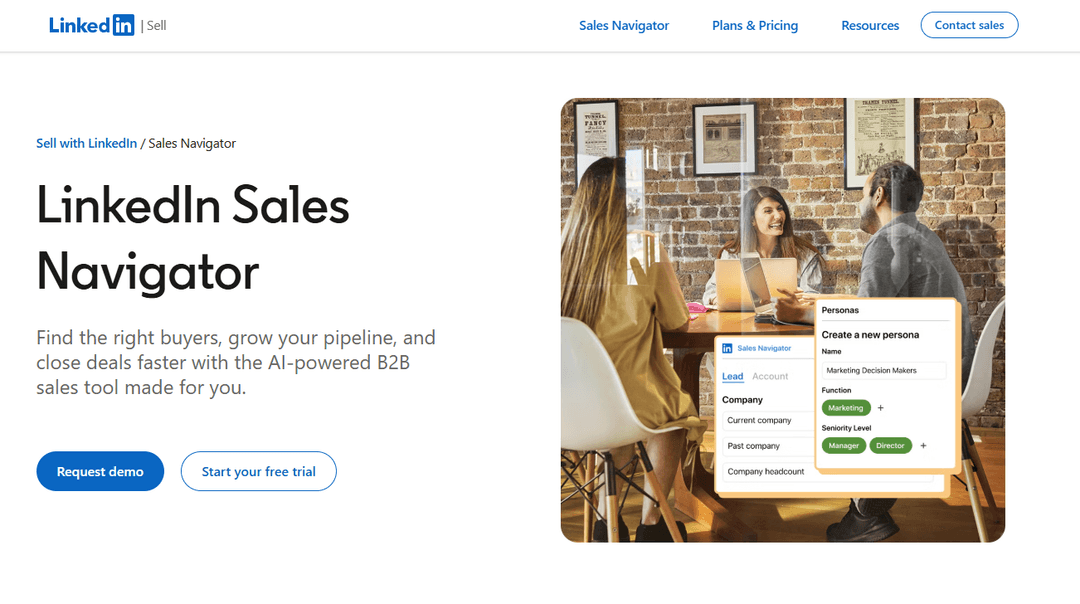
Sales Navigator is LinkedIn's own prospecting layer. It opens filters the free product hides, saves leads and accounts, alerts you when somebody changes role, and hands you InMail credits for people outside your network.
It fits almost any B2B seller as a research surface, and it stays the reference point for job-change data. That matters more than it sounds: median job tenure in the United States runs 3.9 years, and 22% of employees have been in post under a year, so a fifth of your target list is new in role and open to a conversation.
Lusha and LeadMagic both work from a copy. This one reads the source. What it won't give you is an email address or a phone number, so it never works alone and the second line item is not optional.
Price
Core $119.99 per license a month, or $1,079.88 a year. Advanced $159.99 a month, or $1,799.88 a year. Advanced Plus on quote.
Seat minimum
None. Single licenses are available.
Where the company sits
United States, as part of Microsoft.
Lusha
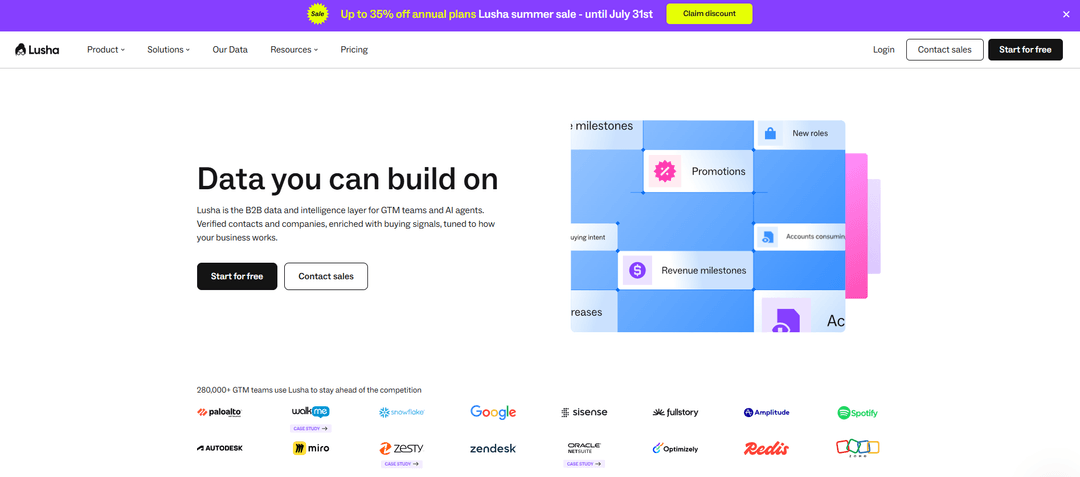
Lusha lives mostly in a browser extension. You open a profile or a company site, click the icon, and it reveals an email address or a mobile number against your credit balance. Plans include seats rather than charging per user, so adding a rep splits the pool instead of adding a license.
It fits a rep who researches by hand and wants a contact detail on demand, and it stays popular with teams that call. Phone reveals cost several times what an email reveal costs, so a phone-first motion drains an allocation fast and the slider becomes the real price.
Against LeadMagic the difference is the surface: the reveal happens in front of a human, inside the browser, one profile at a time. No pipeline to build, no key to manage, which is the whole point for a team of two.
Price
Free plan with 40 credits a month. Starter $37.45 a month on annual billing, $49.90 monthly. Pro $52.45 annual, $69.90 monthly. Premium $299.95 annual. Scale on quote.
Seat minimum
None. Plans include seats: 1 on Starter, 2 on Pro, 5 on Premium.
Where the company sits
We haven't confirmed the entity on this pass.
LeadMagic
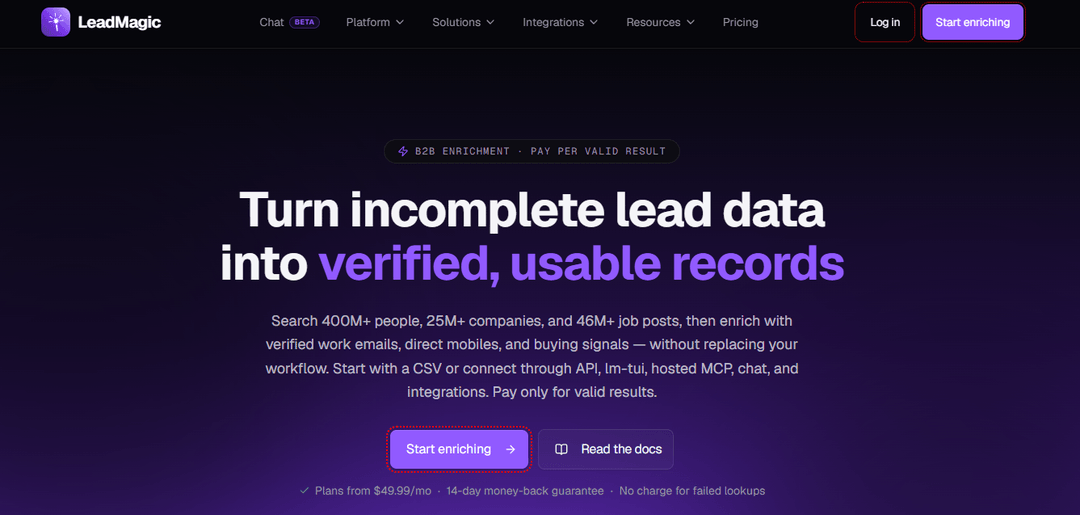
LeadMagic sells enrichment as an API first and an app second. It finds work emails, personal emails and mobile numbers, validates addresses, detects job changes, and spends credits only when a lookup comes back with a valid result.
It fits a technical team, an agency running enrichment at volume, or anyone building an agent that needs data on demand. Teams that want a screen to click through will find it thin, and that's deliberate rather than a gap.
Neither Lusha nor Sales Navigator offers this: a hosted MCP server and a command-line tool, so an AI agent enriches contacts through the same key as your scripts. Search costs nothing on the middle tier and up, which is unusual in this group.
Price
Basic $49.99 a month or $490 a year for 2,000 monthly credits. Essential $99 a month or $990 a year for 5,000. Growth $249 a month or $2,490 a year for 20,000. Enterprise from $2,490 a quarter.
Seat minimum
None. Plans include 1, 3 and 5 seats on one shared credit pool.
Where the company sits
We couldn't confirm the entity from the vendor's own pages on this pass.
Which tools publish a price and which send you to a sales call
Eleven of the thirteen publish a number you can read without talking to anybody. Here's what each one asks for at the entry point.
Two publish nothing at all, and several others publish only their first step. Common Room quotes Advanced and Enterprise. 11x quotes Pro and Enterprise. Clay, Ocean.io and Leadfeeder each keep an unpriced Enterprise tier on the last rung.
For a two-person team the consequence is concrete. Without a published price you can't compare two vendors, you can't put a line in next quarter's budget, and you burn a discovery call plus a demo before you learn whether the answer was ever going to be yes. A published number costs you four seconds and tells you whether to keep reading.
Where your prospect data lives
Google treats European compliance as its own category on this query, so it deserves a straight answer. The difference isn't whether a vendor claims GDPR compliance, because every one of them does. The difference is which company signs your contract.
Sign with a vendor established in the European Union and GDPR applies to that entity directly, your counterparty sits in the same legal space you do, and your own regulator can reach it. Sign with a US vendor and the vendor covers the transfer through contractual mechanisms such as standard contractual clauses or the EU-US Data Privacy Framework, while the parent company stays subject to US law. That second arrangement is legal and extremely common. It's also more paperwork for whoever owns privacy at your company, and one more question your enterprise customers will raise during their own security review.
Here's where these companies sit, based only on what we could confirm from their own pages and from public registers. European entities: Gojiberry in France, PhantomBuster as The Phantom Company SAS in Paris, Leadfeeder as Dealfront Group GmbH in Germany, and Cognism as Cognism Limited in London, which puts it in the United Kingdom rather than the European Union. United States entities: Apollo, ZoomInfo, Clay, Common Room, 11x and Sales Navigator.
Ocean.io deserves its own line. It sells strong European company coverage and plenty of buyers file it as a European option, yet the entity printed in its own footer is Ocean Global, Inc. in San Francisco. We couldn't confirm the entity behind Lusha or LeadMagic from their own pages, so we left both out of the lists above rather than guess.
Never take a certification on trust. Before you sign, ask the vendor to put three things in writing: the legal entity on the contract, the region where the data sits, and the list of sub-processors. A badge on a marketing page tells you what the vendor wants you to believe. The data processing agreement tells you what you can hold them to.
Run the math for a team of three
Take three salespeople contacting 400 prospects a month between them, which is a normal load for a small team that also demos and closes. Buy the research layer and the reveal layer separately and you're at $119.99 a license for Sales Navigator, so $360 a month, plus around $50 for enrichment. That's $410 a month for the ability to find people, before anybody decides who deserves a message.
Buy the all-in-one instead and Apollo runs $147 a month for three seats on Basic, with the credits deciding the real bill. Buy the agent and 11x starts at $3,750 a month on an annual commitment. Gojiberry is $99 a month flat for the account, and it answers a different question from all three: not who exists, but who moved.
None of those numbers is wrong for somebody. The mistake is stacking all three because each one looked cheap in isolation, then wondering in March why the tooling line grew faster than the pipeline did.
How to prospect in B2B without a big budget?
The order you buy in matters more than the logos. Four steps, and each one maps to a different type of tool.
- 🎯Define who really buys. Not who could buy, and not the market you'd like to serve. Open your last ten closed deals and write down what they share: size, sector, the tool they already run, the title that signed.
- 🔔Pick the signal that says now. New money in the bank, a hire in the function you sell to, someone changing seats, a competitor getting attention, a visit to your pricing page. Signal tools cover the market, site identification tools cover your own traffic.
- 📧Find the contact. Research tools give you the person and reveal tools give you the address. A free tier plus $50 a month of enrichment carries a small team a long way.
- ✍Write about the signal. Not about your product. The event that fired is the reason your message isn't cold, so it belongs in the first line. Our cold email templates show the pattern for each signal type.
Steps one and four cost nothing and carry most of the outcome. There's also a hard reason to keep volume down: Google requires bulk senders to stay under a 0.3% spam complaint rate, and blasting an unfiltered list is the shortest route to that threshold. Teams that skip the thinking buy bigger tools to compensate, then get the same silence back at a higher price.
How to choose the good one in three questions
Three questions route you to a group rather than to a logo. The quiz at the top of this page walks you through them, and here's what each answer means.
Do you struggle to find contacts or to know which ones to write to?
If you have contacts and no replies, the bottleneck is timing and you want the signals group. Come to us instead if you'd rather the tool told you the twenty accounts worth a message right now, at $99 a month with no seat minimum.
How many seats do you need and does the tool sell you fewer?
Per-seat pricing punishes growth, and Apollo, Sales Navigator and Cognism all bill that way. Clay, Ocean.io, Leadfeeder and Gojiberry price the account instead, so a third rep costs you nothing extra.
Do you sell into Europe and does that change who you can use?
If your customers audit your sub-processors, the shortlist narrows to European entities before you compare a single feature. Gojiberry, PhantomBuster and Leadfeeder sit there, and Cognism sits in the United Kingdom.
The first question is the one we answer
Get leads without the lookupWhy we built this
Before Gojiberry there was Coco.ai, and before Coco.ai there was Roman spending his days prospecting on socials and checking by hand who'd just changed roles, raised money or started following a competitor. The pattern was obvious after a few months. The accounts that replied weren't the ones that matched a filter best, they were the ones that had moved recently.
Doing that manually caps out somewhere around thirty accounts a week, and it dies the moment you get busy closing. So we built the thing that watches for us. That's also why we're honest about the shape of the product: it won't hand you a hundred thousand rows, because that was never the part that was broken.
The thirteen tools on this page all earn their place with somebody. Match the group to your bottleneck, check the entity before you sign, and refuse to spend a call finding out a price. That's most of the decision.
What people ask before they pick a prospecting tool
What are the best tools for B2B sales prospecting?
There's no single best tool, because the category splits by job. For buying signals, start with Gojiberry, Common Room and Leadfeeder. For an all-in-one mid-market platform, Apollo. For enterprise data, ZoomInfo. For European coverage, Cognism and Ocean.io. For enrichment workflows, Clay. For AI agents, 11x and PhantomBuster. For research and contact finding, Sales Navigator, Lusha and LeadMagic. Pick the group that matches your bottleneck, then compare inside it.
What is B2B prospecting?
B2B prospecting means finding the companies that fit what you sell, working out who decides inside them, and starting a conversation. It covers three jobs: deciding which accounts deserve your time, finding a way to reach the right person, and choosing the moment to write. A prospecting tool automates one or more of those. It doesn't replace the judgment behind them.
How do I prospect in B2B sales?
Define who really buys rather than who could buy. Pick the signal that says now: fresh funding, a new hire, a change of seat or a visit to your site. Find the contact and verify the address or the number. Then write about the signal instead of about your product. Each step maps to a different tool type, and you rarely need all four from one vendor.
Which B2B prospecting tools offer a free plan?
On our August 2026 checks, Gojiberry, Apollo, Clay, Lusha and Leadfeeder all publish a free plan, and ZoomInfo publishes a free Lite tier. Ocean.io, PhantomBuster, Sales Navigator and LeadMagic offer a trial rather than a permanent free plan. Cognism, Common Room and 11x publish neither a free plan nor a self-serve trial.
What does a B2B prospecting tool cost?
Published entry prices in this list run from $0 to $3,750 a month, and a small team usually lands between $50 and $250 a month per tool. Two mechanics move the total: a per-seat price multiplies with headcount, and a credit price multiplies with how many phone numbers you reveal. Enterprise data platforms sit in a different bracket and quote you by contract.
Do I need a prospecting tool and a CRM?
Yes, because they solve opposite problems. A CRM records what already happened with people you know. A prospecting tool finds people you don't know yet and tells you when to write. Most prospecting tools push into HubSpot, Pipedrive or Salesforce rather than replacing them. Check the integration exists on the plan you're buying, not just on the enterprise tier.
Which prospecting tools work for European teams?
All of them sell into Europe, so the real question is which entity you contract with. Gojiberry is a French company. PhantomBuster is registered in Paris under the name The Phantom Company. Leadfeeder bills you from Germany. Cognism is Cognism Limited in London, so the United Kingdom rather than the European Union. Apollo, ZoomInfo, Clay, Common Room, 11x and Sales Navigator are US companies, and Ocean.io names a San Francisco entity on its own site despite its European coverage.
Stop building lists and start reading signals
Gojiberry tracks more than 30 buying signals and hands you the accounts worth writing to this week, with the reason they moved.

More High-Intent Leads = Your New Growth Engine.
Start Now and Get New High Intent Leads Delivered Straight to Slack or Your Inbox.