
Apollo pricing 2026: the real price

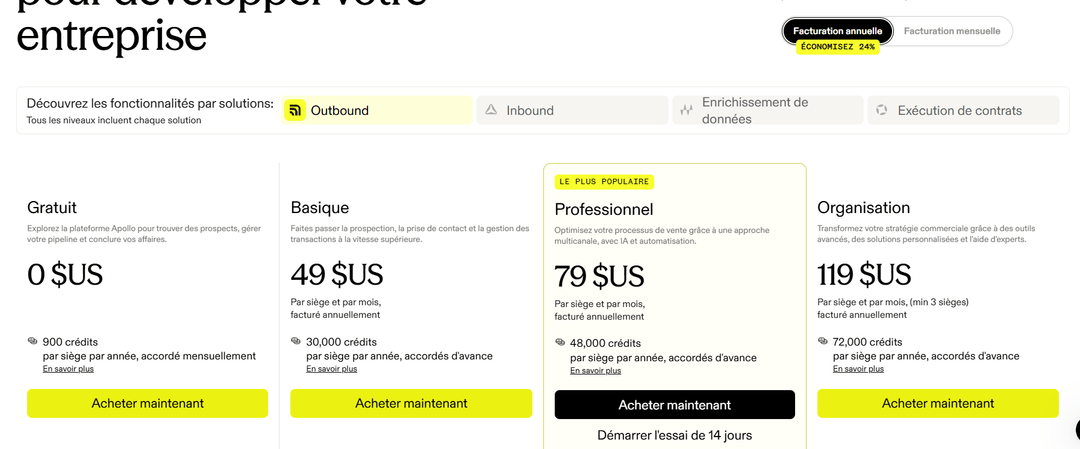
Apollo plans as of August 2026
- Paying yearly takes around 20 percent off the monthly rate.
- Organization is sold on annual billing only and won't go below 3 seats, so its real entry point is $4,284 a year.
- Credits are granted per seat and per month, upfront. They aren't a shared annual pool, the way several comparison pages describe them.
Apollo publishes its prices and makes a selling point of doing so, which means you've already seen the four tiers above. What the pricing page doesn't tell you is what one credit buys once you start clicking.
So this page has the current grid, the credit cost of every action Apollo charges for, and the arithmetic of what a team of three or five can do with a month's allowance.
Gojiberry finds your prospects for you
Apollo gives you a database to search. Gojiberry watches more than 30 buying signals and tells you which accounts are worth contacting right now, for $99 a month.
Start free, no list neededTable of contents
How do Apollo credits work?
A credit is the unit Apollo bills you in, and one leaves your balance the moment you reveal something. The catch is that reveals aren't priced the same.
- 📧An email address costs 1 credit. It's the cheapest thing you can pull.
- 📞A phone number costs 8 credits. Same click, eight times the bill.
- 🔍Enriching a record costs 1 to 8 credits, depending on which source fills the gap.
- 🤖An AI research run costs 1 credit, and it spends one every time it runs.
- 🎧The US dialer costs 2 credits per minute of talking.
- 🌍The international dialer varies by region. There's no single published rate.
Two things follow. Every seat gets its own allowance, so a five-person team on Basic opens each month with 12,500 of them rather than 2,500. That's a real point in Apollo's favor, and several comparison pages get it wrong by describing one pool shared across the account for a year.
The second one decides your budget if you're calling. A mobile costs eight times what an email address costs. A team running email barely watches the meter. A team that dials watches it move all day.
What can you do with your monthly credits?
Divide the month's allowance by the price of what you're after and each plan turns into a number of contacts. Here are both extremes, with the whole month spent on one type of reveal.
Real usage lands somewhere between those two columns. The dialer is where the arithmetic turns against you. At 2 credits a minute, a rep who spends two hours a day on the phone burns 240 credits a day, or 4,800 a month. That's past the whole Professional allowance on call minutes alone, before a single contact has been revealed.
Then there's a ceiling almost nobody quotes. Free and Basic cap you at 250 emails a day, and Basic gives you one mailbox per user. Unlimited sending, along with unlimited Google and Microsoft mailboxes, starts at Professional. If volume email is the plan, that daily cap bites well before your credit balance does.
You pay to find out if it was the right person
Apollo charges the same credit whether the contact fits your ICP or not, and eight of them for a phone number. Gojiberry works out who is worth contacting first, then hands you the list.
Get your first leads for freeWhat does Apollo charge extra for?
Two add-ons sit outside the plans, and the good news comes first. Both are billed per team rather than per seat, so on a team of five they're one line on the invoice instead of five.
Inbound, $149 a month per team
It identifies companies visiting your website, up to 50,000 a month globally, plus up to 10,000 individual contacts a month in the US only. It tracks 100 domains and enriches 5,000 form submissions a month.
Advanced Dialer, $149 a month per team
It adds international dialing, a parallel dialer, a power dialer and local presence. If your reps call outside the US, this is the line where that lives.
Two conditions are worth knowing before you budget for either one. You have to be on a paid plan before you can add them, so neither is a way to stretch the free tier. And Apollo describes both as introductory pricing that may change.
What are Apollo's contract terms?
None of what follows is published on the pricing page. These four points are reported by third parties, so read them as a reason to check your own paperwork before you sign anything.
- 🔁Contracts renew on their own. Written notice is reportedly due 30 days ahead of the renewal date, so the calendar entry matters more than the intention.
- 👥Seat counts don't come down mid-contract. A team that shrinks keeps paying for the seats it no longer fills.
- 💰Payments are described as non-refundable. A downgrade takes effect immediately and nothing comes back for the rest of the term.
- 📌Plans sold as unlimited sit under a fair use policy. The word means what the policy says it means.
Which Apollo plan do you need?
A tier list doesn't tell you which one you need. What you're doing next month does. Four situations, and where each one lands.
You want to test the data quality before you send anything
Free, with one warning. 100 credits is 100 email addresses or 12 phone numbers, and you're held to 2 sequences, 250 emails a day and a 25-record selection limit in the Chrome extension. It's enough for a sample and too thin for a pilot.
You're running email at low volume with the CRM connected
Basic, at $59 a month, $49 if you pay yearly. That's where unlimited sequences, CRM integrations, waterfall enrichment and 6 intent topics start. Keep the 250-a-day cap and the single mailbox in view.
You're running volume, several mailboxes and US phone outreach
Professional, at $99 monthly, $79 on the annual plan. It's the first tier with unlimited sends, unlimited Google and Microsoft mailboxes, the US dialer, 4,000 minutes of call recording, automated workflows and analytics.
You're calling internationally, or you need SSO and custom reports
Organization, at $149 monthly, $119 annually, with its 3-seat minimum and annual commitment. It adds 12 intent topics, 8,000 recording minutes, customizable reports, advanced security, SSO and the option to plug in your own LLM API key.
That's the invoice side of the decision. If you want the product judgement that goes with it, our full Apollo review covers what the tool is like to live in day to day.
Gojiberry costs $99 a month for the team
Not per seat. No credits to count, and no phone reveal to pay for before you know who you're calling. Tell Gojiberry who you sell to and it starts finding companies showing buying signals.
Get leads without counting creditsIs Apollo worth it for a small team?
Start with what Apollo does well, because it's a lot. A small team doing email at volume gets a contact database and a sequencer on one invoice, with no five-figure commitment and no sales call to see a price. Apollo displays a 4.7 out of 5 on its own pages, across more than 9,000 G2 reviews. That score is earned.
The first limit is structural. Pricing is per seat, so it climbs with every hire, while the two add-ons stay flat across the team. Hire two reps and you're paying for their data before either one has sent anything.
The second one is the one that matters at 2 to 10 people. You pay for the reveal before you know whether the contact was the right one. The credit leaves your balance the moment you click, whether the person matches your target or not, and eight of them leave for a direct dial with no more certainty attached than that.
Put a number on it. A five-person team on Professional with annual billing pays $4,740 a year. Gojiberry costs $1,188 for the whole team, flat, with the same five people on it.
If it's the seat math rather than the product that sent you looking, we keep the best Apollo alternatives in a separate piece.
Apollo vs Gojiberry: what do you get for your money?
One thing the table can't show. Apollo does things Gojiberry doesn't, in particular the searchable contact database, the dialer and CRM enrichment. If your motion leans on any of those three, that's a solid reason to stay where you are.
The difference worth weighing is the direction of the work. Apollo hands you a search engine and leaves you to guess what to search for. Gojiberry starts from the signal and works back to the company.
FAQ
How much does Apollo cost per user?
Apollo bills per seat. Basic is $59 monthly and $49 with annual billing, Professional is $99 or $79, and Organization is $149 or $119 with a 3-seat minimum and no monthly option. There's also a free seat at $0. Paying yearly takes around 20 percent off, and every figure here was checked in August 2026.
How many credits does a phone number cost on Apollo?
Eight. An email address costs one. So a number is eight times the price of the cheapest reveal. Spend a Professional allowance of 4,000 credits entirely on dialing data and it works out to 500 phone numbers a month, against 4,000 email addresses if you spend it the other way.
Are Apollo credits shared across the team?
No, and this is the point most comparison pages get wrong. Credits are granted per seat and per month, upfront, so a five-person team on Basic opens each month with 12,500 credits because every seat carries its own 2,500. Apollo's own pricing page doesn't describe an annual pool shared across the account.
Is the Apollo free plan enough to prospect with?
It's enough to see whether the data holds up on your market. 100 credits buys 100 email addresses or 12 phone numbers, and you're limited to 2 sequences, 250 emails a day and a 25-record selection limit in the extension. As a trial it does the job. As a month of prospecting it runs out in an afternoon.
How many emails can you send per day on Apollo?
250 a day on Free and on Basic, with a single mailbox per user on Basic. Unlimited sending, plus unlimited Google and Microsoft mailboxes, starts at Professional. If your plan is volume email, that daily cap decides your tier long before the credit balance does.
Do Apollo credits roll over?
Apollo's pricing page describes credits as granted per seat and per month, upfront, and it publishes no rollover policy there. So treat the month as the unit, and check your own agreement before you count on carrying anything into the next one. We'd rather say that than repeat a figure we can't source.
What is the cheapest Apollo plan with CRM integration?
Basic, at $59 a month or $49 with annual billing. It's the first paid tier, and it's where CRM integrations, unlimited sequences, waterfall enrichment and 6 intent topics appear. The free plan doesn't include them, so $49 is the floor if the CRM has to be connected.
Can you cancel Apollo mid-contract?
Third-party reports describe contracts that auto-renew, with written notice due 30 days before the renewal date. The same reports put payments as non-refundable, and say a downgrade takes effect immediately with nothing back for the remainder of the term. None of that sits on the pricing page, so read your own agreement.
Want us to find the prospects too?
Tell Gojiberry who you sell to and it starts finding companies showing buying signals. $99 a month for the team, no annual contract, no credits to count.
Start for free
More High-Intent Leads = Your New Growth Engine.
Start Now and Get New High Intent Leads Delivered Straight to Slack or Your Inbox.