
Dripify vs Waalaxy: which LinkedIn tool should you pick in 2026?

60-second quiz
Dripify, Waalaxy or something else?
No email required.
QUESTION 1 / 3
What matters most for your setup right now?
QUESTION 2 / 3
How do you build your prospect list today?
QUESTION 3 / 3
What does a good quarter look like from here?
🍒
Your match
Gojiberry fits what you described
You don't need more sending capacity. You need a shorter list of better-timed accounts, which is what we build.
- Buying signals watched around the clock, scored on fit before you see them
- Outreach written from whatever surfaced the account
- Flat price for the workspace, free to start
⚡
Your match
Dripify is the closer fit
You know who to contact and you want the campaign supervised rather than babysat. Dripify does that better than we do, and better than Waalaxy does. Come back when the list is what's capping the quarter.
- Runs on their servers, laptop shut
- Unlimited campaigns from the Pro tier
- Seven days of trial, no card
🪐
Your match
Waalaxy is where you should start
You want the cheapest way into a first sequence, and the templates will teach you the shape of one. Layer intent on top once the motion works and the volume stops being the problem.
- Entry tier at €19 a month per user
- Prebuilt sequences you adjust instead of design
- Fourteen days of trial, no card
Dripify starts at $39 a seat on annual billing, $59 month to month. Waalaxy starts at €19 a seat. Neither of those is the number most teams end up paying.
For a solo founder watching every euro, Waalaxy wins. For anyone who wants campaigns running with the laptop shut, Dripify wins, and it's the better pick for most people who land on this page. Below: both price grids, the safety difference, and the three-rep math that settles it.
Gojiberry finds the accounts worth writing to
Both of these tools automate how you send. Gojiberry decides who you send to, from more than 30 buying signals.
Get your first leads for freeTable of contents
- Which one is better for a small team?
- What is Dripify?
- What is Waalaxy?
- How do you launch a campaign in each one?
- What do you see once the campaign is running?
- Does it plug into the rest of your stack?
- Will either one get your LinkedIn account restricted?
- What does each one cost for a team your size?
- So, Dripify or Waalaxy?
- What if the sending was never the problem?
- FAQ on Dripify and Waalaxy
Which one is better for a small team?
Both tools do the same job at different levels of commitment. They push a list you already have through a sequence of connection requests, messages and follow-ups. The split that matters isn't feature depth, it's where the software runs.
Dripify runs on the vendor's machines, so you close your laptop and the campaign keeps going. Waalaxy runs as a Chrome extension inside your own session, which makes your browser the engine. That one architectural choice explains most of the price gap, most of the safety argument, and most of what people write in reviews on either side.
Both pricing pages read in August 2026. Annual billing means one upfront payment on either side, and both vendors quote per user.
If you read those seven rows and neither column feels right, that's a useful result rather than a failure of the comparison. Three tools sit next door to this one.
Expandi and HeyReach figures come from their public plan pages and third-party trackers rather than our own account, so confirm the current rate before you budget. We put HeyReach and Waalaxy side by side here.
How we compared these two
We read both pricing pages on the same afternoon in August 2026, priced every tier at one, three and five seats, and took the public ratings from G2 and Capterra rather than the badges each vendor picks for its own site. We ran the plan quotas against the invitation ceiling the platform enforces, because capacity you can't legally spend isn't capacity.
One thing you won't find here: a stopwatch on campaign setup. We haven't timed a first launch in both tools on the same list, on the same day, with the same copy, and an invented figure would be worth less than this sentence admitting it. When we run it, the number lands on this page and the badge comes back with it. We pay for the plans we test, and no vendor read a word of this before publication.
What is Dripify?
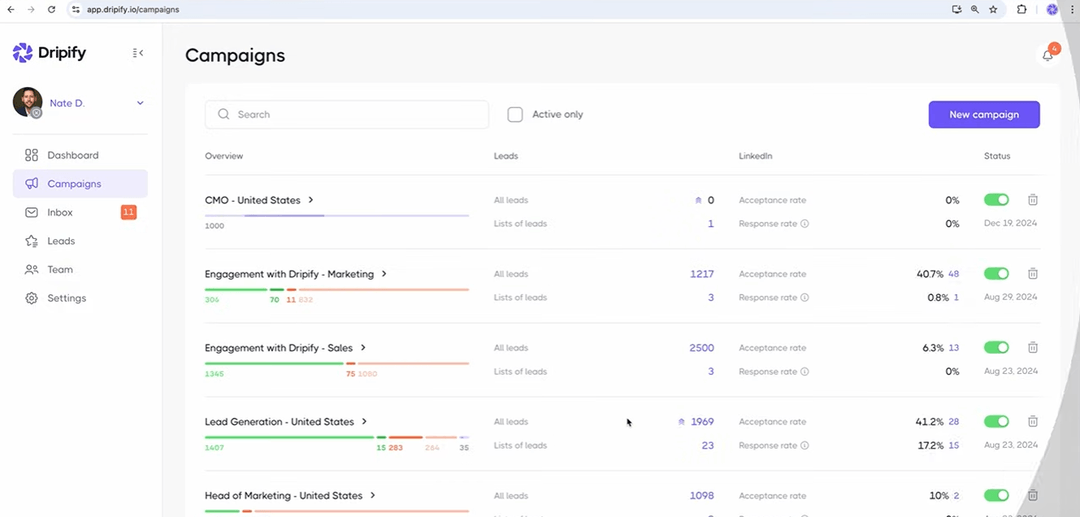
Dripify is a cloud platform for social sequences. You connect an account, import a list off a search or a CSV, then build a campaign out of profile visits, invitations, messages and follow-ups with delays between each step. Everything runs on Dripify's servers, so the campaign doesn't care whether your machine is on.
It's built for someone who already knows the target list and wants it worked through reliably. Solo founders use it that way, and so do three-person sales teams, though the per-seat bill is what eventually sends them looking around.
The tiers gate more than volume, which is the part the pricing page doesn't shout about. Basic holds you to one campaign at a time and leaves out CSV export. Pro opens unlimited campaigns and it's where most solo users land. Advanced adds team management and it's the tier agencies get pointed toward. Every plan includes 100 email finder credits a month, which covers about two days of real work.
What works
- Campaigns run without your browser, or your computer
- Deep sequence building with conditions and branches
- Team roles and per-member reporting on the top tier
- A/B testing on messages, which almost nothing at this price offers
Where it costs you
- Per seat, so a third rep is a third invoice
- No permanent free plan, only a seven-day trial
- Basic is a demo wearing a price tag: one campaign, no export
- Personalization stops not far past first name and company
Public sentiment sits in a narrow band. Dripify holds 4.5 out of 5 across 333 reviews on G2 and 4.7 across 476 on Capterra, both checked in August 2026. Praise clusters on setup being short and the interface staying out of the way. Complaints cluster on two things: what the per-seat model does to a team budget, and how thin the personalization gets once you're past the obvious variables.
What is Waalaxy?
Waalaxy is a Chrome extension from a French team, built so someone who has never automated anything can launch a sequence the same afternoon. You import prospects straight from a search, pick a prebuilt sequence, and it starts working through the list. The extension is the engine, which is the source of both the simplicity and the main limit.
Pro at nineteen euros gives you 300 invitations a month and 25 email finder credits. Advanced at €49 raises invitations to 800 and adds API access with Zapier, Make and n8n modules. The Business plan at €69 is the first tier with cold email sequences and multiple sender accounts, and it lifts credits to 500. The inbox is a paid add-on on every tier, including the most expensive one.
One detail changed quietly and it's worth knowing before you plan around it. The pricing page now shows three paid plans and a fourteen-day trial, with no free tier displayed, while most comparisons still describe a permanent free plan capped at 80 invitations a month. If that plan is part of your decision, check inside the app rather than trusting an article, this one included.
What works
- Cheapest paid entry in the category by a wide margin
- Templates mean you don't have to invent a sequence
- Reply detection stops a sequence when someone answers
- Fourteen days of trial, and CRM sync across thousands of tools
Where it costs you
- The browser is infrastructure: close it and sending stops
- Cold email waits until the €69 tier
- The reply inbox is billed on top of every plan
- Advanced sells 800 invitations, well past what an account can spend
Review volume is where the two part company. Waalaxy sits at 4.6 out of 5 across 1,315 reviews on G2 and 4.4 across 253 on Capterra, checked on the same morning. Ease of use scores above value for money on both platforms, and the written reviews say the same thing in longer form: people like the tool and flinch at the renewal.
How do you launch a campaign in each one?
This is where the two stop feeling like the same product. The order of operations differs, and it shapes what your first hour looks like.
Waalaxy: you start on the search results
You run a search, open the extension, and push the results into a list inside Waalaxy. Then you pick a sequence from the template library, which is where the tool earns its reputation. The sequences are named for what they do, so you're choosing rather than designing. Personalization comes next, and it comes step by step: each message opens its own panel, so a three-touch sequence means moving in and out of three panels and holding the thread of your own copy in your head. Then you launch, and you leave the browser open.
Dripify: you start in the builder and the search comes to you
You connect the account once, import from a search URL or a CSV, then open the campaign builder and drag the steps into place. Visit, invite, wait two days, message, wait three, follow up. Conditions branch the path, so the people who accept get one message and the ones who don't get another. The copy for every step sits on one screen, which sounds minor until you're editing the third touch and can still see the first. You launch, and you close the laptop.
The trade shows up on the second campaign rather than the first. Waalaxy gets you moving faster when you don't yet know what a sequence should look like. Dripify is slower to learn and faster to reuse, because a campaign you've built once is a shape you duplicate and edit rather than reassemble. If your copy is the part you're unsure about, our cold email generator writes a first draft you can paste into either builder.
What we can't give you is the number of minutes. Timing both launches on the same list, against one list, one sitting, one set of messages, is a real test that deserves real numbers, and we'd rather leave the line empty than fill it with an estimate.
What do you see once the campaign is running?
Both dashboards show the same headline numbers: invitations sent, acceptance rate, replies, messages delivered. The differences are in what you can slice and what you can take with you.
Dripify reports per campaign and per team member, with conversion between steps, and the highest plan adds split-test results so you can see which of two openers is doing the work. Export is where the tier gate bites hardest. On Basic there's no CSV export at all, so your numbers stay inside the tool and your CRM stays uninformed.
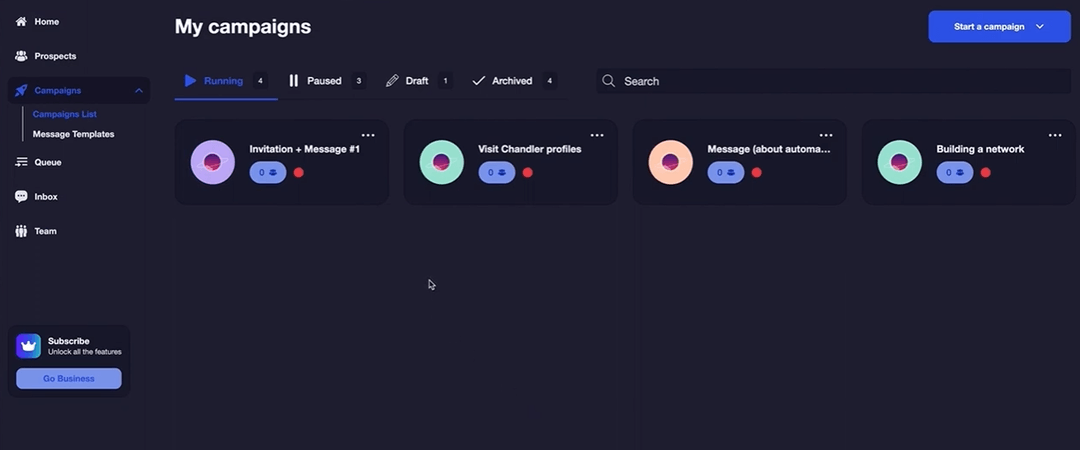
Waalaxy sorts campaigns into running, paused, draft and archived, and reply detection pauses a sequence the moment someone answers, which saves you from the worst kind of automated follow-up. Handling those replies is the part that costs extra. The inbox sits outside every plan, so at €69 a month you're still looking at a separate line to answer at scale.
Neither dashboard reports the number that decides the quarter, which is whether the people in the campaign were worth contacting at the moment you contacted them. A 42% acceptance rate on the wrong 400 accounts still ends the month at zero, and no chart in either tool will tell you that's what happened.
Does it plug into the rest of your stack?
Both connect to a CRM. What separates them is how often you have to think about it afterward.
Waalaxy syncs with more than 2,000 tools through Zapier, Make and n8n, and API access opens on the Advanced plan. Set the connection once and new leads leave on their own. Imports run the other way too, from a standard search, from Sales Navigator, or from Recruiter Lite, and CSV moves in both directions from the entry tier.
Dripify pushes through Zapier and webhooks as well, and the tier that opens them sits somewhere above Basic. Sources disagree on whether that's Pro or Advanced, and the vendor's own pages aren't consistent either. If the integration is the reason you're buying, confirm the tier on their plan comparison before you commit to a year.
The detail worth checking on a trial, in both tools, is whether a connection is configured once for the account or rebuilt for every campaign. A tool you reconfigure each Monday costs more than what's on the invoice, and the cost is paid by whoever has the least time.
Will either one get your LinkedIn account restricted?
Start with the part nobody controls. The platform doesn't publish its limits. What's widely observed is a ceiling around 100 invitations in a rolling seven-day window, and it moves with account age, acceptance rate, and how many requests you've left hanging.
Run that against the plans and something odd shows up. Waalaxy's Advanced tier sells 800 invitations a month, which works out near 185 a week. Dripify's quotas scale by tier toward the same place. Both let you buy more capacity than your account can legally spend, which makes the quota on a pricing page a marketing number before it's a limit.
Cloud against extension is the part people argue about, and the argument is less settled than either side pretends. A cloud tool acts from hardware you don't own, so your activity arrives from an address you don't own. An extension acts inside your session, from your own address, in a page the platform reads directly. Each one leaks a different signal, and no vendor can promise you an outcome, because the enforcement rules are private and change without notice.
What's documented is more mundane than the architecture debate. Restrictions follow volume spikes, low acceptance rates and piles of pending requests. A young account that jumps to 40 invitations a day is the textbook case, and no amount of IP rotation makes that behavior look normal.
Both tools ramp new accounts and let you cap daily activity. Dripify applies safety quotas by default. Waalaxy caps by plan, which does the same job quietly. More manual control helps when you know what you're doing and hurts when you don't, and comparison pages tend to leave that half out.
The email side has a published number, and it's worth borrowing. Google has required bulk senders to keep spam complaints under 0.3% since February 2024, and the threshold is written down in Google's own sender guidelines. Nothing on the social side is that explicit. The logic carries anyway: contact enough people who didn't want to hear from you and the platform makes the decision for you.
You shouldn't have to guess who to contact
Gojiberry watches more than 30 buying signals across socials and the web, checks each account against your ICP, and sends you the ones worth writing to.
Start free, no list neededWhat does each one cost for a team your size?
Both vendors quote per user. That single sentence decides everything below.
Dripify publishes three tiers plus an enterprise quote. Basic is $39 a seat on annual billing and $59 if you pay by the month, and it holds you to one campaign at a time. Pro is $59 yearly and $79 monthly, and that's where unlimited campaigns start. Advanced is $79 annual and $99 monthly, and it adds team management and the A/B testing. The trial runs seven days and asks for no card.
Waalaxy publishes Pro at €19, Advanced at €49 and Business at €69, all per seat each month, with 50% off for paying a year up front and 20% off for a quarter. Cold email starts on Business. The trial runs fourteen days. The inbox add-on is billed separately whatever tier you're on.
Totals are the published per-user rate multiplied by seats. Sales Navigator sits on top at roughly $99 a seat, and most teams running either tool are already paying it.
The agency line is the one to read twice, because we'd rather lose the click than sell you a compromise. Neither tool is built for five client accounts. Both bill per seat, both put five separate inboxes in front of you, and the platforms built for that shape bundle sender accounts under one subscription instead. If that's your situation, price a per-sender tool at your real account count and skip the rest of this comparison.
Run the math for a team of three
Three reps on Dripify Pro: $2,124 a year, and building the list is still someone's Monday. Three reps on Waalaxy Business: €1,242 a year paid up front, and building the list is still someone's Monday. Gojiberry is $99 a month for the workspace, so a third hire doesn't change the invoice. What changes is who builds the list.
There's a second number nobody puts on a pricing page. B2B contact data decays at about 2.1% a month, roughly 22.5% a year, according to HubSpot's database decay research. Whatever you paid for the list, a fifth of it stops being true before the annual plan renews.
So, Dripify or Waalaxy?
Choose Dripify if
Your list is already good, you want the campaign running while you're in meetings, and you'd rather pay more per seat than keep a browser tab alive. For most people who land on this page, this is the right answer.
Choose Waalaxy if
You're one person, you're starting out, and the gap between €19 and $59 a month is a real decision. The templates teach you what a sequence looks like, and you can leave whenever you want.
If neither is the problem
You've run sequences before. The copy is fine, the acceptance rate is fine, and the pipeline still isn't. Then the sender wasn't the thing you needed to change.
What if the sending was never the problem?
Gojiberry is an AI-powered multichannel prospecting platform. It tracks more than 30 buying-intent signals across socials and the web, surfaces the leads who are in market right now, and triggers personalized outreach across channels. Dripify and Waalaxy begin once the list exists. We begin one step earlier.
🎯 Signals, not static lists
Funding rounds, hiring pushes, role changes, competitor engagement. The account enters the queue when something moves, not when a scraper found it.
🤖 The sourcing is the product
Agents watch public signals around the clock, score each account on fit with what you sell, and surface only the ones worth a message this week.
💬 Copy written from the trigger
Each message starts from the event that surfaced the account, which is why it reads like a person noticed something rather than a merge field firing.
💰 One price for the workspace
Sourcing, enrichment and outreach in a single $99 line. A fourth teammate joins and the invoice stays where it was.
Timing is the whole argument, and there's a public number behind it. Median job tenure in the United States is 3.9 years, and 22% of employees have been in their role under a year, per the Bureau of Labor Statistics. Every one of those moves is a new budget, a new stack decision and a short window. A sequencer sends into that window by accident. We aim at it.
Where we lose: point Gojiberry at a market where nothing public ever moves. No hiring, no funding, no role changes, no visible activity. The signal layer has nothing to work with, and a cheap sender pointed at a list you built by hand will beat us. Those markets exist, and if you're in one, buy Waalaxy and spend the difference on research.
+31%
Mindflow lifted outbound reply rate by switching to intent-triggered outreach.
See what Mindflow changed100+
GTE Localize booked more than a hundred meetings after moving off cold email volume.
Read the GTE Localize story
Where this came from
Before Gojiberry there was Coco.ai, and before Coco.ai there was Roman spending his days prospecting on socials the way everyone does it. He kept a spreadsheet of accounts that had done something worth noticing, checked it by hand every morning, and wrote to the ones that had moved. The messages that worked were never the best written ones, they were the best timed ones.
Coco.ai became the place where that hunch got tested against real pipelines, and the part that kept working was the part nobody wanted to do by hand. Gojiberry is that morning ritual, running without him. If you've ever kept a list like that in a spreadsheet, you already understand the product.
If you'd rather see the wider category before deciding, we keep a running list of sequencing tools and where each one breaks.
FAQ on Dripify and Waalaxy
Is Dripify or Waalaxy safer for your account?
Neither vendor can promise you anything, because the platform keeps its enforcement rules private and changes them without notice. What's structural is this: Dripify acts from its own servers, so the traffic arrives from an address that isn't yours, while Waalaxy acts inside your browser session, from your own address, in a page the platform can read. Each leaks a different signal. The behavior that gets accounts restricted is the same on both, and it's volume you haven't earned: a spike in invitations, a low acceptance rate, a pile of requests nobody answered.
Which one is cheaper for a team of three?
Waalaxy, by a wide margin, and it isn't close. Three seats on Dripify Pro come to $177 a month on annual billing, so $2,124 for the year. Three seats on Waalaxy Business come to €103.50 a month billed yearly, so €1,242, or €207 a month if you'd rather not prepay twelve months. Add the inbox add-on on the Waalaxy side and the gap tightens, though it doesn't close. Neither figure includes Sales Navigator, which most teams running either tool already pay for.
Can Waalaxy replace a dedicated cold email tool?
For a founder sending a few dozen emails a week alongside social touches, yes. Business at €69 includes cold email sequences, multiple sender accounts and 500 finder credits a month. Past that volume it stops being a fit. A dedicated sender gives you inbox rotation, warmup, deliverability reporting and per-domain reputation, and none of that is Waalaxy's job. If email is your main channel and social is the follow-up, buy the sender first.
Does Dripify work without Sales Navigator?
Yes. You can import from a standard search, from a CSV, or from a saved list, and campaigns run the same either way. What you lose without Sales Navigator is the filtering, and that's not a small loss: the difference between a good campaign and a bad one usually happens before the sequence starts. Budget for it if you're pricing seats, because at $99 a seat it's often the largest line in the stack.
Why do teams switch from one to the other?
Two directions, two reasons. People leave Waalaxy for Dripify when they're tired of the browser being part of the infrastructure, usually after a campaign stalls over a weekend. People leave Dripify for Waalaxy when the per-seat invoice arrives for a third rep and the value doesn't scale with it. A third group leaves both, and it's the group whose acceptance rate is fine while the pipeline stays empty.
Which one should an agency pick?
Neither, and we'd rather say so than sell you a compromise. Both bill per user, so five client accounts means five seats and five separate inboxes to check. Tools built for this bundle sender accounts under one subscription instead. If you run client profiles, price a per-sender platform at your real account count, and start with our comparison of HeyReach against Waalaxy.
Can I use both at the same time?
Technically yes, practically no. Running two automation tools against one account stacks their daily activity on top of each other, and the platform sees one account behaving twice as hard as it did last week. That's the pattern restrictions follow. If you're testing, run them on separate accounts or run them in separate months.
Is Gojiberry a replacement for either?
It replaces the work that happens before either one. Gojiberry reads buying signals wherever they surface, checks each account against your ICP, and hands you the ones that deserve a message, then triggers outreach across channels. Teams run it instead of a sender when the sequence was never the weak part, and alongside one when they want to keep a motion they've already tuned. Pricing is a flat $99 a month for the workspace, so a third seat changes nothing on the invoice.
Try it on your own market
Tell Gojiberry who you sell to and it goes looking for qualified prospects. No sequence to build, no browser tab to babysit.
Open a free workspaceRead the case studies
More High-Intent Leads = Your New Growth Engine.
Start Now and Get New High Intent Leads Delivered Straight to Slack or Your Inbox.