
Cold email generator, and four examples you can copy

This free cold email generator takes a few facts about your prospect and what you help them do, then hands back three ready-to-send drafts, each one short enough to read on a phone. It writes a good email, and it can't tell you who's worth writing to, or what changed on their side this week.
Free, no signup
Cold email generator
Add your prospect, what you help them do, and one real thing you noticed. You get three full emails on different angles, each kept short with a live word count.
Start with a verb and describe the outcome, not the feature.
A real trigger makes the email feel researched instead of mass-sent.
Tell us what you help them do first.
Your cold emails
Gojiberry finds your prospects for you
This tool writes the email. Gojiberry finds the person worth writing to and picks the moment.
Get your first leads for freeTable of contents
4 cold email examples that get replies
Every rule further down this page is easier to see than to read about, so here are four complete emails, ready to copy. Each one is short, sells an outcome, and leans on something that happened on the prospect's side. The fastest version of this exercise is to run the tool above on your own take of each situation, then paste your details straight in.
After a funding round
A founder writing to another founder, the week the raise gets announced.
Subjectcongrats on the Series B
Hi Sarah,
Saw Northbeam closed its Series B on Tuesday, congrats. A round usually arrives with a hard pipeline number attached to it, and a quarter to hit it.
We help seed to Series B founders book meetings off buying signals, without adding a rep to run the motion.
Worth 15 minutes to see if it fits how you're scaling?
Alex
Why it works: one trigger, one outcome, one small ask, and not a line of it could have gone to anybody else.
After a job change
A rep on a five-person team writing to somebody three weeks into a new job.
Subjectyour first 90 days at Volt
Hi Marcus,
Congrats on the VP of Sales role at Volt. The first quarter is usually where the outbound motion gets decided for the year.
We get small sales teams in front of accounts that are already showing intent, so reps spend the day on people who are likely to buy.
Open to comparing notes before you lock Q3?
Jess
What's doing the work: a new job is something worth writing about today, and the offer is tied to the decision they're about to make, rather than to a feature list.
When they're hiring for a role you sell to
An agency owner writing to a company that just posted a job the agency could make unnecessary.
Subjectsaw you're hiring an SDR
Hi Priya,
Noticed Cadence posted an SDR opening to build outbound from scratch. That's usually six months of ramp before the first meeting lands.
We're a small agency that runs outbound for teams your size, so you get booked meetings in weeks instead of onboarding a hire.
Happy to send two examples from companies your size, no call needed?
Tom
Why this one lands: the job post is the whole opener, and the ask, as written, costs them nothing.
A follow-up that isn't "just checking in"
The second email, three days later, after the first one got nothing.
Subjectone more thing on Volt's Q3
Hi Marcus,
Didn't want to nudge without bringing something. Here's a two-line teardown of how a team your size booked 11 meetings last month off intent signals: [link].
If outbound isn't the priority this quarter, say so and I'll stop. If it is, still worth a short call?
Jess
The part that earns the reply: it brings something, instead of asking for attention, and it hands them an easy way out. Most replies live in the follow-up.
Fill it in like this
The tool's only as good as what you feed it. Two fields do almost all the work, and the gap between a vague answer and a specific one is the gap between an email that gets deleted, and one that gets read.
What do you help them do?
Nowe do AI-powered sales automation
Yeswe get founders 10 meetings a month without hiring an SDR
What did you notice about them?
Nothey're in SaaS
Yesthey posted last week about their sales rep leaving
Both good answers name a concrete outcome or a recent event with a date you could point to. That's the whole of what "personalized" means here, and it's what makes the draft read like you wrote it for one person. If the opening line is the part you stall on, the icebreaker generator does only that piece.
Why does anyone reply?
The tool handles the structure. Four things decide whether an email earns a reply, and each one below has a published number behind it, which is more than you'll get from most pages on this topic.
- 🔔Give them a reason with a date on it. Backlinko and Pitchbox read 12 million outreach emails in 2019 and found 8.5% of them got any reply at all. The ones that land almost always point at something the recipient announced, posted, or hired for.
- 🎯Sell the outcome, not the feature. "We get founders 10 meetings a month" beats "AI-powered sales automation." Boomerang's read of 40 million emails found that plain writing at a third-grade reading level pulled the best response rates of any group it measured.
- 📝Keep it between 50 and 125 words. That band cleared a 50% response rate in the same 2016 Boomerang study. The drafts here come out in that range, and the counter on each one tells you when your edits push it back out.
- 🔁Send the second one. A single follow-up lifted replies by 65.8% in the Backlinko data. Make it carry something new: a teardown, a number, a customer who looked like them.
There's one number no generator hands you, and it's whether this person has any cause to care this week. That comes from something moving on their side, and it's the part the tool above leaves entirely to you.
Who is this for?
Three people, all sitting in the same bracket: they're small teams sending a few hundred emails a month, to a list somebody chose by hand.
The founder doing their own outbound
You write every email yourself, between two other jobs. What you need at nine in the evening is a solid first draft, not a copywriting course, and not a blank box.
The rep on a five-person team
No copywriter, no template library, five people improvising five different emails. A shared starting point fixes that in an afternoon.
The agency just getting started
You sell outbound for a living, so your own cold emails have to be sharp. Draft fast, keep the angles varied, and put the saved hour into the list.
If you send fifty thousand emails a month, this one isn't built for you. Everything here is calibrated for a team of two to ten, and a few hundred sends a month.
Why timing beats copywriting
Both emails below go to the same person and sell the same thing. The only thing that moves between them is whether there's a reason for the email to exist.
Written from a bland fill
Subject: quick question
Hi Marcus,
We help sales teams with AI-powered outbound automation. Thought it might be relevant for Volt.
Worth a quick call this week?
Jess
Written from a real signal
Subject: your first 90 days at Volt
Hi Marcus,
Saw you took the VP of Sales seat last month, and that Volt posted an SDR opening on Monday.
We get teams your size in front of accounts already showing intent, so your first hire ramps on warm pipeline instead of a cold list.
Worth 15 minutes before Q3?
Jess
The wording barely moved. What changed is that the one on the right has a reason to exist, and that reason came out of two signals: a role change, and an open job. Neither one is exotic, and you don't need a research team to catch them. US median job tenure sits at 3.9 years, and 22% of employees have held their job under a year, according to the Bureau of Labor Statistics, so somebody in your market changes seats most weeks. The work is noticing.
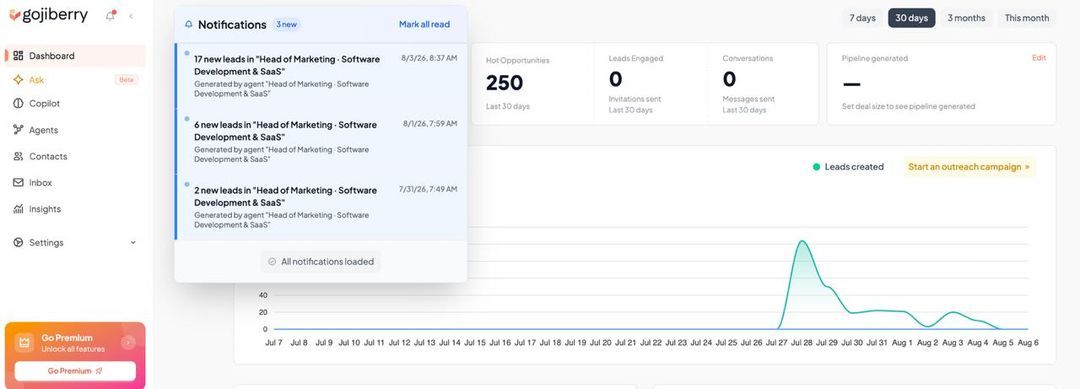
You describe your buyer once, head of marketing at a software company for instance, and Gojiberry keeps running against it after you close the tab. New matches land as dated notifications, in batches, with the signal that surfaced each one. The list refreshes on its own instead of aging in a spreadsheet. Mindflow ran outbound off a list built that way and lifted reply rates by 31%, and the write-up is here.
You shouldn't have to guess who to contact
Gojiberry watches more than 30 buying signals across socials and the web, checks each account against your ICP, and writes the first message from the reason that fired.
Start free on your ICPGot other questions?
How long should a cold email be?
Between 50 and 125 words, and the low end of that band is the safer bet. Boomerang's read of 40 million emails put that range above a 50% response rate, and the counter under each draft tells you where you landed. One clear ask beats a full pitch, because a busy buyer skims before they read.
How many follow-ups should you send?
Two to four, spaced a few days apart, each one carrying something the last one didn't. A single follow-up lifted replies by 65.8% in the Backlinko and Pitchbox data, so the first email is rarely the one that works. What kills a sequence is four messages that all say the same thing in different words.
When is the best time to send a cold email?
When something changed for the prospect. Day-of-week and hour-of-day effects are small and they don't hold up consistently from one study to the next, and a relevant email on a bad day still beats an irrelevant one on a good day. Fix the reason before you tune the schedule.
Do AI-written emails land in spam?
Not because a model wrote them. Placement comes down to sending reputation, volume, links, and relevance. Since February 2024, Google has held bulk senders to a spam complaint rate under 0.3%, and you'll cross that line by mailing people with no reason to hear from you, whoever typed the words. A short plain-text email to the right person is fine. Our spam checker flags the wording and formatting that filters tend to punish.
How do you find someone's email address?
You need the person's name and their company domain, then a finder to work out the address and confirm it resolves. Our free email finder does that part, and it's worth verifying before you send so a good email doesn't bounce off a dead mailbox.
What if you don't know who your ideal customer is?
Start from your best five to ten customers and write down what they share: industry, headcount, the job title that signed, and what was going on inside the company when they bought. That last column is the one most people skip, and it's the one that tells you when to write. The generator works without any of it, and it earns its keep once you can name who you're writing to and why.
Are cold emails still legal?
In most markets, yes, inside rules. In the US, CAN-SPAM allows B2B cold email as long as your headers are accurate, you include a real postal address, and you don't ignore opt-outs. In the EU and the UK, GDPR and PECR expect a legitimate-interest basis, targeting that holds up to scrutiny, and an easy, visible way out. None of this is legal advice, so check your own market and your recipients'.
Does this write follow-ups too?
This one writes the first email. Our free follow-up email generator handles the next ones, scenario by scenario. Gojiberry runs the whole sequence off what the prospect does after you send, so you're not the one watching the calendar.
Want your prospects found for you?
Tell Gojiberry who you sell to and it starts surfacing people who are already in market. You keep writing, it decides who and when.
Let Gojiberry do the lookingRead the case studiesMore free tools from Gojiberry
All free, and you won’t be asked to sign up for any of them. Use them next to the generator to build the list, clean it, and then write to it.

More High-Intent Leads = Your New Growth Engine.
Start Now and Get New High Intent Leads Delivered Straight to Slack or Your Inbox.