
HeyReach vs Waalaxy: which LinkedIn tool should you pick in 2026?

Quiz · 60 seconds
HeyReach, Waalaxy or Gojiberry?
3 quick questions to see which outreach tool fits you best. No email required.
Question 1 / 3
What matters most in your outbound right now?
Question 2 / 3
Whose LinkedIn accounts do you send from?
Question 3 / 3
Which change would make the biggest difference?
🎯
Your result
Your bottleneck is who you contact, not how you send
Your answers point at timing and lead quality rather than sending capacity. HeyReach and Waalaxy both solve the sending. Gojiberry decides who is worth sending to, and starts the conversation from the signal that surfaced them.
- More than 30 buying signals watched across socials and the web
- Every account pre-filtered against your ICP before it reaches you
- Email waterfall enrichment across 15+ providers
- Flat $99 a month on Pro, and it sits alongside the tool you already send with
🏢
Your result
HeyReach is the right subscription for your shape
Multiple accounts, sender rotation and a pooled inbox are what you described, and that is the entire HeyReach product. Budget 79 dollars per LinkedIn sender a month and ignore the Agency bundle until you pass roughly thirteen senders.
- Get delivery right first, then look at where the names come from
- When the list becomes the ceiling, that is the layer we add on top
🚀
Your result
Waalaxy fits, and it will cost you a fraction of the alternative
One account per person, a small budget and a need to start now. That is Waalaxy at 19 euros a user, or 69 if you want cold email in the same tool. Take the 14-day trial before you commit to the annual plan.
- Cheapest way to find out whether outbound works on your market
- Once the sequences hold up, the next question is who goes into them
HeyReach charges 79 dollars per LinkedIn sender per month and exists to run many accounts from one dashboard. Waalaxy charges 19 euros per user per month and exists so one person can launch a campaign the same afternoon they install it.
For most people reading this page, the decision is already made before they get here. These two tools are not fighting over the same buyer, so the comparison only turns into a real choice for one profile: the team of two to ten people. That team is who the rest of this page is written for.
Gojiberry finds your prospects for you
Both of these tools automate how you send. Gojiberry decides who is worth sending to, from more than 30 buying signals.
Get your first leads for freeTable of contents
- HeyReach vs Waalaxy: which one should you choose?
- HeyReach is built for agencies running many accounts
- Waalaxy is built for solo founders and small teams
- What does each one do better?
- Will either one get your LinkedIn account restricted?
- What you will really pay as your team grows
- Which one has the better support?
- The tool you choose matters less than who you contact first
- The one you should choose depending on your needs
- Why some teams use Gojiberry with HeyReach or Waalaxy
- Why did we create Gojiberry?
- Common questions before choosing
HeyReach vs Waalaxy: which one should you choose?
It is not a close match for most readers, and pretending it is would waste your afternoon. The two products answer different questions, so the answer usually falls out of one fact about your situation: whose LinkedIn accounts are you sending from?
You run an agency
Take HeyReach. Sender rotation, one pooled inbox, client workspaces and white label are the whole product. Waalaxy does not compete on that ground and does not claim to.
You are solo on a tight budget
Take Waalaxy. 19 euros against 79 dollars, an interface you learn in an afternoon, and a French support team if you sell in France.
You are a team of 2 to 10
This is the real decision. Below it, price settles the argument. Above it, multi-account settles it. In between, you have to weigh both.
The table below uses written values rather than checkmarks, because a coloured dot tells you nothing about why a tool scores that way. Four of these rows go against us, and we left them in.
Sources and date: prices from heyreach.io/pricing and waalaxy.com/pricing, review counts from the G2 head-to-head page and each Capterra listing, all checked on 6 August 2026. Prices are shown in the currency each vendor publishes, with no conversion applied, because an exchange rate goes stale faster than the prices do.
HeyReach is built for agencies running many accounts
HeyReach sells one thing: LinkedIn sending infrastructure that holds together when the number of accounts goes up. Everything in the product follows from that. You connect LinkedIn accounts as senders, campaigns rotate volume across them so no single account carries the whole load, and every reply from every account lands in one inbox instead of forcing you to log in and out all day.
The pieces that matter if you manage accounts you do not own: workspaces that keep each client's senders, leads and campaigns walled off under one login; white label branding included from the Agency plan so the dashboard carries your name; unlimited teammates, virtual assistants and client logins at no extra cost, because the meter runs on senders and not on people. On the integration side there is a public API with webhooks, an MCP server, and connections to Clay, HubSpot, Make and Zapier among others.
The limits are the flip side of the same design. There is no native cold email, so a multichannel motion means a second subscription and a second place where your sequence lives. If that is the part you are weighing, we also went through Instantly alternatives for cold outreach teams. Enrichment is thin out of the box at 100 credits per sender on Growth. The Agency and Unlimited plans require you to bring your own proxies. And below roughly five senders you are paying for an architecture you are not using: at one or two accounts, a cheaper single-account tool does the same sending. If HeyReach is close but not quite right, we compared twelve HeyReach alternatives and who each one is really for.
Where HeyReach is strong
- 🔄Sender rotation and one pooled inbox across every connected account, included in the base plan.
- 🏷️Client workspaces and white label from the Agency plan. Nothing comparable exists at Waalaxy.
- 👥Users, teammates and clients cost nothing. Only senders are billed, so onboarding a VA is free.
- ☁️Runs on their servers. Campaigns continue when your machine is off.
Where HeyReach is weak
- 📧No native cold email. Multichannel means a second tool, a second login and a second bill.
- 🔒Proxies are on you from the Agency plan up, which is one more thing to buy and maintain.
- 💰Little advantage at one or two senders, where the price per account is at its highest.
- 📊71 G2 reviews, a thin public base for a product at this price point.
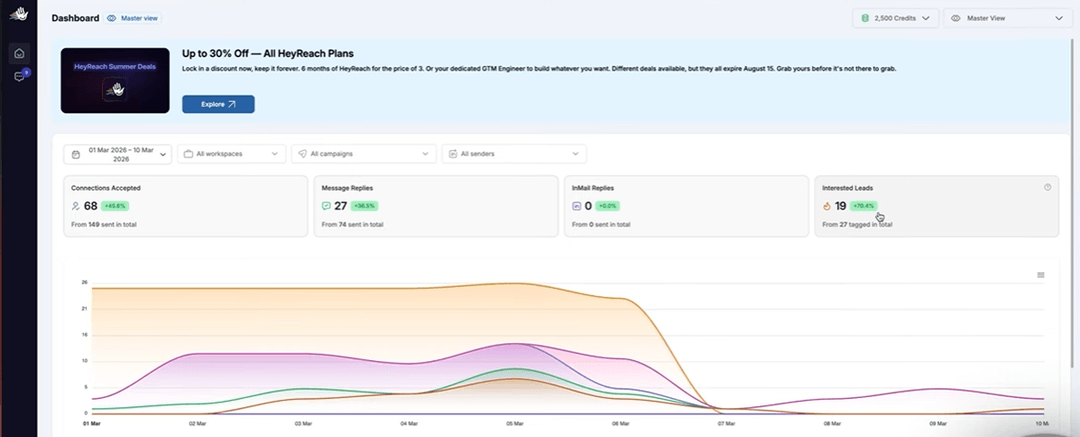
What the public scores say. On G2, HeyReach sits at 4.6 out of 5 from 71 reviews, with 90.8 percent of them from small businesses. Its Capterra listing shows a perfect 5.0, but from two reviews, which is not a sample worth weighing. On G2's own head-to-head against Waalaxy, HeyReach scores higher on every rated dimension: meets requirements 9.1 against 8.6, ease of use 9.2 against 8.9, ease of setup 9.2 against 8.8, ease of admin 9.5 against 8.7, quality of support 9.3 against 8.6. Read those with the sample sizes attached, because they come from roughly 60 HeyReach reviews against several hundred for Waalaxy.
Waalaxy is built for solo founders and small teams
Waalaxy takes the opposite bet. It lives as a Chrome extension on top of LinkedIn, which means there is nothing to provision: you install it, import a list straight from LinkedIn Basic, Sales Navigator or Recruiter Lite, pick one of the pre-built sequences, and you are sending. Reply detection stops a sequence when someone answers, CRM sync covers a couple of thousand tools, and the Waami assistant drafts message variants if you would rather not stare at a blank field. The company is French, which shows in the support and the documentation if you sell in Europe.
The tiers are worth reading carefully, because the headline price is not the price most teams land on.
- Pro, 19 euros. 300 invitations a month and 25 email finder credits. A LinkedIn-only tool in practice.
- Advanced, 49 euros. Invitations lifted to 800, plus API access and the Make, Zapier and N8N modules.
- Business, 69 euros. Where cold email sequences and 500 email finder credits arrive.
So if the reason you are looking at Waalaxy is both channels in one place, 69 euros is your real entry price, not 19. Quarterly billing takes 20 percent off and yearly takes 50 percent off, the steepest annual discount in this category.
The constraints are structural. Because the extension runs from your browser, a closed laptop is a paused campaign, which is a real operational cost for anyone who works from more than one machine. One seat maps to one LinkedIn account, so a team of five is five separate seats. And the shared LinkedIn inbox, the feature HeyReach includes in its base plan, is a paid add-on on every Waalaxy tier with a price that is not published.
Where Waalaxy is strong
- ⚡Fastest of the three from install to first message sent. No provisioning, no proxies.
- 💵19 euros to start, and a 50 percent annual discount, the deepest in the category.
- 📨LinkedIn and cold email in one subscription from the Business tier.
- ⭐1,443 G2 reviews and 253 on Capterra, a track record long enough to read properly.
Where Waalaxy is weak
- 💻Sequences pause when Chrome closes. The campaign only exists while the browser is open.
- 💳Shared inbox is a paid add-on on every tier, and its price is not published.
- 📧25 email finder credits a month below the Business plan, roughly one per working day.
- 🏢No white label, no client workspaces, no pooled sender rotation at any price.
The point that goes against us, on a third party's word
This is the section where an honest comparison has to hand something over. Waalaxy carries 1,443 G2 reviews at 4.5 out of 5 and 253 Capterra reviews at 4.4, against 71 and 2 for HeyReach. That gap cuts both ways: it is the single strongest signal here that a very large number of small teams have run Waalaxy long enough to write about it, and it also means HeyReach's higher scores rest on a sample roughly twenty times smaller.
If you weigh scores by how hard they have been tested, Waalaxy has the more durable record and HeyReach has the better numbers. Both statements are true and both came off the same page.
Why some teams use Gojiberry with HeyReach or Waalaxy
The comparison format pushes everyone toward an exclusive choice, and that is not how most of these stacks get built in practice. Because Gojiberry works on a different layer, it sits in front of either tool rather than replacing it.
Agency, seven client accounts
Delivery is already solved: senders rotate, replies land in one inbox, each client sits in its own workspace. What is not solved is where the next 300 names per client come from every month, which is usually a Sales Navigator search someone rebuilds by hand. Gojiberry runs that layer per client ICP and pushes signal-qualified accounts into the HeyReach campaign. Nothing about the sending setup changes.
Four-person B2B team
Four seats on Waalaxy, sequences that work, copy that has been through a few iterations. The pain is Monday morning: somebody has to decide who gets contacted this week, and that job quietly falls to whoever has the fewest meetings. Gojiberry replaces that decision with a queue of accounts that moved, each with the signal attached.
Why did we create Gojiberry?
This story belongs on this page more than on any other page of the blog, because you are comparing two LinkedIn automation tools right now.
This started as a problem we had
Before Gojiberry, Roman spent his days prospecting on LinkedIn for Coco.ai. Not sending sequences: doing the intent research by hand. Watching who had just changed jobs, who had started engaging with the category, who had commented on something that suggested they had the problem. Then writing to those people, one at a time, with a reason that was true.
It worked. That is the part worth saying plainly, because it is why the product exists. And it did not scale. One person can follow about thirty accounts properly. Past that the method collapses, and what collapses first is the reason for writing. You stop noticing the signal, you keep the cadence, and within a month you are doing mass outreach with a personalization field.
Gojiberry is that manual routine running by itself. We lived with the problem for years before we sold anyone the solution, which is also why this page does not tell you HeyReach and Waalaxy are bad. We used tools like them. They send. Somebody still has to decide who.
Common questions before choosing between HeyReach and Waalaxy
Is HeyReach or Waalaxy safer for your LinkedIn account?
They fail differently. HeyReach runs on its own servers and gives every connected sender a dedicated residential proxy on the Growth plan, so your sending stays on one stable identity and keeps running when your laptop is closed. Waalaxy runs as a Chrome extension from your own browser and your own IP, which is the same fingerprint you already use on LinkedIn, but sequences stop whenever Chrome is closed.
Neither vendor publishes a restriction rate, so anyone quoting you a percentage is estimating. What triggers a restriction is volume and pattern, not which logo is on the dashboard.
Which one is cheaper for a team of three?
Waalaxy, by a wide margin. Three Pro seats cost 57 euros a month, so roughly 684 euros a year on monthly billing and 342 on annual. Three HeyReach Growth senders cost 237 dollars a month, so 2,844 dollars a year and 2,268 on annual billing.
Even three Waalaxy Business seats at 69 euros each, the tier that adds cold email, come to 2,484 euros a year and stay below HeyReach. HeyReach becomes the better economic answer when the accounts you send from are not your own three but a growing set of client accounts.
Does HeyReach do cold email?
Not natively. HeyReach automates LinkedIn and connects to Instantly and Smartlead for the email side, which means the email sequence lives in a second tool with a second bill and a second login. That is a deliberate product choice rather than a gap: HeyReach sells LinkedIn sending infrastructure and says so.
If you want both channels inside one subscription, Waalaxy Business at 69 euros per user per month is the closer fit of the two.
Is Waalaxy really free?
Not on the current pricing page. As of 6 August 2026, Waalaxy lists three paid tiers, Pro at 19 euros, Advanced at 49 and Business at 69 per user per month, each with a 14-day free trial and no card required. The limited free tier that circulated for years, capped at a small number of invitations a month, is no longer shown on the pricing grid.
Check their current pricing page before you plan a budget around a permanent free plan.
Which one is better for an agency managing client accounts?
HeyReach, and it is not close. Separate client workspaces, sender rotation across many LinkedIn accounts, one pooled inbox and white label branding from the Agency plan are the product. Waalaxy has no white label and no client workspace model at any price.
One piece of arithmetic before you buy: the Agency bundle at 999 dollars for 25 senders only beats stacking Growth seats once you pass about thirteen senders. An agency running ten client accounts is usually cheaper on Growth. If you are shortlisting beyond these two, our HeyReach alternatives comparison covers the rest of the agency-grade options.
Can Waalaxy handle several LinkedIn accounts?
Only by buying several seats. One Waalaxy seat maps to one LinkedIn account, so a team of five is five seats billed separately, and the shared LinkedIn inbox is a paid add-on on every tier rather than something included.
That works for a small team where each person runs their own account. It does not replicate what HeyReach does, which is treating many accounts as one pooled sending capacity with rotation and a single inbox.
Can I run Gojiberry alongside either one?
Yes, and that is the common setup rather than the exception. Gojiberry decides who is worth contacting and when, from more than 30 buying signals checked against your ICP. HeyReach and Waalaxy execute the sending.
Agencies tend to keep HeyReach for multi-account delivery and add Gojiberry so client campaigns start from a signal-qualified list. Small teams tend to keep Waalaxy for the sequence and let Gojiberry pick the names.
Which one should a team of 2 to 10 pick?
This is the only band where the comparison is a genuine decision, and the deciding question is whose LinkedIn accounts you send from. If the accounts belong to your own reps and each rep runs their own, seats are seats and Waalaxy is far cheaper. If you are already sending from accounts that are not yours, or expect to be within a year, HeyReach per-sender billing and its pooled inbox will cost you less pain than retrofitting later.
The trap at this size is buying sending capacity to fix a list problem. A team of four does not usually fail outbound because the sequences were unreliable. It fails because nobody had time to decide who to write to, so the list came from a saved search and the copy had to carry weight it could not carry.
Try it on your own market
Tell Gojiberry who you sell to and it starts finding qualified prospects for you. Then let HeyReach or Waalaxy do what they're good at.
Get your first leads for free