
Free sales pitch generator for cold emails, calls and pitches

Tell it what you sell, pick where the pitch has to work, and get three angles you can say out loud. It's free, there's no sign-up, and nothing you type leaves your browser.
Free tool
Write a sales pitch in fifteen seconds
Three angles, in the format you need, ready to copy.
Stuck? Borrow one of these
Where are you going to use it?
Tell me a bit more about what you sell so I can write something useful
Free, no sign-up, no email
Example
Most agency owners rebuild the same staffing sheet on a Friday afternoon. It's nobody's job, so it lands on whoever cares most. We put the schedule in one place and update it when a project moves, so Friday goes back to being Friday. How do you handle it today?
A pitch this good still needs somebody on the other side who wants the problem solved this month. That's the half a generator can't reach. Gojiberry watches for the companies that just showed a buying signal, then puts your pitch in front of them. See who's ready to hear it.
Table of contents
What is a sales pitch?
A sales pitch is the short version of why somebody should talk to you. It names a problem the buyer already feels, shows what changes once that problem goes away, and asks for one small next step. The channel decides the length, never the job. Thirty seconds at an event, ninety words in an inbox, one sentence on a profile: it's the same work in all three.
Your pitch is only half the job
Find the buyers already lookingSales pitch examples
Five pitches, written out in full, for a fictional company called Rotamap that sells staffing software to creative agencies. Swap the details for yours and the shape holds. Read them out loud before you send anything, because a pitch that trips your own tongue will trip theirs too. You'll hear the weak line before you see it.
Elevator pitch at an event
"Most agency owners I meet rebuild the same staffing sheet every Friday afternoon. It's nobody's job, so it lands on whoever cares most, and it breaks the week someone goes on holiday. We put that schedule in one place and update it when a project moves. Three agencies switched last quarter and none of them opened the old sheet again. How do you handle it today?"
Sixty-six words, and it ends on a question so the other person has somewhere to go. The number does the heavy lifting because it's small and checkable. Nobody believes a fivefold improvement from a stranger at a conference.
Cold email with its subject line
Subject: Your two open producer roles
"Hi Marta,
You're hiring two producers, which usually means the staffing sheet already broke once this quarter.
Rotamap keeps the schedule in one place and updates it when a project moves, so nobody spends Friday afternoon rebuilding it. Ledger Studio stopped doing that entirely after two weeks.
Worth fifteen minutes to see whether it fits how you run projects?"
Seventy-four words, one ask, no bullet points. The subject line names something Marta published herself, so it reads as attention rather than a merge tag. Our cold email generator writes the whole message once you've picked the angle.
Phone opener
"Marta, I'm calling because you've got two producer roles open and the agencies we work with tell us that's when scheduling falls over. Can I take thirty seconds to explain, or is now bad?"
Twenty-nine words, and it says why you called this person, rather than any person, then hands them the exit. Asking permission beats pushing through, because a no costs you nothing here and a yes buys real attention. It's the same instinct behind a good cold email icebreaker.
One-line positioning sentence for a profile
"Rotamap keeps creative agencies staffed without the Friday spreadsheet."
Ten words, and it survives a sideways glance in a feed. A one-liner earns its place by naming the buyer and the pain in the same breath. Drop either half and you're back to a category label.
Discovery call opener
"Before I say anything about Rotamap, I want to check I understood your setup. You run about twelve projects at a time, two producers share the schedule, and it lives in a spreadsheet. Is that right, and what breaks first when it goes wrong?"
The opener hands the first two minutes back to the buyer. Reps who talk first on a discovery call lose it, because they pitch a problem the prospect never confirmed. Every sentence gets easier once they've described the mess in their own words.
Mindflow
Rebuilt outbound around intent signals and lifted reply rates by 31 percent.
Read the Mindflow storyThe 5 steps to a sales pitch
Five steps, in order, and skipping the first leaves the other four with nothing to stand on.
- Research one specific thing. One fact you can point at: a job posting, a new office, a role that changed hands. Median job tenure in the United States sits at 3.9 years, and 22 percent of workers started their job inside the last twelve months, so somebody in your market changed seats this quarter. Example: "You posted two producer roles last week."
- Name the problem in their words. Use the phrase they'd use with a colleague, not the one your marketing page uses. Example: "the staffing sheet breaks every time someone goes on holiday."
- Show what changes. One outcome, stated as a difference between before and after. Example: "nobody rebuilds the schedule on a Friday."
- Back it with one piece of proof. A customer, a number, or a name they recognize. One is plenty. Example: "Ledger Studio stopped after two weeks."
- Ask for one thing. The smallest next step that still moves the deal. Example: "worth fifteen minutes?"
Google's bulk sender rules now hold senders to a spam complaint rate under 0.3 percent. Step one is what keeps you under it. Volume without a reason to write buys you a filter, not a meeting.
The pitch was fine. The timing was not
Gojiberry tracks over 30 buying-intent signals across socials and the web, then surfaces the accounts researching your category right now.
Start free on your marketThe 5 elements of a sales pitch
The steps above are a process, and these are the contents. A pitch that's missing one of the five still works sometimes. A pitch missing two rarely does.
- 🎯A hook tied to them. One line that could only go to this buyer, because a generic opener costs you the sentence where you had their attention.
- 🔎A problem they recognize. Their version of it, in their vocabulary. If they can't recognize themselves in it, nothing downstream lands.
- 💡A solution in one sentence. What you do, without the feature list. The demo exists for the detail.
- 📊One piece of proof. A customer name, a number, or a result somebody comparable got. Two proofs read as insecurity.
- 📅A single ask. One next step, small enough that saying yes costs nothing. Two asks split the answer and you lose both.
What makes a sales pitch convert
Structure gets you a draft, and these four decide whether that draft earns a reply.
Lead with their pain
Open on the problem they feel, not the product you built. If they don't see themselves in line one, they never reach line two.
Sell the outcome
Translate features into what changes on a Monday morning. Buyers pay for the destination, and they tolerate the engine.
Back it with proof
One number, one case, or one recognizable customer. Proof turns a claim into something they can check.
End with one ask
A single low-friction step. Give them two doors and most people walk through neither.
There's a fifth thing that sits outside the sentence. Send the same pitch in March instead of June and it dies, word for word identical. No amount of rewriting fixes a message that arrived eight months early.
Pitch generator vs Gojiberry
A generator sharpens how you say it, and who hears it decides whether it lands. Those two jobs sit on either side of a line, and the tool at the top of this page doesn't cross it.
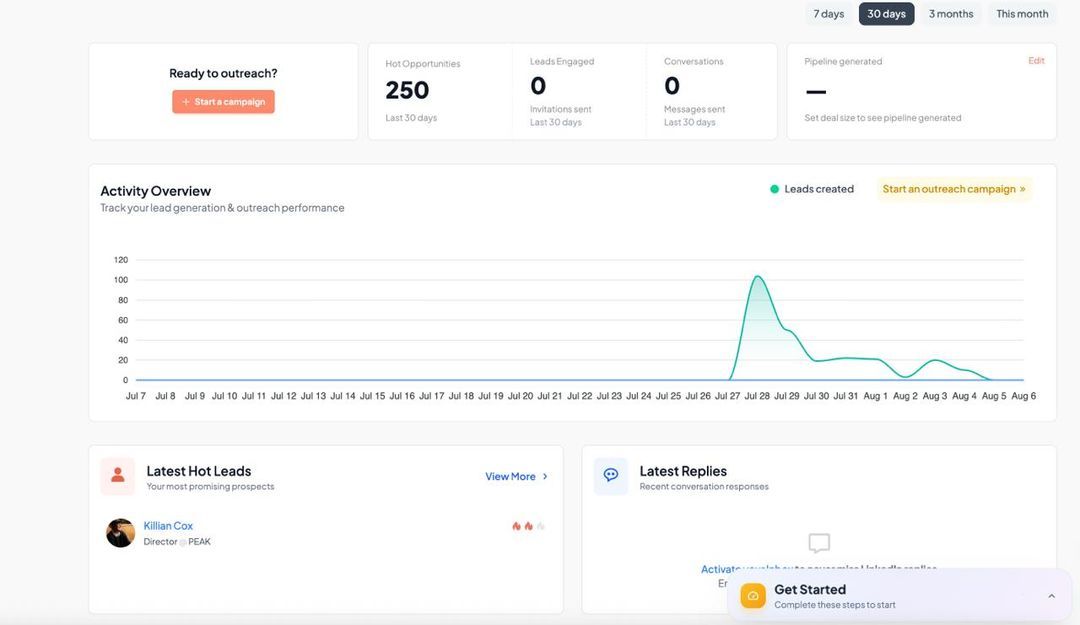
Gojiberry is an AI-powered multichannel prospecting platform. It tracks over 30 buying-intent signals across socials and the web, surfaces the leads in active research right now, and triggers personalized outreach across several channels. The signal comes first, and you write the pitch from it. You don't open a blank page, you open a reason to write.
Timing matters more than most reps admit, because the list ages while you work it. B2B contact data decays at roughly 2.1 percent a month, about 22.5 percent a year. A pitch written on Monday against a list built in January reaches a quarter of the people who've already left.
GTE Localize
Over 100 meetings after moving from email blasts to intent-based outreach.
Read the GTE Localize storyBaur Software
Network doubled by scaling authentic outreach instead of raw volume.
Read the Baur Software story
More High-Intent Leads = Your New Growth Engine.
Start Now and Get New High Intent Leads Delivered Straight to Slack or Your Inbox.