
ZoomInfo review 2026: real pricing, data accuracy and what they don't tell you

ZoomInfo is the best-known B2B database on the market, and the only one whose price nobody knows before talking to a sales rep. This review answers the price question first, with reported figures, their sources and their dates, then works through the data, the contract and whether a team of two to ten should sign at all.
Table of contents
How we tested ZoomInfo
I have run outbound for small teams for years, and I went through ZoomInfo the way a buyer would. I worked the product documentation and the public pricing and FAQ pages as they stood in August 2026, read the published license terms line by line, and pulled contract figures from procurement benchmarks and buyer reports. Every number below carries the place it came from and the month it was read. Where a figure comes from users rather than the vendor, it’s presented as a reported range.
What you won’t find here is a measured accuracy scorecard. We haven’t run a controlled reveal test on an identical list, and an invented percentage would be worth less than this sentence saying so. Gojiberry is our own product, we pay for the tools we test, and no vendor read a word of this before it went up.
What is ZoomInfo?
ZoomInfo is a business-to-business data platform. You search a database of companies and the people who work at them, filter by firmographics, technology stack and job title, then export the records you want into your CRM or your sequencer. Everything else the platform sells sits on top of that one thing, so if the database doesn’t fit your market, nothing built above it will.
On scale, the company states it covers more than 100 million companies and 500 million contacts, a figure it published in an April 2026 announcement about its category rankings. Treat it as the vendor number it is. It counts what’s stored rather than what’s current, and it says nothing about how much of that overlaps the market you sell into.
The suite around the data has grown a lot. There’s an intent feed that flags companies researching a topic, website visitor identification, org charts, a sequencing and dialing layer, conversation intelligence through Chorus, and enrichment that writes back into Salesforce or HubSpot. In a stack, ZoomInfo tends to replace a contact database, a data enrichment tool and an account-scoring layer at once. It’s sold as one platform rather than a set of parts you assemble.
Who is ZoomInfo built for?
The platform was designed around a sales floor with an operations function behind it, and that shows up everywhere: seat minimums, the annual term, the amount of configuration it rewards. Here’s where that shape lands well and where it doesn’t.
Good choice if
- 👥You run 15 reps or more and someone owns sales operations full time
- 🌍Your buyers sit in North American companies above 500 employees
- 📞Direct dials matter more to your motion than email does
- 🧩You need org charts to map a committee before a complex deal
- 🔄Your CRM is the system of record and enrichment writes back into it
- 🧮Your software budget carries a five-figure annual line without flinching
Poor choice if
- 🤝You’re two to ten people and everyone who sells also does something else
- 📅Nobody on the team has time to administer credits, filters and integrations
- 🔖You need to know your cost before you book a call with a sales rep
- 🔒You want to leave after a quarter if the data doesn’t perform
- 🌐Your buyers are outside North America, where coverage thins out
- 🔔The gap in your pipeline is timing rather than the size of your list
That second column is where most readers of this page sit, and it’s why the rest of the review spends so long on price and contract terms. At this size, those two lines settle the question before a single feature gets a look.
60-second fit finder
Is ZoomInfo the right size for your team?
Three questions, no email required.
QUESTION 1 / 3
How many people on your team sell every week?
Two or three of us, and we all wear other hats
Four to ten, with nobody running operations full time
Fifteen or more, with a dedicated operations function
QUESTION 2 / 3
What is missing from your prospecting right now?
Contacts are fine, too few of them reply
The list itself is thin, we need more verified records
We need org charts and direct dials at enterprise accounts
QUESTION 3 / 3
What would you sign this quarter?
Something monthly we can cancel if it doesn’t work
A modest annual plan with a published price
A negotiated annual contract, budget approved
🎯
Timing is your gap, not coverage
You’ve names and too few conversations, so a bigger database buys you more of what you already have. Gojiberry watches for the accounts moving in your market and drafts the first message, at $99 a month with no annual signature. Mindflow lifted replies 31 percent working this way.
💰
A published price beats a quote here
Your list needs filling and your budget needs to stay visible, which is the one thing a quote-based annual contract won’t give you. Start with a database that prints its price. Once the list is healthy, the question becomes which names to work this week, and that’s the part we add.
🏢
ZoomInfo is built for your shape of team
Fifteen reps, an operations owner and an approved budget is the configuration this platform was designed around, and the depth will pay off. Where it stays quiet is the week a target account changes something, so plenty of teams your size run a signal layer beside the database.
What is inside ZoomInfo?
The platform is sold as one product, but it’s priced as a set of modules, and the difference between what a demo shows and what a contract includes lives here. Read this section as a checklist for your quote. Each block below says what comes with the core plan and what sits behind a higher tier.
How big is the contact database?
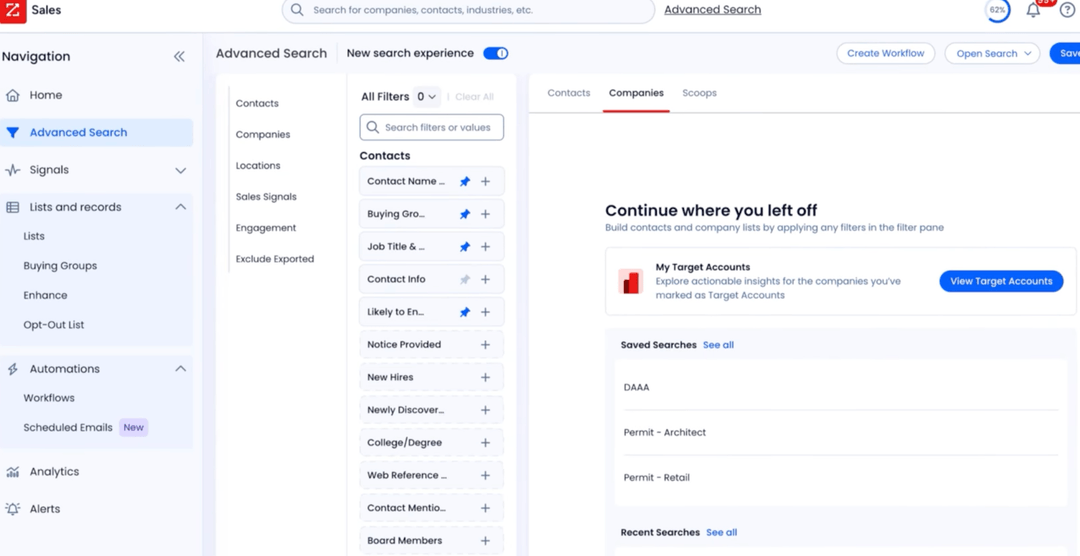
This is the core of the product and the part every plan includes. You filter by industry, headcount, revenue, technology installed, seniority and title, then export contacts with emails and phone numbers attached. Coverage runs deepest for North American companies above a few hundred employees, and it thins fast outside that. You won’t see a credit move for viewing a record, only for exporting one. Exports draw down credits, while viewing a record does not, which is a friendlier meter than most tools in this category run.
What do the intent signals show you?
ZoomInfo surfaces companies whose employees have been reading about a topic across a publisher network, and ranks them by how far that reading sits above the company’s own baseline. The signal attaches to the company rather than to a person, and that distinction runs through the rest of this review. Intent also sits on the higher tiers rather than the entry plan, which matters when a quote gets built: the feature most buyers come for is often the one that moves the number.
Can it tell you who visited your site?
Website visitor identification matches anonymous traffic to companies and pushes those accounts into your workflow. It needs traffic to be worth anything, because a handful of visits a week won’t produce a list long enough to prioritize. Like intent, it’s commonly an add-on line rather than something the entry plan carries.
Does it send the emails too?
There’s a sequencing and dialing layer, with cadences, templates and a click-to-call. It’s competent, and most teams that use ZoomInfo still pair it with a dedicated sending tool, because deliverability tooling is a category of its own. If you plan to send from ZoomInfo, price that module explicitly rather than assuming the database plan carries it.
What does Chorus record?
Chorus records and transcribes calls, makes them searchable, tracks when a competitor gets mentioned and turns the whole archive into coaching material. It’s a strong product and it is the piece users praise most consistently. It’s also a separate commercial decision, so a quote that includes it looks nothing like a quote that does not.
How well does it sync with your CRM?
Native connectors cover Salesforce, HubSpot and Microsoft Dynamics, with two-way updates and routing rules. This is the part of the platform that earns its reputation with operations teams, and it’s also the part that takes longest to set up properly. Advanced API access and custom integration work sit above the standard connectors.
How much does ZoomInfo cost?
This is the section the rest of the page exists to support, so it’s worth being precise about what can be known and what cannot. ZoomInfo publishes no prices. Everything below is either a benchmark from verified purchase data or a figure reported by buyers, and each one is labeled as such.
Why can you not see a price?
The public pricing page lists the product lines and what each one includes, and not one dollar figure anywhere. Every button on it leads to a form. You give a business email, a company name and a team size, you submit, and what comes back is a confirmation that somebody’ll be in touch. That was still the flow when we checked in August 2026.
The vendor explanation is that pricing is consumption-based and quoted per organization, which is true and also convenient. At this size the effect is simpler: you can’t build a budget without booking a call you may not be ready for, and the first number you hear on that call is an anchor rather than a rate card.
What are teams reporting they pay?
The most useful public benchmark comes from Vendr, a procurement platform that publishes aggregated figures from the contracts it handles. Its ZoomInfo page, read in August 2026 and last updated by Vendr in February 2026, reports a median contract of $33,500 a year across more than 1,500 tracked purchases, a spread running from about $7,200 to about $155,280, and an average saving of roughly 22 percent for buyers who negotiate. That last figure tells you how much air sits in a first quote.
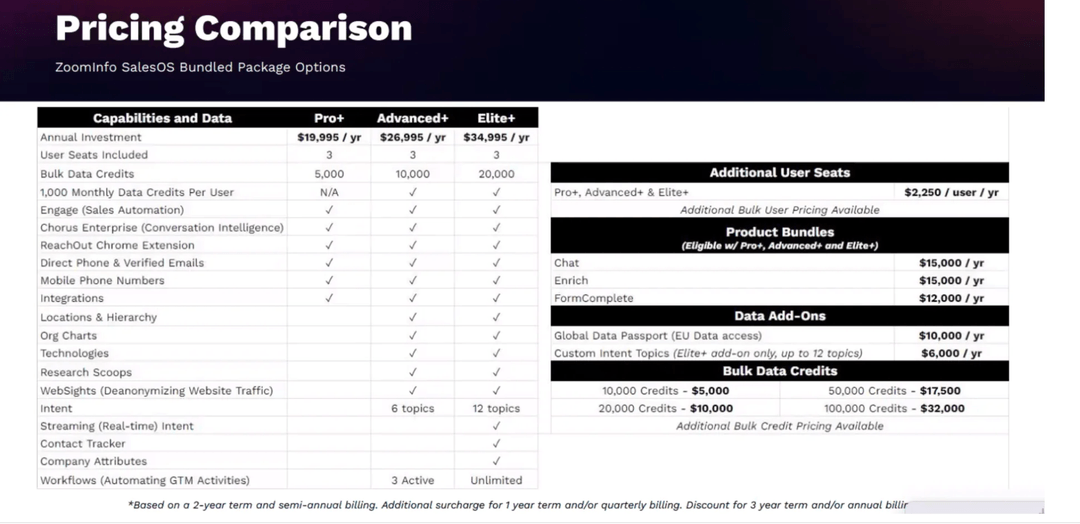
The sheet above puts line items under that median. It’s a SalesOS bundled package sheet of the kind ZoomInfo puts in front of a prospect who asks, and the prices on it assume a two-year term billed twice a year, with a surcharge for a one-year term or quarterly billing. A shorter commitment costs more than what you are about to read.
The add-ons sit beside the packages rather than inside them, and they’re where a quote grows. Chat and Enrich are listed at $15,000 a year each, FormComplete at $12,000. Custom intent support, sold only against Elite+, adds $6,000. Access to EU data is its own line at $15,000 a year, which is worth knowing before anyone assumes European coverage comes with the box.
Extra credits are priced in blocks too, at $10,000 for 10,000 and $32,000 for 100,000, so the unit rate improves as you commit further. Three numbers are worth holding on to from all of this: the package, the seats above three, and whichever add-on you’re shown in the demo.
What does that mean for a team of three?
Take Pro+ at $19,995 and divide. Three seats and 5,000 bulk credits works out to $4.00 for every contact you pull, before anybody has replied to anything. Spread across twelve months, that’s a little over 400 exports a month for the whole team, which is a workable volume and not a generous one.
The credits are what move the invoice from there. Run dry in month nine and the next 10,000 cost $10,000 at the block rate. Run under and the unused balance doesn’t roll into the next term. Running out costs you money and running under costs you headroom you already paid for.
One more thing the sheet makes plain: Pro+ carries no monthly per-user credits and no intent topics at all. A three-person team that came for the timing signals is looking at Advanced+ from the start, and that’s $26,995 before a fourth seat exists.
And for a team of ten?
Ten seats means the three included plus seven more at $2,250 each, so $15,750 lands on top of whatever package you sit on. On Advanced+ that’s $42,745 a year before a single add-on. On Elite+ with custom intent support it clears $56,000.
Notice how close the Advanced+ arithmetic runs to the $33,500 median Vendr reports. That median isn’t so much a discount off the sheet as a picture of who buys: mid-sized teams on the middle package with a couple of extra seats, some negotiating well and some not.
So the shape of it is a package price, a per-seat price, a credit meter and a set of add-ons, four dials a sales rep can turn on their own. Four dials means four places to negotiate. It also explains why two companies of the same size compare quotes and find twenty thousand dollars between them. The comparison that settles it is rarely price per record, though. It’s cost per meeting booked, which is a different arithmetic entirely.
How accurate is ZoomInfo’s data?
There’s a contractual answer and a reported answer, and they measure different things. Most articles quote the first and describe the second without noticing the gap between them.
What does the 95 percent guarantee promise?
ZoomInfo publishes license terms with a specific accuracy mechanism, and the detail is worth reading before you rely on it. The commitment is that no more than 5 percent of the contacts in your licensed materials aren’t employed by, or similarly affiliated with, the company listed against them. It covers company affiliation and nothing beyond it. Phone numbers, job titles and email deliverability all sit outside the promise.
The remedy runs in three steps. You give notice. ZoomInfo then has 30 days to bring the data to at least 95 percent accurate. If that doesn’t happen, you may terminate and receive a prorated refund of prepaid fees for the remaining term. That’s a real commitment, and it’s also narrower than the marketing figure suggests, since proving the threshold has been crossed is work you do yourself, against a database you licensed, before anyone at the vendor has to act. You measure it, you document it, and only then does the 30-day clock start.
Where does the data hold up, and where does it slip?
Reported experience is consistent enough to summarize by data type. Direct dials for North American contacts are the strongest part, and they’re the reason plenty of teams stay. Email addresses are solid at the enterprise end and thinner for small companies. Job titles are the most common complaint, because people move and a record that was right in March describes someone else by September.
None of that’s unique to this vendor. HubSpot puts B2B database decay at roughly 2.1 percent a month, which is close to a fifth of any list going stale over a year. Company data outside North America is where reviewers report the widest gaps, particularly across Europe and Asia-Pacific, where reviewers report the widest gaps between what the filters promise and what the export returns.
The working rule: plan a verification pass on anything you export before it goes into a sending tool. That’s true of every database in this category, and paying more doesn’t remove the step.
What happens when you try to leave?
This is the least documented part of most reviews and the most documented part of the public record. We report what’s published and we link to it, so you can read the sources yourself. The reviews below are other people speaking. We’re quoting them rather than making the accusation ourselves.
How does the renewal clause work?
Contracts are annual and renew automatically. The notice period sits in your agreement rather than in any public rate card, and Vendr describes typical notice periods on these contracts as 30 to 90 days, with the advice to negotiate for 90 to 120 so there’s time to evaluate alternatives. It also lists annual price escalation clauses of roughly 5 to 10 percent as a common contract feature. Neither number is fixed before you sign.
The mechanics matter more than the percentage. Miss the notice window and the term renews, at the new rate, for another full year. The protection is dull and it works: find the renewal date the week you sign, and put the notice deadline in a calendar with the order form attached to it.
What do the review platforms record?
The gap between review sites is the most striking thing about this vendor. On G2, ZoomInfo products carry 4.5 stars across roughly 12,900 reviews, and the praise there is about data depth and integration quality. On Trustpilot, where a few hundred people have written and nobody is prompted to, the recurring subjects are the cancellation window, renewals customers say they didn’t expect, and how hard it was to reach someone once they wanted out. Same vendor, two different populations writing.
The Better Business Bureau maintains a public complaint file with the same themes, including disputes about cancellation and billing after a customer says they gave notice. Read a sample of both platforms rather than either one. The two populations aren’t the same, and the difference between a solicited review and an unsolicited one is most of the gap.
If you’re evaluating rather than escaping, the useful move is to ask for the notice period and the escalation cap in writing before you sign. Both are negotiable at that point, and both get far harder to change once a renewal is in front of you.
Is the intent data useful?
Yes, with one distinction that decides everything below ten reps, and it’s the distinction a demo is least likely to dwell on.
What does an account-level signal tell you?
It tells you that somebody at a company has been reading about your category, above that company normal baseline. It doesn’t tell you who. A 400-person business generates a surge because an analyst was researching, or a procurement lead was benchmarking, or eleven people in a department that will never buy from you clicked the same article.
So the output is an account name and a topic. Turning that into an action means working out which of the forty plausible people at that company to contact, whether the reading was a buying motion or idle curiosity, and doing it this week while the signal is warm. That research is the actual job, and the signal hasn’t done it for you.
Why does that matter for a team of three?
At enterprise scale it barely does, because a research function or a junior SDR turns account signals into person-level lists as a full-time job. At three people it decides everything, because whoever would do that conversion is also the one selling, onboarding and answering support tickets.
Person-level signals answer a different question. Someone changed jobs, and the US Bureau of Labor Statistics finds 22 percent of workers have been in their role under a year, so job moves are constant and each one resets a buying committee. Someone started following a competitor. Someone posted about the problem you solve. Those are one person and one moment, which is narrow enough to act on before it goes cold.
Gojiberry finds the prospects, you do the talking
Account-level intent says a company is interested. Gojiberry says which person moved this week, and drafts the opening line before anyone else spots it.
Get your first leads for freeHow does ZoomInfo compare?
Four comparisons are worth making, because each one replaces a different part of what ZoomInfo does. The table puts all five side by side, with ours in the first column, and the paragraphs underneath it say what a table can’t.
ZoomInfo or Apollo?
Apollo is the comparison most lean teams land on, because it bundles a large database with sequencing and it prints what it charges. The database is shallower on org charts and on verified direct dials, and the credit meter bites once you’re pulling mobile numbers at volume. What you gain is the ability to start on a Tuesday without a sales call. Our full Apollo review works through where that trade breaks down.
ZoomInfo or Cognism?
If your buyers sit in Europe, this comparison matters more than the price one. Cognism built its coverage around phone-verified mobiles and compliance screening across European markets, and reviewers there report better connect rates than they’d get from a North American database. Both are quote-based and annual, so neither one will tell you what it costs before a call.
ZoomInfo or Clay?
Clay isn’t a database, it’s a workbench you point at other databases, chaining providers so one takes over when another misses. It’s more flexible than anything else here and it needs someone to own it, in weeks rather than days. For a team with a builder on staff, the per-record economics can be much better. Without that person, the setup cost lands on whoever can least afford it. We break the field down in our Clay alternatives guide.
ZoomInfo or Gojiberry?
These two solve different problems, so the fair way to put it’s what each one can’t do. Gojiberry isn’t a database. If your list is empty, we won’t fill it, we have nothing like 500 million records to search, we don’t publish org charts, and we don’t give you a direct dial for a name you type in. Anyone whose gap is raw coverage should buy coverage.
What Gojiberry does is watch more than 30 buying signals across socials and the web, check each surfaced account against your ICP, and draft the first message tied to the signal that triggered it. Pricing is $99 a month on Pro with 2 AI agents and up to 1,800 prospects contacted a month, then Custom for teams of five and up. Monthly, and a third rep doesn’t change the bill.
100+
meetings after switching from email blasts to intent outreach, at GTE Localize.
Read the case studyIf you want the field rather than the head-to-head, we keep a longer list of ZoomInfo alternatives with what each one replaces and where it starts, and a closer look at one enterprise pairing in our Amplemarket and ZoomInfo comparison.
Is ZoomInfo worth it in 2026?
For a large team with budget and an operations function, the answer is yes, and a review that says otherwise isn’t describing the market. The database is the deepest available, the CRM integrations are the most reliable in the category, and Chorus is a strong product in its own right. Depth like that has a price, and enterprise buyers pay it because it returns.
For a team of two to ten, the answer is usually no, and it isn’t a verdict on quality. A five-figure annual commitment, a three-seat minimum, a credit meter and a platform that rewards administration all point the same direction: this product asks for time and budget in exactly the proportions a small team has least of.
Take ZoomInfo if
- 📊You run 15 or more reps and someone owns operations
- 📈Direct dials into North American enterprises decide your quarter
- 📁You map buying committees and need current org charts to do it
- 🎧Call coaching matters enough that Chorus alone would justify a line item
- 💰Your budget carries $30,000 a year without a conversation about it
Look elsewhere if
- 🔧You’re under ten people and nobody has spare hours for a platform
- 🔍You need to see a price before you commit to a call
- 🔁You want the option to stop after a quarter that didn’t work
- 🌍Most of your buyers are outside North America
- 🎯Your list is fine and the gap is knowing who to work this week
If you landed in the second column, the next step that tells you something is a parallel pilot on your own ICP rather than another demo. Run a cheaper database or a signal tool beside whatever you’re using now for two weeks, then count meetings booked instead of records exported. Two weeks of real usage answers more than another demo will.
Common questions about ZoomInfo
How much does ZoomInfo cost per year?
There’s no published price. The best public benchmark is Vendr, which reports a median contract of $33,500 a year across more than 1,500 tracked purchases, with a spread from roughly $7,200 to roughly $155,280, read in August 2026. Buyer reports put the entry Professional tier near $14,995 a year for three seats, Advanced near $24,995 and Elite above $40,000, and those tier figures come from users rather than from the vendor.
Does ZoomInfo have a free trial?
Yes, on request. The company FAQ describes trials that include searching and viewing contact and company profiles, arranged through its sales team rather than self-serve, and a limited free tier has been reported alongside it. There’s no card-on-file signup that gets you into the paid product, so a trial still begins with a conversation.
Is ZoomInfo worth it for a small team?
Usually not, and it’s structure rather than quality that decides it. A three-seat minimum on an annual contract at a reported five-figure entry point asks a two-to-ten-person team for budget and administration time in the proportions it has least of. If your buyers are large North American companies and direct dials decide your quarter, it can still pay for itself, so the question is what your motion needs rather than what the platform can do.
How accurate is ZoomInfo’s data?
The published license terms commit to company affiliation accuracy of at least 95 percent, with 30 days to correct after notice and a prorated refund with termination if that fails. That covers whether a contact works where the record says. Phone numbers, titles and deliverability sit outside it. Reported experience is strongest on direct dials and weakest on job titles and non-US coverage, which tracks a category-wide decay rate of about 2.1 percent a month.
Can you cancel a ZoomInfo contract?
At the end of the term, and only if you give notice inside the window your agreement sets. Contracts renew automatically and they won’t remind you, and Vendr describes typical notice periods on these deals as 30 to 90 days, recommending buyers negotiate 90 to 120. Cancellation friction is the most common theme in unsolicited reviews of this vendor, so find the renewal date the week you sign and calendar the notice deadline against it.
Is ZoomInfo GDPR compliant?
The company operates a privacy center with data subject request handling and states that it processes European personal data with notice, which is the framework most B2B data vendors work within. Compliance isn’t something a vendor hands you, though: your own basis for contacting a person, your record keeping and your opt-out handling stay your responsibility. Teams selling mainly into Europe often find both the coverage and the compliance story better served by a European-first provider.
ZoomInfo or Apollo, which one?
Apollo for a lean team on a visible budget, ZoomInfo for a large one with operations behind it. Apollo prints its prices, bills monthly and bundles sequencing, and it’s shallower on org charts and verified mobiles. ZoomInfo is deeper on both and costs several times more with an annual signature attached. If cost per meeting is the metric, most teams under ten people get there faster on Apollo.
Does ZoomInfo tell you when to reach out?
Partly. The intent feed flags companies reading about your category, which is a timing signal at the account level, and website visitor identification adds another. Neither one tells you which person to contact or what changed for them, so turning an account signal into a person and a reason is work somebody on your team still does. That conversion step is the one a two-to-ten-person crew rarely has the hours for.
Want us to find the prospects too?
Tell Gojiberry who you sell to and it starts finding prospects who’re already looking. No annual contract, and no sales call before a price.
Start free on your market Read what customers got
More High-Intent Leads = Your New Growth Engine.
Start Now and Get New High Intent Leads Delivered Straight to Slack or Your Inbox.