
Apollo.io Review 2026: Features, Pricing & Alternatives for LinkedIn Outreach

Apollo won its place by putting a contact database and a sequencer on the same invoice. Before that, a three-person team paid one vendor to find people and another to write to them, then spent a morning a week moving CSV files between the two.
The hard part has moved since. Finding more contacts is close to solved in 2026 and the tools that solve it are cheap. Knowing which of those contacts deserves an email this week isn't solved, and that gap is where this review keeps landing.
Table of contents
What is Apollo.io?
Apollo is a sales intelligence platform with an outreach layer bolted on top, and the second half is what made it popular. You search a database of more than 275 million contacts by Apollo's own count, filter it down to a list, reveal the emails, and push that list into a sequence without leaving the tab.
In a small stack it replaces three line items: the data provider, the email finder, and the sequencer. That's the whole pitch, and for a founder or a two-person sales team starting outbound from zero it's a reasonable one. You get a Chrome extension for revealing contacts as you browse, a dialer on the higher tiers, intent topics, and native sync with HubSpot and Salesforce.
The main use case hasn't changed in five years. You define a segment, you build a list of a few hundred people who match it, and you write to all of them. Apollo is good at that motion. The question this review keeps returning to is whether that motion still pays.
Who is Apollo built for?
Most reviews answer this with three vague lines. Here's the split we'd give a team asking us directly.
Apollo is a good fit if
- 🎯You're starting outbound and you own nothing yet. No list, no sequencer, no verified emails. One subscription gets you all three by Friday.
- 📧Classic cold email is your channel. Segment, list, sequence, follow up. Apollo runs that loop without any glue code.
- 💳You want a price before you talk to anyone. Self-serve checkout, a free tier, and a card is the only approval you need.
- 🚀Your market is North American. US coverage is where Apollo puts its effort and it shows in the connect rates.
Apollo is the wrong tool if
- 🌍You sell into Europe, APAC or LATAM. Coverage thins out fast past the US border and bounce rates follow.
- 🔔Timing is your bottleneck. Apollo tells you a company exists. It won't tell you the week something changed there.
- 🧩You need enrichment that falls back. One database, one attempt. No second provider steps in when a record comes back empty.
- 📞Phone is your primary channel. A mobile number costs eight times what an email costs, and the meter notices.
Quiz · 60 seconds
What's the piece your outbound is missing?
No email required.
Question 1 / 3
Where does most of your week go?
Question 2 / 3
Where do the people you sell to sit?
Question 3 / 3
How many people run outbound with you?
🔥
Your result
Your problem is timing, so a bigger database won't move anything
You already know who your buyers are. What you don't know is which of them started looking this month. That's the layer Gojiberry adds, and it's the reason Mindflow saw a 31% lift in reply rate after switching to signal-led outreach.
- More than 30 buying signals watched across socials and the web
- Email waterfall enrichment across 15+ providers, so an empty record gets a second attempt
- Two AI agents draft the first message from the signal that triggered it
- Flat $99 a month on Pro, no credit meter behind it
🧰
Your result
Apollo is the right first subscription for you
Solo, US-focused, and missing the basics. One tool that hands you a list and sends for it beats three tools you have to wire together. Take the free tier first and see how far the credits go before you commit a year.
- Get the motion running, then judge whether volume or timing is your ceiling
- When the ceiling turns out to be timing, that's the part we add on top
🌐
Your result
Your bottleneck is coverage, and Apollo is the weakest place to fix it
European mobiles and phone-verified numbers are a specialist job. A single-source database will keep handing you records it can't confirm. Fix the data layer first, because no amount of sending volume rescues a list that bounces.
- Waterfall enrichment beats one provider on any market outside the US
- Once the addresses hold up, timing becomes the next thing worth buying
What's inside Apollo?
Apollo ships five things that matter. Each one is usable on the entry plan and each one has a ceiling that moves you up a tier.
How big is the contact database?
Apollo reports more than 275 million contacts and upwards of 30 million companies, with around 65 filters to cut through them. These are the ones a small team ends up living in:
- 🔖Job title and seniority, granular enough to separate a Head of Ops from the VP she reports to
- 👥Headcount, in bands tight enough to keep a 40-person company out of a list built for 400-person ones
- 📈Revenue, handy for qualifying out before a rep spends a morning on an account that can't afford you
- 🔧Technologies in use, which is how you find the accounts already running something you plug into
- 💡Funding stage, the closest thing in here to a timing filter
- 📌Location, by country, region or city
The filtering is the part people stay for. Building a segmented list of 500 people takes minutes rather than an afternoon, and the saved-search feature keeps feeding you new matches as they appear.
The headline number is a total, not a promise. It counts every record Apollo holds, including the ones where the email hasn't been verified and the ones where the job title is two roles out of date. Treat it as a ceiling on what you might find, and see the accuracy section below for what tends to survive contact with a send.
How does the email finder work?
Apollo reveals an address from its own records, checks it against a verification step, and marks it verified or not. One verified email costs one credit. The Chrome extension does the same job on a company page or a profile you're looking at, which is how most reps end up using it day to day.
What it won't do is try somewhere else when it comes up empty. There's no fallback to a second or third provider, so a missing record stays missing. Teams that need higher match rates end up paying for a separate waterfall tool, which quietly reopens the multi-vendor problem Apollo was meant to close.
What do sequences let you send?
Sequences are multi-step campaigns mixing automated emails, call tasks, and manual steps. The free tier caps you at two active sequences; every paid tier lifts that cap. Professional and above add A/Z testing, automated workflows, and unlimited daily sends, plus mailbox rotation so a single inbox doesn't carry the whole volume.
The sequencer is the strongest thing Apollo builds and the reason most teams pick it over a standalone database. It handles reply detection, out-of-office handling, and follow-up spacing without a second subscription.
What does the AI layer do?
Apollo has spent the last two years adding AI, and it shows up in three places today:
- 💬Email drafting, an assistant that writes sequence copy from your prompt and whatever the record already holds
- 🔬AI research, which answers a question about an account and spends a credit every time it runs
- 🎧Meeting intelligence, recording and summarizing calls, on the higher tiers only
The drafting is a real time saver on the second and third emails of a sequence, where nobody wants to write from scratch.
The distinction matters. AI writing makes an average email faster to produce. It doesn't make an untimely email welcome, and a reader who wasn't in the market last week isn't in the market because the prose improved. Speed and relevance are different purchases.
Which CRMs does it sync with?
HubSpot and Salesforce get native two-way sync on the paid tiers, and there's an API plus a growing set of connectors for everything else. Contacts, activity, and sequence status all flow back, which is what keeps a manager from having to ask reps what happened.
Reviewers do flag the Salesforce sync as a recurring source of duplicate records, and workflow logic is rigid enough that teams reach for middleware to bend it. On HubSpot the experience is smoother. Neither integration needs a developer to set up.
How accurate is Apollo's data?
Apollo publishes a 97% email accuracy figure. That number was measured against a database of around 230 million records, and the headline count has since grown past 275 million, so the percentage and the size come from different moments. It isn't a false claim. It's an average across a database whose quality varies enormously depending on where you point it.
Here's how coverage tends to break down by market, based on what reviewers report and what our own sends have looked like.
North America
The strongest region by a distance. Emails hold up, direct dials connect often enough to justify the credit cost, and titles are usually current. If your market is here, most of the criticism below won't reach you.
Europe
Thinner and more uneven. Data protection rules make it harder for a US-based provider to keep European records fresh, and phone-verified mobiles are rare. Bounce rates climb noticeably against a US baseline.
APAC and LATAM
The weakest coverage of the four. Reviewers report outdated titles and invalid numbers as the norm rather than the exception. A verification pass before sending stops being optional here.
The verification process is worth understanding because it explains the gap. Apollo refreshes records continuously and checks addresses against a validation step before marking them verified. That catches dead mailboxes. What it can't catch is a person who still has a working address at a company they left in March. The mailbox is live, the record is wrong, and your email reaches an autoresponder or a colleague who never asked for it.
This is a problem for every database, not a flaw specific to Apollo. HubSpot's research on database decay puts the rot at roughly 2.1% of a B2B list every month, which compounds to about 22.5% a year. A list you exported in January is a fifth wrong by December, whoever sold it to you.
Which points at the limit of the whole category. A record can be perfectly accurate and still be worthless to write to. Knowing that someone is a VP of Operations at a 200-person logistics firm, and that the address works, tells you nothing about whether they're looking for what you sell this month.
What does Apollo cost?
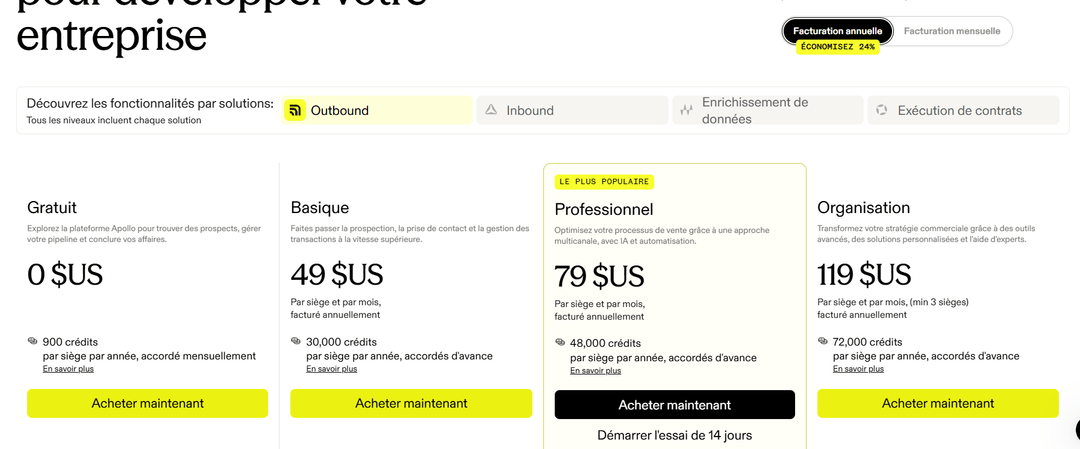
Four tiers, published, self-serve, no sales call to see a number. Annual billing is the advertised price and month-to-month costs more. Every figure below was checked against Apollo's public pricing page in August 2026.
Credits are the part that decides your real invoice. A verified email costs one credit and a phone number costs eight, so a rep pulling 200 mobiles a month burns 19,200 credits a year on phone alone. On Basic that's two thirds of the annual allowance gone before a single email address gets revealed.
Unused credits don't carry over. They expire at the end of the billing cycle, which means a quiet quarter is money you spent and didn't use, and a busy one sends you looking for a top-up. Overage pricing isn't published on the pricing page. Third-party reporting puts it around $0.20 a credit at low volume with a 250-credit minimum purchase, so the smallest top-up lands near $50.
How much does it cost for a small team?
Say there are three of you on Professional. Billed annually that comes to $237 a month, or $2,844 across the year, and you're sharing 144,000 credits between you. If you'd rather keep the option to walk away and pay month to month, the same three seats cost $297, so that flexibility is running you around $720 a year.
You could move everyone down to Basic and save $90 a month, though you'd be handing back the dialer, the automated workflows and two thirds of your credits. Going the other way, Organization won't sell you fewer than three seats, which puts a floor of $357 a month, or $4,284 a year on a plan you may only have wanted for one feature.
Then the team grows to ten, Professional turns into $790 a month or $9,480 a year, and the product hasn't changed at all. That's the thing about per-seat pricing: it bills you for headcount, so your seventh rep costs what your third does even when she pulls a tenth of the data.
Why cold lists stopped working
The motion Apollo was built for goes: define the profile, build the list, send the email. It worked because inboxes were quieter and because a well-matched profile was itself a decent signal. Both of those conditions have gone.
The newer motion runs the other way round. You start from something that happened, work out what it implies, and reach out because of it. A company posts four sales roles. A team lead moves to a competitor. A firm publishes a page about a problem you solve. The list assembles itself out of events instead of being filtered out of a database.
There's a reason job changes carry so much weight. US Bureau of Labor Statistics data on employee tenure puts the median time in a role at 3.9 years, and 22% of workers have been in their job under a year. In any given quarter a meaningful slice of your target market is new in seat, budget unspent, and looking at what the last person left behind. A static list can't see that. It shows you the same names in October it showed you in March.
This started as a problem we had
Before Gojiberry there was Coco.ai, and Roman spent his days prospecting on socials for it. He was doing the signal work by hand: scrolling for job changes, watching who commented on what, keeping a spreadsheet of accounts that had shown a flicker of movement. The messages he sent off that spreadsheet got answered. The ones he sent off a filtered export didn't.
Coco.ai turned into the place we learned the pattern. The tool exists because doing it manually worked and doing it manually didn't scale past one person.
60%
Wispra now sources 60% of its weekly demos from intent signals rather than list-based outbound, having replaced volume sending with a smaller number of timed approaches.
Is Apollo worth it in 2026?
For a lot of readers the answer is yes, and pretending otherwise would waste your time. Apollo does what it says at a price that's published, and no tool in this category gives a small team more for $49 a seat.
Take Apollo if
- 🔍You need a database and a sequencer and you own neither. The consolidation is worth real money at this size.
- 📝Cold email is your channel and the US is your market. This is the configuration Apollo is tuned for.
- 🤝You want to start today without a sales call. Free tier, card, done.
Look elsewhere if
- 🧠You have enough contacts and not enough qualified conversations. More rows won't fix that.
- 📊Your credit overages have started outrunning your seat costs. That's the model telling you it's the wrong shape.
- 🔄Europe is your market and phone is your channel. A specialist will beat a generalist here every quarter.
Our reservation is narrow, and worth stating clearly enough that you can disagree with it. Apollo is excellent at answering who exists. Nothing in the product answers when to write, and over the next few years we think that second question is where outbound performance gets decided. If you agree, you'll end up layering something on top. If you don't, Apollo will serve you well for years.
Common questions about Apollo
Is Apollo.io worth it in 2026?
For a small US-focused team running cold email, yes. At $49 a seat a month on annual billing you get a 275 million contact database, a sequencer, and CRM sync in one subscription, which is more consolidation than anything else at that price. The reservation is that Apollo answers who exists and not when to write, so teams whose bottleneck is qualification rather than volume tend to add something on top rather than switch away.
How accurate is Apollo's data?
Apollo publishes a 97% email accuracy figure measured against a smaller version of its database. In practice accuracy is strongly regional: North American records hold up well, European coverage is thinner with higher bounce rates, and APAC and LATAM are weakest. Run a verification pass on any non-US list before you send. Every B2B database also decays at around 2.1% a month, so a list is a fifth wrong within a year regardless of the vendor.
Is Apollo.io free?
There's a free tier with 900 credits a year, two active sequences, and basic search filters. It's enough to judge whether the database covers your market and whether the interface suits you. It isn't enough to run outbound: 900 credits buys 900 verified emails across twelve months, or roughly 112 phone numbers, and most teams hit that ceiling within weeks.
How much does Apollo cost per month?
On annual billing it's $49 a seat for Basic, $79 for Professional, and $119 for Organization with a three-seat minimum. Month to month those become $59, $99, and $149. A three-person team on Professional pays $237 a month annually or $297 monthly. Credits sit on top of all of it, and since they expire each cycle without rolling over, heavy months mean top-ups at roughly $0.20 a credit with a 250-credit minimum purchase.
Does Apollo have buying intent data?
Yes, as intent topics. Basic includes 6 topics and Organization goes to 12. Apollo flags companies whose employees have been researching subjects you select, which narrows a list to accounts showing category-level interest. What it doesn't cover is event-level signals: a job change, a funding round, a hiring push, a new tool appearing in someone's stack. Topic intent points at an account. Event signals point at a week.
Is Apollo better than ZoomInfo?
For a team under twenty reps, almost always. ZoomInfo has deeper firmographics, better org charts, and stronger US intent, but it's sold on custom annual contracts commonly quoted in five figures and it needs someone to administer it. Apollo gives you eighty percent of the useful surface for a published per-seat price you can cancel. Above twenty reps with a RevOps function, the comparison flips.
What are the best Apollo alternatives?
It depends which part of Apollo is failing you. For European mobiles and cold calling, a phone-verified specialist beats it. For high-volume sending at low cost, a dedicated sender does. For enrichment that falls back across providers, a waterfall tool does. For timing rather than volume, that's the job we built Gojiberry for. We compare twelve options in detail on our Apollo.io alternatives page.
Can Apollo tell you when to reach out?
Partly. Intent topics tell you an account has been reading about your category recently, which is a timing hint at company level. What Apollo won't do is watch a named person and tell you the week their situation changed. That distinction is worth money: GTE Localize booked more than 100 meetings after moving from list-based email to outreach triggered by signals, using the same team and the same offer.
Want us to find the prospects too?
Tell Gojiberry who you sell to and it starts finding prospects who are already looking. Keep Apollo for the database if you like it, we handle the timing.
Start free on your market See the case studies
More High-Intent Leads = Your New Growth Engine.
Start Now and Get New High Intent Leads Delivered Straight to Slack or Your Inbox.