
HeyReach review 2026: pricing, account safety and who it's really for

HeyReach solves one problem with unusual precision: running a lot of sender accounts from a single dashboard without losing track of who said what to whom. The only question worth answering on this page is whether that's your problem.
Table of contents
- How we tested HeyReach
- What is HeyReach?
- Who is HeyReach built for?
- What's inside HeyReach?
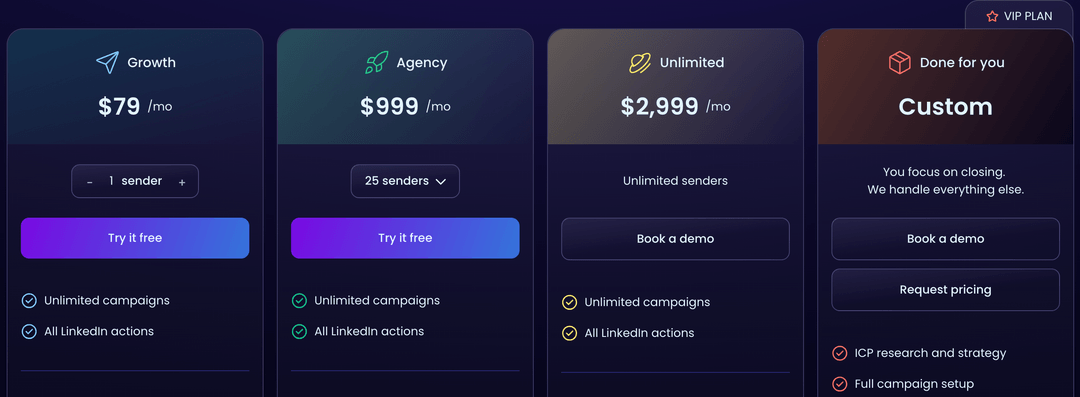
- How much does HeyReach cost?
- Will HeyReach get your account restricted?
- What do HeyReach users say?
- What HeyReach doesn't do
- What is the best alternative to HeyReach?
- How does HeyReach compare?
- Is HeyReach worth it in 2026?
- Common questions about HeyReach
How we tested HeyReach
Three things went into this page. We read the pricing grid on the vendor's own site on August 10, 2026 and took every number from there, because comparison articles still quote plan names HeyReach has retired and discounts that expired. We went through the plan grid tier by tier, counting what each one includes in senders, credits and branding rights. And we read the public review corpus rather than cherry-picking from it, then summarized the recurring complaints in our own words further down.
One thing you won't find here: a scorecard of measured acceptance rates across sender accounts. We haven't run a controlled test on an identical list, and an invented percentage would be worth less than this sentence admitting it. When we run it, the numbers land on this page. Gojiberry is our own product and it gets one section, near the end, where we say what it replaces and what it doesn't. We pay for the tools we write about, no vendor read a word of this before publication, and our customer results are published case by case.
What is HeyReach?
HeyReach is a cloud platform for running outreach across several LinkedIn sender accounts at once. It launched in 2023 out of an agency problem: when you run outbound for eight clients, each with three sender profiles, you spend your morning logging in and out of twenty-four accounts and answering replies in twenty-four separate inboxes.
The architecture matters more than the feature list. Campaigns execute on HeyReach's servers instead of your browser, so nothing pauses when you shut your laptop. Each sender gets a dedicated residential proxy on the entry plan, and that keeps a team of five from looking like five people sharing one connection. And a single campaign can draw from several senders at once, rotating the sending between them instead of stacking it on one profile.
In a stack, it replaces the per-seat automation extension and the spreadsheet you were using to track which account touched which prospect. It doesn't replace your data source. It was never designed to.
Who is HeyReach built for?
Good choice if
- 🏢You run an agency. Separate workspaces per client, whitelabel branding from the Agency tier, one login across all of it.
- 👥Every rep has their own account. One campaign rotates across all of them and the weekly volume spreads instead of piling on a single profile.
- 📥Replies arrive faster than you can switch accounts. The unified inbox puts every conversation in one place, and it's where a teammate answers for you when you're out.
- 🔗Your data already lives in a table. The native Clay and RB2B connections push enriched rows straight into a campaign.
Bad choice if
- 📌You're a founder with one account. At $79 a month for a single sender you pay agency-grade infrastructure for a solo motion.
- 💬You need email in the same sequence. HeyReach sends on one network and hands email off to a partner tool through an integration.
- 🔍You don't have a list yet. Nothing in the product ranks the market for you or tells you where to start.
- 🧮You're two or three people. The per-sender rate is identical at two seats and at twenty-four, and the flat Agency tier sits a long way above you.
3 questions
Is HeyReach your tool?
No email required.
QUESTION 1 / 3
How many sender profiles will run outreach?
A
One, and it's mine
B
Two to five
C
More than five
QUESTION 2 / 3
Where does your prospect list come from today?
A
We already have one we trust
B
We buy or scrape one
C
We don't have one yet
QUESTION 3 / 3
What breaks first in a normal week?
A
We can't send enough
B
We don't know who to contact
C
Replies sit unanswered for days
🏢
HeyReach is your fit.
Several senders, a list you trust, and a sending ceiling you keep hitting. That's the exact shape HeyReach was designed around, and nothing else rotates accounts as cleanly. The half it leaves to you is deciding who goes into the list next month.
🚀
Gojiberry is your fit.
One or two accounts and no list worth the name. More sending capacity would only get you to the wrong people faster. Gojiberry watches over 30 buying signals, surfaces the people who are in-market this week, and writes the first message.
🔀
You need both halves.
You have the accounts and the sending motion, and the list is the part you patch together each month. HeyReach keeps doing the sending. Which names go into next month's campaign is the half we handle.
What's inside HeyReach?
Five blocks carry the product. Each one below says what's on the entry plan and what waits on a higher tier.
How does multi-account rotation work?
You attach several sender profiles to one campaign, and HeyReach spreads the actions across them inside each sender's own daily ceiling. Five senders at twenty invitations a day reach a hundred people a day without any single profile behaving unusually. It's the feature nobody else in the category does as well, and it's included from the entry plan upward. Bring-your-own proxies arrive on the Agency tier, where they stop being optional.
What does the unified inbox change?
Every conversation from every connected account lands in one view, filterable by account, campaign or tag, with one-click push to HubSpot or Pipedrive. You can also answer for a colleague while they're away, which is the part agencies mention most. It's included on every plan.
How far do campaigns and sequences go?
Connection requests, messages, follows, profile views and InMails, with an "if connected" condition that splits existing contacts from new ones. Campaigns are unlimited on every tier. Multichannel means a native handoff to a partner email tool, not an email step HeyReach sends itself, which is a real distinction when you're comparing prices.
What do client workspaces and white label give an agency?
Workspaces isolate each client's senders, leads and campaigns behind one login, and they're available from the entry plan. Whitelabel branding is not: one branded domain comes with the Agency tier, and additional brandings on the top tier cost $500 each as an add-on. Users and teammates are free on every plan, since billing counts senders rather than people.
Which integrations are native?
Clay, RB2B, Trigify, Smartlead, Instantly, Make, Zapier, HubSpot and a handful of others, plus an open API, webhooks and an MCP server for AI agents. Every plan includes a one-time allocation of enrichment credits for finding verified emails, 100 per sender on the entry tier, 1,000 on Agency and 3,000 on the top tier. Those credits attach a verified address to a name you already have. They don't identify anyone.
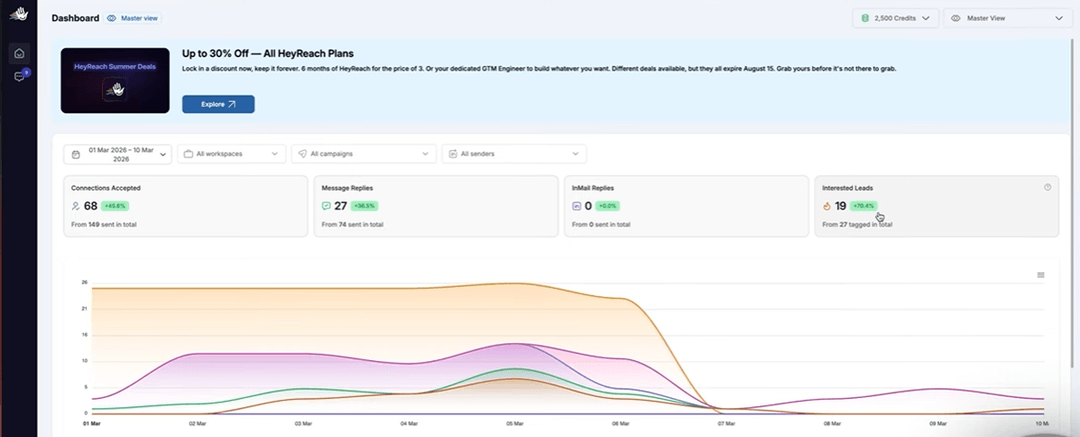
How much does HeyReach cost?
Prices read on the vendor pricing page on August 10, 2026. Quarterly billing takes 10 percent off, annual billing takes 20 percent.
A 14-day trial covers the entry plan with three accounts and no card. The top tiers offer a 30-day trial on request. There's also a discounted early-stage program for companies under $250,000 in revenue with fewer than five people, which is worth asking about if that's you.
Run the math for one, two and five accounts. On monthly billing, one sender costs $79, two cost $158 and five cost $395. Commit annually and the same three setups cost $756, $1,512 and $3,780 for the year.
Now compare that to the flat tier: 25 senders for $999 works out to $40 per sender. You pay roughly double per account at five senders than an agency pays at twenty-five. The pricing curve rewards scale, and it rewards it steeply.
Competitors make this point about HeyReach and they're right to: the entry tier is expensive for a single account next to individual automation tools that sit between $19 and $59 a month. Nobody at HeyReach hides this. The product's value shows up the moment you're coordinating several accounts, and it stays hidden until then. If you'll run one sender for the next year, you're buying an engine for a bicycle.
Will HeyReach get your account restricted?
It's the most searched question on the topic, so here's what can be verified rather than what gets promised. HeyReach gives every sender its own residential IP on the entry tier, randomizes timing between actions, respects per-sender daily ceilings and ramps new accounts gradually. On the Agency and top tiers you supply your own proxies, which shifts part of that responsibility back to you.
The platform side moved in 2026. Most profiles now sit around 100 connection requests per week, with mature accounts carrying a strong engagement history reaching 150 to 200. The reset is a rolling seven-day window from your first request, not a Monday. Sending the week's allowance in one Monday morning burst looks nothing like a human, so 15 to 25 a day across five working days is the shape that survives.
What triggers a restriction is rarely raw volume. It's ignored requests piling up, a large pending backlog, and recipients marking messages as spam. An agency-side analysis of the arithmetic runs the numbers: at 100 invitations a week and a 15 percent acceptance rate, one seat produces about 15 new connections, while the same 100 invitations at 45 percent produce 45. Same cap, triple the output, and a healthier account at the end of it.
Which leads to the point worth saying out loud. Adding sender accounts multiplies your volume, never your relevance. Five accounts working a weak list send five times as many requests to people who never asked, and every ignored request is a small negative signal that compounds. Rotation protects each individual profile beautifully. It does nothing for the underlying targeting, and targeting is what the restriction algorithm is really reading.
One piece of context that circulated widely: in March 2026 the platform removed HeyReach's own company page and several executive profiles. That concerned the vendor's brand assets, not customer accounts, and it has happened to most tools in this category. It's a reminder that every tool here operates on platform tolerance rather than permission.
What do HeyReach users say?
On G2, HeyReach sits at 4.6 out of 5 across 71 reviews, read on August 10, 2026. Capterra shows 5 out of 5, but across only 2 reviews, which is too thin a sample to weigh at all. Below is what recurs on both sides, summarized in our words.
What comes up in the praise
Support is the single most cited strength, named in 23 reviews, with responses described as fast and human rather than scripted. Ease of setup comes next, then the multi-account handling itself. A recurring note from long-term users: six to twelve months of running campaigns with no restriction.
What comes up in the criticism
The absence of a native email channel is the most frequent regret. Daily target ceilings frustrate people who want volume without adding seats. Reporting is called shallow. A minority describe real friction: work lost because progress isn't saved automatically, sessions dropping, and slow support on the way to a refund.
The pricing complaint deserves its own line, because it's specific rather than general. Nobody says HeyReach is expensive at scale. They say it's unfavorable at one or two seats, which is the same conclusion the pricing math reached above, arrived at by people paying for it.
What HeyReach doesn't do
- 🔎It doesn't find leads. Campaigns start from a list you supply, from a search export, a CSV or a connected table. The product has no opinion about who belongs in that list.
- 📧It doesn't enrich. The included credits find a verified email for a name you already wrote down. It won't tell you the person changed jobs last month, or that their company just raised.
- 🌐It runs one network. Email happens through a partner tool, which means a second subscription, a second dashboard and a second bill.
Those three gaps compound in a way that's easy to miss. A contact list decays at roughly 2.1 percent a month, or about 22 percent a year, according to long-running database research. So the list you loaded in January is a quarter wrong by December, and the tool that sends from it faithfully will keep sending faithfully to people who left.
What is the best alternative to HeyReach?
Start with an observation that doesn't come from us. An agency that runs managed outbound for clients every day wrote it clearly: the gap between a 5 percent acceptance rate and a 35 percent one comes almost entirely from copy, positioning and target quality, and HeyReach is neutral on all three. Most disappointed reviews of HeyReach are disappointed reviews of lists. The tool sent exactly what it was told to send, to exactly the people it was handed.
A third party with no reason to help us just made our argument. So here's the split.
If you're an agency, or any team running five or more sender accounts, the answer is still HeyReach. We've looked for a reason to say otherwise and there isn't one. Nothing else rotates senders across a shared campaign this well, and nothing else gives you client workspaces and whitelabel branding at that price per account. Keep it, and spend your energy on the list instead.
If you're a founder or a team of two to ten, your bottleneck isn't sending capacity. One person on one account can already reach 100 people a week, and the reason that doesn't produce pipeline is that most of the 100 have no reason to reply this month. That's the problem Gojiberry was built for.
Gojiberry is an AI-powered multichannel prospecting platform. It tracks more than 30 buying-intent signals across socials and the web, surfaces the leads who are actively looking right now, and triggers personalized outreach across several channels. Free plan, then $99 a month with 2 social senders included, priced per workspace rather than per person.
GTE Localize
Moved from email outbound to intent-based outreach and booked more than 100 meetings.
Wispra
60 percent of weekly demos now come from intent signals rather than cold lists.
Why we built this instead of another sender
Roman, one of our cofounders, spent his days prospecting on socials for Coco.ai. He kept noticing that the messages which worked weren't the better-written ones. They were the ones sent to somebody who had just changed roles, or whose company had just announced funding, or who had just commented on a competitor's post.
So he started tracking those moments by hand, in a spreadsheet, before any product existed. It was slow and it worked. Coco.ai became the testing ground for the thing we ended up building, and the reason Gojiberry starts from timing rather than from volume.
For the wider field rather than our own pitch, we keep a running list of the nine strongest alternatives, and a head-to-head on how the two products differ.
Gojiberry finds your prospects for you
HeyReach sends brilliantly. Gojiberry decides who is worth sending to, from more than 30 buying signals, and writes the first message.
Get your first leads for freeHow does HeyReach compare?
Five accounts, monthly billing, prices read on each vendor's own page in August 2026.
That last row needs a caveat we'd rather write ourselves than have you find. The $99 covers 2 social senders, not 5, so it isn't a like-for-like swap against four columns priced for five accounts. We are not a multi-account rotation platform at agency scale, and we don't intend to become one. Point five client accounts at us and HeyReach does that job better.
Who each one suits: HeyReach for agencies and teams of five senders and up, Dripify for a solo rep who wants sequences and nothing else, Expandi for one seat that needs branching logic, Waalaxy for the cheapest entry into automation, Gojiberry for a small team without a list. If you want the detail behind two of these, we've written up the head-to-head against Waalaxy and a full Expandi review.
Is HeyReach worth it in 2026?
Take HeyReach if
- You run an agency, or a team where five or more people each have a sender account. For you the answer is yes, without reservation. This is the best product in its category and the per-account economics get better the more you add.
- You need one inbox across many accounts and you need it to work every day.
- Your list already comes from somewhere you trust, and the missing piece is capacity.
- You want whitelabel reporting your clients can look at without seeing another vendor's logo.
Look elsewhere if
- You're one person on one account. The same sending costs a quarter of this elsewhere.
- You want email and socials in a single sequence from a single bill.
- Your real problem is an empty or stale list, in which case more sending capacity won't fix anything, it will only get you to the wrong people faster.
- You're two or three people, where the per-sender rate bites and the flat tier is out of reach.
The short version: HeyReach is excellent at the job it chose, and that job is the second half of outbound. Whether it's worth it comes down to which half you're currently losing.
Common questions about HeyReach
Does HeyReach have a free trial?
Yes. The entry plan comes with a 14-day trial covering three sender accounts, with no card required. The Agency and Unlimited tiers offer a 30-day trial on request rather than by default, so you have to ask for it.
Can HeyReach get your sender account restricted?
Any automation carries that risk, and no vendor can remove it. HeyReach reduces it with a residential IP of its own per sender, randomized timing, per-account daily ceilings and a gradual warm-up. Long-term reviewers frequently report six to twelve months without an incident. What raises risk is a weak list: ignored requests and spam reports are what the platform reacts to.
How many sender accounts can you run?
As many as you pay for. The entry plan is billed per sender with no ceiling, the Agency tier bundles 25 or 50, and the top tier is unlimited under a fair-use policy that isn't fully published. Teammates and clients are free on every plan, since billing counts senders rather than people.
Does HeyReach do cold email?
Not natively. It integrates with dedicated email platforms so a sequence can span both channels, but the emails leave through the partner tool and you pay two subscriptions. If you want one bill and one dashboard for both channels, this isn't the product.
Does HeyReach find leads for you?
No, and it doesn't claim to. You bring the list from a search export, a CSV or a connected enrichment table. The included credits find a verified email for a contact you already identified. Deciding who deserves a message stays your job, and that gap is what Gojiberry was built to close.
Is HeyReach worth it for one person?
Rarely. At $79 a month for a single sender you're paying for rotation you can't use and workspaces you don't need. A solo founder gets equivalent sending for $19 to $59 elsewhere. The economics turn in HeyReach's favor at three or four senders and get strong past five.
HeyReach or Dripify, which one?
Dripify if one person runs everything: it's built around a single operator and costs less at that size. HeyReach the moment a second and third account join, because Dripify charges per user with no rotation and no shared inbox across accounts. Our full Dripify review goes through the tiers.
Can you use Gojiberry alongside HeyReach?
Yes, and for a lot of teams that's the sensible setup. Gojiberry decides who belongs in the campaign this week based on buying signals, HeyReach handles the sending across your accounts. One tool answers who, the other answers how many.
Want us to find the prospects too?
Tell Gojiberry who you sell to and it starts finding prospects who are already looking. Keep HeyReach for the sending if it fits you, we handle the who.
Get your first leads for freeSee client results
More High-Intent Leads = Your New Growth Engine.
Start Now and Get New High Intent Leads Delivered Straight to Slack or Your Inbox.