
AI SDR for Recruitment: Automate Talent Acquisition

Picture this: your recruitment team spends less time endlessly scrolling through LinkedIn profiles and more time talking to high-quality, pre-vetted candidates. Sound like a dream? It’s the reality an AI SDR for recruitment can create. This isn't about replacing recruiters; it's about giving them superpowers. 🦸♂️
Recruitment teams using AI SDRs are seeing a massive impact, with some reducing their time-to-hire by up to 60%. How? By automating the most soul-crushing part of the job: manual candidate sourcing. It's slow, inconsistent, and frankly, doesn't scale in today's competitive talent market. The solution is an AI-powered Sales Development Representative (SDR) that automates sourcing, outreach, and engagement, feeding your team a steady stream of warm, interested candidates.
So, what will you learn in this guide?
- -How to implement an AI SDR, step-by-step.
- -The non-negotiable features to look for in a top-tier tool.
- -Best practices to avoid common pitfalls and maximize your ROI.
Ready to free up your team to focus on what they do best—building relationships and closing top talent? Let's dive in.
What Is an AI SDR for Recruitment?
Let's clear this up right away. An AI SDR for recruitment isn't just another automation tool that blasts out generic emails. Think of it as a dedicated, 24/7 sourcing specialist that handles the heavy lifting at the very top of your talent funnel. It’s a huge leap forward from traditional recruitment tools.
So, what does it actually do? An AI SDR scours platforms like LinkedIn and professional databases to find potential candidates who match your ideal profile. It then enriches their profiles with relevant data and kicks off incredibly personalized outreach campaigns. The key difference is that it does all this at a scale that's simply impossible for a human to replicate.
Key Capabilities
At its core, an AI SDR is designed to own that crucial first touchpoint with a potential candidate. Its main jobs are:
- -Candidate Research: Finding and verifying contact information and professional details.
- -Personalized Outreach: Crafting and sending initial messages that feel one-to-one, not automated.
- -Engagement Tracking: Monitoring opens, clicks, and replies to understand candidate interest.
- -Automated Follow-ups: Sending smart, non-intrusive reminders to stay on a candidate's radar.
The real goal is to feed a consistent stream of warm, qualified candidates directly into your Applicant Tracking System (ATS). Once the AI gets a positive response, the candidate is seamlessly handed off to a human recruiter, perfectly primed for a real conversation.
Why Recruitment Teams Need AI SDRs in 2026
Still on the fence? Let’s talk about why leaning on AI recruitment isn't just a "nice-to-have" anymore—it's becoming a competitive necessity.
- -The Talent Shortage is Real: Competition for top candidates is fierce. The best people are often passive, meaning they aren't actively looking. You need a proactive strategy to find and engage them before your competitors do.
- -Manual Sourcing Doesn’t Scale: A great recruiter can maybe source a few dozen quality candidates a week. An AI SDR can source hundreds, even thousands, in the same amount of time. You can’t scale your hiring goals without scaling your sourcing.
- -The High Cost of Hiring Delays: Every day a critical role sits empty, your company loses productivity and money. Faster hiring means getting impactful people in the door sooner.
- -AI is the New Standard: The HR and recruitment world is rapidly adopting AI. Teams that embrace recruitment automation will build better talent pipelines, hire faster, and gain a significant competitive advantage.
Is your current process built to win in this environment? If not, it might be time for a change.
How AI SDRs Transform Recruitment Workflows
Bringing an AI SDR for recruitment into your team doesn't just add a tool; it fundamentally redesigns your daily workflow for the better. Here’s a look at how it changes the game at each stage.
- Candidate Research & Enrichment: The process starts with the AI scanning LinkedIn, job boards, and databases to find candidates matching your ideal profile. It then automatically enriches these profiles with verified contact details and other relevant info.
- Personalized Outreach at Scale: This is where the magic happens. The AI uses your pre-defined templates to send personalized emails and InMails. It can reference a candidate's specific skills, recent projects, or company history to make the message feel authentic.
- Engagement Tracking & Automated Follow-ups: The system becomes your eyes and ears, tracking every interaction—opens, clicks, and replies. Based on this behavior, it triggers intelligent follow-ups to keep the conversation going without annoying the candidate.
- Qualification & Scoring: As candidates engage, the AI scores them based on their fit for the role, skills match, and interest level. This ensures your human recruiters only spend time on the most promising leads.
- Seamless ATS Integration: Once a candidate responds positively, their entire profile and conversation history are automatically synced to your Applicant Tracking System (ATS) or CRM. This creates a warm, seamless handoff for your team to take over.
The result? Your recruiters stop chasing cold leads and start having meaningful conversations with engaged, pre-qualified talent. We cover similar top-of-funnel automation in our guide on AI for lead generation.
AI SDR for Recruitment vs. Traditional Sourcing
So, how much of a difference does it really make? Let’s put the numbers side-by-side. The contrast between AI-powered and manual sourcing is stark.
| Metric | AI SDR Sourcing | Manual Sourcing |
|---|---|---|
| Sourcing Speed | 500–1000+ candidates/week | 20–30 candidates/week |
| Cost Per Candidate | Significantly lower due to scale | High (recruiter salary + time) |
| Data Accuracy | High (automated verification) | Lower (prone to human error) |
| Scalability | High (runs 24/7 without fatigue) | Low (limited by human capacity) |
| Personalization | High (AI-driven personalization at scale) | High quality, but very slow |
| Follow-up Consistency | 100% consistent | Often inconsistent and manual |
While a great human sourcer provides an unmatched personal touch for executive or highly sensitive roles, the data is clear: for building a scalable talent pipeline, AI talent acquisition is a game-changer. The best approach? A hybrid model where the AI handles the top-of-funnel volume, and recruiters focus their expertise on building relationships with the best candidates the AI surfaces.
Key Features to Look For in a Recruitment AI SDR
When you start evaluating tools, you’ll find they aren't all created equal. What separates the truly game-changing platforms from the glorified email blasters? Here are the non-negotiable features you should be looking for.
- -Deep LinkedIn Integration & Data Enrichment: The tool must have a robust connection to LinkedIn. It needs to identify candidates, enrich their profiles with accurate contact data, and engage them directly on the platform where they are most active.
- -Personalization at Scale: Simply plugging in
[First Name]doesn't work. A top-tier AI SDR can scan a profile and weave in specific details—like a recent project, a shared connection, or a key skill. This is what makes automated outreach feel human. - -Multi-Channel Outreach: Your strategy should include both email and LinkedIn. People have different communication preferences, and a smart tool lets you build sequences that combine both channels to maximize response rates.
- -Seamless ATS Integration: Your AI SDR must integrate smoothly with your existing Applicant Tracking System (e.g., Greenhouse, Lever, Workday). Manual data entry is exactly what you're trying to eliminate.
- -Compliance & Data Privacy: The platform must be designed with regulations like GDPR and CCPA in mind. The last thing you want is a compliance headache.
- -Actionable Analytics & Reporting: You need a clear dashboard. What are your response rates? Which messages are performing best? If you can't measure it, you can't improve it.
- -Ease of Use: Your team should be able to set up and manage campaigns without needing a developer. Look for a no-code or low-code interface that makes implementation straightforward.
Ready to find a tool with these features? Check out the top contenders next.
Top AI SDRs for Recruitment in 2025
The market for recruitment automation is heating up. Here's a look at three top contenders, each with its own strengths, based on user feedback and market analysis.
1. Gojiberry.ai
- -Overview & Best Use Case: Gojiberry.ai is designed specifically for high-volume, top-of-funnel automation. It excels at identifying high-intent candidates from platforms like LinkedIn and engaging them with hyper-personalized, multi-channel outreach. It's ideal for fast-growing companies that need to build a robust talent pipeline without hiring more sourcers.
- -Key Features: Advanced LinkedIn automation, AI-powered message personalization, unified inbox for managing conversations, and seamless integration with popular ATS and CRM systems.
- -Pricing: Based on a per-AI-agent model, making it predictable and scalable.
- -Pros & Cons: Users report its personalization engine is top-notch, leading to higher response rates. The main consideration is that it’s a specialized tool focused on sourcing and outreach, so it works best alongside an existing ATS.
- -Ideal Team Size: Startups to mid-market companies looking to scale their talent acquisition efforts efficiently.
2. Clay
- -Overview & Best Use Case: Clay isn't exclusively a recruitment tool; it's a powerful data enrichment and automation platform that can be configured for recruitment workflows. It’s best for tech-savvy recruitment teams or RevOps specialists who want granular control over their data sources and outreach logic.
- -Key Features: Integrates with over 50 data providers, uses AI (including GPT-4) to write personalized messages, and builds complex "waterfall" enrichment sequences.
- -Pricing: Usage-based, which can be cost-effective for smaller projects but may become expensive at high volumes.
- -Pros & Cons: Incredibly powerful and flexible. However, it has a steeper learning curve and requires more setup than a dedicated recruitment SDR tool.
- -Ideal Team Size: Small, technically-inclined teams or larger organizations with dedicated ops support.
3. SourceWhale
- -Overview & Best Use Case: SourceWhale is a recruitment engagement platform that focuses on streamlining outreach and follow-ups. It’s designed for recruiters who want to automate their communication across email, LinkedIn, and SMS while maintaining a high degree of personalization.
- -Key Features: Chrome extension for sourcing from various sites, automated multi-channel sequences, ATS integration, and detailed analytics on team performance.
- -Pricing: Per-seat licensing model, common for SaaS platforms in the recruitment space.
- -Pros & Cons: Praised for its user-friendly interface and strong analytics. Some users note that its data enrichment capabilities are less extensive compared to more specialized platforms like Clay.
- -Ideal Team Size: Recruiting agencies and in-house talent teams of all sizes who want to improve their outreach efficiency.
Comparison Table: AI SDRs for Recruitment
| Feature | Gojiberry.ai | Clay | SourceWhale |
|---|---|---|---|
| Primary Use Case | Automated Sourcing & Outreach | Data Enrichment & Workflow Automation | Recruiter Engagement & Follow-up |
| LinkedIn Integration | Native & Deep | Via Integrations | Strong (Chrome Extension) |
| ATS Sync | ✅ Yes | ✅ Yes | ✅ Yes |
| AI Personalization | ✅ Advanced | ✅ Highly Customizable | ✅ Good |
| Ease of Use | User-friendly | Steep Learning Curve | Very User-friendly |
| Pricing Model | Per AI Agent | Usage-Based | Per Seat |
| Best For... | Scaling talent pipelines | Tech-savvy teams needing control | Improving recruiter efficiency |
Real-World Case Studies
Theory is great, but what about results? Here’s how real companies are using AI SDRs for recruitment to gain a competitive edge.
Case Study 1: Tech Startup Slashes Time-to-Hire
- -Company: A 150-person SaaS startup in hyper-growth mode.
- -Challenge: Their manual sourcing process was a major bottleneck. Critical engineering roles were sitting open for months, delaying product development. Time-to-hire was over 90 days.
- -Solution: They implemented an AI SDR to automate top-of-funnel outreach for their most critical roles. The AI was tasked with identifying and engaging senior software engineers on LinkedIn 24/7.
- -Results: In the first quarter, they reduced their average time-to-hire by 60%, bringing it down to just 36 days. The AI delivered a consistent pipeline of over 20 qualified, interview-ready candidates per month, something that would have required two full-time human sourcers.
Case Study 2: Consulting Firm Nails Niche Role Sourcing
- -Company: A global management consulting firm.
- -Challenge: They constantly struggled to find candidates for highly specialized roles in niche industries. Finding these "purple squirrel" candidates was a manual nightmare with low response rates.
- -Solution: They deployed an AI SDR with a very specific Ideal Candidate Profile (ICP). The AI focused on identifying professionals with a rare combination of industry experience and technical skills, then engaged them with highly contextual messages referencing their specific expertise.
- -Results: The firm saw a 40% increase in qualified interviews for their hardest-to-fill roles. Their cost-per-hire dropped by 25% because they were spending less time on sourcing and more time with high-quality candidates.
Implementation Best Practices: A 6-Step Guide
Ready to get started? Rolling out an AI SDR is a strategic process. Follow these steps to ensure a smooth and successful launch.
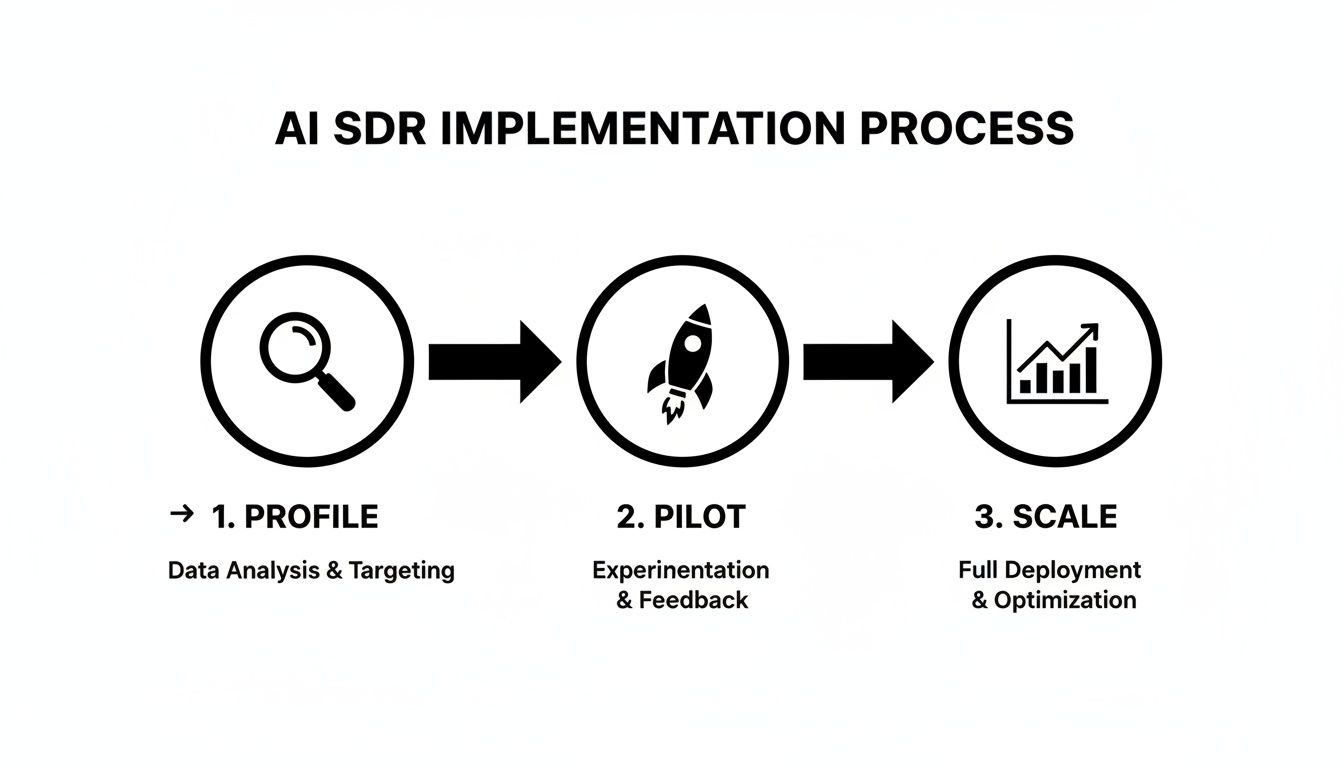
Step 1: Define Your Ideal Candidate Profile (ICP)
Before anything else, get crystal clear on who you're targeting. What skills, experiences, and titles are you looking for? The ICP is the brain of your AI—the better the input, the better the output.
Step 2: Set Up ATS Integration
Connect your AI SDR tool to your Applicant Tracking System from day one. This is non-negotiable. It ensures candidate data flows seamlessly and eliminates manual data entry.
Step 3: Create Personalized Outreach Templates
Craft a series of messages that reflect your company's voice and culture. Create different templates for different roles and seniority levels. Use dynamic variables to let the AI inject personalization.
Step 4: Pilot with One Role or Department
Don't try to boil the ocean. Start small. Pick one high-priority role and run a pilot program. This is your chance to test your messaging, refine your ICP, and prove the ROI before a wider rollout.
Step 5: Measure and Optimize
During the pilot, be obsessed with your data. Track response rates, engagement metrics, and the quality of candidates being passed to recruiters. Use this data to A/B test your messages and tweak your targeting.
Step 6: Scale Across All Hiring Needs
Once you have a proven model that's delivering results, it's time to scale. Roll out the AI SDR across other departments and roles, applying the lessons learned from your pilot program.
Personalization at Scale: The Key to Success
Let’s be honest: generic, templated outreach is dead. Top candidates can spot it from a mile away and it's an instant trip to the trash folder. The single biggest key to success with an AI SDR for recruitment is mastering personalization at scale.
So, how do you do it?
- -Go Beyond the Name: Don’t just use
[First Name]. Use AI to reference a candidate’s specific skills, a recent project on their profile, a post they shared, or their university. These small details show you’ve done your homework. - -Craft Authentic Messages: Write your templates like a human. Be conversational, respectful, and get straight to the point. Why are you reaching out to them specifically? What’s in it for them?
- -A/B Test Everything: Don't assume you know what works. Continuously test different subject lines, opening hooks, and calls to action. Let the data tell you which messages get the best responses.
- -Monitor and Iterate: Keep a close eye on your response rates. If they start to dip, it’s a sign that your messaging is getting stale or your targeting is off. Be ready to refresh your templates and refine your ICP.
Remember, the goal of AI isn't to remove the human touch; it's to automate the repetitive work so you can apply that human touch where it matters most.
Compliance & Legal Considerations
When you’re automating outreach, you have to be smart about compliance. Ignoring regulations isn't just risky—it can land you in serious trouble. Here’s what you need to keep on your radar.
- -GDPR & CCPA: Regulations like the General Data Protection Regulation (in Europe) and the California Consumer Privacy Act govern how you collect, store, and use personal data. Ensure your AI SDR tool is compliant and that you have a clear process for handling data requests.
- -LinkedIn's Terms of Service: LinkedIn has strict rules about automation. Using tools that violate their ToS can get your account restricted. Always choose a platform that operates within LinkedIn's guidelines to protect your company's presence.
- -Ethical AI Recruitment: Automation brings a responsibility to be fair and unbiased. Work to ensure your AI’s sourcing criteria don’t inadvertently discriminate against certain groups. Regularly audit your process to promote diversity and inclusion. Algorithmic bias is a real concern, and it's on you to mitigate it.
Common Mistakes to Avoid
Jumping into automated recruiting without a plan can lead to frustrating results. Based on what we've seen in the industry, here are some common mistakes to sidestep:
- Over-Automating Without Personalization: Setting up a generic "spray and pray" campaign is the fastest way to damage your employer brand.
- Ignoring the Candidate Experience: Remember there’s a person on the other end. Your automated communication should still be respectful, timely, and professional.
- Using Poor Data Quality: Garbage in, garbage out. If your initial candidate lists are outdated or inaccurate, your AI will be targeting the wrong people with the wrong information.
- Not Training Your Recruiters: Your team needs to understand how the tool works, what its role is, and how to take over the conversation from the AI seamlessly.
- Expecting Overnight Results: An AI SDR needs time to learn and be optimized. Don't expect a perfect pipeline on day one. Be patient and follow the data.
- Neglecting the Follow-up Strategy: The initial outreach is just the start. A smart, automated follow-up sequence is often where the real engagement happens.
AI SDR + Human Recruiter: The Winning Combination
The most effective recruitment teams don’t see this as AI vs. human. They see it as AI plus human. The goal is to create a powerful partnership where each plays to its strengths.
Here’s how to structure this winning combination:
- -AI SDR Responsibilities: Top-of-funnel sourcing, data enrichment, initial outreach, and automated follow-ups. The AI’s job is to identify and warm up potential candidates.
- -Human Recruiter Responsibilities: Building relationships with engaged candidates, conducting deeper qualification calls, guiding them through the interview process, and closing the offer.
This hybrid model allows the AI to handle the volume and repetition, freeing up your talented recruiters to focus on high-value, strategic work that only a human can do.
Measuring Success: KPIs to Track
How do you know if your AI SDR is actually working? You need to track the right Key Performance Indicators (KPIs). Move beyond vanity metrics and focus on what truly impacts your hiring goals.
- -Candidates Sourced Per Week: A good measure of the AI's top-of-funnel productivity.
- -Response Rate & Engagement Rate: Are candidates actually opening and replying to your messages? This tells you if your personalization is effective.
- -Time-to-Hire Reduction: The ultimate metric. Is the AI helping you fill roles faster?
- -Cost Per Hire: By automating sourcing, you should see a significant drop in your cost-per-hire.
- -Candidate Quality (Interview-to-Hire Ratio): Are the candidates sourced by the AI actually getting hired? This proves you’re targeting the right people.
- -Recruiter Satisfaction & Time Saved: Don’t forget the internal impact! Is your team happier and more productive?
Ready to stop sourcing manually and start building a pipeline of warm, qualified talent on autopilot? It's time to put an AI SDR to work for your team.
Start by mapping out your ideal candidate profile for your most critical role. Then, explore a tool that can execute your vision. This small step is the beginning of transforming your entire talent acquisition function.
Frequently Asked Questions
What's the difference between an AI SDR and an ATS?
Think of it this way: an Applicant Tracking System (ATS) is a system of record for managing candidates who have already applied or entered your pipeline. It’s primarily for organization and workflow management after initial contact. An AI SDR for recruitment, on the other hand, is a system of action. Its job is to proactively go out and find new talent, engage them, and bring them into your ATS. They are two different but complementary parts of a modern recruiting tech stack.
Can an AI SDR handle inbound candidate screening?
While an AI SDR's primary function is outbound sourcing, the underlying AI technology can certainly be applied to inbound screening. Some advanced platforms can integrate with an automated job application system to help parse resumes, score applicants against the job description, and even send automated initial screening questions. This creates a unified system for managing both outbound and inbound talent flow.
How much time does it take to set up an AI SDR campaign?
The initial setup for your first campaign will take the most time, but it’s an investment that pays off. Expect to spend a few hours defining your Ideal Candidate Profile, writing and refining your outreach templates, and configuring the ATS integration. Once you have a proven playbook, launching new campaigns for similar roles becomes much faster—often taking less than an hour. The key is to get the foundation right first.
Ready to stop sourcing manually and start building a pipeline of warm, qualified talent on autopilot? GojiberryAI identifies high-intent candidates and engages them with personalized outreach so your team can focus on what they do best: closing top talent.
Discover how GojiberryAI can transform your recruitment process.

More High-Intent Leads = Your New Growth Engine.
Start Now and Get New High Intent Leads Delivered Straight to Slack or Your Inbox.