
AI SDR vs Traditional SDR: Which Wins in 2026?

AI SDR vs Traditional SDR: The Complete Comparison for Modern Sales Leaders
AI SDRs book meetings 40% faster than traditional SDRs—but there’s a catch. 🤫 While the speed and cost savings are tempting, the real question is whether automation can truly replace the nuanced, human touch that builds lasting customer relationships. It’s a classic battle: relentless efficiency vs. genuine connection.
The role of the Sales Development Representative (SDR) is evolving faster than ever. For years, the playbook was simple: hire more people, make more calls. But in today's world, sales leaders are bombarded with promises that AI can slash costs, fill pipelines 24/7, and work without ever needing a coffee break. ☕
So, is it time to hand over the keys to the algorithms? Or is there a smarter way to play this game?
This guide is designed to cut through the noise with a data-driven, decision-oriented comparison. We're not just talking theory; we're digging into the real numbers, workflows, and scenarios you face every day. You’ll learn:
- -We The real numbers: A side-by-side cost breakdown of a human SDR vs. an AI SDR subscription.
- -Performance benchmarks: How each model stacks up on speed, volume, and lead quality.
- -The hybrid model: Why combining human talent with AI automation is often the winning strategy.
- -A clear decision framework: Actionable advice on when to choose one, the other, or both.
Ready to make a data-driven decision for your sales engine? Let's dive in.
What Is a Traditional SDR?
Before we get into the tech, let's ground ourselves in the original model. What does a traditional, human Sales Development Representative actually do, and why have they been a cornerstone of B2B sales for so long?
At its core, the traditional SDR role is about creating genuine human connections. They’re the first handshake, the first voice a prospect associates with your brand. Their mission is to turn a cold list into a warm pipeline of qualified leads who are genuinely ready to talk business with an Account Executive.
A Day in the Life of a Human SDR
Think about your best SDR. Their day is a blend of detective work, psychology, and persistence. It’s far more art than science.
Here’s a typical workflow:
- -Deep Prospect Research: They go beyond a quick LinkedIn scan. They’re reading press releases, analyzing 10-K reports, and listening to earnings calls to understand a prospect’s world—their challenges, their goals, and their recent wins.
- -Crafted, Personal Outreach: This is where great SDRs earn their stripes. They write emails that don’t sound like templates because they aren’t. They reference a recent podcast the prospect was on or a company initiative they launched, building rapport from the very first line. This is the heart of personalized sales outreach.
- -Smart, Persistent Follow-Up: There’s a fine line between persistence and annoyance. A skilled SDR walks it by adding value with every touchpoint, sharing a relevant case study or a helpful article to keep the conversation moving.
- -Dynamic Qualification Calls: This is where humans are irreplaceable. On a call, an SDR can read between the lines, navigate unexpected objections with empathy, and uncover deep-seated pain points a prospect hasn’t even articulated yet.
The Cost Structure of a Human SDR
Of course, that human expertise comes at a significant cost. And it’s not just the salary.
- -The Real Cost: A traditional SDR costs you a $40,000–$60,000/year base salary, plus commissions, benefits, and payroll taxes. But don’t forget the hidden costs: recruitment fees, software licenses (CRM, data tools, dialer), and management overhead.
- -The Ramp-Up Tax: Here’s the big one—a new SDR typically takes 3–6 months to become fully productive. That’s a quarter of a year you’re paying for training and learning, not just results.
Understanding this all-in cost is critical for any honest AI SDR vs traditional SDR comparison. Now, let’s see what the other side looks like.
What Is an AI SDR?
So, what are we really talking about when we say "AI SDR"? Forget simple chatbots or glorified email automators. A modern AI Sales Development Representative is an autonomous system designed to run your top-of-funnel prospecting 24/7.
Think of it as a dedicated engine for the most repetitive, time-consuming parts of the SDR job, operating at a speed and scale that is simply not humanly possible. It’s not just working through a list; it’s actively scanning the market for buying signals and pouncing on opportunities the moment they arise.
Capabilities and the Technology Stack
The goal of an AI SDR is to automate the prospecting workflow from initial research to a booked meeting, all without human intervention. This is a game-changer for sales team productivity.
Here's how it works:
- -Automated Research & Data Enrichment: An AI SDR can analyze thousands of data points in seconds to identify companies that fit your Ideal Customer Profile (ICP). It tracks real-time buying signals like new executive hires, recent funding rounds, or new tech adoption.
- -Personalization at Scale: Using generative AI, it drafts and sends thousands of unique emails that reference those specific buying signals. Each message feels relevant because it is relevant.
- -Relentless, Multi-Channel Follow-Up: An AI never forgets to follow up. It executes complex outreach sequences across email and social channels flawlessly, ensuring no lead falls through the cracks.
- -Intelligent Qualification & Booking: Once a prospect shows interest, the AI can ask qualifying questions and, if the criteria are met, book a meeting directly on an Account Executive's calendar.
The Cost Structure of an AI SDR
One of the biggest draws is the straightforward cost model. Instead of the complex math of hiring a person, AI SDRs operate on a predictable SaaS pricing model.
- -SaaS Pricing: Typically, you’ll see costs ranging from $500 to $2,000 per month per tool or seat.
- -Tooling Ecosystem: This subscription often covers the entire tech stack needed for prospecting—data enrichment, sending infrastructure, and the AI itself. This consolidates costs and simplifies your sales tech stack.
This model makes it incredibly easy to forecast your budget and scale your outreach efforts up or down as needed. You’re not just buying a tool; you’re subscribing to an outcome: a consistent stream of qualified meetings.
Head-to-Head Comparison: AI SDR vs Traditional SDR
Alright, let's get down to the brass tacks. When sales leaders evaluate these two models, they’re really asking: which one will build more pipeline, faster, and for less money? It's the bottom-line question.
To answer it, we'll compare them across four critical areas: Speed & Volume, Cost, Quality, and Scalability.
Table 1: Speed & Volume
| Metric | AI SDR | Traditional SDR |
|---|---|---|
| Response Time | 2–4 hours (or instant) | 24–48 hours |
| Daily Contacts | 500–1,000+ | 50–100 |
| Qualification Speed | Automated, in seconds | Manual, requires calls |
| Follow-ups | 100% consistent | ~70% consistent |
Table 2: Cost Analysis
| Metric | AI SDR | Traditional SDR |
|---|---|---|
| Cost Model | $500–$2,000/mo SaaS | $40k–$60k/yr salary + benefits |
| Cost Per Lead | Lower, due to volume | Higher, due to manual effort |
| ROI Timeline | Weeks to months | 6–9 months (incl. ramp time) |
| Hidden Costs | Integration, setup fees | Recruitment, training, software |
Table 3: Quality Metrics
| Metric | AI SDR | Traditional SDR |
|---|---|---|
| Personalization | Template-based at scale | Deep, 1:1 customization |
| Relationship Building | Initiates conversations | Builds deep rapport |
| Context Awareness | Based on data triggers | Based on emotional intelligence |
| Accuracy | High (data-driven) | Variable (human error) |
Table 4: Scalability & Flexibility
| Metric | AI SDR | Traditional SDR |
|---|---|---|
| Scaling Capacity | Scales instantly | Scales with hiring (slow) |
| Adaptability | Learns from data patterns | Learns from coaching & experience |
| Learning Curve | Minimal for the user | 3–6 month ramp-up |
| Coverage | 24/7 global reach | Limited by time zones |
These tables paint a clear picture. The AI SDR is an efficiency machine, built for volume and speed. The traditional SDR is a specialist, built for depth and nuance. The choice isn't about which is "better" overall, but which is better for a specific task.
Speed: How Fast Can Each Close Deals?
In sales, speed is everything. A lead that’s engaged within the first 5 minutes is 9x more likely to convert. So, how do our two contenders stack up?
AI SDR: 2–4 Hours Average Response Time (or Instant)
An AI SDR can respond to an inbound inquiry or a buying signal (like a website visit) instantly, 24/7. This immediate engagement is a massive competitive advantage. When a prospect is hot, you can’t afford to wait.
Traditional SDR: 24–48 Hours Average Response Time
A human SDR has meetings, lunch breaks, and a life outside of work. It’s normal for responses to take a day or two, especially with high lead volume. But by then, that hot lead may have already spoken to three of your competitors.
The impact on conversion rates is staggering. Studies consistently show that response time is one of the single biggest factors in lead qualification. Faster response = more meetings booked. It’s that simple.
Cost Analysis: AI SDR vs Traditional SDR
Let’s talk money. 💰 This is often the driving factor for teams considering AI.
AI SDR: $500–$2,000/month per tool
The cost is a predictable, scalable operating expense. For the price of a fraction of one SDR's salary, you get an engine that can do the work of 5-10 humans.
Traditional SDR: $40,000–$60,000/year salary + benefits
The total cost of an SDR (or a human SDR) is closer to $75,000–$100,000 per year when you factor in benefits, taxes, software, and management.
Cost Per Lead Generated & ROI
Because of its massive volume, an AI SDR can generate leads at a significantly lower cost per lead. The ROI is also much faster. A human SDR takes 3-6 months just to ramp up, meaning you won’t see a return on your investment for over half a year. An AI SDR can start booking meetings in the first week. The efficiency gains are a clear example of business process automation benefits.
Quality: Personalization & Relationship Building
Cost and speed are great, but what about the quality of the interaction? Can an algorithm build the trust needed to close a big deal?
AI SDR: Template-Based Personalization at Scale
An AI SDR excels at data-driven personalization. It can reference a new funding round, a recent job change, or a technology the prospect uses. It’s highly relevant but lacks true empathy. It starts conversations effectively but can't navigate complex human emotions.
Traditional SDR: Deep Relationship Building and Context Awareness
This is where humans shine. A great SDR can connect with a prospect on a personal level, share an anecdote, read their tone of voice, and build genuine rapport. This is critical for high-touch, strategic accounts where trust is the most important currency.
While AI-generated leads are qualified based on data, human-qualified leads are often vetted for nuance and strategic fit. This can sometimes lead to higher downstream conversion rates, especially in complex B2B sales cycles.
The Hybrid Approach: AI + Human SDRs
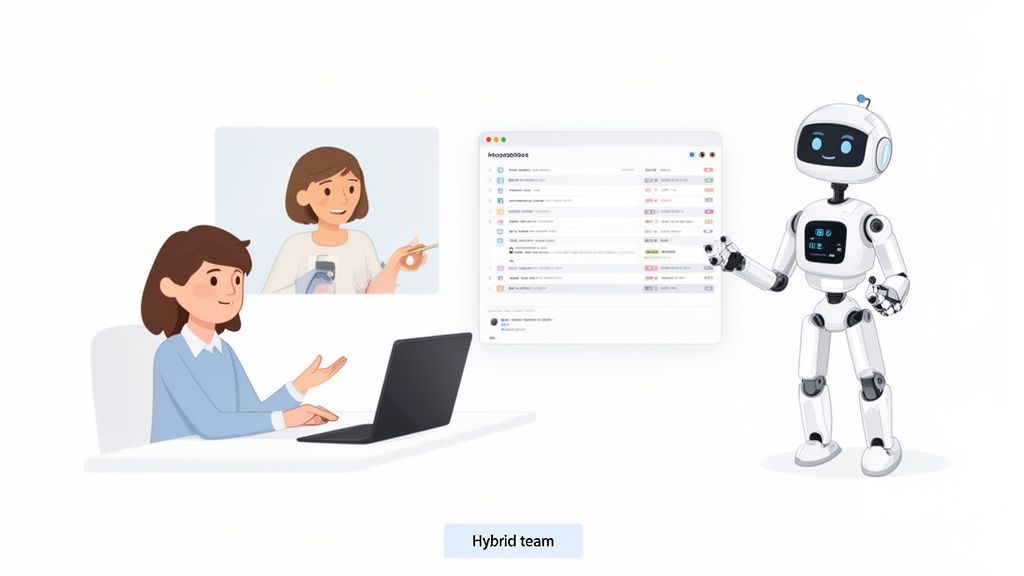
After looking at the data, it becomes clear that the "AI SDR vs traditional SDR" debate is asking the wrong question. The smartest sales leaders aren't choosing one over the other. They’re combining them to create a revenue machine that’s greater than the sum of its parts.
This is the hybrid model: using AI for what it does best (scale, speed, data) and humans for what they do best (empathy, strategy, relationship-building).
A Clear Division of Responsibilities
A successful hybrid team works like a well-oiled assembly line.
- -AI SDR's Role (The Qualifier): The AI handles the entire top of the funnel. It sifts through thousands of prospects, engages them with personalized outreach, and books the initial meeting. Its only job is to get a qualified, interested prospect on the calendar.
- -Human SDR's Role (The Strategist): Once the meeting is booked, the human SDR takes over. They step into a warm conversation with a prospect who has already shown intent. All their time is spent on high-value activities: building rapport, understanding complex needs, navigating buying committees, and teeing up a perfectly qualified opportunity for an Account Executive.
Real-World Success Story
A B2B SaaS company I know was struggling to scale. Their small SDR team was great at closing enterprise deals but couldn't possibly cover their entire addressable market. Thousands of smaller accounts were being ignored.
By implementing a hybrid model:
- They deployed an AI SDR to engage their entire mid-market and SMB segments—over 15,000 accounts.
- The AI started booking meetings with qualified leads the human team would have never had time to find.
- This freed up the human SDRs to focus exclusively on their top 100 strategic accounts.
The result? They increased their pipeline by 60% in six months without hiring a single new person. The AI didn't replace the team; it became their ultimate force multiplier.
When to Choose an AI SDR
An AI SDR is your go-to when speed, volume, and efficiency are your top priorities.
✅ Go with an AI SDR if:
- -You have high-volume outreach needs and a large total addressable market.
- -You're working with budget constraints and need to maximize every dollar.
- -You require 24/7 lead engagement to capture interest across time zones.
- -You have rapid scaling objectives and can't wait months to hire and train a team.
When to Choose a Traditional SDR
A human SDR is indispensable when nuance, trust, and strategic relationships drive your sales.
✅ Go with a Traditional SDR if:
- -You're navigating complex B2B sales cycles with multiple stakeholders.
- -You're selling high-ticket items to strategic, high-touch accounts.
- -Your product requires deep industry expertise to establish credibility.
- -You have long sales cycles where building long-term trust is paramount.
Common Misconceptions
Let's bust some myths that cloud the "AI vs human sales" conversation.
- -“AI SDRs will replace human SDRs.” False. AI SDRs are replacing tasks, not people. They automate the repetitive parts of the job, elevating the human SDR role to be more strategic.
- -“AI SDRs can’t build relationships.” Partially true. They can't build deep, empathetic relationships. But they are excellent at initiating them by delivering the right message to the right person at the right time.
- -“Traditional SDRs are always better.” False. For high-volume, transactional sales, a human SDR can be slower, more expensive, and less consistent than an AI SDR.
- -“You have to choose one or the other.” This is the biggest misconception. The most effective strategy for most companies is a hybrid approach that leverages the strengths of both.
Implementation Roadmap
Ready to get started? Don't just flip a switch. A methodical, step-by-step approach will ensure you get real value.
Step 1: Assess Your Needs and Constraints
Before you do anything, audit your current process. Where are the bottlenecks? Are your SDRs spending too much time on research? Are leads falling through the cracks? Identify the specific problem you want SDR automation to solve.
Step 2: Pilot an AI SDR
Don’t go all-in at once. Start with a focused pilot program. Pick a specific segment of your market (e.g., one industry vertical or territory) and let the AI SDR work it for 30-60 days.
Step 3: Measure, Compare, and Optimize
Track everything. Compare the AI's performance against your human team's benchmarks on key metrics:
- -Cost per meeting booked
- -Lead-to-opportunity conversion rate
- -Sales cycle length
Use this data to see what’s working and where you need to adjust your messaging or targeting. Using solid lead scoring best practices is crucial here.
Step 4: Scale, Hybridize, or Adjust Strategy
With real data in hand, you can make an informed decision. If the pilot was a success, it's time to scale up. You might expand the AI's scope or, more likely, design a hybrid model where the AI hands off qualified meetings to your human team.
Make Your Next Move the Smart One
The debate isn't really "AI SDR vs Traditional SDR." It's about building a smarter, more efficient sales engine.
- -AI SDRs deliver unmatched speed, scale, and cost-efficiency. They are the perfect tool for high-volume, top-of-funnel prospecting.
- -Human SDRs provide the irreplaceable nuance, strategy, and relationship-building needed for complex, high-value deals.
The winning move for most modern sales organizations is the hybrid approach—using AI to automate the grind and freeing up your human talent to focus on what they do best: building relationships and closing deals.
Stop choosing between them. Start combining them. Explore some of the best AI tools for sales to see what's possible.
Ready to see how an AI copilot can fill your pipeline on autopilot? Book a demo with GojiberryAI today and let's build your hybrid sales engine.
FAQ: Your AI SDR Questions Answered
Can an AI SDR actually sound human and handle complex conversations?
AI has gotten incredibly good at sounding natural for initial outreach. Based on user feedback, modern AI sales agents can handle initial objections (like "not interested right now") and answer basic qualifying questions. However, they are not designed for deep, consultative conversations. Once a prospect asks complex, multi-part questions or wants to discuss strategy, the best practice is to have the AI seamlessly hand off the conversation to a human.
What's the biggest risk of implementing an AI SDR?
The biggest risk reported by marketers is poor targeting and messaging. If you feed an AI SDR a poorly defined Ideal Customer Profile (ICP) or generic email templates, you're not automating sales development—you're automating spam at scale. This can damage your brand's reputation. Success requires a tight ICP, compelling value propositions, and continuous monitoring of the AI's performance to ensure it aligns with your brand voice.
How do you keep the sales team motivated when introducing AI automation?
This is a change management challenge. The key is to frame the AI SDR not as a replacement, but as a "copilot" or "assistant." Show your human SDRs how the AI will eliminate the most tedious parts of their job (manual research, cold outreach, follow-ups) so they can focus on the most rewarding and lucrative part: talking to interested buyers and closing deals. Many sales leaders find that this hybrid approach actually boosts morale and reduces burnout.

More High-Intent Leads = Your New Growth Engine.
Start Now and Get New High Intent Leads Delivered Straight to Slack or Your Inbox.