
AI SDR Agents: The Future of Autonomous Sales Development in 2026

Tired of sales tools that feel like they need constant babysitting? Let's talk about what's next for sales development, because it’s a big leap forward. AI SDR agents aren’t just another piece of automation software. Think of them as autonomous team members built from the ground up to run your top-of-funnel activities, all with surprisingly little human hand-holding. They can prospect, personalize outreach, and qualify leads on their own, and that’s changing the sales game entirely.
If you've ever managed an SDR team, you know the routine all too well. It’s a grind of setting up rigid workflows, writing email sequences that quickly go stale, and constantly tweaking campaigns. Your tools follow the rules you set, but they can't actually think. The moment a prospect asks an unexpected question or a new lead source pops up, everything stops, waiting for you to jump in and fix it. That kind of manual oversight is a massive time sink. 😩
This is exactly the problem AI SDR agents are built to solve. They don't just follow a script; they operate with genuine autonomy. They can think, adapt, and learn from their interactions. So what's the big deal? In this guide, you'll learn:
- -How AI SDR agents actually work (no jargon, I promise).
- -The key capabilities that set them apart from traditional tools.
- -A practical roadmap for implementing them in your own team.
- -A look at the future and where this tech is headed.
The bottom line? These agents aren't just sending emails; they're managing entire sales workflows from end to end. Ready to see how? Let's dive in.
What Are AI SDR Agents?
So, what's the difference between an AI SDR agent and an automation tool? It’s a game-changing distinction.
Traditional SDR automation is like a robot on an assembly line. It does one task over and over, perfectly. But if a part is out of place, the whole line shuts down. An AI SDR agent, on the other hand, is more like the floor manager. It doesn't just see the problem—it can figure out a new workflow on the fly and keep things moving, all without waiting for instructions.
An agent doesn't just execute commands; it makes intelligent decisions. It operates with three core capabilities: it can decide the best course of action, act on that decision, and adapt its strategy based on the outcome. This is possible because of sophisticated learning mechanisms. Through constant feedback loops, they analyze what's working (and what's not), getting progressively smarter with every interaction. For a deeper dive into this, check out our guide on how to train your agent. This distinction is what unlocks true autonomy and is already driving huge wins for B2B sales teams.
How AI SDR Agents Work
So, what's really going on under the hood? An AI SDR agent is a whole lot more than just a clever script. It's a complex system built to replicate the thought process of your best sales rep. Let's pull back the curtain on how these agents work, without the dense technical talk.
The real power of an AI agent is its ability to sense what’s happening, make a judgment call, and then act on it to hit a goal. Think of it less like a calculator spitting out answers and more like a chess grandmaster seeing the whole board, thinking several moves ahead, and adapting on the fly.
This journey from simple sales tasks to the smart, independent agents we have today has been a big one.
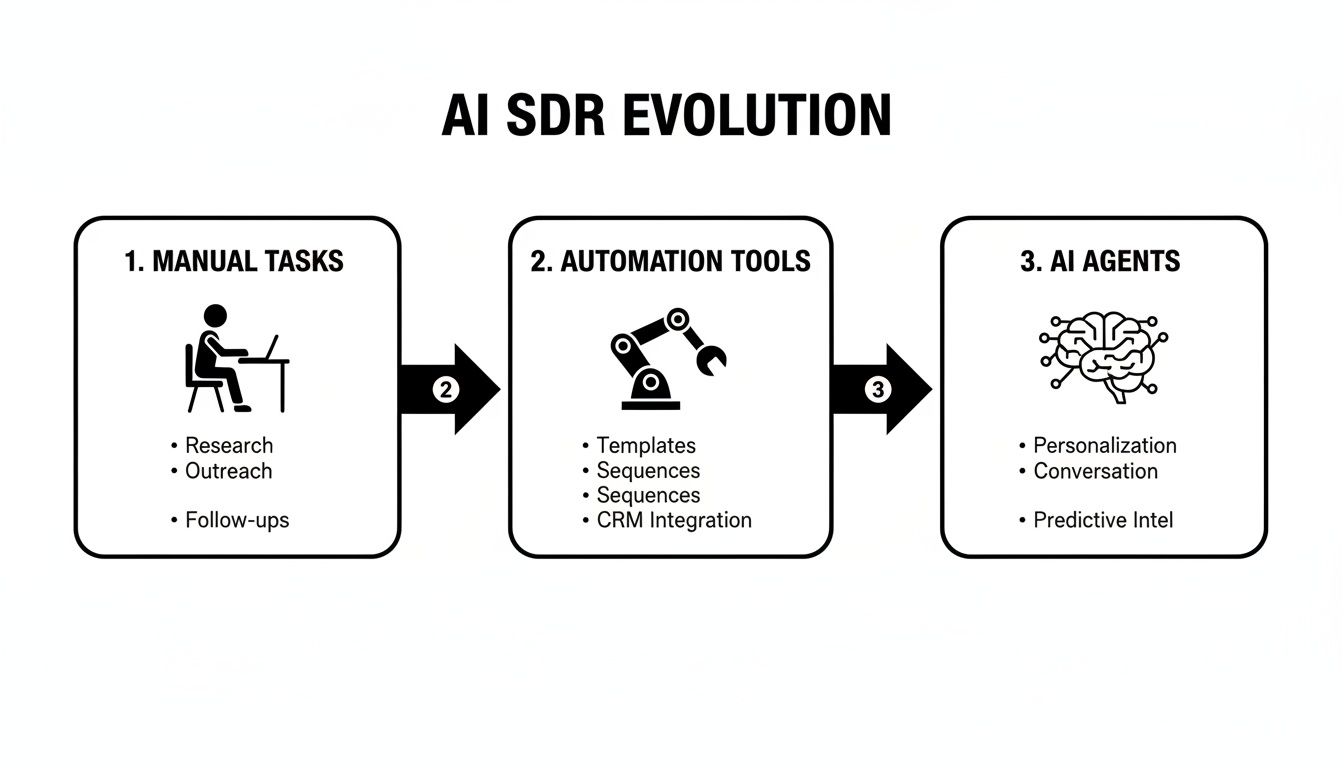
As you can see, the game-changing leap is from rigid, pre-programmed automation to intelligent, autonomous action. That’s the true mark of an "agent."
Autonomous Decision-Making
The "brain" of an AI SDR is its reasoning engine. We're not talking about basic "if this, then that" rules here. Instead, it uses context to figure out what a prospect actually means—their intent, their sentiment, and their specific needs.
For example, if a prospect mentions a competitor, the agent doesn't just flag a keyword. It grasps the competitive landscape and can tweak its response to be more effective. This is what allows the agent to make smart decisions on its own. Should it follow up right away, or wait until the prospect clicks on a case study? The agent weighs all these factors to pick the best next step, just like a seasoned pro would. Mastering this requires deep learning, a core part of effective AI agent training.
Multi-Step Workflows
Where these agents really come into their own is managing complex, multi-step campaigns completely by themselves. They don't just fire off a single email and call it a day; they orchestrate the entire prospecting sequence from beginning to end.
A typical workflow might look something like this:
- -Prospecting: The agent scans different data sources to pinpoint high-intent leads.
- -Outreach: It then writes and sends a hyper-personalized message based on that lead's specific profile and activity.
- -Qualification: It reads the replies, asks smart follow-up questions, and figures out if the lead is a good fit.
- -Handoff: Once a lead is qualified, the agent books a meeting on the sales rep's calendar and neatly syncs all the conversation history into your CRM.
This full-cycle management is what modern AI SDR software is built to do.
Learning & Optimization
AI SDR agents are built to get smarter with every interaction. They run on a constant feedback loop, analyzing what works and what doesn't. Which subject lines are getting opened? What kind of messaging is actually getting replies? The agent uses this data to constantly A/B test its own strategies, automatically tweaking its approach for better results. This learning mechanism turns every outreach campaign into a live experiment that drives constant improvement and a higher LinkedIn automation ROI.
Integration & Orchestration
An AI SDR agent doesn't work in a silo. It acts as the central orchestrator of your top-of-funnel tech stack. By integrating seamlessly with your CRM (like Salesforce or HubSpot), it ensures all data is synced in real-time. It can manage outreach across multiple channels—email, LinkedIn, etc.—and trigger other workflow automations, making it a powerful hub for your growth hacking efforts.
Key Capabilities of AI SDR Agents
So, what's all the fuss about? What makes an AI SDR agent so different from the automation tools we've been using for years? It’s not just about speed; it's about introducing a level of intelligence that simply wasn't possible before. Let's break down the core abilities that set these autonomous agents apart. 🦸
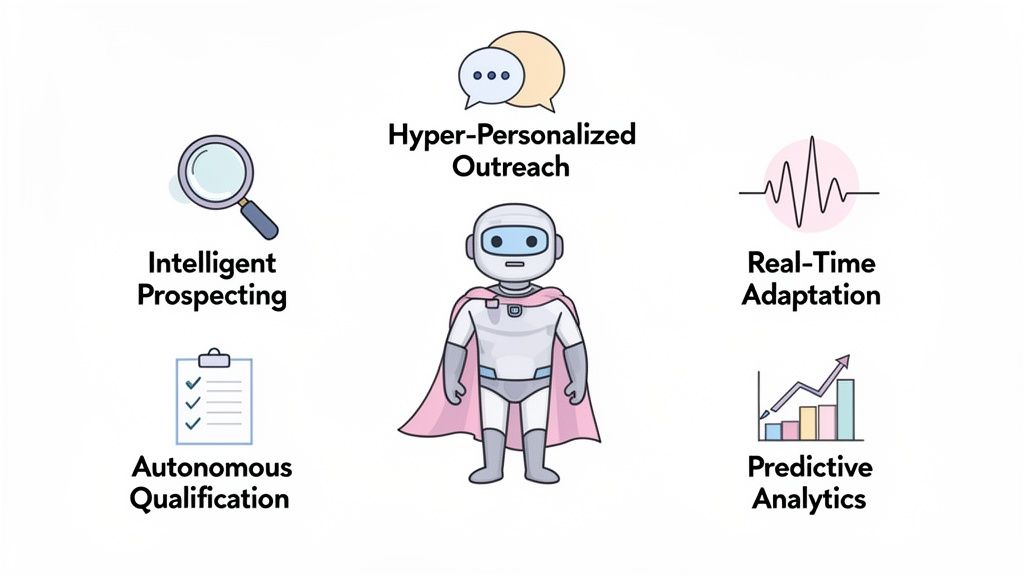
These aren’t just bullet points on a feature list. They represent a completely new way of thinking about prospecting—moving from manual, often frustrating guesswork to a smart, data-backed process.
Intelligent Prospecting
Forget about spending your days scrolling through LinkedIn or wasting money on stale contact lists. AI SDR agents act like your personal market intelligence analyst, working around the clock to find prospects showing real buying intent. They go way beyond basic company size and industry filters, looking for real-time triggers like job changes, funding news, or tech stack shake-ups. Some of the most advanced AI SDR tools report accuracy rates above 95% in identifying high-fit leads based on behavioral analysis.
Personalized Outreach
We’ve all gotten those lazy, "Hi [First Name]" emails that we instantly trash. AI SDR agents are designed to make that kind of outreach extinct by crafting a unique message for every single person. They scan a prospect's LinkedIn profile, recent press releases, and online activity to write an email or message that feels authentic and relevant. The agent can even adjust its tone of voice and support multiple languages, making it a powerful tool for global teams. This dynamic message generation is a must for following LinkedIn automation best practices.
Real-Time Adaptation
Here’s where AI agents really pull away from the old-school automation tools. When a prospect writes back, the agent doesn't just shut down or forward the email. It reads it, understands the context, and decides what to do next. It can analyze the sentiment of a reply and handle common objections, answer questions, or find a time to meet—all without a human stepping in. This conversation understanding and strategy adjustment is a key part of modern growth hacking.
Autonomous Lead Qualification
Let's be honest: not every lead is a good one. AI SDR agents serve as your first line of defense, using your ideal customer profile to vet prospects before they ever get to your sales team. The agent can ask critical qualifying questions about budget, team size, and decision-making authority, then make a judgment call: nurture them, disqualify them, or book them directly with the right Account Executive. This automated routing is a core feature of leading AI SDR software.
Predictive Analytics
Finally, AI SDR agents give you a much clearer, forward-looking view of your pipeline. By analyzing every interaction and outcome, they can start to offer surprisingly accurate forecasts. They can help predict meeting booking rates, show you which messaging angles are landing best, and even score leads based on their probability to close. This kind of data-driven insight helps sales leaders stop guessing and start building a more predictable revenue engine with a clear LinkedIn automation ROI.
AI SDR Agents vs. Traditional Tools
So, is an "AI SDR agent" just a slick new name for the sales automation tools we've been using for years? Not even close. We're talking about a fundamental shift from a tool that follows instructions to a system that actually thinks. 🧠
Let's break it down. Traditional sales automation is like a well-programmed robot on an assembly line. It does its one job—like sending a sequence of emails—over and over again, very efficiently. But if something unexpected happens, it just stops. It can't adapt. An AI SDR agent, on the other hand, is more like the factory floor manager. The difference isn't a minor upgrade; it's a whole new way of doing sales development.
Autonomy Level
The biggest difference comes down to autonomy. Traditional tools are completely rule-based. You set up rigid "if-then" commands. The tool executes that command perfectly, but it's stuck inside the box you built for it. AI SDR agents, however, are built for autonomous decision-making. They don't just follow a script. They analyze the context of every interaction and decide the best next move on their own.
| Capability | Traditional SDR Tools | AI SDR Agents |
|---|---|---|
| Decision-Making | Follows pre-set rules | Makes autonomous decisions |
| Oversight Required | High | Low |
For more on this, explore what makes a true AI SDR software platform.
Learning Capability
Traditional automation is static. The email sequence you wrote in January is the exact same one it will send in July unless you manually change it. It has zero ability to learn. AI SDR agents operate on a principle of continuous learning. They constantly analyze reply sentiment, open rates, and meeting conversions to get progressively smarter and more effective over time. This is why it's so critical to train your agent with good data from the start.
Scalability
Scaling up with traditional tools is a linear game. If you want to double your outreach, you usually have to double your software licenses and the people managing those workflows. AI SDR agents offer a completely different path. A single agent can manage thousands of conversations and orchestrate complex workflows simultaneously, letting you scale your outreach exponentially without a linear increase in headcount. This is a game-changer for growth hacking.
Cost Efficiency
With traditional tools, much of the cost is hidden in management overhead. Sales leaders spend countless hours building, tweaking, and monitoring rigid campaigns. Agents, on the other hand, require minimal oversight once they're trained. This lean model completely changes the ROI calculation. They don't just save time; they create new value by executing entire functions autonomously, leading to a much stronger LinkedIn automation ROI.
Use Cases for AI SDR Agents
So where can AI SDR agents make the biggest impact? 🤔 Their ability to work 24/7 with precision and scale opens up some powerful use cases that were nearly impossible to execute well with human teams alone. Here are a few common scenarios where these agents are absolute game-changers.
Enterprise Sales
- -The Challenge: Enterprise sales cycles are long and complex, requiring deep research and highly personalized outreach to multiple stakeholders within a target account. SDRs often spend more time researching than selling.
- -The Agent Solution: An AI SDR agent can be tasked with mapping out an entire enterprise account, identifying key decision-makers, and monitoring the company for buying signals (like new initiatives or executive hires).
- -Implementation: The agent runs a multi-touch, multi-stakeholder outreach campaign, personalizing messages for each person based on their role and recent activity.
- -Expected Results: A steady stream of qualified meetings with the right people at target accounts, freeing up your Enterprise AEs to focus on strategic relationship-building. This approach is a core function of modern AI SDR software.
High-Volume Prospecting
- -The Challenge: SMB or mid-market sales teams need to contact thousands of potential customers to hit their numbers, but generic, blast-and-pray emails get ignored.
- -The Agent Solution: An AI agent can manage outreach to tens of thousands of leads simultaneously while still personalizing each message at a one-to-one level.
- -Implementation: The agent is fed a large list of leads, enriches the data, and runs a high-volume campaign, automatically handling replies and booking meetings with interested prospects.
- -Expected Results: A dramatic increase in booked meetings and pipeline without having to hire a massive SDR team. This is a classic growth hacking play.
Multi-Market Expansion
- -The Challenge: Breaking into a new country or region is tough. You lack local market knowledge, face language barriers, and need to test the waters without a huge upfront investment in a local team.
- -The Agent Solution: A multi-lingual AI SDR agent can be deployed to test a new market quickly and cost-effectively.
- -Implementation: The agent is trained on the new market's ICP and messaging nuances. It can conduct outreach in the local language, gathering real-world data on what resonates.
- -Expected Results: You can validate product-market fit in a new territory in weeks, not months, and gather the intelligence needed to build a full go-to-market strategy. This is a powerful tactic for growth hacking SaaS businesses.
24/7 Lead Nurturing
- -The Challenge: A prospect downloads a whitepaper or attends a webinar, shows interest... and then goes cold. Your SDRs are too busy chasing new leads to follow up consistently.
- -The Agent Solution: An AI agent acts as a tireless nurturer, keeping your brand top-of-mind with every lead that isn't immediately sales-ready.
- -Implementation: The agent is connected to your marketing automation system. When a new lead comes in, the agent follows up with helpful content, checks in periodically, and monitors for re-engagement signals.
- -Expected Results: You stop losing warm leads through the cracks. The agent re-engages dormant leads and hands them back to sales the moment they show buying intent, which is one of the LinkedIn automation best practices.
Top AI SDR Agent Platforms
So, where do you even start looking for an AI SDR agent? The market is flooded with platforms that slap an "AI" label on their marketing, but there's a world of difference between a tool with a few smart features and a truly autonomous agent.
Let's cut through the noise. Here's a look at the platforms pioneering autonomous sales development and how they compare to popular tools that offer powerful automation but still need a human in the driver's seat. The goal is to give you a clear map so you can pick the right tech for your team.
gojiberry.ai ⭐ (Featured)
- -Overview: Gojiberry.ai has carved out a name for itself as a true autonomous agent platform. It’s built from the ground up for B2B teams that need a steady flow of high-quality pipeline without the endless manual prospecting.
- -Agent Capabilities: The Gojiberry.ai agent constantly scans the web for high-intent signals—like key job changes, fresh funding announcements, or a prospect engaging with a competitor. The agent then takes these signals, automatically vets the leads against your Ideal Customer Profile (ICP), enriches them with verified data, and can kick off personalized outreach.
- -Autonomous Features: The autonomy is what sets it apart. You don’t feed it a list of who to find; you tell it what kind of company you want to talk to. From there, the agent independently sources, qualifies, and preps those leads.
- -Pricing: Custom pricing based on pipeline goals.
- -Best For: Founders, scale-ups, and any B2B sales team looking for a lean, efficient way to generate high-intent pipeline on autopilot.
- -Pros & Cons: Users report that its ability to uncover "hidden gem" leads is a major pro. The main con is that it's designed for full autonomy, so teams looking for a tool to simply assist their human SDRs might find it too hands-off.
- -Integrations: Plugs right into common CRMs and sales engagement platforms.
- -Learning Mechanisms: Its built-in learning mechanism gets smarter over time, refining its understanding of your ICP based on which leads actually convert.
- -User Rating: Consistently high marks for the quality of leads it finds. Gojiberry.ai is a leading AI SDR software for teams serious about autonomy.
Outreach.io
- -Overview: Outreach is a titan in the sales engagement space, known for its incredibly robust sequencing and workflow automation.
- -"Agent-Like" Capabilities: Outreach uses AI to help reps write more effective emails, suggests the best times to send them, and even analyzes the sentiment in a prospect's reply. Its "Kaia" virtual assistant transcribes calls and pulls out key insights.
- -Limitations: At its core, Outreach is a human-driven platform. It automates tasks based on the rules you set but won’t make independent strategic decisions. An SDR is always steering the ship. It's one of the top AI SDR tools for empowering reps, not replacing manual prospecting.
Lemlist
- -Overview: Lemlist made its name with highly creative and personalized email campaigns, especially its unique ability to drop dynamic, personalized images and videos into an email.
- -"Agent-Like" Capabilities: Lemlist’s AI can help you draft entire email sequences from scratch, generate clever icebreakers based on a prospect's LinkedIn profile, and adopt different tones of voice.
- -Limitations: Lemlist is a master at automating the content of your outreach, but it doesn't automate the strategy. A human still needs to define the audience and build the campaign logic.
Apollo.io
- -Overview: Apollo.io has become a go-to for many sales teams because it combines a massive B2B database with lead sourcing and outreach tools all in one place.
- -"Agent-Like" Capabilities: Apollo's AI shines in lead scoring, helping you pinpoint which prospects in a list are most likely to engage. Its AI writing assistant is handy for crafting quick messages.
- -Limitations: Much like the others, Apollo is a powerful assistant that executes a human's strategy. Its automation is fantastic for high-volume prospecting, but it still relies on you to build the lists and manage the playbook. Check out other AI SDR tools to compare.
Hunter.io
- -Overview: Hunter.io is famous for its email finder and has evolved into a simple but effective cold outreach platform.
- -"Agent-Like" Capabilities: Hunter’s main use of AI is in data verification and enrichment. You can set up automated email sequences, but it’s more of a direct automation tool than an intelligent agent.
- -Limitations: Hunter was built to find and verify emails, then send simple follow-ups. It doesn’t have the complex decision-making or learning abilities that define a true AI SDR agent.
Implementing AI SDR Agents
So, you're ready to bring an AI agent onto your sales team? Great. Let’s walk through the practical, step-by-step playbook for making it a success. This isn't about flipping a switch and hoping for the best; it's a strategic process designed to nail the launch from day one.
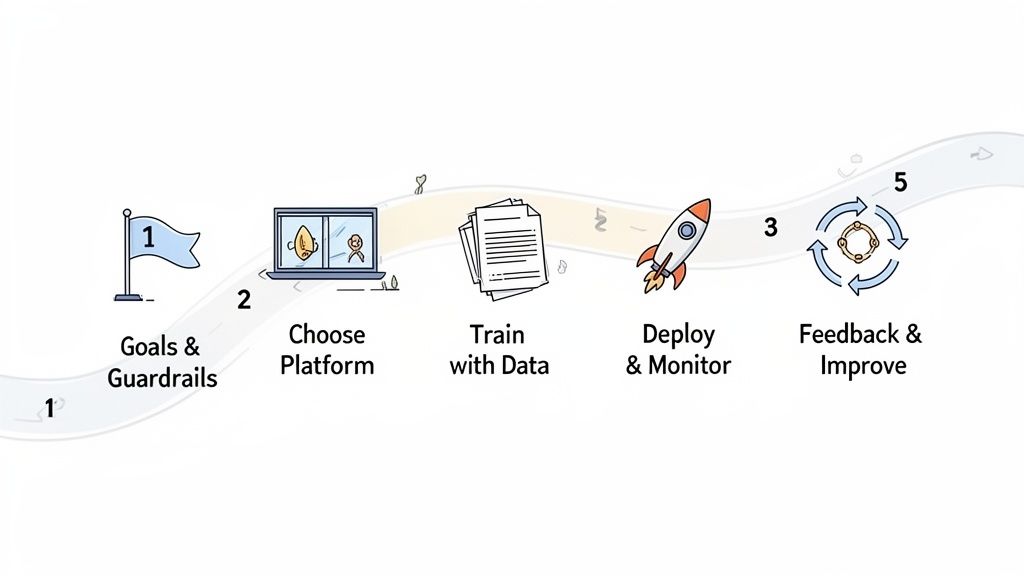
Step 1: Define Agent Goals
First things first: what, exactly, do you want this agent to accomplish? "Book more meetings" isn't specific enough. A well-defined mission gives your agent a North Star. This is also where you establish the guardrails—defining the tone of voice and brand guidelines to make sure the agent acts as a true extension of your team. This is a crucial first step for any growth hacking initiative.
Step 2: Choose Your Agent Platform
Not all platforms are built the same. As we've covered, some tools offer "agent-like" features, while others provide genuine, hands-off autonomy. The platform you choose should align directly with your goals. Look for an AI SDR software platform that matches your ambition, integrates with your current tech stack, and offers solid implementation support.
Step 3: Train Your Agent
This is the most critical step of all. Think of it like onboarding a new human team member. You have to give it the context it needs to succeed by feeding it high-quality data: your ICP, successful messaging, and objection handling tactics. The better the data you provide, the faster your agent learns. To really master this, our deep dive on how to train your agent is a must-read.
Step 4: Deploy & Monitor
Once your agent is trained, it's time to set it loose. But don't just "set it and forget it." Start with a smaller, lower-stakes segment of your database. For the first few weeks, it's a good idea to read every message it sends to spot any quirks and build trust in the system. As you gain confidence, you can transition to spot-checking. Having a solid LinkedIn automation ROI framework is key here to track performance.
Step 5: Continuous Improvement
Implementation isn't a one-and-done event; it's a continuous cycle of improvement. The data your agent generates is a goldmine. Regularly review what’s working and what isn’t, then use those insights to refine its strategies. This feedback loop is how you turn a good agent into a world-class prospecting machine and maximize your growth hacking potential.
AI SDR Agent Best Practices
Deploying an AI SDR agent is more than just a technical setup; it’s a strategic shift. To make it a success, you need a smart playbook. Here are some clear do's and don'ts to guide you.
Setting Clear Objectives
- -Do: Define specific success criteria from the start. What does a "qualified meeting" look like? What's your target cost per meeting?
- -Don't: Give the agent a vague goal like "get more leads." This leads to low-quality results and makes it impossible to measure ROI.
- -Pro Tip: Set up compliance guardrails to ensure the agent's outreach always aligns with industry regulations and follows your company's LinkedIn automation best practices.
Maintaining Human Oversight
- -Do: Establish a regular review process, especially in the first 90 days. Have a human spot-check messages and monitor conversations.
- -Don't: "Set it and forget it" from day one. Trust is built over time by verifying the agent's performance.
- -Pro Tip: Create an exception handling workflow. If the agent encounters a truly unique or sensitive query, it should know to flag it for a human teammate. This is a smart growth hacking principle: automate the predictable, escalate the exceptional.
Data Quality & Privacy
- -Do: Start with the cleanest, highest-quality data you have. The agent's learning is only as good as the data it's trained on.
- -Don't: Feed it an old, unverified list and expect magic. Garbage in, garbage out.
- -Pro Tip: Ensure your platform and processes are fully compliant with GDPR, CCPA, and other privacy regulations. Data security isn't just a feature; it's a necessity. This is another key part of safe LinkedIn automation best practices.
Continuous Learning
- -Do: Treat your agent like a member of the team. Regularly feed it new insights from closed deals and customer feedback.
- -Don't: Assume the initial training is enough. Markets change, and your agent needs to evolve with them.
- -Pro Tip: Use the agent's performance data to refine your overall sales strategy. The insights it uncovers can be incredibly valuable. Effective AI agent training is an ongoing process.
The Future of AI SDR Agents
This isn't just a passing trend; it's the beginning of a major shift in how sales teams operate. So, what’s next on the horizon for AI SDR agents? Let's look at the near future. 🔮
Emerging Capabilities
We're already seeing agents move beyond simple text-based interactions. The next wave will feature advanced reasoning that allows agents to understand complex business problems and propose nuanced solutions. We'll also see more sophisticated intent detection—agents that can sense a prospect's emotional state or level of urgency from the language they use. This continuous evolution is why ongoing AI agent training is so critical.
Market Trends
As the technology matures, we can expect three major trends:
- -Increased Adoption: What is now a competitive advantage will soon become table stakes for high-growth companies.
- -Improved Accuracy: The models powering these agents will become even better at identifying high-intent leads and personalizing outreach.
- -Decreased Costs: Like all technology, the cost to deploy a powerful AI agent will continue to fall, making it accessible to even more businesses. This democratization of AI is a massive opportunity for growth hacking.
Predictions for 2025–2026
By 2026, we'll likely see the rise of fully autonomous sales teams, where a small group of human strategists oversees a fleet of AI agents that handle all top-of-funnel activities. The relationship will shift from human-led to true AI-human collaboration. We'll also see category consolidation, as the market moves away from point solutions and toward integrated AI SDR software platforms that can manage the entire sales development function.
Case Studies
Okay, let's move from theory to reality. How are real companies using AI SDR agents to drive results? Here are a few anonymized examples based on common use cases.
Enterprise SaaS Co. Boosts Pipeline by 5x
- -Challenge: A B2B software company was struggling to break into Fortune 500 accounts. Their SDRs spent 80% of their time on manual research and couldn't generate enough qualified meetings.
- -Agent Solution: They deployed a gojiberry.ai agent tasked with account mapping and personalized outreach to key stakeholders at their top 100 target accounts.
- -Implementation: The agent was trained on their ICP and successful enterprise messaging. It monitored the target companies for buying signals like new projects or leadership changes.
- -Results: Within 90 days, the agent had booked 5x more qualified meetings than their entire SDR team combined in the previous quarter. The ROI was estimated to be over 10x.
- -Lesson Learned: For complex enterprise sales, an AI agent can handle the time-consuming research and outreach at a scale humans simply can't match.
Fintech Startup Cracks a New Market
- -Challenge: A fintech startup wanted to expand into Latin America but lacked the budget for a local sales team and was unsure if their value proposition would resonate.
- -Agent Solution: They used an AI SDR agent with multi-lingual capabilities to run a pilot campaign in Brazil and Mexico.
- -Implementation: The agent conducted outreach in Portuguese and Spanish, A/B testing different messaging angles to see what landed best.
- -Results: The pilot generated dozens of sales-ready leads and provided invaluable market intelligence. The company was able to validate the market and build a full go-to-market strategy based on the agent's findings.
- -Lesson Learned: AI agents are the ultimate tool for lean market expansion, allowing you to test and learn without a massive upfront investment.
Marketing Agency Revives Dead Leads
- -Challenge: A marketing agency had a CRM full of 50,000 "cold" leads—prospects who had gone dark months or even years ago. Their sales team didn't have the bandwidth to re-engage them.
- -Agent Solution: An AI agent was tasked with a 24/7 lead nurturing campaign to revive the dormant database.
- -Implementation: The agent sent personalized, value-driven check-ins over several months, tracking engagement and looking for signs of renewed interest.
- -Results: The agent reactivated over 1,200 leads, leading to a 15% increase in annual revenue from a list that had been written off as worthless.
- -Lesson Learned: There is a goldmine hidden in your CRM. An AI agent can patiently work those cold leads and turn them into new revenue.
We've covered a lot of ground, from what AI SDR agents are to how you can put them to work. The takeaway is simple: this isn't science fiction anymore. Autonomous agents are here, and they're fundamentally changing the sales development playbook. They offer a path to smarter, more efficient, and scalable growth.
For teams ready to move beyond the limits of traditional automation, the next step is clear. Platforms like gojiberry.ai are leading this charge, providing the tools to build a truly autonomous pipeline engine. The question is no longer if this technology will impact sales, but when you'll make it part of your strategy.
Ready to see what an autonomous agent can do for you? Explore AI SDR agents with gojiberry.ai and start building the future of your sales funnel today. This is your chance to get ahead of the curve with a powerful AI SDR software.
FAQ
Got a few more questions? You're in good company. This space is moving incredibly fast, and it’s smart to dig into the details. Here are some straightforward answers to the most common questions we get from sales leaders. 🤔
How are AI SDR agents different from chatbot tools?
Chatbots are typically rule-based and reactive; they respond to inbound queries on a website based on a pre-programmed script. An AI SDR agent is proactive and autonomous. It doesn't wait for leads to come to it; it actively prospects, initiates conversations across multiple channels, and makes strategic decisions to move a lead through the funnel. It's a key difference between passive assistance and active selling, which is what separates leading AI SDR software from basic tools.
What kind of skills does my team need to manage an AI agent?
You don't need a team of data scientists. The most important skills are strategic. Your team needs to be able to clearly define your Ideal Customer Profile, understand what good messaging looks like, and analyze performance data to provide feedback. Think of it less like coding and more like coaching. The ability to properly train your agent is far more important than any technical expertise.
Is there a risk of the agent damaging our brand's reputation?
This is a valid concern, and it's why human oversight is critical. The best practice is to start with a "human-in-the-loop" approach, where you review the agent's messages before they go out. As you build trust, you can transition to spot-checking. Leading platforms also have brand safety guardrails to prevent off-brand messaging. When implemented correctly, agents actually enhance your brand's reputation by enabling consistent, professional, and highly personalized outreach at scale. This is a core benefit when compared to many basic AI SDR tools.
How long does it take to see a return on investment?
While it varies, many teams report seeing a positive LinkedIn automation ROI within the first quarter. The initial investment in platform setup and agent training typically pays off quickly through an increase in qualified meetings and a reduction in the manual labor costs associated with prospecting. The key is to have clear goals and metrics from day one.
Can AI agents work with a niche or highly technical product?
Absolutely. In fact, this is where they can really shine. For niche products, the agent can be trained on the specific technical language, customer pain points, and competitive landscape. It can then sift through vast amounts of data to find the few companies that are a perfect fit—a task that can be incredibly time-consuming for human SDRs. This level of targeted growth hacking is ideal for specialized markets.

More High-Intent Leads = Your New Growth Engine.
Start Now and Get New High Intent Leads Delivered Straight to Slack or Your Inbox.