
SDR AI: Complete Guide to AI-Powered Sales Development in 2026

Every sales leader knows the feeling: staring at a CRM packed with leads that have long gone cold while the team burns out on manual prospecting. It's a familiar story, right? The traditional Sales Development Representative (SDR) role, built on a foundation of cold calls and sheer volume, is struggling to keep up.
It’s expensive, a nightmare to scale, and a surefire recipe for team burnout. What if you could flip the script? 🤔
Imagine handing off that entire top-of-funnel grind to an intelligent system. That’s exactly what SDR AI brings to the table. We’re not talking about a slightly smarter email bot. Think of an AI agent that works around the clock, uncovering high-intent prospects by tracking real-time buying signals like job changes, new tech adoption, or even engagement with a competitor's content.
From there, it personalizes outreach at a scale no human team could ever hope to match. This is the shift from spray and pray to predictive sales, and it completely changes the game.
This isn't some far-off concept; it's what winning sales teams are doing right now. In fact, companies that have adopted SDR AI often report a 3-5x ROI by automating the repetitive tasks that bog down their top talent.
This guide will break down what SDR AI actually is, show you how it works, and give you a clear plan to implement it. Here’s what you’ll learn:
- -How SDR AI Works: We’ll go from identifying leads using complex intent signals to automating outreach across multiple channels.
- -Benefits and ROI: We’ll get into the real numbers—cost savings, productivity boosts, and why AI often drives higher conversion rates.
- -Top Tools/Platforms: An honest look at the best tools on the market so you can find the right fit.
- -Implementation Roadmap: A step-by-step plan to integrate an SDR AI into your sales process without causing chaos.
Ready to see the future of sales development? Let's dive in. 😉
What Is SDR AI?
Let's cut through the marketing fluff. What is SDR AI, really? 🤖
An SDR AI isn't just another automation tool or a glorified email sequencer. Think of it as an autonomous system designed to execute the core responsibilities of a top-performing Sales Development Representative—prospecting, outreach, and qualification—at a scale and speed that humans simply can't match.
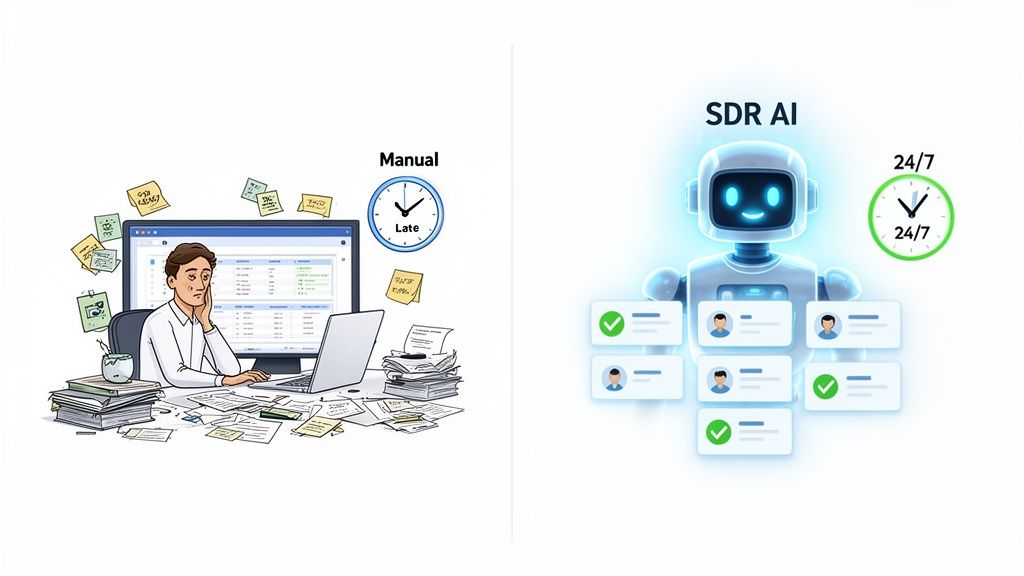
It's like giving your sales team a digital partner who works 24/7. This AI teammate takes on the most time-consuming parts of the job, freeing up your human reps to focus on what they do best: building relationships and closing deals.
At its heart, an SDR AI runs on a sophisticated workflow powered by artificial intelligence and machine learning. Here are its key capabilities:
- -Intelligent Prospecting: It sifts through massive datasets to identify companies and individuals that perfectly match your Ideal Customer Profile (ICP).
- -Automated Outreach: It launches personalized, multi-channel campaigns (email, LinkedIn, etc.) that adapt based on prospect behavior.
- -Lead Qualification: It analyzes responses and engagement to score leads, separating the genuinely interested from the tire-kickers.
The real game-changer is context. Old-school automation is "dumb"—it sends the same message to everyone. A true SDR AI is "smart"—it knows who to contact, when to reach out, and why the message is relevant at that exact moment. It’s the difference between a cold call and a warm introduction.
So, when is an SDR AI the right choice? It's ideal when you need to scale your pipeline without exponentially increasing your headcount, improve lead quality, and free up your A-players from repetitive top-of-funnel tasks. This intelligent, context-driven approach is what transforms an AI SDR software from a simple tool into a strategic growth engine.
How SDR AI Works
So, what’s really going on under the hood? An SDR AI isn't just a fancy email blaster. It runs on a smart, multi-step workflow that’s always learning and improving. Think of it as a four-part engine that fuels your sales process.
Lead Identification
It all starts with finding the right people. Forget spending hours manually scraping LinkedIn or buying stale lists.
AI-powered prospecting uses sophisticated algorithms to analyze vast amounts of public data—social media activity, company news, tech stack changes, job postings, and more. It identifies prospects who not only fit your Ideal Customer Profile (ICP) but are also showing active buying signals. This means you’re engaging people who are already in-market for a solution like yours. The accuracy rates of these systems are constantly improving, ensuring your team spends time on leads that are far more likely to convert. Effective AI agent training ensures the system gets better at identifying your perfect customer over time.
Outreach Automation
Once the AI has a target, it moves on to outreach. This is miles beyond a simple {First Name} mail merge.
The AI builds and executes multi-channel sequences, engaging prospects on both email and LinkedIn. It uses natural language generation (NLG) to craft hyper-personalized messages that reference the specific buying signals it uncovered. Furthermore, it optimizes the timing of each touchpoint to maximize the chance of a response, ensuring your message lands when it's most likely to be read. Following LinkedIn automation best practices is crucial here to maintain account health and effectiveness.
Lead Qualification
As replies come in, the AI takes over qualification. Using natural language understanding (NLU), it analyzes the sentiment and intent of responses.
Did the prospect ask about pricing? Mention a specific pain point? Forward your email to a decision-maker? The AI uses a scoring model based on these qualification criteria to determine which leads are hot and ready for a human conversation. Only genuinely interested, sales-ready leads are handed off to your sales team, eliminating wasted time on dead-end calls. This is a core function of any powerful AI SDR software.
Continuous Learning
Finally, the whole system is built for continuous improvement. This is not a "set it and forget it" tool.
The AI constantly tracks campaign performance—monitoring open rates, reply sentiment, and meetings booked. Through feedback loops, it learns what messaging works, which channels are most effective, and what prospect profiles are most responsive. These optimization cycles mean your outreach gets smarter and more efficient over time, turning your sales development into a self-improving engine for sales growth hacking.
Benefits of SDR AI
So, what’s the actual payoff? Why are so many sales leaders making the switch? It boils down to four key advantages that directly impact your bottom line.
Cost Reduction
Let's talk numbers. The average salary for an SDR in the US is north of $70k, and that’s before you factor in commission, benefits, training, and equipment. Then there's the inevitable turnover cost when an SDR leaves after 12-18 months.
SDR AI platforms operate on a predictable subscription model that is a fraction of the cost of a fully-loaded employee.
- -Lower labor costs: No salaries, bonuses, or benefits.
- -Reduced training: The AI comes pre-trained and learns on the job.
- -No turnover cost: The AI doesn't quit for a better offer.
The ROI calculation is compelling. A single SDR AI seat can often do the work of 3-5 human SDRs for less than the cost of one.
Increased Productivity
A human SDR works about 8 hours a day, takes breaks, and has good days and bad days. An AI works 24/7 without ever getting tired, distracted, or unmotivated.
- -24/7 Operation: Your prospecting engine never sleeps, engaging leads across different time zones.
- -No Fatigue: The 10,000th email is sent with the same precision and personalization as the first.
- -Consistency: Every lead is followed up with according to the exact cadence you define.
- -Scalability: Need to 10x your outreach? It’s a matter of adjusting settings, not a six-month hiring plan. This is a cornerstone of effective sales growth hacking.
Better Results
More activity is great, but does it translate to more revenue? The data says yes. Because SDR AI is so good at targeting and personalization, it often drives superior outcomes.
- -Higher response rates: Relevant, timely messaging gets more replies.
- -Better targeting: Focusing on high-intent leads means less wasted effort.
- -Improved conversion: Leads handed to sales are better qualified, leading to higher close rates.
- -More qualified leads: The AI acts as a perfect filter, so your closers only talk to people who are ready to buy. This focus on results is key to maximizing your LinkedIn automation ROI.
Data-Driven Insights
An SDR AI is a data-gathering machine. Every interaction is tracked and analyzed, giving you a level of insight that's impossible to get from a manual process.
- -Analytics: See exactly which messages, channels, and personas are driving results.
- -Recommendations: The AI can suggest improvements to your campaigns based on performance data.
- -Trend detection: Spot emerging market trends or changes in buyer behavior before your competitors do.
These insights allow you to stop guessing and start making strategic decisions based on hard data, which is a powerful tactic for sales growth hacking.
SDR AI vs Traditional SDR
It's the question on every sales leader's mind: should the next budget line item be for another SDR hire or an SDR AI platform? Let's put them head-to-head to see how they stack up.
Cost Comparison
A traditional SDR comes with a fully loaded cost: salary, commission, benefits, payroll taxes, software licenses, and training. This can easily exceed $100k per year. The total cost of ownership is high and unpredictable due to turnover.
An SDR AI platform is typically a fixed monthly or annual subscription. It’s a predictable operational expense that is significantly lower than a human hire. While there's an initial setup cost, the long-term ROI calculation often proves far more favorable.
Productivity Comparison
A high-performing human SDR might send 50-100 personalized emails and make dozens of calls per day. Their output is limited by human bandwidth.
An SDR AI can manage thousands of personalized conversations simultaneously across multiple channels, 24/7. It can handle a volume of leads and follow-ups that would require an entire team of humans, dramatically improving metrics like leads/day and conversations/day. This level of output is a huge advantage for any sales growth hacking strategy.
Scalability Comparison
Scaling a traditional SDR team is slow and expensive. It involves recruiting, hiring, onboarding, and a 3-6 month ramp-up time for each new rep. This creates a significant growth ceiling.
SDR AI scales instantly. Need to target a new market or double your outreach volume? You can do it with a few clicks. There are no hiring constraints or long onboarding periods, making it a perfect tool for ambitious SaaS growth hacking.
.tbl-scroll{contain:inline-size;overflow-x:auto;-webkit-overflow-scrolling:touch}.tbl-scroll table{min-width:600px;width:100%;border-collapse:collapse;margin-bottom:20px}.tbl-scroll th{border:1px solid #ddd;padding:8px;text-align:left;background-color:#f2f2f2;white-space:nowrap}.tbl-scroll td{border:1px solid #ddd;padding:8px;text-align:left}FeatureTraditional SDRSDR AICostHigh (Salary + Benefits + Training)Lower (Predictable Subscription)ProductivityLimited (8 hours/day)Unlimited (24/7)ScalabilitySlow & ExpensiveInstant & Cost-EffectiveConsistencyVariable100% ConsistentData InsightsManual ReportingAutomated & Deep Analytics
Hybrid Approach (The Best Model)
So, is this the end of the human SDR? Absolutely not. The winning strategy isn't man vs. machine; it's man with machine.
The best model is a hybrid approach:
- -AI handles the top of the funnel: Use the SDR AI for prospecting, initial outreach, and lead qualification at scale. It acts as the ultimate air cover, teeing up warm conversations.
- -Humans handle mid-funnel: Once a lead is qualified and shows genuine interest, it's handed off to a human SDR or Account Executive. They use their empathy, creativity, and problem-solving skills to build relationships and close complex deals.
This hybrid model lets you combine the scale and efficiency of AI with the irreplaceable touch of human connection. It's how modern sales teams are built. This strategic integration is at the core of the best AI SDR software.
SDR AI Use Cases
SDR AI isn't a one-size-fits-all solution. Its power lies in its adaptability to different industries and sales motions. Let's look at a few real-world examples of how it's making a huge impact.
B2B SaaS Sales
- -Challenge: A high-growth SaaS company needs to generate a massive volume of qualified demos to feed its aggressive sales targets, but hiring a large SDR team is too slow and expensive.
- -AI Solution: An SDR AI platform is deployed to identify companies that just hired a new VP of Marketing (a key trigger) or recently started using a complementary technology.
- -Implementation: The AI automates personalized outreach on LinkedIn and email, referencing these specific triggers to start relevant conversations.
- -Expected Results: A 300% increase in qualified meetings booked per month without adding headcount, dramatically lowering the customer acquisition cost. This is a classic SaaS growth hacking win.
Enterprise Sales
- -Challenge: An enterprise software company has long, complex sales cycles. Their Account Executives (AEs) are spending too much time on prospecting instead of nurturing high-value accounts.
- -AI Solution: An SDR AI is used for account-based marketing (ABM) at scale. It identifies key stakeholders within target accounts and runs hyper-personalized "air cover" campaigns.
- -Implementation: The AI warms up multiple contacts within an account over several weeks, tracking engagement signals. Once an account shows high intent, it’s flagged for the dedicated AE to take over.
- -Expected Results: Sales cycles are shortened by 25% because AEs engage with accounts that are already educated and showing interest. This strategic use of AI SDR software transforms AE productivity.
Sales Agencies
- -Challenge: A lead generation agency needs to deliver consistent results for multiple clients, each with a different ICP and value proposition. Scaling with human SDRs is unprofitable and creates operational headaches.
- -AI Solution: The agency uses a multi-tenant SDR AI platform to manage campaigns for all their clients from a single dashboard.
- -Implementation: They create a unique AI "agent" for each client, trained on that client's specific ICP and messaging. The agency's role shifts from manual outreach to strategy and optimization.
- -Expected Results: The agency can service 5x more clients with the same team, leading to a massive increase in profitability and client satisfaction. It's a prime example of sales growth hacking for service-based businesses.
Recruitment
- -Challenge: A recruitment firm needs to constantly find and engage top-tier, passive candidates for hard-to-fill roles. Recruiters spend 80% of their day just sourcing, not talking to candidates.
- -AI Solution: An SDR AI is repurposed for talent acquisition. It scours LinkedIn, GitHub, and other platforms for professionals with the right skills and experience who aren't actively looking.
- -Implementation: The AI initiates confidential, personalized outreach to gauge interest in new opportunities, only handing off conversations to human recruiters once a candidate expresses curiosity.
- -Expected Results: Time-to-hire is reduced by 40%, and recruiters can handle more requisitions, directly boosting firm revenue through effective growth hacking.
Top SDR AI Platforms
The SDR AI market is heating up, and choosing the right tool can feel overwhelming. To help you navigate the options, here’s a breakdown of some of the top players, their strengths, and who they’re best for.
gojiberry.ai ⭐ (Featured)
- -Overview: gojiberry.ai is designed specifically for B2B founders and sales teams who need a predictable pipeline of high-intent leads without the manual grind. Its core strength lies in its ability to monitor real-time buying signals and deliver in-market prospects daily.
- -Key Features: AI-powered intent signal tracking, autonomous multi-channel outreach (LinkedIn & email), daily list of warm leads, seamless CRM integration.
- -Pricing: Based on a subscription model, often positioned as a more affordable alternative to hiring a full-time SDR.
- -Best for: Startups, scale-ups, and sales teams that want to automate their top-of-funnel and focus their human reps on closing deals.
- -Pros & Cons: Users report that its ability to surface truly "warm" leads is a game-changer. The platform is highly focused on lead generation, so teams needing complex, all-in-one sales engagement features might look elsewhere.
- -Integrations: Connects with popular CRMs like HubSpot and Salesforce.
- -Support: Known for responsive, hands-on support, which is critical for teams new to AI.
- -ROI Potential: High. Many users see a positive ROI within the first few months by replacing the need for an SDR or significantly boosting their existing team's output.
- -User Rating: Generally very positive, with users praising its ease of use and the quality of leads generated. It's a leading piece of AI SDR software.
Outreach.io
Outreach.io is an enterprise-grade sales engagement platform. It’s a powerful, all-in-one solution for managing the entire sales cycle, from prospecting to forecasting.
- -Strengths: Deep analytics, robust sequencing capabilities, and tight integration with Salesforce.
- -Limitations: Can be complex and expensive, with a steeper learning curve.
- -Ideal Use Case: Large enterprise sales teams that need a comprehensive platform to manage complex sales motions. For more details, see our comparison of AI SDR tools.
Lemlist
Lemlist is a favorite among teams that want to add a human touch to their cold outreach. It’s famous for its advanced personalization features, like dynamic images and videos.
- -Strengths: Excellent for crafting creative, memorable email campaigns that stand out.
- -Limitations: Requires more manual setup and management compared to fully autonomous platforms.
- -Ideal Use Case: Sales and marketing teams focused on running highly personalized, creative outreach campaigns. Check out our list of AI SDR tools for more alternatives.
Apollo.io
Apollo.io bundles a massive B2B contact database with a suite of sales engagement tools. It aims to be a one-stop-shop for prospecting and outreach.
- -Strengths: The convenience of having lead data and outreach tools in one platform is a major draw.
- -Limitations: Based on user feedback, data accuracy can sometimes be inconsistent, requiring manual verification.
- -Ideal Use Case: Sales teams that want a single platform for both finding contacts and engaging with them.
Hunter.io
Hunter.io is primarily known as a powerful email finder, but it has expanded into simple email outreach and verification services.
- -Strengths: Highly effective and accurate for finding email addresses associated with a specific domain or professional.
- -Limitations: Its outreach capabilities are more basic compared to dedicated sales engagement platforms.
- -Ideal Use Case: Teams whose primary need is to build accurate email lists quickly.
Implementing SDR AI
Ready to build your AI sales engine? Awesome. A smart, methodical approach will ensure a smooth rollout and maximize your results. Here’s a practical, five-step plan to get it right. 🚀
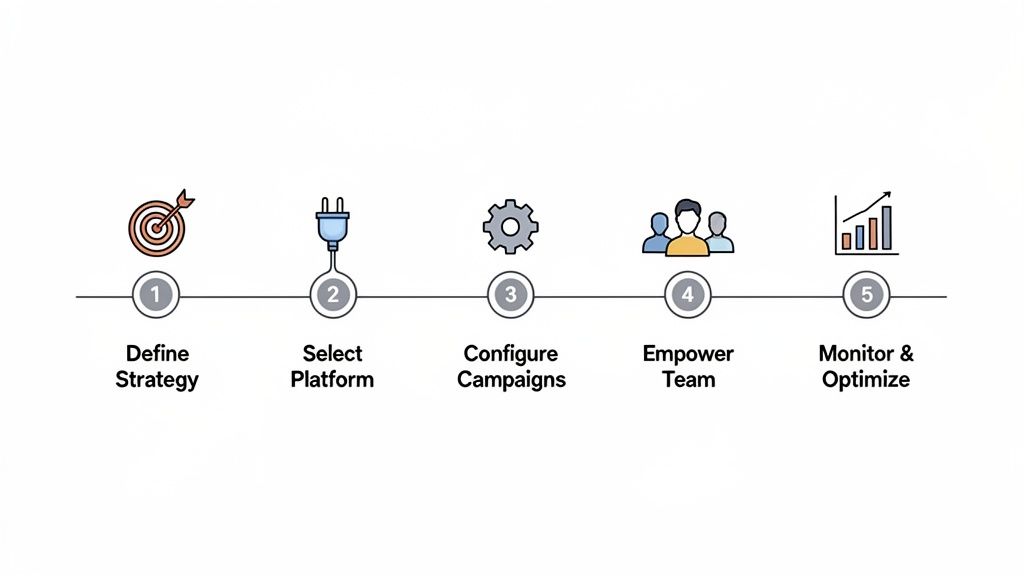
- Assess Needs: Before you look at any software, get crystal clear on your goals. Are you trying to increase lead volume, improve lead quality, or reduce customer acquisition cost? Define your Ideal Customer Profile (ICP) and what a "win" looks like. This strategic groundwork is the foundation for any effective sales growth hacking initiative.
- Choose a Platform: With your strategy defined, you can now find an SDR AI platform that fits your needs. If your goal is to generate high-intent leads from real-time buying signals, a tool like gojiberry.ai is built for that exact purpose. Evaluate ease of use, CRM integrations, and support quality. Choosing the right AI SDR software is a critical decision.
- Set Up Campaigns: This is where theory becomes action. Configure your ICP, connect your accounts, and start crafting the outreach sequences your AI will use. Pay close attention to personalization and adhere to channel-specific rules, especially when it comes to LinkedIn automation best practices.
- Train Your Team: Your AI is a new teammate, not just a tool. Train your human reps on the handoff process. Show them how to interpret the AI's insights and how to take a warm, AI-qualified lead and run with it. Solid AI agent training ensures a seamless collaboration between human and machine.
- Monitor & Optimize: An SDR AI is not a "set it and forget it" solution. Keep a close eye on key metrics—response rates, meetings booked, pipeline generated. Use this data to constantly refine your messaging and targeting. This continuous improvement loop is how you'll achieve maximum impact and a killer ROI calculation.
SDR AI Best Practices
Deploying an SDR AI is one thing; getting the most out of it is another. Follow these best practices to ensure your AI-powered sales engine runs smoothly, safely, and effectively.
Personalization at Scale
The magic of SDR AI is its ability to personalize outreach for thousands of prospects at once. Don't squander it with generic messaging.
- -Do: Use dynamic variables that go beyond
{first_name}. Reference industry, company news, or tech stack. Segment your lists finely to ensure every message is highly relevant. - -Don't: Send the same breakup email to everyone. The AI is smart enough to create nuanced follow-ups.
Following these LinkedIn automation best practices will help you personalize without getting flagged.
Safety & Compliance
Automation comes with responsibility. Protecting your domain reputation and your social media accounts is paramount.
- -Do: Warm up new email accounts gradually. Respect platform limits (like LinkedIn connection requests). Be aware of data privacy regulations like GDPR and CCPA.
- -Don't: Blast thousands of emails from a brand new domain. Scrape data in a way that violates a platform's terms of service.
Prioritizing safety ensures the long-term viability of your outreach channels. Many platforms have built-in safeguards, but it's crucial to understand the rules of engagement.
Quality Control
Even the smartest AI needs a human in the loop. Set up a process for regular quality checks to ensure the system is performing as expected.
- -Do: Regularly review a sample of sent messages and AI-driven conversations. Implement a clear lead QA process before handoff to sales. Monitor response sentiment closely.
- -Don't: Let the AI run for months without any human oversight. Assume every lead it qualifies is perfect.
This quality control loop is a key part of any successful sales growth hacking system.
Continuous Improvement
An SDR AI is a learning machine. Your job is to feed it the right data and insights to help it improve.
- -Do: Hold regular meetings to review performance data. A/B test different subject lines, messaging, and calls-to-action. Update your ICP and messaging based on what you learn.
- -Don't: Set up a campaign and never look at it again. Ignore negative feedback or low engagement rates.
Consistent optimization is what separates good results from great ones and ensures a strong LinkedIn automation ROI.
Case Studies
Theory is great, but results are better. Let’s look at how companies are using SDR AI to drive real-world growth.
1. B2B SaaS Startup (gojiberry.ai)
- -Challenge: A seed-stage SaaS company had a great product but no sales team. The founder was spending 20 hours a week on manual prospecting with little to show for it.
- -Tool: gojiberry.ai
- -Implementation: They set up an AI agent to monitor for companies that just hired a Head of Sales and were using a competing, older technology. The AI ran a personalized sequence on LinkedIn and email to these specific targets.
- -Results: Within 90 days, the AI was booking 15 qualified demos per month, creating a predictable pipeline that led to their first six-figure ARR. This represented a 5x ROI compared to the cost of the platform.
- -Lesson: SDR AI can be your first and most effective salesperson, allowing founders to focus on product and closing.
2. Sales Agency
- -Challenge: A marketing agency offered lead generation as a service but struggled to scale it profitably. Hiring and managing SDRs for each client was an operational nightmare.
- -Tool: A multi-tenant SDR AI platform.
- -Implementation: The agency transitioned its SDRs from manual outreach to "AI operators." Each operator now manages the strategy for 5-7 client campaigns run by the AI.
- -Results: The agency tripled its client capacity without increasing headcount. Client retention improved due to more consistent and predictable results.
- -Lesson: AI enables agencies to productize their services and scale in a way that's impossible with a purely human-based model.
3. Enterprise Tech Company
- -Challenge: A large software company needed to penetrate a new enterprise market segment. Their AEs were high-cost resources and shouldn't be spending time on cold outreach.
- -Tool: An enterprise-grade SDR AI.
- -Implementation: They used the AI to run a multi-touch, multi-channel ABM campaign against a target list of 500 Fortune 1000 companies. The AI warmed up contacts for six weeks before flagging engaged accounts for AE follow-up.
- -Results: The AI-powered campaign generated a 22% meeting rate with target accounts, compared to the 4% rate from previous manual efforts.
- -Lesson: For enterprise sales, AI is the ultimate tool for doing account-based marketing effectively at scale.
FAQ
Still have a few questions? We've got you covered. Here are answers to some of the most common queries about SDR AI.
Is SDR AI just for tech companies?
Not at all! While the B2B tech space was an early adopter, SDR AI is industry-agnostic. Any business that relies on proactive outreach to generate leads can benefit. We've seen it used successfully in professional services, manufacturing, financial services, and even recruitment. The key is having a clearly defined Ideal Customer Profile that an AI can target.
How much work is it to set up and manage an SDR AI?
The initial setup typically takes a few hours to a few days, depending on the platform. This involves defining your ICP, crafting your messaging, and connecting your accounts. Once it's running, plan to spend 1-3 hours per week monitoring performance, reviewing conversations, and making small optimizations. It's not "zero work," but it's a fraction of the time required to manage a human SDR. The best AI SDR software is designed to be intuitive and easy to manage.
Can the AI handle complex, multi-step conversations?
Today's SDR AI is excellent at initiating conversations, answering basic questions (like "can you send me more info?"), and qualifying initial interest. However, it's not designed to handle deep, consultative conversations or complex negotiations. The best practice is to set a clear handoff point. Once a lead asks a complex question or agrees to a meeting, it should be immediately routed to a human. This hybrid approach is a core principle of effective sales growth hacking.
The future of sales development isn't about replacing humans with robots. It’s about empowering your best people with intelligent tools that let them do what they do best: sell. SDR AI is a paradigm shift, moving the role of a sales rep from a manual prospector to a strategic closer.
Platforms like gojiberry.ai are leading this charge, offering a turnkey solution to build a predictable, high-intent pipeline without the cost and complexity of hiring a traditional sales team. By automating the top of the funnel, you free your team to focus on building relationships and driving revenue.
The question is no longer if you should adopt AI in your sales process, but how quickly you can do it to gain a competitive edge. The tools are here, the results are proven, and the opportunity is massive.
Ready to stop prospecting and start selling? Your AI-powered sales engine is waiting.

More High-Intent Leads = Your New Growth Engine.
Start Now and Get New High Intent Leads Delivered Straight to Slack or Your Inbox.