
Growth Hacking: The Complete Guide to Rapid Business Growth in 2026

Ever wondered how companies like Airbnb, Dropbox, and Slack shot from scrappy startups to household names seemingly overnight? 🤔 It wasn't just a nine-figure marketing budget or a lucky break. It was a disciplined, data-obsessed process called growth hacking. This is your complete playbook for making it work.
This isn't another surface-level article full of hype. By the time you're done reading, you'll have a rock-solid, actionable understanding of what it takes to build a real growth engine for your business. We'll break down the mindset, the core frameworks, and 10 specific strategies you can start testing today. You'll learn from legendary case studies (the good, the bad, and the brilliant), discover the essential tools for the job—including how platforms like GojiberryAI can execute your LinkedIn outreach experiments—and walk away with a step-by-step action plan to put it all into practice.
Ready to ditch the old marketing playbook and start building a scalable, repeatable growth machine? Let's dive in.
What Is Growth Hacking?
So, what is the official growth hacking definition? At its heart, growth hacking is a process of rapid, data-driven experimentation across the entire customer journey to find the most effective ways to grow a business. The term was coined by Sean Ellis in 2010 to describe a new breed of professional whose true north was, simply, growth.
It's not about finding one magic "hack." Think of it more like applying the scientific method to business challenges. While traditional marketing often operates in long campaign cycles with broad goals, growth hacking is defined by:
- Rapid Experimentation: Launching small, fast tests to learn what works and what doesn't.
- Data-Driven Decisions: Letting metrics, not opinions, guide every action.
- Cross-Functional Approach: Blurring the lines between marketing, product, and engineering to tackle growth problems holistically.
This approach is a game-changer for startups because it values resourcefulness over massive budgets. A growth hacker doesn't ask, "What's our Q3 budget?" They ask, "What's the highest-impact experiment we can run right now with what we've got?" This lean, agile methodology allows growth hacking for startups to be a powerful force for competing with established players.
The Growth Hacking Mindset
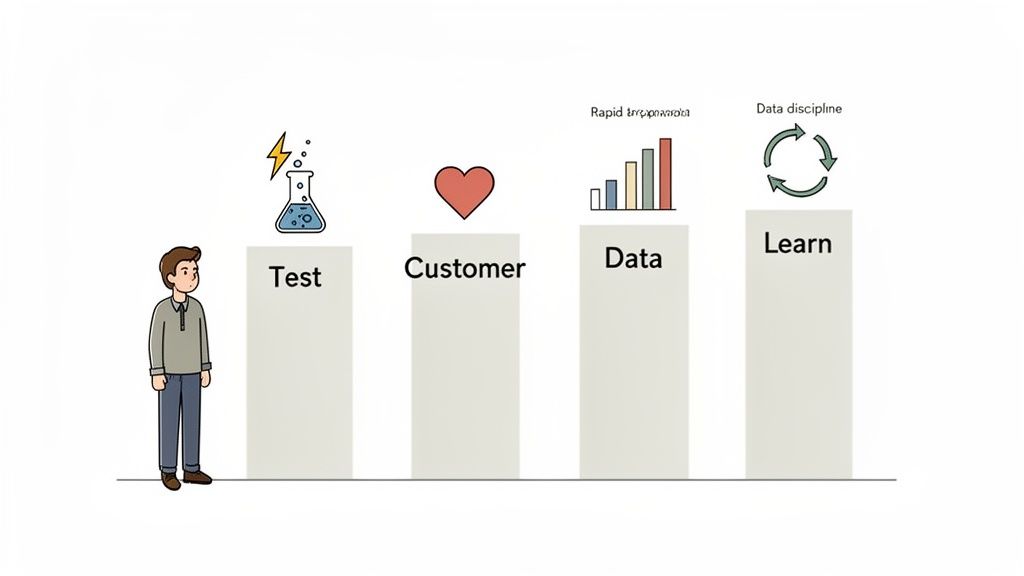
Before you touch a single tactic or tool, you have to get the mindset right. Growth hacking isn't a checklist; it's a completely different way of seeing the world. It’s about ditching the "this is how we've always done it" mentality and asking, "what can we test to do this better?" 🤔
This philosophy is the engine that drives any real growth strategy. It’s built on a few core pillars:
Experimentation > Perfection
The heart of the growth hacking mindset is a relentless focus on learning through quick experiments. Forget spending months trying to build the "perfect" campaign. A growth hacker would rather launch several small, scrappy tests in that same amount of time. The goal isn't to be right on the first try; it’s to learn as fast as possible. A "failed" experiment is actually a win—it’s a clear data point telling you what doesn't work, saving you time and money.
Speed & Iteration
In the world of growth, speed is a competitive advantage. The faster you can cycle through the loop of idea -> test -> measure -> learn, the faster you'll find the channels and tactics that actually move the needle. This means embracing minimum viable tests and being okay with "good enough" to get data back quickly.
Customer Obsession
You can't grow a business if you don't truly understand your customers. Growth hackers are obsessed with their users. They dig through feedback, pour over behavior analytics, and live inside the data to figure out the "why" behind every click and churn. This obsession ensures every experiment is grounded in solving a real user problem.
Data Discipline
Opinions are fine, but data is what drives results. In growth hacking, every decision must be backed by evidence. A gut feeling might be a great starting point for a hypothesis, but only data can prove it right or wrong. The best ideas—the ones proven by the numbers—are the ones that win.
The Growth Hacking Framework (AARRR)
So, you have a million growth ideas. Where do you start? A classic startup mistake is focusing only on getting new users through the door. But what good are those signups if they bounce after five minutes and never pay you a dime?
This is where the AARRR framework comes in. Coined by investor Dave McClure, it's famously called "Pirate Metrics" because, well, say it out loud (A-A-R-R-R!). More importantly, it provides a simple but powerful map of your entire customer journey.
The framework breaks your funnel down into five distinct, measurable stages:
- Acquisition: How do people find you?
- Activation: Do they have a great first experience?
- Revenue: How do you make money from them?
- Retention: Do they stick around?
- Referral: Do they love you enough to tell others?
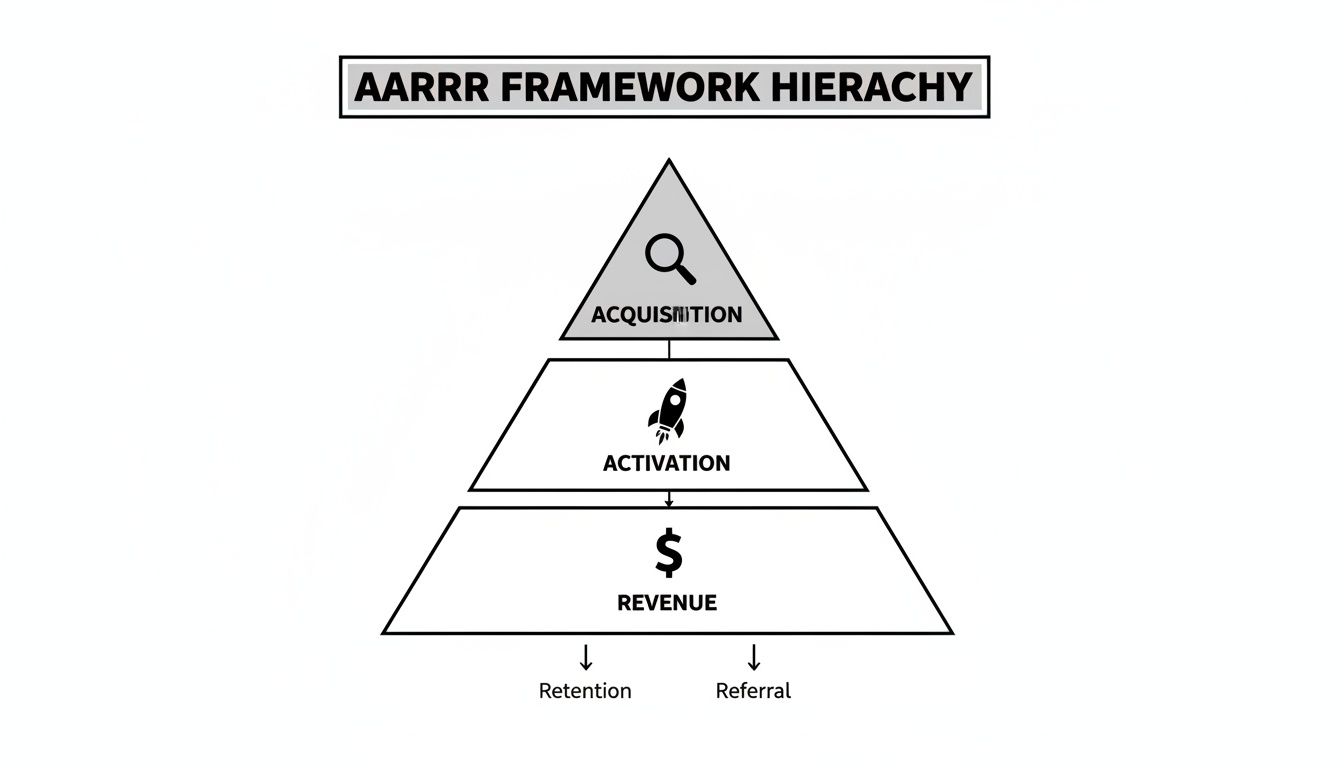
Looking at your business through this lens helps you pinpoint exactly where your funnel is leaking. It stops you from chasing vanity metrics and forces you to focus experiments on the stage that needs the most attention. Let's break it down.
StageGoalExample TacticsCore KPIAwarenessAttract new, relevant visitors to your product or website.SEO, paid ads, content marketing, social media campaigns.Channel Traffic, Cost Per Acquisition (CPA).ActivationDeliver the "Aha!" moment where users experience the core value.Simple onboarding, interactive tutorials, free trial with clear value.Activation Rate, Trial-to-Paid Conversion Rate.RevenueConvert activated users into paying customers.Clear pricing tiers, in-app upgrade prompts, targeted discounts.Customer Lifetime Value (LTV), Average Revenue Per User (ARPU).RetentionKeep users coming back and actively using the product.Email newsletters, push notifications, new feature announcements.Churn Rate, Daily/Monthly Active Users (DAU/MAU).ReferralMotivate happy users to become brand advocates.Two-sided referral programs, social sharing prompts, affiliate marketing.Viral Coefficient (K-factor), Net Promoter Score (NPS).
By systematically tracking these metrics, you shift from guessing what might work to knowing exactly which lever to pull to drive meaningful growth. It's about being deliberate and data-informed.
10 Growth Hacking Strategies That Work
Below are 10 strategies (and how to implement them). Treat each one as a testable play.
1) Build a Viral Loop
What it is: Users bring users, baked into the product.
Example: Dropbox’s two-sided storage reward.
How to implement:
- Identify a product benefit you can “split” (credits, capacity, features)
- Create a two-sided incentive (“Give X, Get X”)
- Make sharing frictionless (one click, pre-filled copy)
Track: K-factor, invites/user, invite conversion.
2) Use Scarcity & Exclusivity
What it is: FOMO via waitlists, invite-only access, limited drops.
Example: Early Gmail invites.
How to implement:
- Waitlist landing page + “position in line”
- Lightweight referral boost (“Move up by inviting 3 people”)
Track: waitlist conversion, referral rate.
3) Product-Led Growth (PLG)
What it is: The product is the primary growth driver (free tier/trial + self-serve).
Example: Slack’s bottom-up adoption.
How to implement:
- Define activation event (“aha moment”)
- Shorten time-to-value with guided onboarding
- Make upgrade path obvious after value
Track: activation rate, TTV, trial→paid.
4) Engineer Social Proof
What it is: Reduce perceived risk with proof (logos, reviews, usage signals).
Example: Booking-style urgency and proof.
How to implement:
- Collect testimonials systematically
- Add proof near CTAs (landing pages, pricing)
- Use “real” proof (numbers + recognizable brands)
Track: conversion rate, bounce rate.
5) Content as a Product (Lead Magnets That Actually Work)
What it is: A free tool/template/resource that solves a painful problem.
Example: HubSpot’s Website Grader.
How to implement:
- Pick a recurring ICP pain
- Build a simple tool (calculator, checklist, template pack)
- Gate it lightly (email) if relevant
Track: lead→SQL rate, organic traffic.
6) LinkedIn Outreach Experiments (B2B Growth)
What it is: Structured outreach to start conversations with a defined ICP.
How to implement (simple system):
- Define ICP + trigger (role, company size, hiring, funding, tech stack)
- Build a targeted list (Sales Navigator)
- Write a 3-step sequence (connect → value → soft question)
- Run for 14 days with conservative volume
- Iterate based on data
Track: acceptance rate, reply rate, meetings booked, show rate.
Tooling note: If you want to run consistent outreach experiments (without spending hours on execution), a platform like gojiberry.ai can automate the workflow while you focus on targeting and messaging quality.
CTA: Explore gojiberry.ai to execute LinkedIn outreach experiments more consistently.
7) Launch a Referral Program
What it is: Structured incentives for bringing new paying customers.
Example: Newsletter rewards, credits, perks.
How to implement:
- Offer a reward users truly value
- Promote in lifecycle emails + in-app
Track: referral CAC, referral conversion.
8) Piggyback on Existing Platforms
What it is: Tap into where your audience already is.
Example: Airbnb’s Craigslist distribution hack (historical).
How to implement:
- Identify ecosystems (marketplaces, communities, directories)
- Create integration or strong distribution asset
Track: partner traffic, conversion by source.
9) Affiliate & Partner Channels
What it is: Pay only for outcomes.
Example: PartnerStack/Tapfiliate-style programs.
How to implement:
- Commission structure + clear rules
- Recruit niche creators/operators
Track: affiliate CAC, revenue/partner.
10) Webinars & Virtual Events for High-Intent Demand
What it is: Teach something tactical → convert via follow-up.
How to implement:
- Narrow topic (one pain, one outcome)
- Include a real framework + examples
- Follow with a sequence (replay + CTA)
Track: attendance rate, SQLs, close rate.
Growth Hacking Case Studies
Airbnb: Piggybacking Distribution
- Challenge: no budget, chicken-and-egg marketplace problem
- Tactic: leveraged existing demand channels; optimized trust
- Lesson: distribution beats perfection early
Dropbox: Two-Sided Referral Program
- Challenge: paid acquisition too expensive
- Tactic: “Give storage, get storage”
- Lesson: align incentive with product value
Slack: Bottom-Up PLG
- Challenge: crowded market
- Tactic: freemium + incredible onboarding/retention
- Lesson: activation + retention compound acquisition
Hotmail: Signature Loop
- Challenge: awareness at zero cost
- Tactic: signature line turned every email into distribution
- Lesson: frictionless virality scales
Uber: City-by-City Playbook
- Challenge: launch marketplaces locally
- Tactic: repeatable launch ops + incentives
- Lesson: operational playbooks can be growth loops
Conclusion
Growth hacking isn’t a hack—it’s a disciplined system. The teams that win build a culture of testing, measure the right KPIs, and scale what’s proven. Start with your biggest funnel leak, ship one experiment this week, and keep the learning loop running.
If you’re B2B, LinkedIn outreach is often one of the fastest experiments to run—especially when you can execute consistently and measure cleanly. Explore gojiberry.ai to run LinkedIn outreach experiments with less manual work and more reliable iteration.

More High-Intent Leads = Your New Growth Engine.
Start Now and Get New High Intent Leads DeliveredStraight to Slack or Your Inbox.