
ZoomInfo pricing 2026: the real numbers before the sales call

ZoomInfo publishes no prices at all, and every quote goes through a sales conversation before you see a number.
The median signed contract sits at $33,500 a year, based on more than 1,500 purchases aggregated by Vendr in 2026.
ZoomInfo never says how many seats a plan includes. It only says paid plans carry a seat minimum, and that's worth knowing before the call.
You can't find the price because ZoomInfo doesn't put one anywhere. The official pricing page is a contact form. Their own blog post on what the product costs runs about twenty minutes of reading and gives you no figure at the end of it.
So this page gathers what buyers report paying, what makes a quote climb once the call starts, and the team size at which that spend starts to pay for itself. Every number here is attributed in the sentence that carries it, because none of them come from ZoomInfo's own price list.
Gojiberry finds your prospects for you
ZoomInfo sells you access to a database. Gojiberry watches more than 30 buying signals and tells you which accounts are worth contacting right now, for 99 dollars a month.
Get your first leads for freeTable of contents
- What does ZoomInfo cost for a team your size?
- Is ZoomInfo free?
- What is a ZoomInfo credit?
- What does ZoomInfo charge extra for?
- What happens when your ZoomInfo contract renews?
- What do users say about ZoomInfo pricing?
- Can you negotiate ZoomInfo pricing?
- What would ZoomInfo cost for your setup?
- At what team size does ZoomInfo make sense?
- ZoomInfo vs Gojiberry on price
- FAQ
What does ZoomInfo cost for a team your size?
Plan names tell you less than headcount does, because the platform fee is only the starting point and seats stack on top of it. Here's what teams report spending across a full year, seats and the usual extras included.
ZoomInfo bills annually. The invoice covers twelve months and it's paid upfront.
There is no monthly subscription, and no self-serve checkout that would let you start small and grow into it.
If you see a monthly figure quoted on another site, that's an annual price divided by twelve so it reads better in a budget. It isn't a way to pay.
Is ZoomInfo free?
Yes, and the free tier is real rather than a trial with a countdown on it. ZoomInfo rewrote its pricing content on 7 August 2026 to push exactly this message, so anyone landing on the site now meets a free-to-start offer before meeting a rep.
Here's what ZoomInfo Lite includes, according to ZoomInfo.
- 💰Free forever: the plan doesn't expire and there's no trial clock running against you.
- 📌No credit card: you sign up with a work email and start looking things up.
- 🧮10 credits a month: that rises to 25 a month if you join the Community Edition and contribute data back.
- 🧩The Chrome extension: the same lookup tool paying accounts use, running on the same free credit balance.
- 🌐WebSights Lite: it reveals up to 10 companies visiting your website per day.
Put 10 credits back in perspective before you plan anything around them. Ten credits a month means ten contact records downloaded, which is a sample rather than a pipeline. Lite is there to check whether ZoomInfo's data holds up in your market, not to prospect with.
What is a ZoomInfo credit?
A credit is spent the moment you export a record, whether that record is a person or a company. Looking at a profile inside the platform costs nothing. Taking it out of the platform is what draws down the balance.
The cost per record isn't flat either. A basic record burns fewer credits than one enriched with technology stack data, org chart relationships and intent signals, so two exports from the same list can carry different prices. On the GTM.AI side there are two separate currencies to track, data credits and AI credits.
Now the calculation that matters most on this page, and both halves of it come from ZoomInfo. Their own blog gives the example of a five-person team exporting 50 contacts a day each, which it puts at roughly 1,000 credits a week. Buyers report the Professional plan including around 5,000 credits a year. Divide one by the other: ZoomInfo's own worked example empties the entry plan in five weeks.
The unit cost follows from the same two numbers. At a reported $15,000 for a reported 5,000 credits, a record leaves the platform at about $3. You'll pull several records before one of them matches your target and is in market, so a prospect worth contacting costs a multiple of that reported $3.
What does ZoomInfo charge extra for?
The plan price doesn't cover the whole product. Several pieces that buyers expect to find inside their tier get quoted as separate line items.
- 🔔Real time buyer intent: Streaming Intent is sold on top of the plan rather than bundled into it.
- 📞Sequencing and dialing: Engage is the module that sends and calls, and it's priced separately from the data.
- 🌍Data outside North America: coverage beyond the region is an add-on, so a team selling into Europe pays for it twice over in credits and in access.
- 👥Seats beyond the included count: each one is billed at the reported extra seat rate for your tier.
- 🔗API and MCP access: pushing data into your own systems programmatically is quoted on its own.
When you get ZoomInfo on the phone, ask for a quote itemized line by line instead of a single total. That's the only way you'll see which of these five is already inside your tier and which is about to be added to it, and it's a reasonable thing to ask for before you commit to a year.
You shouldn't have to guess who to contact
Gojiberry checks every account against your ICP and sends you the ones showing buying signals. No credits, no export limit, no annual contract.
Start free on your marketWhat happens when your ZoomInfo contract renews?
This is the part that surprises people who've never signed an enterprise software contract, so it's worth walking through slowly. The contract renews itself. On the anniversary date it restarts for another full twelve months without anyone at your company doing anything, and there's no cancel button in the product to stop it. Ending it takes a formal notification sent before a deadline.
That deadline sits in a notice window that buyers report running 60 to 90 days ahead of the renewal date. Make it concrete: if your contract ends on 1 January, your notice needed to go in back in October or November. Miss the window and you owe another full year, whether the team logs in or not.
The renewal price is also not the price you signed at. Reported increases run 10 to 20 percent year over year, and since the annual invoice is paid upfront, that increase arrives as one payment rather than as a slightly larger monthly line.
Two questions to put to your rep before you sign, in writing:
🔎What happens to the records I've already exported if I don't renew? You want to know whether the contacts sitting in your CRM stay usable.
📥Do unused credits roll over into the next period? If they don't, a balance you didn't spend is a balance you paid for and lost.
What do users say about ZoomInfo pricing?
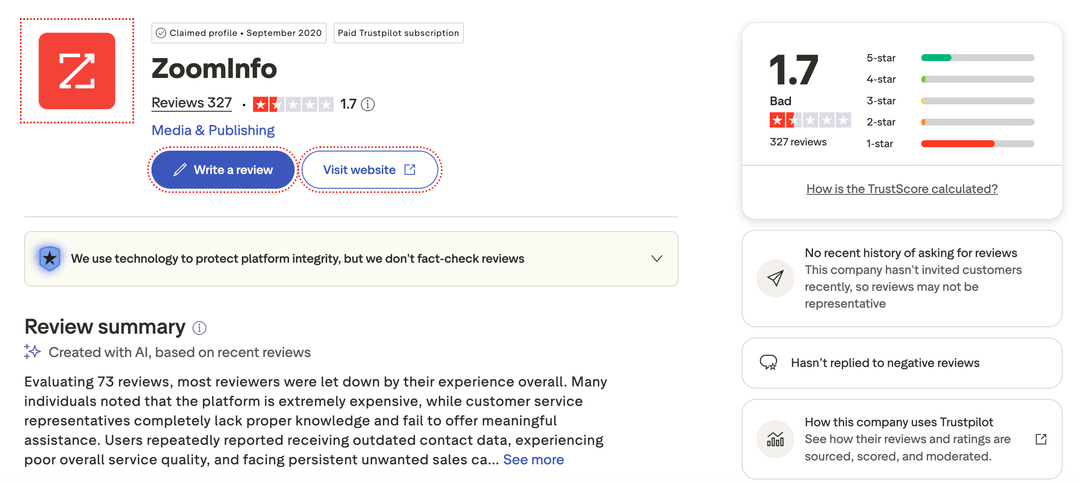
Two review platforms give two very different answers, and the gap is wide enough to be worth explaining. ZoomInfo scores 4.5 out of 5 on G2 across 9,384 reviews, a figure ZoomInfo displays itself on its own pricing page. On Trustpilot the score sits far lower: 1.7 out of 5 across 327 reviews, read off the page in August 2026, so a few hundred people rather than a few thousand.
The gap isn't a mystery and it isn't a scandal either. G2 reviews come mostly from people using the product every day, often at companies large enough to have bought it deliberately. Trustpilot reviews come largely from people who tried to cancel. Both scores are real and they aren't measuring the same thing, so read the first for the product and the second for the contract.
Our full ZoomInfo review goes through the product side of that split in more detail.
Can you negotiate ZoomInfo pricing?
Yes, and you should assume the first number your rep gives you is a starting point rather than a price. A quote assembled from seats, credits and add-ons has movement in every one of those three parts.
- 📝Ask for the quote broken down by line item: a single total hides which parts are negotiable. Once each line has its own number, you can push on the ones you don't need instead of asking for a vague discount.
- 📅Negotiate at the end of a fiscal quarter: reps have targets and a deal that closes this week is worth more to them than a deal that closes next month. The same quote often moves several thousand dollars on timing alone.
- 🔍Turn up with a quote from another tool: a competing price on paper changes the conversation from what you'd like to pay to what the market charges. It also tells your rep the deal can be lost.
- 🧮Negotiate credit volume rather than seat count: if your constraint is exports and not headcount, extra seats won't help you. Trading seats you don't need for credits you do is often the cheapest change in the whole quote.
- 🔒Get a cap on the renewal increase written into the contract: a verbal reassurance from a rep who may have moved roles by next year is worth nothing. A capped percentage in the document is worth the whole conversation.
ZoomInfo publishes these same negotiation tips on its own blog, which tells you something about how much room sits inside a first quote.
One thing to weigh before you spend a quarter on this. A negotiated five-figure contract is still a five-figure contract, and for a team of 2 to 10 people, Gojiberry does the job of finding the prospects for $1,188 a year. Compare the two annual spends rather than the feature lists: that's roughly 12 times less than ZoomInfo's reported entry plan, and roughly 28 times less than the median contract at $33,500.
What would ZoomInfo cost for your setup?
Set your seat count, the volume you'd export in a year and the extras you'd be quoted for, and this gives you the annual band buyers report for that shape of deal.
Estimate your own ZoomInfo quote
Treat the result as a range to budget against. It's built from prices buyers report paying, so it tells you which order of magnitude the conversation will start at, and the extras it counts have no published price at all. Your rep's number is the only quote.
A price you can read before you talk to anyone
Gojiberry costs 99 dollars a month, contacts up to 1,800 prospects for you, and tells you which accounts are showing intent this week. No seat minimum and no twelve-month lock.
See who is in market nowAt what team size does ZoomInfo make sense?
The product is built for revenue teams that are already structured: a defined ICP, someone owning operations, and a tooling budget signed off once a year rather than approved purchase by purchase. ZoomInfo's own reviewers describe it as a poor fit below roughly 15 to 20 people, which is a useful line to hold on to when a rep tells you it scales down.
Three things break below that size.
- 📦The annual commitment has no exit: a small team that changes its motion in March still pays through December.
- 🧪The credit model charges for every attempt: testing a new segment costs credits whether the segment works or not, so the pricing quietly discourages the experiments a small team most needs to run.
- 🎯You're buying a database, not an answer: the platform tells you who exists. Deciding who's worth a message this week is still your job, and at three reps nobody has a spare day for it.
If your team sits under that line, the shortlist worth reading is the best ZoomInfo alternatives, where most of the tools publish a price you can read without a call.
ZoomInfo vs Gojiberry on price
Two products, two ways of charging, and the difference shows up in the commitment more than in the monthly figure.
One caution about reading those two entry prices side by side. A ZoomInfo credit buys the right to download a row, and a Gojiberry prospect is someone who has been identified as in market and then contacted. The first is a lookup, the second is an outcome, so dividing one price by the other would flatter us and mislead you. Compare what each spend leaves on your plate at the end of the month instead.
Wispra now sources 60 percent of its weekly demos from intent signals.
Read the case studyMindflow lifted its outbound reply rate by 31 percent by working from intent.
Read the case studyFAQ
How much does ZoomInfo cost per user?
ZoomInfo doesn't sell per user, so there's no list price to quote. Buyers report an extra seat at around $1,500 a year on Professional and around $2,500 on Copilot Advanced, on top of a platform fee that starts at roughly $15,000. Divide the reported median contract of $33,500 a year, aggregated by Vendr in 2026 across more than 1,500 purchases, by a five-person team and you land near $6,700 per head.
Can you pay ZoomInfo monthly?
No. ZoomInfo bills annually and the invoice is paid upfront. If you've seen a monthly figure quoted somewhere, it's an annual price divided by twelve so that a budget line reads more comfortably, and it isn't a way to pay.
Is ZoomInfo free?
There's a free tier called ZoomInfo Lite, and it's free forever with no credit card. It gives you 10 credits a month, 25 if you join the Community Edition, the Chrome extension, and WebSights Lite showing up to 10 companies that visited your website that day. Ten credits means ten contact records downloaded, so Lite tells you whether the data covers your market and not much else.
How many credits does a small sales team need?
Start from what your reps export rather than from what a plan includes. ZoomInfo's own blog uses a five-person team pulling 50 contacts a day each, which it puts at roughly 1,000 credits a week. Buyers report Professional including around 5,000 credits a year, so that worked example runs the entry plan dry in five weeks. A team of three exporting a few hundred records a month will feel the ceiling within the first quarter.
Why doesn't ZoomInfo publish its prices?
Quotes are built from seats, credit volume and add-ons, and the same three-person team can be quoted very differently depending on what gets attached. Keeping the number off the page also keeps the conversation with a rep, where a discount can be traded against a longer term. It's a common model in enterprise software, and it's the reason you're reading this page instead of a pricing page.
How do I cancel a ZoomInfo contract?
There's no cancel button. The contract auto-renews for another twelve months on its anniversary date unless you send formal notice inside a window that buyers report running 60 to 90 days before that date. If your term ends on 1 January, notice has to be in by October or November. Miss the window and the next year is owed whether anyone logs in or not.
Is ZoomInfo worth it for a team of five?
It depends on whether five people can keep 5,000 credits busy and still close enough to cover $15,000 to $25,000 a year. Reviewers describe the product as a poor fit below roughly 15 to 20 people, and the annual commitment is what makes a mistake expensive at that size. If you're buying it to answer the question of who to call this week, that's the part it doesn't do for you.
What does ZoomInfo cost compared to the alternatives?
Most tools in this category publish a price, which already changes the shape of the decision. Budget database and sending tools start in the low tens of dollars a month, and our Saleshandy review walks through one of them. Gojiberry is $99 a month on the Pro plan, or $1,188 a year, which is roughly 12 times less than ZoomInfo's reported entry plan.
Want us to find the prospects too?
Tell Gojiberry who you sell to and it starts finding companies showing buying signals. 99 dollars a month, no annual contract, no credits to ration.
Start for free Read the customer stories
More High-Intent Leads = Your New Growth Engine.
Start Now and Get New High Intent Leads Delivered Straight to Slack or Your Inbox.