
Lusha vs Amplemarket 2026: pricing, features and verdict

Two questions
Which one is your team supposed to buy?
No email required.
Question 1 / 2
How many people will use it?
Just me, or the two of us
Four to ten of us
Question 2 / 2
What do you need it to do?
Give me the email and the number for people I have already picked
Find the right people and message them for me
🔍
Your match
Lusha is your fit
You know who you want to reach, so you're buying a lookup and nothing heavier. Lusha bills monthly and stops when you tell it to. If picking the names is the part that eats your week, that's the part we take over.
Around $40 a seat, cancel from your settings
One credit per email, ten per direct dial
Nothing in it decides who's worth a call
🚀
Your match
Amplemarket is your fit
At that headcount, one contract for data, sequences and signals beats five subscriptions. Budget $7,200 for the year before anyone sends a message. If you'd rather not commit twelve months to find out, fix the list first and add the machine later.
$7,200 a year, with two seats included
Multichannel sequences and deliverability in one login
No monthly billing on any tier
🎯
Your match
Gojiberry is your fit
You want the whole motion, and a $7,200 annual term for two seats prices you out of the tool that sells it. Gojiberry tracks the buying signals, builds the list from them and runs the outreach, on a free plan you can start this afternoon.
More than 30 buying signals, watched where your market posts
Personalized outreach across several channels
Free plan, no card, no annual term
These two get compared constantly, and they don't do the same job. Lusha hands you an email and a direct dial for someone you already picked. Amplemarket runs the whole outbound motion, and its cheapest published plan is $600 a month on an annual term.
That's $7,200 committed before anyone sends a message, against roughly $40 a seat for Lusha. Here's who each one is for, and what the gap between those two numbers buys.
Table of contents
- Lusha if you need contacts and Amplemarket if you have $7,200
- How we compared them
- What Lusha does well
- What Amplemarket does well
- The annual commitment behind the $600
- We priced it out for a team of three
- Who should buy Lusha and who should buy Amplemarket
- What if the leads came to you instead
- Your questions about Lusha and Amplemarket
Lusha if you need contacts and Amplemarket if you have $7,200
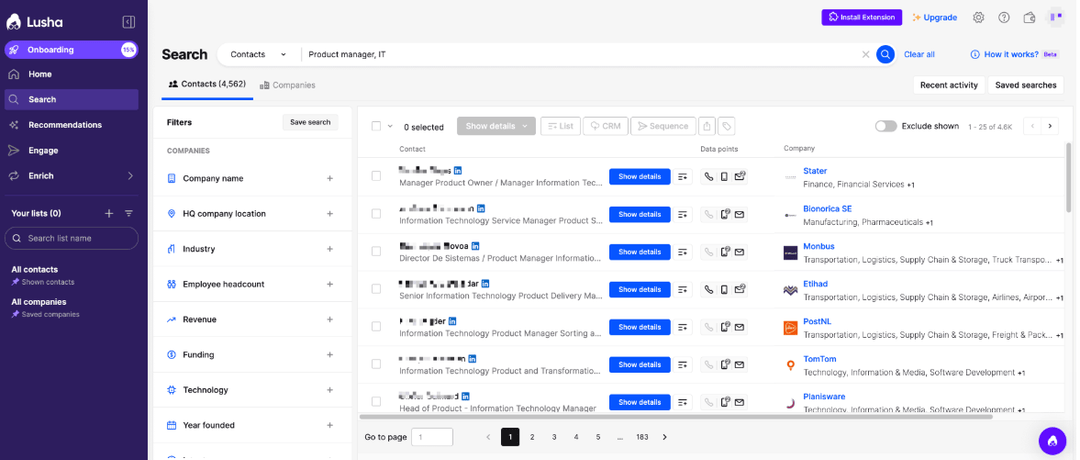
Lusha is a contact database with a browser extension. You point it at a profile or a company website, it returns a verified email or a mobile number, and you pay per seat on a plan you can cancel from your account settings. Nothing in it decides who's worth contacting, and nothing in it sends a message.
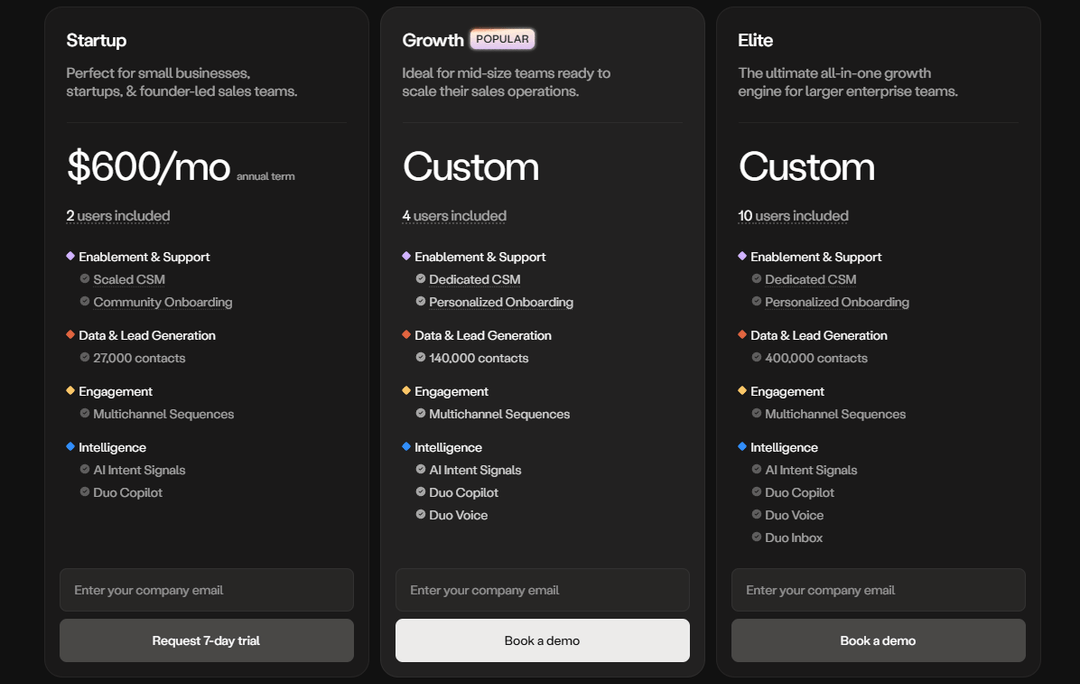
Amplemarket is the opposite shape. Data, multichannel sequences, contact-level intent signals, AI agents and deliverability monitoring live under one login and one contract. The Startup plan is the only tier with a published price: $600 a month for two seats, annual term, and no monthly option at any level.
So the split is clean. Lusha is a lookup you rent by the month, and Amplemarket is an outbound department you're signed up to for a year. Most pages comparing the two score them on one feature grid, which buries the number that decides it for a small team.
Before you pick a lookup tool, see who's already in the market.
Wispra sources 60% of its weekly demos this way.
Get your first leads freeHow we compared them
We read both pricing pages ourselves on September 7, 2026, and we wrote down what each vendor publishes rather than what the roundups say it publishes. Lusha's page spells out its credit mechanics: one credit reveals a verified email, ten reveal a phone number, and the free plan gives you 40 credits a month. Amplemarket publishes one price, the Startup plan, and sends you to a demo for the other two. Anything we could not read on a vendor page is marked as reported and dated, including Lusha's per-seat rates and the cost of an extra Amplemarket seat.
One thing you won't find here: a scorecard of match rates. We haven't run a controlled reveal test on an identical list across both tools, and an invented percentage would be worth less than this sentence admitting it. When we run it, the numbers land on this page. We pay for every plan we use, and neither vendor read a word of this before publication.
Here's the two-column version. We left ourselves out of it on purpose, and our own section comes further down the page.
What Lusha does well
Lusha's whole promise is speed. The extension sits in your browser, you open a profile or a company site, and a verified email comes back in one click. Pricing is published, plans are per seat, and you cancel from your settings without a call.
- 🔎Extension first: it reveals contact details on social profiles, company sites, your CRM and your inbox.
- 💰Credits you can read: one credit reveals an email and ten cover a direct dial, checked on the pricing page in September 2026.
- 🧩A free plan that's usable: 40 credits a month, one seat, no card, enough to test the data on your own market.
- 📞Phone data is the draw: most buyers come for direct dials, and a phone-heavy team burns its allowance ten times faster.
The limit is structural. Lusha finds people and it never contacts them, so you're pairing it with a sender either way. The data ages while you work it too: HubSpot puts B2B database decay at 2.1% a month, which is roughly a fifth of your list gone by this time next year.
What Amplemarket does well
Amplemarket replaces a stack. Data, sequences, signals and deliverability monitoring sit in one place, and that consolidation is the argument for the price. Teams that switch typically drop three to five other subscriptions.
- 🔁Native multichannel sequences across email, phone, socials and messaging, all run from one queue.
- 📊Contact-level intent signals rather than company-level ones, so a sequence can fire on the person who changed roles.
- 🎧Onboarding is bundled into every tier, which counts when there's no self-serve path into the product.
- 🌍Scale in the database: Amplemarket puts it above 200 million verified contacts and reports bounce rates under 3%.
The limit sits in the contract rather than the product. There's no monthly billing, no self-serve signup, and the two-seat floor means a solo founder can't buy it at all.

The annual commitment behind the $600
This is what settles the page when you're two or three people. Amplemarket has no monthly billing at any tier, so the smallest thing you can buy is a year.
The Startup plan bills $600 a month and covers two people, so $7,200 lands on day one. Buyers report extra seats at $300 to $400 a month each, so a third person adds $3,600 to $4,800 to the year. Phone credit top-ups run $0.50 each on Amplemarket's own numbers, and email credit overage rates aren't published anywhere we could find. The pricing page puts a 7-day trial request on the Startup card and a demo booking on the other two, and all three ask for a company email first. Seat and overage figures come from buyer reports, not from a published page, and everything here was checked on September 7, 2026.
So a two-person team that wants to run Amplemarket for one quarter can't. There's no quarter on sale. You commit twelve months and you find out in month two whether your outbound motion was ready for it. Lusha, at the other end of the scale, bills monthly and cancels from a settings page.
The volume trap that comes with the bigger machine
Google has held bulk senders to a 0.3% spam complaint rate since February 2024. A larger sending engine pointed at a colder list reaches that threshold faster than it reaches a meeting. So you're paying more to send more, and it only pays off once the list is already right.
We priced it out for a team of three
One founder and two reps, twelve months, both tools at their entry tier. Lusha's Starter rate is reported at about $37 a seat a month on annual billing, so three seats land near $112 a month. Amplemarket's Startup plan covers two of the three, and the third seat comes in at the reported $300 to $400.
The third Amplemarket seat, on its own, costs about three times what all three Lusha seats cost for the year. Add a sequencing tool next to Lusha and you're still looking at a gap between $9,000 and $10,000.
Run those numbers and the gap is a hire's worth of budget, spent on a sending machine before you've proved the outbound motion works. That's the trade, and it's a reasonable one at ten reps. At three, it rarely is.
Who should buy Lusha and who should buy Amplemarket
A founder prospecting alone
Lusha. Start on the 40 free credits, move to Starter when you run out, and put a $30 sending tool beside it. Amplemarket's floor is two seats, so it isn't sold to you.
A sales team of two or three
Lusha, still. Three seats run near $1,350 a year against $10,800 or more for the same headcount elsewhere. Spend the difference on whatever decides who's worth calling.
A team of ten with a real budget
Amplemarket, once the motion already works. Ten seats is the Elite floor, the stack consolidation is real, and you have the volume to use the credits.
Both of these tools assume you already picked the account
Gojiberry tracks more than 30 buying signals across socials and the web, then hands your reps the accounts worth a call this morning.
See this week's signalsWhat if the leads came to you instead
Lusha makes you go find people. Amplemarket makes you message more of them, faster. Both start from the same assumption: you already know which accounts are worth your week. When you're two to ten people, that assumption is the expensive part.
Gojiberry is an AI-powered multichannel prospecting platform. It tracks more than 30 buying-intent signals across socials and the web, surfaces the leads who are in market right now, and triggers personalized outreach across several channels. You give it your website, it works out who buys from you, and the list arrives filtered by timing rather than by job title.
Timing is the part a database can't hold. Median job tenure in the US is 3.9 years, with 22% of workers under a year in the role, so the org chart you exported last quarter has already moved on you.
- 🔔Signals, not exports: hiring posts, funding, role changes and launches, watched continuously.
- 🎯A morning list of twenty names ranked by how close each account looks to a decision.
- 📤Outreach fires on the signal across several channels, without a rep queueing anything.
- 🤝Free plan, no card, and no annual term to sign before you know whether it works on your market.
What we don't do: we're not a phone-number database. If you need someone's direct line for a named person this afternoon, Lusha does that job and we don't. We also won't replace a ten-seat outbound department that's already hitting quota. Gojiberry is for the team that has the sending covered and keeps guessing at the list.
We built this because we were doing it by hand
Roman spent his days prospecting on socials for Coco.ai, our first company, and the piece that ate his week was never the sending. It was working out which of four hundred companies had a reason to answer him that month.
So he tracked it manually. Hiring posts, funding notes, role changes, product launches, then a message to the ten accounts where something had moved. Replies climbed far enough that the tracking turned into the product. Coco.ai was the testing ground, and Gojiberry is what came out of it.
If you're weighing these two because the sending is already handled, the useful next step is upstream of both of them. Try it on your own market before you commit a budget to either one, and see the wider set of Lusha alternatives if the data layer is what you're replacing.
Give it your website and it builds the target list for you.
Signals pulled from where your buyers already talk, refreshed daily, on a plan that starts at nothing.
Start without a contractYour questions about Lusha and Amplemarket
Can you use Lusha and Amplemarket together?
You can, and some teams do, but it's an expensive overlap. Amplemarket ships its own contact database with 15,000 email credits per seat per year, so paying Lusha on top means buying the same layer twice. The pairing that makes sense goes the other way round: Lusha for the data, a cheap sender next to it, and something upstream that tells you which accounts to load in.
Does Amplemarket offer monthly billing?
No. Every tier runs on an annual term, including the published Startup plan at $600 a month, and nothing about it is self-serve. Startup carries a 7-day trial request, while Growth and Elite send you to a demo booking. Checked on September 7, 2026.
Which one is cheaper for a small team?
Lusha, by a wide margin. Three seats land near $1,350 for a year against $10,800 to $12,000 for the same headcount on Amplemarket's Startup plan with a seat added. The comparison is only fair if you also budget a sending tool next to Lusha, and even then the gap stays in the thousands.
Is Lusha enough on its own?
It's enough when what you lack is contact details. It falls short when what you lack is the list itself, because Lusha reveals people you already chose and the choosing stays manual. That's where most teams of two to ten lose the week. Wispra fixed that side first and now sources 60% of its weekly demos from intent signals, the full case study is here.
Does Amplemarket have a free trial?
Only as a 7-day trial on the Startup tier, and you request it with your work address. There's no free tier and no card-free signup, so evaluation starts with a form. Lusha runs a permanent free plan at 40 credits a month for one seat, which is enough to test the data before you spend.
What happens to Lusha credits you don't use?
It depends on the billing cycle. On monthly plans your unused credits roll over and stack up to twice your plan limit. On annual plans you get the whole year up front and whatever's left resets at the end of the cycle. Both rules come from Lusha's own pricing page, read on September 7, 2026.
Two more pages that'll help before you commit: our rundown of email outreach automation tools and what they cost, and the guide to automating prospecting before you hire another SDR.
Your next customer already showed a signal this week
Free plan, no card, no annual term.
Try Gojiberry nowRead the case studies
More High-Intent Leads = Your New Growth Engine.
Start Now and Get New High Intent Leads Delivered Straight to Slack or Your Inbox.