
AI Agent Definition: Everything You Need to Know

AI agents are everywhere in 2025. But do you really know what they are? 🤔
There's a ton of buzz and, frankly, a lot of confusion around the term "AI agent." Is it just a fancy chatbot? Is it the same as automation? The lines can seem blurry, but the difference is a game-changer.
My promise to you is simple: this guide will give you a crystal-clear definition of an AI agent, break down its key characteristics, and show you exactly how it differs from other tech you're already using.
By the end of this guide, you won't just understand the definition—you'll be able to explain it like an expert. Let's dive in.
A Simple Definition of an AI Agent
Let's start with the official textbook definition. An AI agent is "an autonomous system capable of perceiving its environment, making decisions, and acting without human intervention."
Okay, that’s a bit dry. In plain English? It’s an intelligent program that works on its own to achieve a goal.
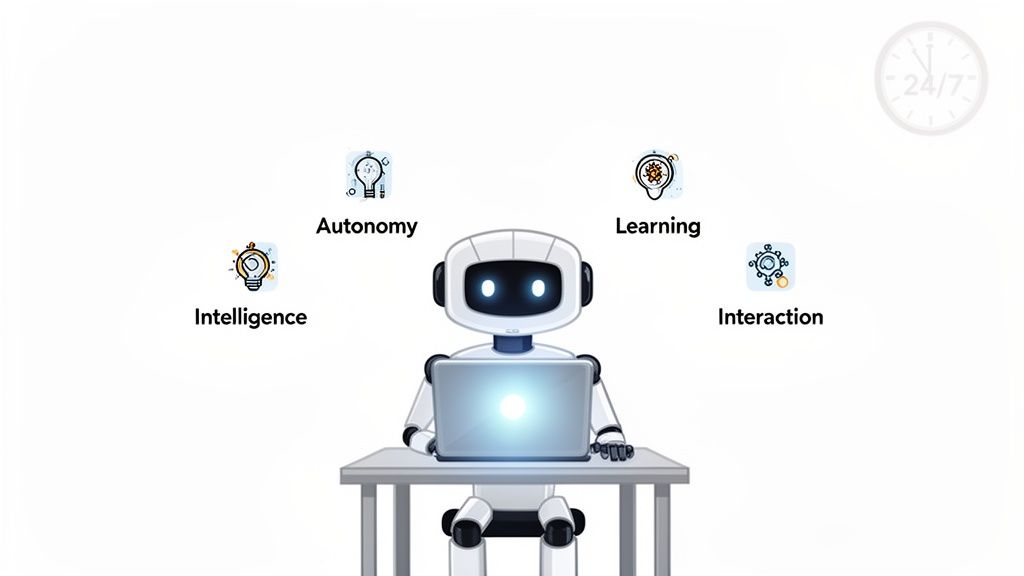
The best analogy is to think of it like a virtual employee working for you 24/7. 🤖 You don't give it a step-by-step to-do list; you give it an objective, and it figures out the best way to get there.
This all comes down to four key characteristics that make an agent, well, an agent:
- Autonomy: It acts without you needing to approve every single step. It's independent.
- Intelligence: It doesn't just follow rules blindly. It analyzes information and makes smart decisions.
- Learning: The best agents get better over time by analyzing their own results.
- Interaction: It can communicate and engage with its environment—whether that’s pulling data from a website, connecting to a CRM, or talking to a human.
Got the basics? Great. Now, let’s see how this virtual employee stacks up against other tech.
Key Differences: AI Agent vs. Chatbot vs. Automation
It's easy to lump all these terms together, but they play very different roles. Understanding the distinctions is key to seeing the true power of an agent.
AI Agent vs. Chatbot
Here's the simplest way to think about it: a chatbot is passive, while an AI agent is active.
- A chatbot is designed to answer questions. It waits for a user prompt and provides a response based on its programming. Think of a customer service bot on a website. It tells you where to find the return policy.
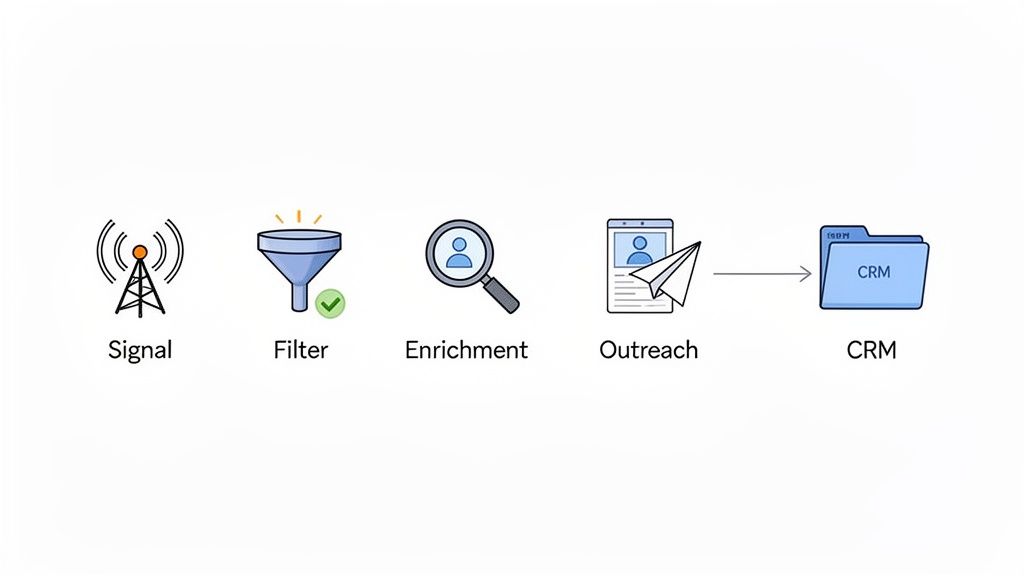
- An AI Agent is designed to take actions. It proactively works to achieve a goal. A sales AI agent doesn't just answer questions about leads; it goes out, finds new leads, qualifies them, and adds them to your CRM.
Do: Think of a chatbot as a reactive receptionist.Don't: Mistake a chatbot's ability to converse for an agent's ability to act.
AI Agent vs. Automation
This is a big one. Traditional automation is fantastic, but it's fundamentally rigid.
- Automation follows fixed, predefined rules. Its logic is simple: “If X happens, then do Y.” An auto-responder that sends a generic "we got your email" message is a perfect example. It's a lifesaver for repetitive tasks, but it can't think outside its script.
- An AI Agent makes intelligent decisions. Its logic is more like: “Analyze the situation and decide the best course of action to reach my goal.” It can handle unexpected scenarios and adapt its strategy, something rule-based automation just can't do.
AI Agent vs. Machine Learning (ML)
Machine learning is a core component of many AI agents, but it isn't the agent itself.
- Machine Learning is the process of learning patterns from data. An ML model might predict which customers are likely to churn.
- An AI Agent uses those predictions to act. It doesn't just identify at-risk customers; it might then automatically enroll them in a retention campaign. ML provides the insight; the agent takes the action.
AI Agent vs. Large Language Model (LLM)
LLMs like ChatGPT are incredibly powerful, but they are just one piece of the puzzle.
- An LLM is an engine for generating text. It's the "brain" that can write, summarize, and understand language.
- An AI Agent uses an LLM to reason and communicate. The LLM might generate the copy for a personalized email, but it's the agent's framework that decides who to email, when to send it, and what to do based on the reply.
So, are you ready to see how these agents are categorized? Let's look at the main types.
The 4 Main Types of AI Agents
Not all agents are created equal. They range from simple reactors to complex, strategic teams. Knowing the types helps you understand what's possible.
Type 1: Reactive Agent
This is the most basic form. A reactive agent perceives its environment and acts based on the current situation.
- What it is: A system that responds directly to stimuli without any memory of past events.
- Example: A simple spam filter. It sees a sketchy link (stimulus) and immediately moves the email to the junk folder (action).
- Pros: Very simple and fast.
- Cons: It can't learn or plan. It's stuck in the present moment.
Type 2: Deliberative Agent
This is where things get more strategic. A deliberative agent can plan ahead.
- What it is: An agent that maintains an internal model of its world and considers the consequences of its actions before choosing one.
- Memory: Yes, it remembers past states and can plan a sequence of actions.
- Example: A prospecting agent tasked with finding 50 qualified leads. It won't just grab the first 50 names; it will plan a series of steps (search, filter, verify) to ensure it hits the goal efficiently.
- Pros: More intelligent and goal-oriented.
- Cons: Slower and more complex than a simple reactive agent.
Type 3: Multi-Agent System
Why have one agent when you can have a team? A multi-agent system is a coordinated group of agents working together.
- What it is: Multiple autonomous agents collaborating to solve a problem that's too big for any single agent.
- Memory: They often share information and a collective memory to coordinate their actions.
- Example: A full sales prospecting team. One agent finds potential leads, another qualifies them against your ideal customer profile, and a third finds their contact info.
- Pros: Extremely powerful and can handle highly complex, end-to-end workflows.
- Cons: The complexity of coordinating multiple agents is significant.
Type 4: Autonomous Agent (Learning Agent)
This is the most advanced type. It's not just intelligent; it actively seeks to improve itself.
- What it is: An agent that can learn from its experiences and adapt its strategies over time.
- Memory: Yes, and it uses this memory to refine its performance.
- Example: An advanced ad-buying agent that analyzes campaign results, learns which ad copy converts best, and automatically reallocates the budget to the top performers.
- Pros: Highly intelligent and self-improving.
- Cons: Can be very complex and requires high-quality feedback data to learn effectively.
Now that you know the types, what are the building blocks that make them all work?
The 4 Core Components of an AI Agent
Every AI agent, regardless of its type, operates on a continuous four-step cycle. Think of it as Observe, Think, Decide, and Act.
Component 1: Perception
This is how the agent gathers information from its environment. It’s the "observe" phase.
- What it is: Receiving raw data through sensors or digital inputs.
- Example: For a prospecting agent, this means “Reading a list of prospects” from a CSV file or monitoring LinkedIn for job changes.
- Why it matters: This is the input. Without good perception, the agent is flying blind.
Component 2: Processing
This is the "think" phase, where the agent makes sense of the data it just collected.
- What it is: Analyzing the data to understand its meaning and context.
- Example: “Analyzing a LinkedIn profile” to see if the person’s job title and company size match your ideal customer profile.
- Why it matters: This is where the agent’s intelligence shines.
Component 3: Decision
Based on its analysis, the agent chooses what to do next. This is the "decide" phase.
- What it is: Selecting the optimal action to take to move closer to its goal.
- Example: “Deciding to send a personalized connection request” because the prospect is a perfect fit.
- Why it matters: This is what makes the agent autonomous. It makes the call without you.
Component 4: Action
Finally, the agent executes its chosen decision. This is the "act" phase.
- What it is: Performing the task in its digital or physical environment.
- Example: Actually “Sending the personalized message” through the LinkedIn platform.
- Why it matters: This is where the agent produces tangible results.
Benefits and Limitations: A Realistic Look
AI agents are powerful, but they aren't a magic wand. It's crucial to have a clear-eyed view of their strengths and weaknesses.
✅ Benefits
- Full Automation: They can run entire workflows 24/7 without supervision.
- Unlimited Scalability: Need to 10x your outreach? An agent can handle it instantly.
- Hyper-Personalization: They can tailor actions for thousands of individuals at a scale no human can match.
- Continuous Learning: The best agents improve their performance over time.
- Cost Reduction: They automate repetitive tasks, freeing up your team for high-value work.
❌ Limitations
- High Initial Cost: Building a custom agent from scratch can be expensive and complex.
- Requires High-Quality Data: The rule "garbage in, garbage out" is absolute. Poor data leads to poor decisions.
- Ethical and Legal Concerns: Issues around data privacy and decision-making transparency must be managed carefully.
- Lack of Human Context: Agents don’t understand nuance, empathy, or the subtle cues of human interaction.
- Ongoing Maintenance: They need to be monitored and updated to ensure they remain effective and aligned with your goals.
So, do you feel like you have a solid grasp on what an AI agent is now?
The next logical step is to see how you can put one to work for you. Building your own AI agent might sound daunting, but platforms today make it easier than ever.
👉 Try Gojiberry for free and start building your first agent in minutes. It's the perfect way to turn theory into practice.
So there you have it. An AI agent is an intelligent, autonomous system that perceives, decides, and acts on its own.
They aren't just the future; they are here now, ready to transform how you work by taking over the repetitive tasks and letting you focus on what truly matters. The only question left is, what will you build first?
It's time to stop just reading about AI agents and start using them. Create your first AI agent now and see the difference for yourself.
FAQ: Your AI Agent Questions Answered
What’s a real-world example of an AI Agent I might have used?
You've likely interacted with one without even realizing it. Think about the navigation app on your phone. It's a deliberative agent! It perceives your current location and traffic conditions, processes that data against its internal map, decides the fastest route to your destination (its goal), and acts by giving you turn-by-turn directions. If conditions change (an accident ahead), it re-evaluates and adapts its plan—true agent behavior!
Can an AI agent make creative decisions?
This is a great question. While an agent can be incredibly "intelligent" in a logical sense—analyzing data and optimizing for a goal—it doesn't possess creativity in the human sense. It can't come up with a truly novel marketing slogan or a groundbreaking product idea. However, it can use an LLM to generate thousands of variations of ad copy and then use its learning capabilities to test and identify which "creative" version performs the best. It's more about data-driven optimization than true inspiration.
How do I ensure an AI agent acts ethically?
This is one of the most critical challenges in the field. The key is human oversight and clear "guardrails." You must define strict operational boundaries and ethical rules for the agent. For example, a prospecting agent should be programmed with a "do-not-contact" list and rules to respect privacy laws like GDPR. It’s not about letting the agent run completely wild; it's about giving it autonomy within a safe and ethical framework that you control. Regular audits of its decisions and actions are also essential.

More High-Intent Leads = Your New Growth Engine.
Start Now and Get New High Intent Leads Delivered Straight to Slack or Your Inbox.