
LinkedIn Automation Scaling: How to Grow Volume & Maintain Quality

So, your first LinkedIn automation campaigns are showing promise. You've got replies, maybe even booked a few meetings, and now you're thinking, "What's next?" It's tempting to just floor it and scale up, but that's a common trap that can do more harm than good.
True LinkedIn automation scaling isn't about blasting more connection requests. It's about building a sophisticated, repeatable system that grows your pipeline without sacrificing the quality that made it work in the first place.
Let's break down how to do it right.
Introduction
Ever wonder how some teams seem to effortlessly multiply their lead flow from LinkedIn? Here's the inside scoop: teams that scale LinkedIn automation properly often see 3-5x growth in qualified leads. 🚀
But there's a catch. Scaling too fast is a one-way ticket to account restrictions, burned-out prospects, and a nosedive in lead quality. The secret isn't speed; it's a structured scaling approach with robust quality controls.
In this guide, you'll learn:
- -Proven strategies for scaling your outreach.
- -How to increase volume without getting your accounts flagged.
- -The keys to maintaining personalization and quality at scale.
Think of it as your blueprint for turning a handful of successful campaigns into a powerful, predictable lead generation engine.
Why Scaling Matters
Why even bother with the complexities of LinkedIn automation scaling? Isn't "good enough" actually good enough? Not if you're serious about growth. Here’s why scaling is a game-changer:
- -Competitive Advantage: While your competitors are stuck sending one-off messages, you’re building a system that reaches more ideal customers faster. This means more leads, faster growth, and a bigger market share.
- -Revenue Impact: It’s simple math. Higher volume of quality outreach directly translates to more conversations, more demos, and ultimately, more deals closed.
- -Team Efficiency: A well-oiled scaling process allows the same team to achieve significantly more. It's not about working harder; it's about empowering your reps to focus on high-value activities (like closing!) instead of manual prospecting.
- -Market Expansion: A scalable system gives you the power to systematically test and penetrate new market segments, industries, or geographic regions with speed and precision.
Pre-Scaling Assessment

Before you hit the accelerator, you need to do a pre-flight check. Jumping into scaling LinkedIn automation with a shaky foundation is like trying to build a skyscraper on sand. It always ends badly.
Run through this checklist first. Be honest.
- -Current Performance Metrics: What are your baseline numbers? You need to know your current connection acceptance rate, reply rate, and most importantly, positive reply rate. Without a baseline, you're flying blind.
- -Account Health Check: Are any of your team's LinkedIn accounts currently facing restrictions or warnings? Scaling with a compromised account is a surefire way to get it permanently shut down.
- -Team Capacity: Can your team actually handle a 3x increase in replies? If hot leads are going to fall through the cracks, you're not ready. This is a crucial, often overlooked step.
- -Infrastructure Readiness: Are your tools, CRM, and internal processes ready for a flood of new data? Is your CRM configured to handle it, or will it become a chaotic mess?
- -Compliance Review: Are you aware of LinkedIn's unofficial rate limits? Are your processes compliant with data privacy regulations like GDPR and CCPA? A quick brush-up on the fundamentals of LinkedIn for prospecting is a great way to make sure your base is solid.
Get these right, and you're cleared for takeoff. 🛫
Scaling Strategies
Scaling your LinkedIn outreach isn't about a single "hack." It's about layering smart strategies. Based on feedback from countless growth teams, here’s a proven playbook.
- -Strategy 1: Increase Volume Gradually: This is the golden rule. The biggest mistake marketers report is going from 0 to 100 overnight. A steady increase of 10-20% per week is the sweet spot. This gradual ramp-up helps you fly under LinkedIn's radar and avoid triggering automated flags.
- -Strategy 2: Expand to New Segments: Once you have a winning campaign, expand to adjacent audiences. If you’ve found success with VPs of Sales in tech, test campaigns for Directors of Sales in tech or VPs of Sales in fintech. This lets you tap into fresh prospect pools without starting from scratch.
- -Strategy 3: Add New Team Members (and Accounts): Distribute the workload across multiple accounts. Onboarding a new team member with a fresh, warmed-up LinkedIn profile is one of the safest ways to increase your total outreach volume.
- -Strategy 4: Optimize Workflows: Where are the bottlenecks in your process? By streamlining internal tasks—like lead handoffs, CRM updates, or actively managing your LinkedIn follow activities—you can free up surprising amounts of capacity without sending a single extra message.
- -Strategy 5: Multi-Channel Expansion: Don't put all your eggs in the LinkedIn basket. Integrating LinkedIn outreach with a follow-up email sequence creates a more resilient system. If one channel slows down, the other can pick up the slack.
Maintaining Quality While Scaling

Let’s get one thing straight: the moment your scaled outreach feels robotic is the moment you start failing. Sacrificing quality for volume is a trap that tanks reply rates and puts your accounts at risk. The goal isn't to send more messages; it's to start more meaningful conversations.
Here’s how to hold the line on quality:
- -Personalization Standards (Non-Negotiable): Set a clear rule: every first message must include a specific, relevant detail about the prospect or their company. No more "I saw your profile and was impressed." Ever.
- -Message Template Consistency: Create a library of approved, high-performing message templates. This ensures every team member is using proven copy, maintaining brand voice and quality. Our Warm DM Playbook is a great resource for this.
- -Lead Quality Focus: Constantly ask, "Are we still reaching our Ideal Customer Profile, or has our targeting gotten lazy?" It's better to have 10 great leads than 100 mediocre ones.
- -Response Rate Monitoring: Track your reply rates and positive reply rates daily. A dip is an early warning sign that your messaging or targeting is off.
- -Account Health Monitoring: This is a daily ritual. Check every account for warnings, connection request limits, and overall standing.
Scaling Volume Without Account Restrictions
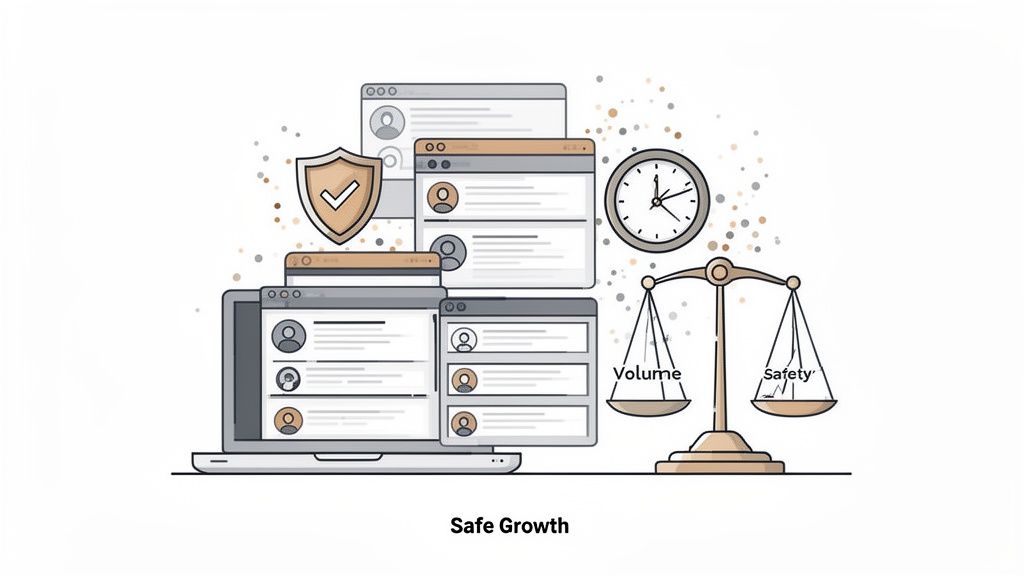
Let's be honest—the biggest fear when scaling is waking up to a restricted account. It’s a gut-wrenching moment that kills momentum. So, how do you ramp up volume without setting off LinkedIn's alarm bells?
Think like a human, not a bot. 🤖➡️👨💼
- -Use Conservative Rate Limits: LinkedIn doesn't publish its official limits, so playing it safe is the only smart move. Stay well under the commonly discussed thresholds for connection requests and messages.
- -Embrace Randomization: A good automation tool should allow you to randomize the timing and volume of your outreach. Sending 100 messages at 9:00 AM sharp every day is a huge red flag. Spreading activity throughout business hours looks far more natural.
- -Vary Your Activity: Don’t just automate outreach. A healthy account mixes automated connection requests with manual activities like engaging with posts, sharing articles, and sending one-off personalized DMs to high-value targets.
- -Warm-Up All New Accounts: Never take a brand new account and immediately hit max volume. A proper warm-up process, gradually increasing activity over several weeks, is essential for building trust with the platform.
- -Use Multiple Accounts: For significant scale, relying on a single account is too risky. Distributing the load across several team members is the professional standard. For advanced teams, you can learn how to create a LinkedIn farm and automate multiple accounts to distribute volume compliantly and effectively.
Scaling Team & Processes
As you grow, your ad-hoc processes will break. Scaling requires intention and structure, especially when it comes to your team.
- -Hiring New Team Members: Develop a clear onboarding process. New reps should know exactly what to do from day one, from setting up their profile to understanding the messaging strategy.
- -Process Documentation: Document everything. Create a playbook that outlines your targeting criteria, messaging templates, follow-up cadences, and lead handoff procedures. This is your single source of truth.
- -Workflow Standardization: A consistent approach across the team ensures quality and makes performance easier to track. Everyone should be using the same tools and following the same core steps.
- -Training & Enablement: Don’t just hand someone a login. Ongoing training on tools, messaging best practices, and LinkedIn's evolving rules is crucial for team alignment and success.
- -Performance Tracking: Implement dashboards to track both individual and team metrics. This fosters accountability and helps you quickly identify who is excelling and who might need more support.
Scaling Infrastructure & Tools
Your tech stack is the backbone of your scaling efforts. Can it handle the pressure?
- -CRM Capacity: Will your CRM choke on a 5x increase in data? Ensure it can handle the influx of new contacts and activities without slowing down.
- -Automation Tool Limits: Check the limits of your automation platform. Does it support the number of accounts and volume you're planning for? Many entry-level tools have surprisingly low ceilings.
- -Integration Performance: Test your integrations. Will your LinkedIn automation tool sync seamlessly with your CRM, email sender, and calendar booking app at higher volumes? A broken sync can bring everything to a halt.
- -Analytics & Reporting: You can't optimize what you can't measure. Make sure your setup allows you to track all key metrics, from top-of-funnel outreach to bottom-of-funnel conversions.
- -Backup Systems: What happens if your primary tool goes down? Having a plan B, even if it's a more manual process, provides crucial redundancy and peace of mind.
Common Scaling Mistakes
Why learn from your own costly mistakes when you can learn from others? Users and agencies consistently report hitting the same roadblocks. Avoid these common pitfalls:
- -Mistake 1: Scaling Too Fast: The #1 reason for account restrictions. The pressure to hit a number leads to cranking the dials to 11, and LinkedIn's hammer comes down. Solution: Gradual, 10-20% weekly increases.
- -Mistake 2: Losing Personalization: As volume grows, personalization is often the first casualty. Generic templates tank reply rates. Solution: Use dynamic templates with personalized snippets and enforce quality standards.
- -Mistake 3: Poor Quality Control: Your pipeline fills with bad-fit leads, wasting your sales team's time. Solution: Regularly review your targeting (ICP) and lead qualification criteria.
- -Mistake 4: Ignoring Account Health: Not monitoring accounts daily is like driving with your eyes closed. You won't see the warning signs until it's too late. Solution: Make daily account health checks a non-negotiable team ritual.
- -Mistake 5: Inadequate Training: Assuming everyone knows how to write a great message or use the tools is a recipe for failure. Solution: Implement a robust onboarding and continuous training program.
Scaling Timeline & Milestones
Scaling doesn't happen overnight. Here is a realistic 5-month roadmap based on successful team rollouts.
- -Month 1: Optimize & Baseline: Focus on optimizing your current workflows. Don't increase volume yet. Establish your baseline metrics for connection, reply, and conversion rates.
- -Month 2: Test Volume Increase: Begin to increase volume by ~20%. Monitor all metrics and account health obsessively. If everything looks good, maintain this new pace.
- -Month 3: Expand to New Segments: With a stable process, start testing campaigns on one new, adjacent audience segment. Compare performance against your original cohort.
- -Month 4: Add Team Members: Begin onboarding new team members. Use your documentation and training process to get them up to speed and contributing to the overall volume.
- -Month 5 & Beyond: Continuous Optimization: Now you have a scalable system. The focus shifts to continuous improvement: testing new messages, exploring new segments, and refining workflows for even greater efficiency.
Real-World Scaling Case Studies
Theory is great, but what does this look like in practice?
- -Case Study 1: SaaS Team (1 to 5 Reps): A SaaS startup scaled from one founder doing outreach to a team of 5 SDRs. They created a central playbook with message templates and ICP definitions. By distributing volume across 5 warmed-up accounts and using strict quality control, they tripled their monthly demo bookings in 4 months without a single account restriction.
- -Case Study 2: B2B Services (Expanding to New Markets): A marketing agency that successfully served clients in North America wanted to expand into the UK. They cloned their proven campaigns, adjusted the messaging for cultural nuances, and ran a pilot program on one new account. After seeing positive initial results (22% reply rate), they scaled to a full team focused on the UK market.
- -Case Study 3: Enterprise Team (50+ Reps): An enterprise company with a large sales team faced chaos. Outreach was inconsistent and untracked. They implemented a centralized automation platform, standardized their messaging, and created dashboards to track team-wide and individual performance. This brought order to their process and increased qualified pipeline by 40% in 6 months by identifying and scaling the tactics of their top performers.
Scaling Metrics & KPIs
To scale successfully, you need to track the right things. Your dashboard should focus on these key areas:
- -Volume Metrics: Connection requests sent, messages sent, profiles viewed. (Your output)
- -Quality Metrics: Connection acceptance rate, reply rate, positive reply rate, conversion rate (e.g., meetings booked). (Your results)
- -Efficiency Metrics: Time spent per lead, cost per meeting booked. (Your ROI)
- -Account Health Metrics: Number of warnings or restrictions (should be zero!), Social Selling Index (SSI). (Your sustainability)
- -Team Performance: Individual and aggregate metrics for all of the above. (Your team's effectiveness)
Ready to Scale the Smart Way?
We’ve covered a lot, from laying the right foundation to the nitty-gritty of high-volume outreach. If you take away one thing, let it be this: LinkedIn automation scaling is a discipline, not a sprint.
The teams that win are methodical. They obsess over quality, document their processes, and use technology to augment—not replace—human connection. The fear of account restrictions is real, but it shouldn't paralyze you. Smart, deliberate growth is not only possible, it's the key to unlocking a massive competitive advantage.
So, what's your next step?
Go back to the pre-scaling assessment. Where do you stand right now? Identifying that one area for improvement is the first step. From there, you can confidently take the next one, whether it’s increasing volume by just 10% or documenting your messaging templates.
That’s how real, sustainable growth is built.
Need help building your scaling plan? Our team has seen what works (and what doesn't) across hundreds of companies. Let's talk about a scaling consultation.
FAQ
How do I know the "safe" limits for LinkedIn automation in 2024?
LinkedIn doesn't publish official numbers, and they change constantly. Based on widespread user feedback, a conservative approach is best. For a fully warmed-up account, many experts suggest staying under 80-100 connection requests per week (not per day) and a similar number of new message threads to non-connections. The key is to start low, monitor your account's response, and increase gradually.
Is it better to scale with one "super-powered" account or multiple team accounts?
Multiple accounts, without a doubt. Relying on a single account creates a single point of failure. If it gets restricted, your entire pipeline shuts down. Distributing volume across multiple, genuine team member profiles is not only safer but also looks more authentic to prospects who see outreach coming from different people at your company.
My reply rates dropped after I started scaling. What's the most likely cause?
This is a classic symptom of sacrificing quality for quantity. The two most common culprits are:
- Diluted Personalization: Your messages have become too generic. Go back and audit your outreach. Is there a genuine, specific reason you're contacting each person?
- Expanded Targeting: You may have broadened your audience too much, and are now reaching less-relevant prospects. Narrow your ICP focus back to the core audience that was working before.

More High-Intent Leads = Your New Growth Engine.
Start Now and Get New High Intent Leads Delivered Straight to Slack or Your Inbox.