
AI SDR Best Practices: How to Maximize Results & Avoid Common Pitfalls

Ever wonder why some sales teams see explosive growth with AI Sales Development Representatives (SDRs) while others just… don’t? Here's a not-so-secret secret: teams following AI SDR best practices often see 3x better results. So what's the difference-maker? 🤔
It isn't the tool itself, but the playbook behind it. Many AI SDR rollouts fail not because the technology is flawed, but because of weak strategy and execution. A powerful engine is useless without a skilled driver and a clear map. Without a solid framework, teams often end up with generic outreach, messy data, and a frustrated sales force wondering where the promised pipeline is. This is where a proven framework to implement, optimize, and scale successfully becomes a game-changer.
In this guide, we're cutting through the noise to give you that actionable framework. You'll learn the pre-launch checklists, launch-day tactics, optimization cadences, and scaling strategies that separate the top-performing teams from the rest. Ready to turn potential into a predictable, revenue-generating machine? Let’s dive in. 🚀
Pre-Launch Best Practices
Setting the stage correctly is half the battle. Rushing into an AI SDR implementation without a solid foundation is like building a house on sand. What should you do before you even hit "go"?
- -Define Clear Goals and KPIs: What does success actually look like? Is it booking 20% more meetings, reducing cost-per-lead by 30%, or saving each SDR 5 hours a week? Get specific and align everyone on the primary objective.
- -Audit Your Data Quality: Your AI is only as good as the data it learns from. Before you begin, audit your CRM for accuracy. Are contact fields complete? Is your data clean and de-duped? This step is non-negotiable.
- -Assess Your Tech Stack: How will the AI SDR fit into your existing ecosystem? Map out its integrations with your CRM (e.g., Salesforce, HubSpot), email platform (e.g., Google Workspace, Outlook), and communication tools.
- -Set Up Tracking and Analytics Correctly: Ensure you have the right dashboards and reporting in place to measure your KPIs from day one. You can't optimize what you can't measure.
- -Prepare Your Team: This is a change management exercise. Train your sales team on how the AI SDR works, what their role is, and how it benefits them. Proactive enablement turns skepticism into adoption.
- -Choose the Right Tool: Not all AI SDRs are created equal. Evaluate platforms based on their integration capabilities, personalization features, data sources, and budget fit. Does it align with your specific use case?
Data Quality: The Foundation of Success
Let's be blunt: "garbage in, garbage out" has never been more true than with AI. Your AI SDR can craft the perfect message, but if it's sent to the wrong person or bounces, it’s all for nothing. Why does data quality matter so much? Because it directly impacts deliverability, personalization accuracy, and ultimately, your ROI.
Cleaning Your CRM Before Launch
Before you let any AI touch your data, it's cleanup time.
- -Do: Run a de-duplication process on your contacts and accounts. Standardize fields like job titles and state names.
- -Don't: Assume your data is "good enough." Small inaccuracies compound into major problems at scale.
Enriching and Validating Contact Information
Once clean, it's time to enrich.
- -Do: Use tools to verify email addresses and append missing data points like direct dials or LinkedIn profiles. This ensures your outreach actually lands.
- -Don't: Rely on a single data source. Cross-referencing multiple providers often yields more accurate results for critical accounts.
Maintaining Ongoing Data Hygiene
Data hygiene isn't a one-time project; it's an ongoing process.
- -Do: Implement automated rules that clean and validate new leads as they enter your system. Schedule quarterly data refreshes to catch stale information.
- -Don't: Let your CRM become a data graveyard. Inactive or unverified contacts should be archived or re-engaged through separate campaigns.
Ready to build a resilient data foundation? The first step is to implement a system that automatically verifies and enriches new leads the moment they enter your CRM.
Personalization at Scale: The Golden Rule
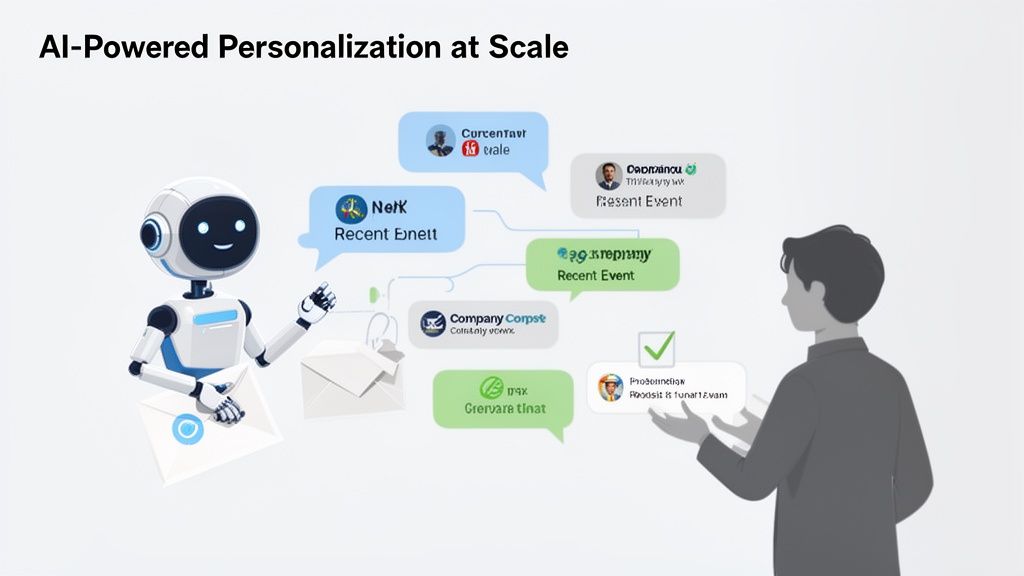
The days of sacrificing personalization for volume are over. One of the most transformative AI SDR best practices is leveraging AI to generate highly personalized outreach at a scale previously unimaginable. Instead of relying on generic {FirstName} and {Company} tokens, AI can now analyze a prospect’s LinkedIn profile, company news, and role-specific challenges to craft messages that feel genuinely one-to-one.
Why Generic Templates Fail
Prospects can spot a generic, mass email from a mile away. It signals a lack of research and respect for their time, leading to instant deletion. Truly personalized messages, on the other hand, demonstrate you've done your homework.
How to Create Truly Personalized Messages
- -Do: Prompt your AI to reference specific "trigger events"—like a recent funding round, a new executive hire, or a post they shared on LinkedIn. This makes your outreach timely and relevant.
- -Don't: Just insert a fun fact about their company. Connect that fact back to a pain point your solution can solve.
A/B Testing Personalization Approaches
- -Do: Test which personalization hooks resonate most. Do prospects respond better to mentions of their personal achievements or their company's strategic initiatives? Let the data decide.
- -Don't: Run tests without a clear hypothesis and a large enough sample size to get statistically significant results.
Balancing Automation with the Human Touch
- -Do: Use AI to generate the first draft, but have a human SDR review and approve messages for high-value prospects. This "human-in-the-loop" approach prevents awkward phrasing and ensures brand voice consistency.
- -Don't: Let the AI run completely unchecked. A small mistake can damage your brand's reputation.
Your next step? Establish a human review workflow for your most important outbound sequences. It's the ultimate quality control.
Message Crafting Best Practices
Even with perfect data and personalization, a poorly crafted message will fall flat. How do you ensure your AI-generated outreach actually drives action?
Subject Lines That Drive Opens
- -Do: Focus on relevance, curiosity, and urgency. A great subject line is specific and benefit-oriented (e.g., "Idea for scaling [Company Name]'s SDR team").
- -Don't: Use clickbait or all caps. It looks like spam and hurts deliverability.
Email Body: Short, Value-First, Clear CTA
- -Do: Keep it concise (under 125 words is a good benchmark). Start with a value proposition tailored to the prospect, and end with a single, clear call-to-action (e.g., "Is this a priority for you right now?").
- -Don't: Talk about yourself or your company's history. The prospect only cares about what you can do for them. For more tips, check out this guide on how to write professional emails that get better, faster replies.
Multi-Channel Sequencing (Email, LinkedIn, SMS)
- -Do: Create a logical flow across channels. An email followed by a LinkedIn connection request two days later feels persistent, not pestering.
- -Don't: Blast every channel at once. Use engagement signals to guide your next move. No email reply? Try LinkedIn next.
Tone and Voice
- -Do: Define brand voice guardrails for your AI. Is your tone professional and authoritative, or friendly and conversational? Consistency is key.
- -Don't: Let the AI default to a generic, robotic tone. Inject your brand's personality into the prompts.
Targeting & Segmentation Best Practices
Who you target is just as important as what you say. A "spray-and-pray" approach is a recipe for failure. An effective AI SDR strategy relies on surgical precision.
Define Your ICP (Ideal Customer Profile)
- -Do: Analyze your best customers. What do they have in common regarding industry, company size, revenue, and technology stack? Use this data to build a crystal-clear ICP.
- -Don't: Rely on gut feelings. Your ICP should be a data-driven blueprint, not a rough guess.
Segment by Industry, Role, Company Size, and Intent Signals
- -Do: Create micro-segments to make your messaging hyper-relevant. An email to a VP of Sales at a SaaS startup should be very different from one to a Director of Operations at a manufacturing firm.
- -Don't: Use a one-size-fits-all message for your entire target market.
Using Intent Data and Buying Signals

- -Do: Prioritize outreach to prospects demonstrating active buying behavior—visiting your pricing page, researching competitors, or hiring for a key role. These are your warmest leads.
- -Don't: Treat all prospects equally. High-intent leads should be fast-tracked for immediate, personalized follow-up.
Ready to sharpen your targeting? Start by defining and documenting your negative personas—the types of companies and roles you absolutely should not be targeting.
Integration Best Practices
Your AI SDR shouldn't operate in a silo. Seamless integration with your core tech stack is essential for creating a smooth, automated workflow.
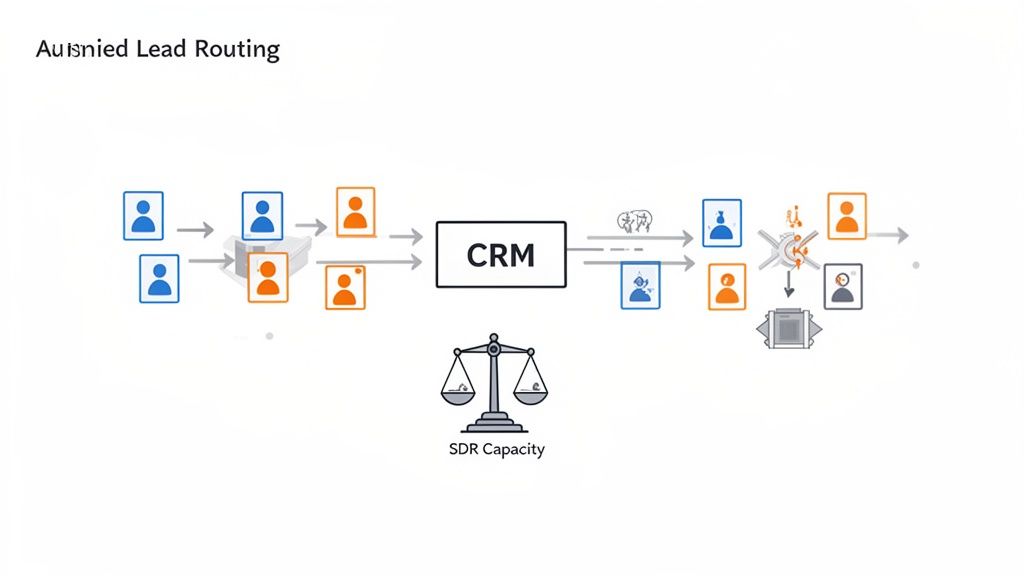
- -CRM Integration: A clean, bi-directional data flow is non-negotiable. Your AI needs to read from and write to your CRM in real-time to avoid duplicates and ensure all activity is logged correctly.
- -Email Platform Integration: This is crucial for tracking opens and replies, managing deliverability, and ensuring compliance with opt-out requests.
- -Calendar Integration: Automate the final step! When a prospect agrees to a meeting, the AI SDR should be able to access your reps' calendars and book a slot automatically.
- -Slack/Teams Alerts: Set up real-time notifications for key events, like when a hot lead replies or a meeting is booked. This keeps the team informed and momentum high.
- -Data Security and Privacy: Ensure all integrations comply with GDPR, CCPA, and other data privacy regulations. Data must be encrypted in transit and at rest.
Action Step: Before a full launch, thoroughly test every integration in a sandbox environment to catch any sync errors or data mapping issues.
Launch Best Practices
A successful launch is methodical, not monumental. How do you roll out your AI SDR in a way that minimizes risk and maximizes learning?
- -Start with a Pilot: Don't go all-in at once. Launch with a small, controlled segment and one clear use case (e.g., qualifying inbound leads from a specific region).
- -Establish Baseline Metrics: Before the pilot, document your pre-AI SDR performance. What's your current response rate and meeting booked rate? You need this baseline to measure impact.
- -Monitor Closely: In the first few weeks, conduct daily or weekly reviews. What's working? What's not? Are there any unexpected AI behaviors?
- -Adjust Prompts and Settings: Use early learnings to refine your AI's prompts and targeting rules. The goal of the pilot is to learn and iterate quickly.
- -Keep Team Communication Tight: Be transparent with the sales team. Share early results (both good and bad) and actively solicit their feedback. This builds trust and buy-in.
- -Document Everything: Keep a running log of what you've tested, what worked, what failed, and why. This documentation will become your playbook for scaling.
Optimization Best Practices
Launch is just the beginning. The best teams treat AI SDR optimization as a continuous process, not a one-time setup.
- -Weekly Performance Reviews: Dedicate time each week to review key metrics and qualitative feedback from the sales team. Look for trends and opportunities for improvement.
- -A/B Testing: Always be testing. Systematically test different subject lines, messaging hooks, CTAs, channels, and timing to find what resonates most with your audience.
- -Prompt Refinement: Your prompts are your primary lever for controlling the AI's output. Continuously tweak them to improve the quality, consistency, and relevance of the messaging.
- -Feedback Loops: Create a formal process for SDRs to report back on lead quality and conversation outcomes. This frontline feedback is gold for refining your AI's targeting and qualification criteria.
- -Iterative Improvements: Focus on making small, incremental changes. Compounding gains from consistent, minor tweaks often lead to massive performance improvements over time.
Scaling Best Practices
Once your pilot is successful and you've found a repeatable process, it's time to scale. But how do you grow without sacrificing quality?
- -Expand Gradually: Don't open the floodgates. Scale one use case, region, or team segment at a time. This allows you to maintain control and ensure a smooth rollout.
- -Maintain Quality as Volume Increases: Put quality control checks in place. For example, have a human spot-check a random sample of 5% of AI-generated messages each day to ensure standards aren't slipping.
- -Enable and Train New Team Members: As you add more users, ensure they receive proper training on the AI SDR platform, your established best practices, and your team's specific playbooks.
- -Standardize Documentation: Your pilot documentation should be turned into a standardized playbook that any new team member can pick up and understand.
- -Monitor for Quality Degradation: Keep a close eye on your core KPIs (like response rate and positive sentiment). A dip can be an early warning sign that quality is suffering as volume increases. Fix it fast.
Team Collaboration Best Practices
An AI SDR isn't a solo act; it's a powerful member of your revenue team. Success requires tight collaboration between Sales, Marketing, and RevOps.
- -Clear Handoffs: Define the exact trigger and process for handing a qualified lead from the AI SDR to a human rep. Who gets the lead? What information do they need? It must be seamless.
- -Weekly/Bi-weekly Sync Meetings: Get the key stakeholders in a room to review performance, discuss challenges, and align on priorities.
- -Structured Feedback Mechanisms: Create a simple way for reps to give feedback on lead quality (e.g., a dropdown in the CRM, a dedicated Slack channel). This makes feedback easy to give and easy to analyze.
- -Ongoing Training and Enablement: As the AI evolves, so should your team's skills. Regular training sessions keep everyone up-to-date on new features and strategies.
- -Celebrate Wins: When the AI SDR books a big meeting or helps close a deal, celebrate it publicly. This reinforces its value and boosts morale.
Compliance & Legal Best Practices
Moving fast can't come at the cost of moving responsibly. Ignoring compliance can lead to massive fines, damaged brand reputation, and crippling email deliverability.
- -GDPR/CCPA: Understand and respect data privacy laws. Ensure you have a lawful basis for processing personal data and a clear process for handling data subject requests.
- -CAN-SPAM: Follow the rules for commercial email. This includes providing a clear and conspicuous way to opt out and honoring those requests promptly.
- -LinkedIn Terms of Service: Be aware of LinkedIn's rules around automation. Excessive or spammy behavior can get your account restricted.
- -Deliverability Best Practices: Protect your domain's reputation. This means maintaining good list hygiene, warming up new sending domains, and monitoring your sender score.
- -Ethical AI Practices: Be transparent about your use of AI where appropriate. Strive to eliminate bias in your targeting and messaging. For a deeper dive, users often look into guides on AI governance and risk management principles to build a responsible framework.
Common Mistakes & How to Avoid Them
Learning from others' missteps is a great way to accelerate your own success. Here are some common pitfalls and how to steer clear of them.
- -Expecting Immediate Results: AI SDRs need time to learn and be optimized. Don't expect a massive pipeline overnight. The fix: Plan for a 30-60 day pilot and optimization period before expecting significant ROI.
- -Ignoring Data Quality: This is the most common reason for failure. The fix: Dedicate time and resources to cleaning and enriching your CRM data before you launch. Make data hygiene an ongoing process.
- -Over-automating Without Personalization: An AI that sends generic, robotic messages is just a sophisticated spam cannon. The fix: Implement a "human-in-the-loop" review process for high-value outreach and continuously refine prompts for authenticity.
- -Poor Targeting and Segmentation: Sending the right message to the wrong person is a waste of effort. The fix: Build a data-driven ICP and create micro-segments based on industry, role, and intent signals.
- -Not Training the Team: If your reps don't understand how the AI works or how to collaborate with it, they won't adopt it. The fix: Invest in comprehensive training and clear documentation. Frame the AI as a tool that helps them, not replaces them.
- -Tracking the Wrong KPIs: Focusing on vanity metrics like emails sent instead of revenue metrics like meetings booked is a classic mistake. The fix: Align your KPIs with business outcomes—qualified pipeline and revenue.
KPIs & Metrics: What to Track
You are what you measure. Focus on metrics that directly reflect the AI SDR's impact on revenue.
Activity Metrics
- -Lead Volume and Lead Quality Score
- -Response Rate and Positive Response Rate
Conversion Metrics
- -Conversion Rate (Lead → Meeting → Opportunity)
- -Cost per Lead and Cost per Opportunity
Business Impact Metrics
- -Time Saved Per Rep
- -ROI and Payback Period
- -Team Adoption and Satisfaction Score
Real-World Case Studies
How do these best practices play out in the real world? Marketers find that applying a structured framework leads to tangible results.
Case Study 1: B2B SaaS Scale-Up
- -Company: A 150-person SaaS company in the martech space.
- -Challenge: Their 10-person SDR team was struggling to hit pipeline targets due to time spent on manual research and outreach.
- -Solution: They implemented an AI SDR focused on personalization at scale, using company funding announcements and new marketing hires as personalization hooks.
- -Results: They saw a 3x increase in positive response rates and booked 40% more meetings in the first quarter, all while saving each SDR an average of 8 hours per week.
Case Study 2: Enterprise Logistics Firm
- -Company: A large logistics provider targeting enterprise accounts.
- -Challenge: Their "spray-and-pray" email blasts had a sub-1% reply rate and were damaging their domain reputation.
- -Solution: They adopted an AI SDR strategy centered on data quality and ICP-based filtering. They enriched their data and focused the AI exclusively on accounts showing high-intent signals.
- -Results: Their email bounce rate dropped from 15% to under 2%. While they sent fewer emails, their meeting booked rate increased by 200% because they were only engaging best-fit, high-intent accounts.
You've just navigated a comprehensive playbook of AI SDR best practices. The journey from a manual, often frustrating prospecting process to a streamlined, AI-powered pipeline engine is about systematically implementing a smarter framework.
The ultimate goal of adopting these AI SDR best practices is to build a predictable, scalable revenue engine that empowers your sales team to do what they do best: build relationships and close deals. By embracing a mindset of continuous improvement and strategic implementation, you’re not just keeping up with the future of sales—you're defining it. Your next great opportunity is waiting. Go get it. 🚀
Ready to see how a purpose-built platform can automate these best practices for you? GojiberryAI is designed to be your intelligent prospecting engine, handling everything from real-time intent tracking and data enrichment to personalized, multi-channel outreach. Stop wrestling with disparate tools and start receiving a daily stream of high-intent, meeting-ready leads by visiting GojiberryAI to see how it works.
Frequently Asked Questions
How do you measure the ROI of an AI SDR?
To accurately measure ROI, you need to look beyond simple activity metrics. The best formula is: (Value of Pipeline Generated by AI SDR - Cost of AI SDR Platform) / Cost of AI SDR Platform. Value of Pipeline is calculated by (Meetings Booked by AI * Opportunity Conversion Rate * Average Deal Size). Also factor in "soft ROI" like hours saved per human SDR, which can be reallocated to high-value selling activities.
Will an AI SDR replace our human SDRs?
Based on current user feedback and market trends, the answer is no. The best-performing teams use AI SDRs to augment their human teams, not replace them. The AI handles the top-of-funnel, repetitive tasks—prospecting, personalizing initial outreach, and booking meetings—freeing up human SDRs to focus on building relationships, handling complex objections, and strategic selling activities. It's a collaborative model.
What is the most common point of failure when implementing an AI SDR?
The single most common failure point, according to industry reports, is poor data quality. If your CRM is full of outdated contacts, duplicates, and inaccurate information, the AI will fail. It will send messages to the wrong people, experience high bounce rates that damage your domain, and make personalization errors. A thorough data audit and cleanup before implementation is the most critical step you can take.
How long does it typically take to see results from an AI SDR?
While some initial results like increased outreach volume are immediate, most teams report seeing a significant, measurable impact on pipeline and booked meetings within 60 to 90 days. This period is crucial for the initial pilot, gathering data, and making the first few rounds of optimizations to messaging, targeting, and prompts. Patience during this initial learning phase is key.

More High-Intent Leads = Your New Growth Engine.
Start Now and Get New High Intent Leads Delivered Straight to Slack or Your Inbox.