
How AI Agent Automation Builds Your B2B Sales Pipeline (While You Sleep)

Imagine your B2B sales team waking up every morning to a fresh pipeline of high-intent leads. They didn't have to lift a finger to find them. Sound too good to be true? That’s the reality of AI agent automation—it’s not just another tool, but a complete overhaul of how modern sales pipelines get built. 🚀
The New Era of B2B Prospecting
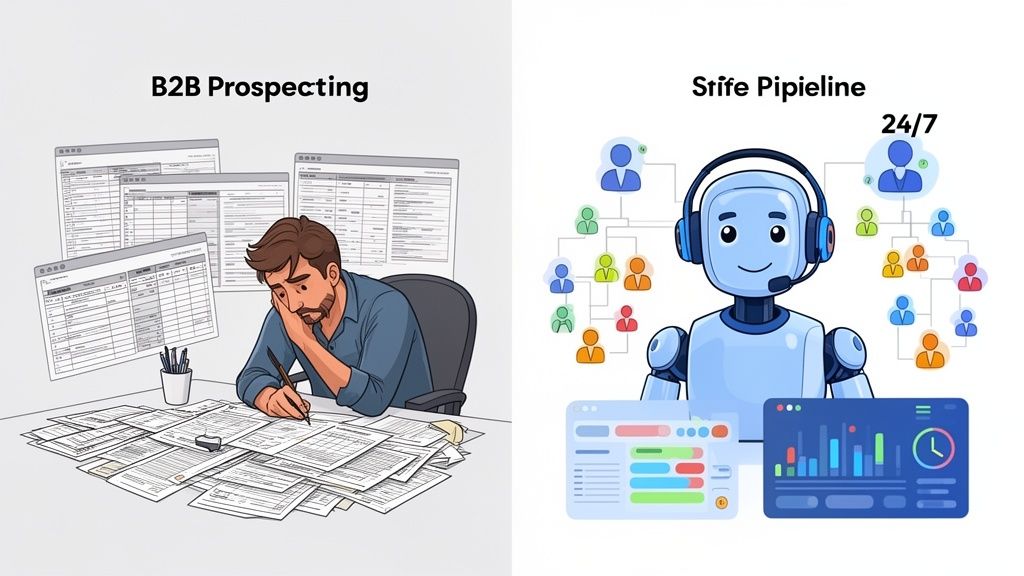
Let’s be honest: traditional prospecting is a grind. It’s an endless cycle of scrolling through LinkedIn, digging for contact info, and making educated guesses about who might actually be ready to buy. It’s time-consuming, often demoralizing, and the data you find is usually stale by the time you use it.
Now, picture a different scenario. Instead of you hunting for leads, an intelligent system finds them for you, 24/7. This is what AI agent automation brings to the table.
So, What Exactly Is an AI Agent?
Think of an AI agent as your most efficient virtual team member—a sales development rep (SDR) that never sleeps. These aren't just simple scripts or chatbots; they are autonomous systems designed to perform a loop of tasks on their own.
- -Perceive: They constantly monitor the digital world for specific buying signals, like key executive job changes, a company receiving new funding, or even certain keywords popping up in online discussions.
- -Decide: When they detect a signal, they instantly analyze whether the potential lead matches your Ideal Customer Profile (ICP).
- -Act: If it’s a match, the agent takes the next logical step. This could be enriching the lead's data with verified contact info and pushing it directly into your CRM for the sales team to follow up.
It's important to distinguish between an AI agent and a chatbot. A chatbot is reactive, waiting for a user to start a conversation. An AI agent is proactive; it independently seeks out opportunities and executes complex tasks without being prompted.
This isn't just a niche trend; it's a market on the verge of exploding. Market research projects the global AI agents market will grow from USD 7.84 billion in 2025 to a massive USD 52.62 billion by 2030. This growth is all about the power of autonomous systems to act on real-time signals—the very engine that fuels tools like GojiberryAI to find warm leads.
Why This Is a Game-Changer for Sales Teams
The move to AI agent automation means leaving behind a manual, often frustrating process for an intelligent, intent-driven one. It’s about swapping guesswork for data-backed precision. By tracking real-time events across the web, these agents pinpoint prospects at the exact moment they show they’re ready to buy.
There are many types of buying indicators, but learning about these 13 intent signals is a great place to start understanding what AI can track.
So, how much of a difference does it really make? Here's a quick comparison.
Manual Prospecting vs. AI Agent Automation
| Task | Manual Prospecting (The Old Way) | AI Agent Automation (The New Way) |
|---|---|---|
| Lead Sourcing | SDRs spend hours on LinkedIn, manually searching for profiles. | AI agents scan millions of data points 24/7 to find ICP-fit leads. |
| Intent Detection | Relies on guesswork or lagging indicators like website visits. | Identifies real-time buying signals (e.g., job change, new tech) instantly. |
| Data Enrichment | Manually finding emails and phone numbers, often with low accuracy. | Automatically enriches lead data with verified, up-to-date contact info. |
| CRM Entry | Tedious, error-prone manual data entry for every new lead. | Pushes clean, enriched lead data directly into your CRM, no typing needed. |
| Scalability | Limited by the number of hours an SDR can work in a day. | Infinitely scalable; can monitor and process thousands of signals at once. |
| Timing | Contact is often made days or weeks after a buying signal appears. | Enables outreach within hours or minutes of an intent signal. |
This shift isn't about replacing your sales team; it’s about freeing them up to do what they do best: building relationships and closing deals.
Ready to see how these agents actually pull it off? Let’s dive in. 👇
How AI Agents Find Your Next Customer
So, how do these AI agents actually work? It might seem like a black box, but the process is surprisingly logical. It’s a repeatable system that’s a world away from the simple, brittle scripts of the past.
The easiest way to think of an AI agent is to break it down into three core parts: the brain, the senses, and the hands.
- -🧠 The Brain: This is the Large Language Model (LLM), the same kind of technology that powers tools like ChatGPT. It’s the reasoning engine, giving the agent the ability to understand context, make judgments, and decide if a potential lead is actually a good fit for you.
- -👂 The Senses: These are the signal trackers. The agent is constantly scanning the digital world for specific triggers—things like job changes on LinkedIn, fresh funding announcements, a company adopting new tech, or even keywords popping up in online forums.
- -✋ The Hands: These are the action-takers. Once the brain makes a call based on what the senses have found, the hands get to work. This could mean finding verified contact info for a lead or pushing a complete profile right into your CRM.
This trio works together in a continuous loop, delivering a steady stream of high-quality leads without you having to lift a finger.
The Anatomy of an AI Prospecting Play
Let's walk through what this looks like in the real world. Imagine you sell project management software to fast-growing tech companies. Here’s how your AI agent would operate:
- Detect a Trigger Event: The agent’s "senses" pick up a huge buying signal: a Series B startup just announced a $50 million funding round on a tech news site. New funding almost always means new software purchases.
- Cross-Reference with Your ICP: The "brain" immediately gets to work. It analyzes the startup against your Ideal Customer Profile (ICP). Is it in the right industry (SaaS)? Does it have the right number of employees (50-250)? Have they been hiring lately? It’s a match.
- Identify the Key Decision-Maker: Next, the agent needs to find the right person to contact. It scans the company’s recent activity and discovers they just hired a new "VP of Operations"—the perfect contact for a conversation about project management tools.
- Enrich the Lead's Data: Now the "hands" take over. The agent uses professional networks and data providers to find and verify the new VP’s corporate email and direct phone number, making sure the information is accurate and up-to-date.
- Execute the Final Action: The final step is to push this fully vetted, high-intent lead directly into your CRM. The agent creates a new contact, adds a note explaining the outreach reason ("New VP Hire + Recent Funding"), and assigns it to a sales rep for immediate follow-up.
From Social Chatter to Sales Pipeline
It’s not just about major news, either. The real power of these agents is their knack for connecting seemingly random dots across the web.
An agent might, for example, notice a marketing manager at a target company complaining on a LinkedIn post about the challenges of "scaling content production." The agent identifies this as a clear pain point. It then confirms the manager’s role and company, enriches their contact data, and flags them as a warm lead for your content marketing software.
Trying to do this kind of granular, intent-based prospecting manually is nearly impossible to scale.
This is where the true value of AI for lead generation really shines—it’s about finding structure in the chaos of online conversations and turning them into real sales opportunities. You can dive deeper into how AI is transforming lead generation in our detailed guide.
Ready to see how you can apply these agents to your own sales process? Let's get into some specific, high-impact use cases.
Putting AI Agents to Work in Your Pipeline
Theory is great, but seeing is believing, right? Let’s move beyond the abstract and look at how AI agent automation is actually changing the game for B2B sales teams on a daily basis. These aren't far-off concepts; they are high-impact applications you can put into play right now.
Based on industry research, the AI agent market is exploding. Seriously. Projections show it ballooning from around USD 2.2 billion in 2025 to an incredible USD 46.3 billion by 2033. That’s a compound annual growth rate (CAGR) of 46.9%. This isn't just hype—it shows how profoundly AI is reshaping the world of prospecting, with deep learning poised to bring even more sophisticated personalization to outreach.
At its core, the process is beautifully simple. It boils down to three steps that turn raw signals into real opportunities.

This simple flow—Signal, Analyze, Action—is the engine behind every powerful AI prospecting workflow. It’s how messy, chaotic data gets transformed into a clean, actionable sales pipeline.
Automated Lead Scoring and Qualification
We’ve all been there. You get a list of a few hundred MQLs from a webinar, knowing that maybe 5% are actually a good fit. It's a classic time-sink.
- -The Old Way: Your SDRs spend the first half of the week manually slogging through the list. They’re jumping between LinkedIn, the company website, and other tools, trying to figure out if someone has budget authority. By the time they find a gem, three days have passed.
- -The New Way: An AI agent plugs directly into your lead sources. It instantly vets every new entry against your Ideal Customer Profile (ICP), analyzing dozens of data points—job title, company size, tech stack, recent hiring trends—and scores them in real-time. Only leads scoring above an 8/10 are routed to your sales team, complete with a note explaining why they’re a priority.
The result? Your reps spend their time talking to high-potential buyers, not digging for them. It’s a massive boost to both efficiency and morale.
Real-Time Data Enrichment
Let's face it: bad data kills sales. An SDR can easily spend 20% of their time—a full day each week—just hunting down and verifying contact information.
- -The Old Way: An SDR finds a perfect prospect on LinkedIn but has no email. They fire up a clunky browser extension that offers three guesses. They try one, it bounces. They try another, crickets. An hour is gone with nothing to show for it.
- -The New Way: The moment an AI agent qualifies a lead, it automatically enriches the profile with a verified corporate email and a direct-dial phone number. This happens in seconds, not hours. The lead lands in the CRM, fully loaded and ready for immediate outreach.
This isn’t just about moving faster; it’s about accuracy. Teams using agent-driven enrichment report dramatically lower bounce rates and higher connect rates. Their messages are actually getting through.
Autonomous CRM Management
Nobody enjoys manual CRM entry. It’s tedious, error-prone, and the main reason reps get bogged down in admin work instead of actually selling.
- -The Old Way: It's the end of a long day, and your rep has 15 new contacts to manually add to the CRM. They copy and paste names, titles, and companies, inevitably creating duplicate records and forgetting to log important context.
- -The New Way: An AI agent acts as a diligent gatekeeper for your CRM. When it finds a new, ICP-fit lead, it first checks for existing records. If none exist, it creates a new, perfectly formatted contact, populates it with all the enriched data, logs the original buying signal, and assigns it to the right rep based on your territory rules.
This keeps your CRM pristine and reliable, turning it into a true source of truth instead of a messy database. For a deeper look, see how an AI SDR can put these tasks on complete autopilot.
Proactive LinkedIn Engagement
Warming up a lead before you send that first email can make all the difference. But who has time to monitor the social activity of hundreds of prospects? Your AI agent does. 😉
- -The Old Way: Your team knows they should be engaging on LinkedIn, but it’s sporadic at best. A top prospect posts something incredibly relevant, but your reps miss it because they're buried in calls.
- -The New Way: You can task an agent to monitor the LinkedIn activity of key prospects in your pipeline. When a decision-maker posts about a challenge your product solves, the agent can draft an insightful, non-salesy comment to add to the conversation. It then flags the comment for human approval before posting.
This kind of intelligent engagement gets you on a prospect's radar in an authentic, helpful way. When your outreach finally lands, it feels less like a cold interruption and more like the next step in a conversation that's already started.
Your AI Agent Implementation Checklist
Alright, you see the potential and you're ready to make a move. But where do you actually start? The idea of launching an AI agent automation system can feel massive, but breaking it down into a clear, step-by-step process makes it totally manageable.
Think of this as your no-fluff roadmap. Let's walk through the exact steps to get you from zero to an automated pipeline, without the usual headaches. 👇
Step 1: Nail Down Your Ideal Customer Profile
Before you automate a single thing, you have to know exactly who you're targeting. An AI agent is only as good as the instructions you give it, and that starts with a crystal-clear Ideal Customer Profile (ICP). This is non-negotiable.
Get hyper-specific. Go beyond just industry and company size. What tech stack do they use? What's their typical annual revenue? What's the average tenure of the decision-maker you need to reach? Vague descriptions like "mid-sized tech companies" will just lead your agent to bring you irrelevant leads, wasting everyone's time.
Actionable Step: Interview your top 5 customers and your sales team. Find the common threads—company size, industry, revenue, tech stack, job titles—and build a detailed, data-backed ICP document.
Step 2: Identify High-Value Buying Signals
Next, you need to teach your agent what to look for. What specific events or behaviors indicate that a company matching your ICP is ready to buy? These are your buying signals.
Your goal here is to connect events to needs. For example, if a company just hired a new VP of Sales, that's a massive signal they're likely rethinking their sales tools and processes.
Here are a few high-impact signals to get you started:
- -Key Hires: A new executive is brought in to solve a problem you can help with.
- -Funding Rounds: Fresh capital means a new budget for tools and expansion.
- -Technology Changes: They just dropped a competitor's software or adopted a complementary one.
- -Keyword Mentions: Decision-makers are discussing relevant pain points on social media platforms like LinkedIn.
Actionable Step: Review your last 10 closed-won deals. What triggered their search? Was it a new hire? A funding round? A bad experience with a competitor? Identify the top 3-5 recurring signals.
Step 3: Choose the Right AI Agent Platform
Now it's time to pick your tool. The platform you choose should feel like a natural extension of your existing workflow, not just another siloed piece of tech you have to manage.
The single most important factor? Integration. Your AI agent needs to communicate seamlessly with your Customer Relationship Management (CRM) system, whether that's HubSpot, Salesforce, or another platform.
Look for a platform like GojiberryAI that not only finds and enriches leads but also pushes them directly into your CRM. This creates a smooth, automated handoff to your sales team, which is the whole point.
Actionable Step: Shortlist 2-3 platforms and request demos. During the demo, focus specifically on the CRM integration and the ease of setting up a new workflow.
Step 4: Configure Your Agent's Workflow
This is where you bring it all together. You'll define the "if this, then that" logic for your agent. It’s like setting the rules of the game so it can play on its own.
A simple, effective workflow might look something like this:
- If: A company matches our ICP and they just announced a Series B funding round...
- Then: Find the Head of Growth.
- Then: Enrich their profile with a verified email address and direct phone number.
- Then: Create a new contact in our CRM and assign it to the enterprise sales team.
This logical flow is the very core of effective AI agent automation.
Actionable Step: Map out your first workflow on a whiteboard or in a simple document. Start with one buying signal and detail every step from detection to CRM entry.
Step 5: Run a Small Pilot Program
Don't try to boil the ocean on day one. Before rolling out your shiny new AI agent across the entire sales team, run a small, controlled test.
Select one or two of your most tech-savvy reps to participate. Have them work the leads generated by the agent for a couple of weeks and gather their direct feedback. You absolutely need to work out the kinks first and prove the concept on a smaller scale to get buy-in from the rest of the team. Announcing a company-wide launch without testing is a classic mistake.
Actionable Step: Define a 2-week pilot. Set a clear goal (e.g., "Generate 20 qualified leads and book 2 meetings"). Hold a kickoff and a wrap-up meeting to gather honest feedback from the reps involved.
Step 6: Scale and Monitor Performance
Once your pilot program has proven successful and you’ve refined your workflows, it’s time to scale up. Roll out the AI agent to the rest of the team and establish the key metrics you'll use to track its performance.
Focus on results, not just activity. Are the leads high-quality? Is the sales team booking more meetings? Is the time-to-outreach for a new lead decreasing? Continuous monitoring and tweaking are essential for long-term success.
Getting your first AI agent up and running involves some key decisions. Here’s a quick guide on what to focus on—and what to avoid.
Do's and Don'ts of AI Agent Implementation
| Area | Do ✅ | Don't ❌ |
|---|---|---|
| Strategy | Start with one specific, high-impact use case, like lead scoring. | Try to automate your entire sales process all at once. |
| Data Quality | Spend extra time defining your ICP and buying signals in detail. | Feed the agent vague or generic criteria and expect great results. |
| Tool Selection | Prioritize platforms with seamless, native CRM integrations. | Choose a tool that operates in a silo and requires manual data transfer. |
| Rollout | Run a small pilot with a few reps to gather feedback and fix bugs. | Announce a company-wide launch without any real-world testing. |
| Measurement | Define clear KPIs upfront, such as lead quality score and meeting conversion rate. | Only track vanity metrics like the number of leads generated. |
Following these simple guidelines will help you steer clear of common pitfalls and ensure your first foray into AI automation is a success story, not a cautionary tale.
Measuring the ROI of Your AI Agents
Automation is exciting, but let's be honest—it all comes down to the bottom line. It’s easy to get caught up in the hype of a new tool, but proving it’s actually making the company money is what really counts. So, how do you measure the return on investment (ROI) from your AI agent automation?
The trick is to look beyond vanity metrics like the raw "number of leads generated" and zero in on the KPIs that directly build pipeline and drive revenue. This is how you make a rock-solid business case and show everyone this isn't just another shiny object. ✨
And the results are already speaking for themselves. Some analyses show B2B teams hitting returns as high as 128% in sales-adjacent areas like customer experience. With Gartner forecasting that 40% of enterprise apps will have task-specific agents by 2026, the market is set to explode—projected to reach $199.05 billion by 2034. For startups, some reports indicate a staggering 93% of leaders see scaling AI agents as a critical competitive advantage. You can dive deeper into these AI agent statistics to get the full picture.
Key KPIs to Track
To really understand your ROI, you have to track the right things. Here are four core metrics that will give you a clear, undeniable view of the value your AI agents are creating.
- -Time Saved on Manual Prospecting: This is your most immediate win. First, calculate the average hours your reps spent on prospecting tasks before implementing the AI agent. Then, compare it to their hours after. Multiply those saved hours by their hourly wage, and you've got a hard number for cost savings.
- -Increase in High-Quality Leads: Are the leads actually better? Track the percentage of leads sourced by your agent that perfectly match your ICP and get the green light from sales. A higher lead acceptance rate means your team stops wasting time and can focus on what they do best: selling.
For instance, if your lead acceptance rate jumps from 40% to 70%, your team is suddenly spending its time on conversations that have a much higher chance of closing. That’s a massive efficiency boost right there.
From Leads to Meetings
Finding good leads is only the first step. The real test is turning those leads into actual conversations with potential customers. These next two KPIs measure exactly that.
- -Reduction in Lead Response Time: In sales, speed is everything. Measure the average time it takes for a new, high-intent lead to be spotted and engaged by your team. AI agents can slash this from days down to hours or even minutes, which has a direct, positive impact on conversion.
- -Improvement in Conversion Rate (Lead to Meeting): This is the ultimate proof point. What percentage of the leads your agent finds actually turn into a booked meeting? Many teams that use AI agents for prospecting are reporting a 30% or higher increase in booked meetings simply because the leads are so much warmer and better qualified.
By focusing on these specific, tangible outcomes, you can paint a crystal-clear picture of success. You’re not just saving a few hours here and there; you're building a more efficient, predictable, and powerful sales engine.
The Future Is a Human-AI Partnership
So, you’ve got your prospecting on autopilot, and the leads are rolling in. What’s next? When we talk about the future of ai agent automation, we’re not just talking about doing the same old tasks faster. We’re talking about a genuine evolution of the sales profession itself. This isn't about replacing salespeople—it's about giving them superpowers.
This shift in thinking means we stop seeing AI as a threat and start treating it like the ultimate sales copilot. Let it handle the mind-numbing data crunching and repetitive tasks. That frees up your team to focus on what humans are uniquely good at: building real relationships, understanding a client's complex problems, and navigating the subtle art of closing a deal.
The Human-in-the-Loop Philosophy
As these AI systems get smarter, the ethical side of things becomes impossible to ignore. Going for full, hands-off automation might sound like the dream, but the teams actually winning are using a human-in-the-loop model. This simply means a real person gives the final nod before anything goes out the door. Why is this so critical?
- -Keeps It Real: It stops your outreach from sounding like it was written by a robot, making sure every message truly reflects your brand’s voice.
- -Provides a Gut Check: A human can spot nuanced context an AI might whiff on, preventing embarrassing or tone-deaf messages.
- -Builds Trust: Let’s be honest, people want to talk to people. Knowing a real person is guiding the conversation builds credibility from the very first email.
This hybrid approach gives you the best of both worlds: the sheer horsepower of automation guided by the wisdom of human experience.
Rise of the Multi-Agent Systems
If we look even further down the road, the real game-changer is the emergence of multi-agent systems. Think bigger than just one AI agent finding leads. Picture a whole crew of specialized AI agents working together as a team.
One agent could be your market trend scout, another your competitive intel specialist, and a third could be crafting hyper-personalized outreach sequences. All of them would collaborate to run your entire top-of-funnel strategy without missing a beat. This is where intelligent, autonomous sales is heading.
This kind of AI teamwork will create a prospecting machine that isn't just fast, but also incredibly smart and quick to adapt.
The move to AI agent automation is already underway, and it's accelerating. Sales teams that get on board now won't just be more productive; they'll run circles around the competition. They'll have smarter data, connect with leads instantly, and spend their valuable time actually closing deals.
The question isn't if AI agents will power your sales process, but when. The technology is here. The roadmap is clear. It’s time to stop the manual grind and start building the future of sales. 🚀
FAQs on AI Agent Automation
Will AI Agents replace my sales team?
Definitely not. 🙅♂️ Think of AI agents as copilots, not replacements. Their job is to handle the repetitive, data-heavy tasks that bog down even the best reps—sifting through leads, enriching contacts, and keeping the CRM clean. This frees up your human team to focus on what they do best: building relationships, understanding nuanced customer needs, and closing complex deals. It’s about making your team better, not smaller.
How is an AI agent different from a simple Zapier workflow?
Great question, as it gets to the core of what makes these agents special. A tool like Zapier is fantastic for linear, rule-based automation. It operates on a simple "if this happens, then do that" logic.
AI agents are a major leap forward because they are proactive and autonomous.
- -They don't just wait for a trigger; they actively monitor the digital world for opportunities (like scanning LinkedIn for buying signals).
- -They don't just follow a static rule; they use reasoning to make judgments based on your ICP, deciding if a lead is worth pursuing.
- -They can execute complex, multi-step tasks independently, like finding a prospect, verifying their data, and pushing a complete profile to your CRM.
It's the difference between a simple script and a virtual assistant that understands your end goal.
What kind of skills does my team need to manage AI agents?
You don't need a team of data scientists. The most important skill is strategic thinking. Your team needs to be able to clearly define a great lead (your ICP) and identify the trigger events (buying signals) that matter most. The best AI agent platforms are designed to be user-friendly, allowing you to build workflows with intuitive, no-code interfaces. The focus is on sales strategy, not technical expertise.

More High-Intent Leads = Your New Growth Engine.
Start Now and Get New High Intent Leads Delivered Straight to Slack or Your Inbox.