
10 best Phantombuster alternatives to fill your pipeline in 2026

Quick quiz
Which tool replaces your Phantoms?
Three questions. No email required.
Question 1 / 3
What matters most in your outbound right now?
Question 2 / 3
What frustrates you most about Phantombuster today?
Question 3 / 3
Which change would move your numbers the most?
🎯
Your match
You're describing what we built
You want timing over volume. That's the swap Gojiberry makes: it watches the market for movement, checks each account against your profile, and writes first.
- More than 30 buying signals across socials and the web
- Every account screened against your ICP before a message
- Email and social touches from one campaign
- Nothing to extract, no proxies to rotate
🔍
Your match
A dedicated extraction platform
Throughput is your bottleneck, and Apify handles it better than anything else here. Once the rows land somewhere, you'll still need to know which twenty of them deserve a message this week. That half is ours.
- Apify for custom code and heavy compute
- Octoparse when nobody on the team writes code
- Gojiberry for the part after the export
🔧
Your match
Phantombuster still earns its slot
You've built workflows that work and you'd rather tune them than rebuild them. Keep them. The piece worth adding is the one that tells you who to feed into them on Monday morning.
- Your Phantoms keep doing what they do
- Gojiberry brings the accounts that moved
- Free trial, no card, cancel from the dashboard
Phantombuster is a cloud automation platform. You point one of its prebuilt scripts at a source, it extracts what it finds, and you're billed for the hours it spent running. Plenty of teams leave anyway, and the reasons repeat. Automated collection puts the connected account at risk, the execution meter turns a fixed budget into a variable one, and nothing in the output tells you which of those thousand rows deserves a message on Monday.
So we went through ten of them and sorted them into the three groups people shop in: tools that decide who to contact, tools that send the messages, and tools that pull the data. Every price below came off the vendor's own page in August 2026. Where one of them beats us, we say so.
Gojiberry finds your prospects for you
No scraping, no proxies, no account at risk. Gojiberry spots who's started looking for what you sell and writes the opening message.
Get your first leads for freeTable of contents
- We compared the best 10 Phantombuster alternatives
- How we tested these 10 tools
- The 10 best alternatives to Phantombuster
- Phantombuster is a scraper, not a prospecting tool
- Will Phantombuster get your account banned?
- Why do people leave Phantombuster?
- Pick the tool that matches the job you're doing
- Why timing beats scraping
- Why we built Gojiberry in the first place
- Common questions about Phantombuster before switching
We compared the best 10 Phantombuster alternatives
Three families cover the whole shortlist. Extraction tools pull data off pages, outreach tools send the messages, and intent tools decide who should receive them. Phantombuster lives in the first family, which is why swapping it for a sending tool doesn't end well.
Two of those rows beat us outright, and pretending otherwise would waste your afternoon. If the job is pulling structured data off web pages at volume, Apify does something Gojiberry does not do at all, and we're not a scraper by design. If the job is a clean export of a saved search for under $20 a month, Evaboot wins on price and nothing here comes close.
How we tested these 10 tools
Every price on this page came off the vendor's own pricing page or its documentation in August 2026, never off a comparison site. Third-party listings on this category go stale within a quarter. We opened self-serve trials where one exists, ran a small extraction on Phantombuster, Apify and Octoparse to see what the free tiers really allow, and read buyer reviews for the tools that gate access behind a call.
One thing you won't find here: a scorecard of measured extraction speeds or match rates. We haven't run one identical list through all ten tools under controlled conditions, and an invented percentage would be worth less than this sentence admitting it. We pay for every plan ourselves, no vendor read a word of this before publication, and Gojiberry is our own product, which is why its limits are written the same way as everyone else's.
The 10 best alternatives to Phantombuster
The order runs from tools that change what you're doing to tools that do the same thing faster. First the three that decide who to contact, then the four that handle sending, then the three built for extraction.
Intent and prospecting first. These three answer the question an extraction tool leaves open: out of everyone who matches your filters, who's worth a message this week?
1. Gojiberry
Gojiberry is an AI-powered multichannel prospecting platform. It tracks more than 30 buying-intent signals across socials and the web, surfaces the accounts in-market right now, and triggers personalized outreach across channels. Nothing here asks you to extract anything: the list is the output instead of the input.
- 🔔Signal tracking: it watches role changes, funding, competitor engagement and category activity, then flags who's worth writing to this week.
- 🎯ICP screening: every surfaced account gets checked against the profile you describe at onboarding.
- 📨Multichannel sending: email and social touches run from one campaign, with two senders on Pro.
- 🧠Copilot mode: approve each message before it leaves, or let the agent send on its own.
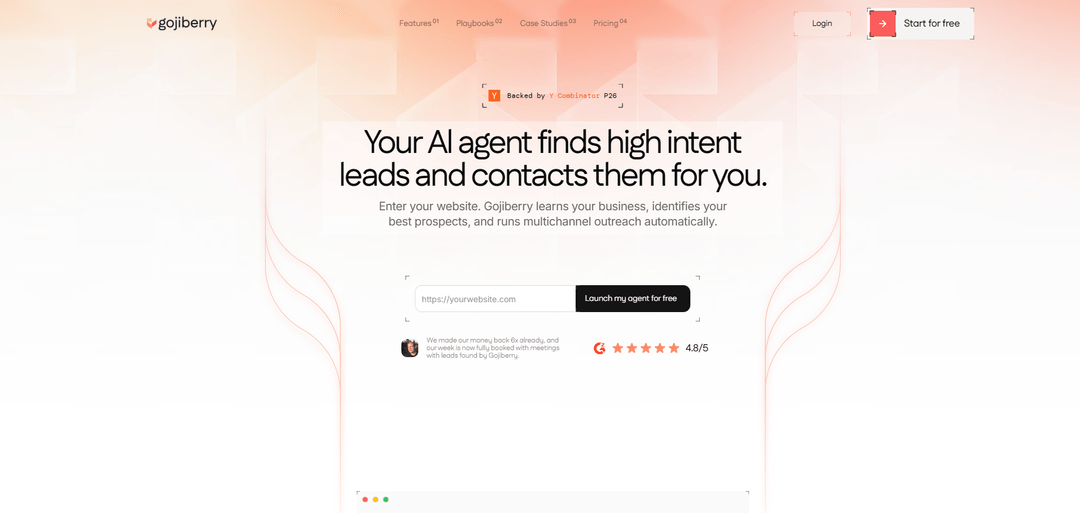
Pro costs $99 a month for two agents, up to 1,800 prospects contacted, and the waterfall enrichment behind the contact data. Above five seats you're on Custom pricing that we don't publish, which is fair to hold against us.
Timing is where it wins. Bulk extraction is where it loses. Wispra now sources 60% of its weekly demos from these signals.
2. Clay
Clay looks like a table and behaves like a pipeline. You load rows, then chain data providers, AI prompts and scrapers column by column until each row says what you're looking for. It replaces the glue work between tools; the extraction still happens elsewhere.
- 🧩Waterfall enrichment: one column queries provider after provider until an email comes back, so misses cost less.
- 🤖Claygent: an AI agent reads pages and answers one question per row.
- 🔗Integrations: results push into a CRM or a sequencer, and the API opens on the higher tier.
- 🧮Two meters: the bill splits Data Credits from Actions, and both burn even when a lookup returns nothing.
Launch is $185 a month with 2,500 data credits and 15,000 actions. Growth is $495 and is the first tier with native CRM sync. Seats are unlimited on every plan.
For a three-person team the entry ticket runs close to double a full Gojiberry subscription, and you're still bringing the list. What comes back is control nothing else here offers. More in our roundup of Clay alternatives.
3. Apollo
Apollo sells access to a few hundred million business records, then lets you reveal emails and phone numbers with credits and send from the same screen. The database is the product, and the sequencer stops you from buying a second subscription.
- 📚Search filters: headcount, title, technology and funding filters narrow a market without an extraction tool.
- 📧Sequences: email steps, calls and tasks live in the platform, and the dialer arrives on Professional.
- 📞Credit math: a verified email costs one credit and a mobile number costs eight, so phone-heavy teams drain a pool fast.
- 🔄CRM sync: two-way sync with HubSpot and Salesforce comes with every paid plan.

Basic is $49 per user per month on annual billing, $59 monthly. Professional is $79, Organization $119 with a three-seat floor, which puts real entry at $357. Credits are pooled, and they don't roll over.
Nothing here gives you more contacts for less money, and nothing here is quieter about which of them you'd want to write to today. Our Apollo alternatives page goes through the credit math.
Outreach automation next. None of the four below finds prospects for you. They take a list you've already got and put messages in front of it, and they differ mostly on how many accounts they can send from at once.
4. TexAu
TexAu chains pre-built actions, called spices, into cloud workflows that run whether or not your browser's open. The 2026 rebuild moved billing off run time and onto credits charged only when a lookup succeeds.
TexAu ships two products under one account, and the split matters for a small team:
- 🔀Workflow chaining: actions pass output to each other on one canvas, with no manual file handoffs.
- 🧰Agency workspaces: each client sits in a separate space while credits stay pooled across the account.
- 📥Built-in verification: email finding and verification happen inside the workflow, with no second vendor.
- 🔧Separate API meter: programmatic access starts at $20 per 1,000 credits, with 50 free on signup.
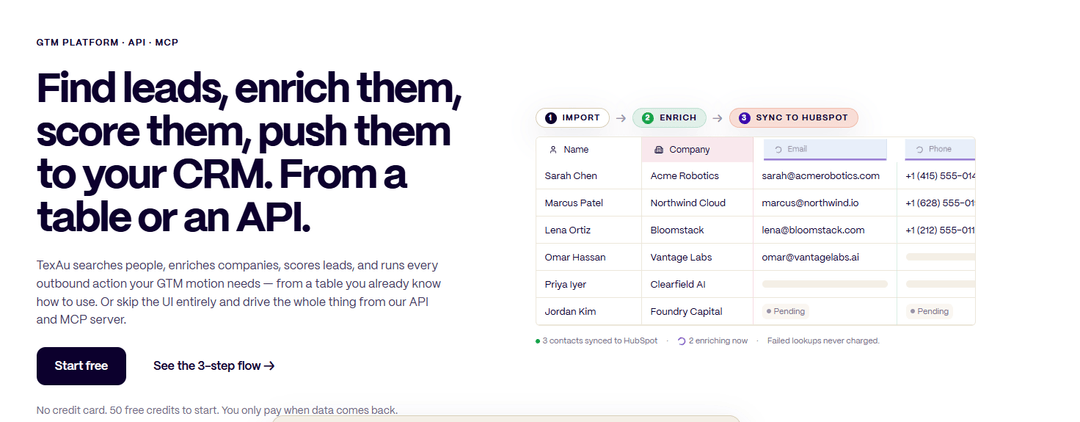
Platform plans start at $99 a month, around $79 with yearly billing, which works out to two months free. TexAu puts 2,500 credits at roughly 450 to 500 enriched leads.
You're still the one deciding who enters the workflow, and that decision is the expensive part of outbound. What TexAu fixes is paying for server time you couldn't forecast.
5. Expandi
Expandi runs social outreach from its own cloud, with a dedicated residential address for each connected account. It's selling caution instead of breadth, and it prices accordingly.
- 🔒Dedicated address: each account keeps one IP instead of sharing a rotating pool with strangers.
- 📅Send windows: actions spread across working hours with randomized gaps between them.
- 🔁Smart sequences: branches react to whether someone accepted, replied or ignored the first touch.
- 🎨Dynamic images: personalized image and GIF steps exist, though they sit behind paid add-ons and never in the base plan.
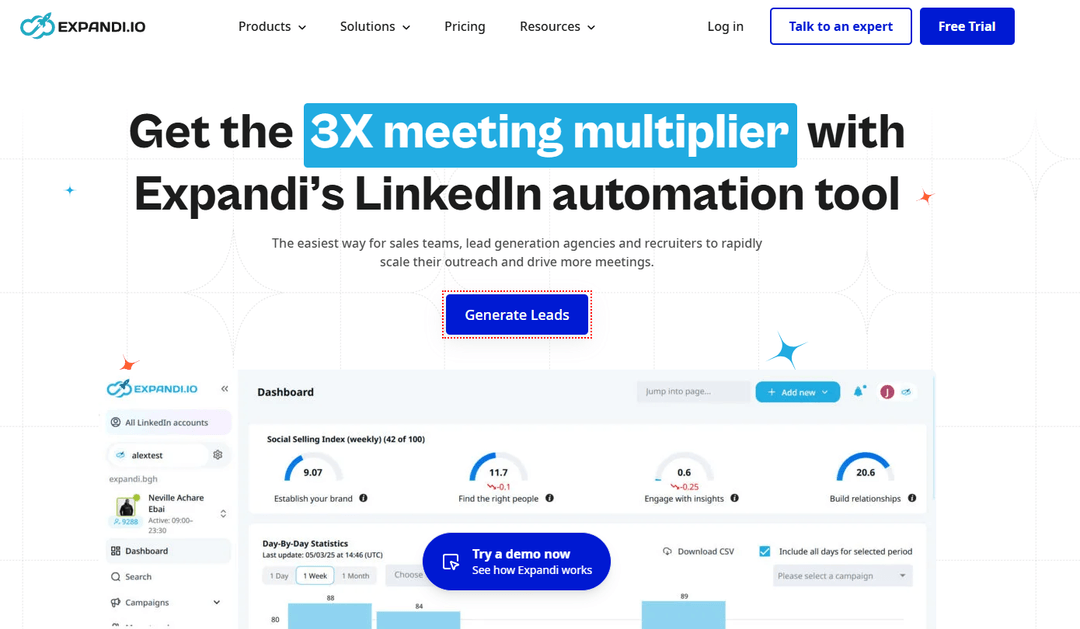
Business is $99 per connected account per month, roughly $79 on annual billing. An agency tier opens at ten accounts and gets negotiated. The trial runs seven days, which isn't much next to a proper warm-up.
Account count decides this one. At one or two profiles it's the most cautious cloud option in the group, and by ten it costs more than the pipeline it builds.
6. Waalaxy
Waalaxy is a browser extension built by a French team, and it's the entry price of the whole category. The free plan never expires, which is rare in this category.
- 💰Entry price: the Pro plan sits at €19 per user per month and gets halved on an annual commitment.
- 📝Sequence templates: prebuilt campaigns cover invite, message and follow-up without a builder session.
- 📬Email step: cold email sequences only open up on Business at €69, so multichannel is not what the headline price buys.
- 🌍European hosting: data and support sit in the EU, which shortens procurement for European buyers.
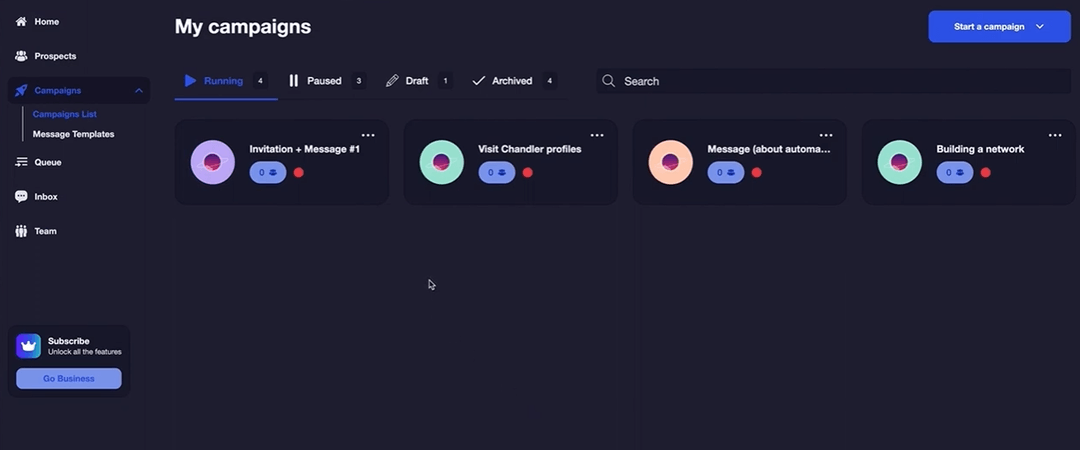
Pro is €19 per user per month, Advanced €49, Business €69, with roughly 50% off on an annual commitment. It only runs while your browser's open, so a closed laptop is a paused campaign.
Nothing here costs less to start. Then you read the entry plan properly. The email credits are token, and multichannel doesn't arrive until three tiers up, which turns €19 into €69 the week you add a second channel.
7. HeyReach
HeyReach was designed around agencies from the start. You connect several profiles, rotate sending across them to keep per-account volume low, and read every reply in one inbox. Team members cost nothing; you're paying per connected sender.
- 👥Sender rotation: a campaign spreads across accounts instead of loading one profile with the whole volume.
- 📊Unified inbox: replies from every sender land in one view, which is the feature agencies point at first.
- 🔖Whitelabel: agency tiers add client-facing branding and separate workspaces.
- 🧵No native email: there's no email sequencer inside, so multichannel means a second bill.
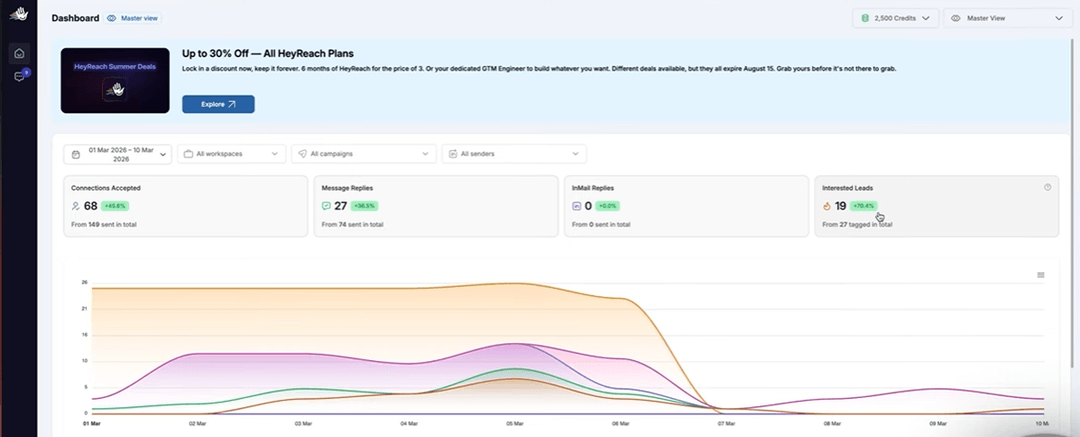
Growth runs $79 per sender per month and drops to $59 past ten. Enrichment credits get bought in packs, and the top tiers won't run without proxies you supply yourself.
Volume across many accounts is where it wins. Deciding who deserves the message is where it stops, because it never looks outside the list you loaded.
Data extraction last, and this is where a like-for-like replacement lives. If you came here because a Phantom broke, these three do that job and do it at a scale Phantombuster can't reach.
8. Apify
Apify is the closest thing here to infrastructure. You run containerized programs called Actors on their cloud, pick from thousands in the store, or write your own in Python or JavaScript. This is the family Phantombuster belongs to, taken several steps further.
Two numbers shape the bill, and the subscription is neither of them:
- 🔬Compute units: a unit is one gigabyte of memory running for an hour, billed at $0.20 on the entry plan.
- 🌐Proxy traffic: datacenter and residential bandwidth bills separately and often outgrows the compute line.
- 📦Actor store: thousands of prebuilt scrapers, some carrying their own rental fee on top.
- 🚀Full API: everything runs headless with webhooks, so results reach your warehouse unattended.
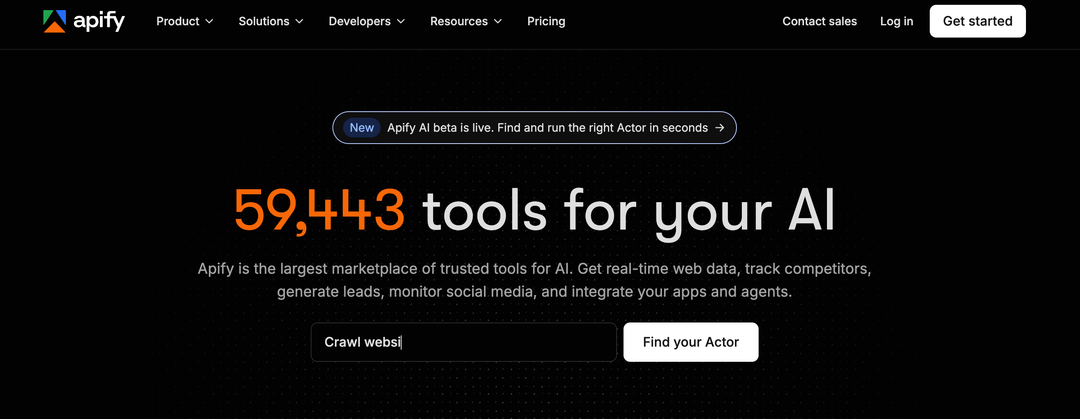
The free tier carries $5 of monthly platform credit. Starter is $29 a month and that fee comes back as $29 of credit you burn down, then Scale at $199 and Business at $999.
It does the extraction job better than anything else here, at the cost of being a platform your team operates instead of a tool it picks up.
9. Octoparse
Octoparse hands the same job to people who don't write code. You open a site in a visual builder, click the fields you want, and it produces a task you can schedule. You learn an interface here, and nobody has to learn a language.
- 🔎Visual builder: clicking through the page defines the selectors, with templates for the most common sites.
- 📁Task quotas: plans are gated on saved tasks and concurrent cloud runs, and never on pages retrieved.
- 🧭Scheduling: cloud runs fire on a timer, so a daily pull needs no laptop left open.
- 🔥Anti-blocking: IP rotation and CAPTCHA handling exist, billed as add-ons on top of the plan.
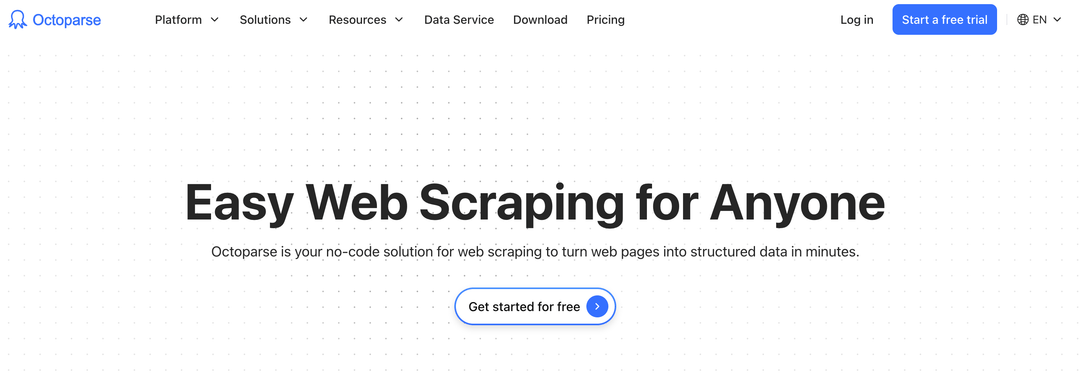
Free covers 10 tasks and local runs. Standard is $69 a month, and that headline already includes the 16% annual discount. Professional is $249, and residential proxy traffic bills at $3 a gigabyte.
For a non-technical operator it's the shortest path from a web page to a clean file. Then the invoice arrives. On protected sites, proxies and CAPTCHA solving can add most of the base price again.
10. Evaboot
Evaboot exports a saved premium search, strips the noise out of it, and finds the emails. It can't work without an active premium search seat, and that seat is the real cost line.
- 🧪Cleaning: emojis, job-title clutter and profiles that slipped past your filters get stripped before the export.
- 📤Email finder: verification is bundled, with a lead costing one credit and a verified email half a credit.
- 📌File output: what you get is a spreadsheet. Nothing sends, nothing sequences, nothing follows up.
- 🏢Single source: it reads one search product, and that product is a subscription you buy elsewhere.
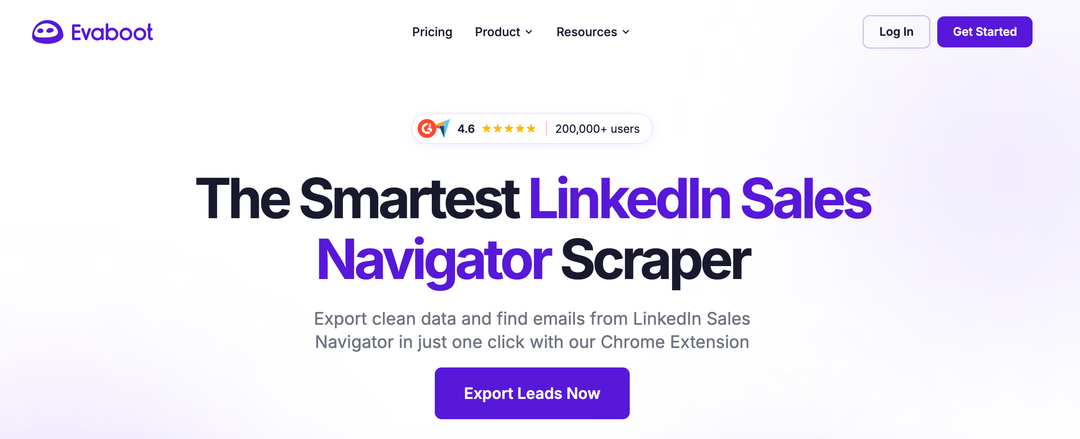
Since the 2026 rebuild the plans are a credit slider from $9 to $79 a month. That's before the premium search seat at around $100, which puts the real entry line closer to $109.
It's the cheapest way to turn a saved search into a usable file, and it's also the tool here most dependent on a subscription you buy from someone else.
You shouldn't have to guess who to contact
Gojiberry watches more than 30 buying signals across socials and the web, checks each account against your ICP, and sends you the ones you'd want to write to.
Start free on your marketPhantombuster is a scraper, not a prospecting tool
The confusion behind most disappointed reviews starts here. Phantombuster is excellent at moving data from a page into a file on a schedule, and it isn't trying to do anything else. It was never built to judge whether the person in that row wants to hear from you. Every complaint about lead quality is a complaint about asking an extraction tool to do qualification.
What can you do with Phantombuster?
You pick a prebuilt script, connect a source, set a schedule, and let it run on their servers. More than a hundred of them exist across social platforms, maps and search results. Chain several into a Workflow and you've got a small pipeline: extract a search, enrich the rows, push the output somewhere. An MCP server also lets tools like Claude drive it directly, which is a genuinely modern touch on an old product.
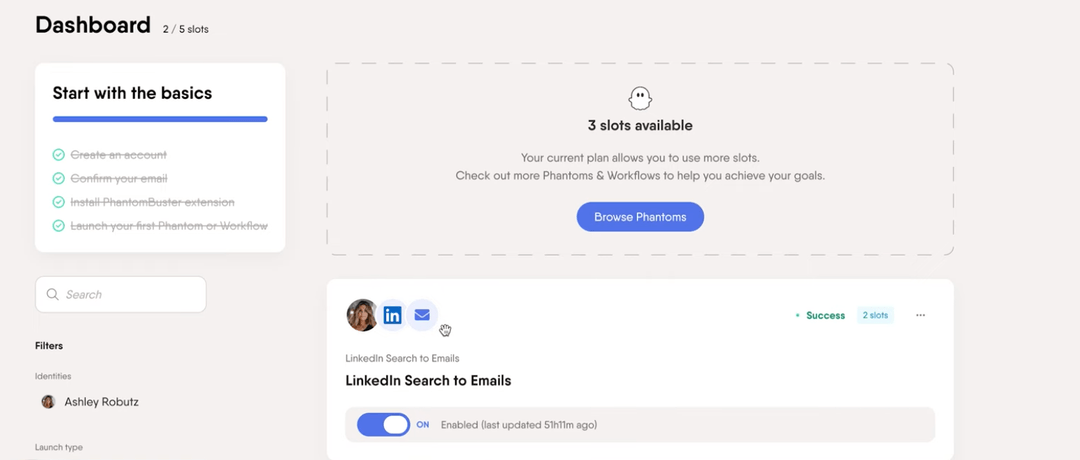
The pros and cons of Phantombuster
The automation library remains impressive, and nothing else here matches its breadth of sources. The weaknesses are commercial, and they don't show up in the first week.
- 🛠A library of more than 100 automations spanning many platforms
- 👥Priced per workspace and not per seat, with up to 100 members sharing it
- ☁Runs in the cloud, so nothing depends on a browser staying open
- 💾Unlimited exports on every paid plan, plus API and MCP access
- ⏳Three separate quotas, and any one of them can stop a campaign
- 🚫No mid-cycle top-up on execution hours; you upgrade or you wait
- 🗑Unused hours and credits expire at the end of every cycle
- ⚠Automated actions carry restriction risk on the platforms they touch
- 🧿Setup assumes somebody on the team enjoys building workflows
How much does Phantombuster cost?
Phantombuster bills three resources at once, and any one of them can stop your month. Execution time is the hours your automations spend running. Slots are how many can stay active simultaneously. Credits cover the metered steps, and they don't share a pool: email discovery, AI, URL lookups and CAPTCHA handling each have their own.
Start is $69 a month for 20 execution hours, 5 slots and 500 email credits. Grow is $159 for 80 hours, 15 slots and 2,500 email credits. Scale is $439 for 300 hours, 50 slots and 10,000 email credits. Annual billing brings those to roughly $56, $128 and $352. There's no mid-cycle top-up on hours, so running out on day 20 means pausing or upgrading permanently.
The detail that moves the invoice sits in the email pool. One credit is spent per discovery attempt, whether or not an address comes back. Phantombuster's own worked example puts 500 attempts at a 40% match rate on the Grow plan, which is 200 verified emails and about $0.80 each. Miss more often than that and the number climbs quietly.
Run the math for a team of three
Three reps working 400 contacts a month each need 1,200 rows. Grow covers the extraction and gives 2,500 discovery attempts, so the data side holds at $159. Then nothing has been sent yet. Add social sequences at €69 per user on the Business tier and you're at roughly $380 a month before anyone writes a first line.
Gojiberry Pro is $99 with two senders included, and a three-rep team goes to Custom pricing that we don't publish. That's a real gap in our favor on the sticker and a real gap against us on transparency. What the $380 stack still doesn't buy is a reason to write today, which is the part Mindflow measured at a 31% lift in replies.
What do Phantombuster users think?
Ratings sit around 4.4 on G2 and 4.5 on Capterra, which is solid for a tool this technical. Reviewers consistently praise cloud execution, since it doesn't depend on a laptop staying awake, and the range of sources it reaches. Pricing dominates the negative reviews, and the specific complaint is almost always execution hours disappearing faster than expected.
Trustpilot tells a more divided story, with a large share of top ratings sitting next to a large share of one-star reviews. That split usually means a tool works beautifully for one profile of user and doesn't fit another at all. Our full Phantombuster review digs through those reviews in detail.
Will Phantombuster get your account banned?
Two accounts are exposed here, and most articles only discuss one. The first is the social profile doing the automated actions. Automated collection and messaging run against the terms of service of every major platform. Detection looks at velocity, at patterns that repeat too regularly, and at sessions arriving from a datacenter address instead of the place you'd normally sign in from.
Phantombuster does apply delays between actions and recommends conservative settings, and cloud execution with proxies reduces the obvious signals. It doesn't remove them. In practice restrictions arrive as a warning first, then a temporary lock, then a permanent one for repeat cases. Repeated disconnections or frequent re-authentication prompts are the early signal worth reacting to.
There's a legal layer as well, separate from the platform's rules. Publicly visible does not mean freely reusable: the data is still personal data under GDPR, and the French regulator has been explicit that accepting a platform's terms is not consent to commercial prospecting. Its guidance on reusing public data for prospecting is short and worth twenty minutes before you build anything on extracted contacts.
The second exposed account is your sending domain, and it fails more quietly. A large extracted list with no intent behind it produces complaints, and complaints now carry a published ceiling you can't argue with. Bulk senders are expected to stay under a 0.3% spam complaint rate, and crossing it degrades delivery for everything you send afterward, including the emails your existing customers were waiting for.
Why do people leave Phantombuster?
Four reasons come up repeatedly, and they stack instead of competing. The first is account exposure, which nobody's thinking about until the week it happens. A restricted profile takes your pipeline with it, and the recovery is slow.
The second is cost drift. You're buying execution time, and results are not what the meter counts, so a month with heavier workflows costs more than a quiet one and the meter gives no warning before it stops. Three separate quotas mean you can sit on unused credits while the hours run dry.
The third is setup time. An extraction platform assumes somebody enjoys wiring workflows together and repairing them when a source changes its layout. In a team of three that person's usually the founder, and their hour is the most expensive one in the building.
The fourth runs deeper than the other three. An extraction tool hands you profiles, never a reason to write today. Meanwhile the list you've built is decaying: B2B contact data goes stale at roughly 2.1% a month, which is around 22% a year, so the file you cleaned in January is noticeably worse by summer.
Pick the tool that matches the job you're doing
Category names aren't much help here, because three of these tools sit in two categories at once. Start from the sentence that describes your week instead.
I need structured data off web pages at scale
Apify if someone writes code, Octoparse if nobody does. Neither one will tell you who to contact, and neither one's pretending to.
I need a clean export of a saved search
Evaboot, and budget the premium search seat alongside it. Nothing else here does that one job as cheaply.
I need to automate sequences on socials
HeyReach past five senders, Expandi at one or two accounts, Waalaxy on the smallest budget. We do this part too, minus the step where you build the list first.
I need enrichment logic I control column by column
Clay, without much debate. Try us instead if you'd rather the enrichment fired behind a signal than sat inside a formula you maintain.
I need contacts and sending on one invoice
Apollo covers both for less than most stacks. Come to us instead if the shortage is names worth writing to this week, not names in total.
My problem is targeting rather than volume
Gojiberry. This is the case the product was built for: a small team that's got more names than time, and no way to tell which of them changed situation last Tuesday.
Your competitors' customers are moving right now
Someone in your market just changed jobs or started following a competitor. Gojiberry spots it, checks they're a match for your ICP, and writes before anyone else does.
Start free, no scrapingWhy timing beats scraping
Extraction answers who exists. Intent answers who changed. The gap between those two questions is most of the difference between a 2% reply rate and a calendar that's filling.
The reason timing works is boring demographics. Median job tenure in the United States sits at 3.9 years, with 22% of workers in post under a year, so a meaningful slice of any market is new in seat at any moment. A new head of a function rebuilds their stack in the first quarter, and they aren't loyal to anything yet. An extraction tool gives you a thousand profiles; Gojiberry gives you the twenty who moved this week.
That difference is measurable on real accounts and never in a benchmark table, which is why the proof below is customer results instead of a scorecard we'd have made up.
GTE Localize
More than 100 meetings booked after switching from cold email to intent-led outreach.
Read the case studyBaur Software
Network doubled by scaling outreach that still reads as written by a person.
Read the case studyWhat support looks like across these tools
Support here splits into three regimes instead of ten different answers, and knowing which one you're buying into matters more than a published response time. The threshold that moves you between regimes is almost always seat count.
Self-serve, chat only
Waalaxy, Apify, Octoparse and Evaboot answer in a chat widget or by email. You sign up, you pay by card, and nobody's going to call you. Onboarding here means documentation.
Per-seat with onboarding
TexAu, Expandi and HeyReach add human onboarding once you cross a seat or sender threshold. Below it you're back in the chat widget with everyone else.
Sales-led above a line
Clay Enterprise and Apollo Organization put a named contact on the account, and both of them put a call between you and the price. Gojiberry does the same above five seats, and we aren't proud of it.
Why we built Gojiberry in the first place
The product started as a manual routine that worked and refused to scale.
Before Gojiberry, Roman spent his days prospecting on socials for Coco.ai. He did intent research by hand, watching for who'd just changed roles, who had started following competitors, who had begun asking questions about the category in public. Then he wrote to them, one at a time, referencing the thing that had changed.
It worked well enough that the ceiling became obvious. One person can follow about thirty accounts properly. Past that the method collapses, and you're back to sending the same message to everyone. Gojiberry is that manual routine running on its own, at a scale a person cannot reach by hand.
That history is also why the product refuses to extract anything. The signal was always the point, and a bigger file wasn't what Roman was missing.
Common questions about Phantombuster before switching
What is the best alternative to Phantombuster?
It depends on which half of the job you want replaced. For extraction at scale, Apify is the closest match and beats Phantombuster on throughput. For the same cloud automation shape, TexAu is the nearest structural swap. For a team of two to ten who care about booked meetings more than row counts, we'd point at Gojiberry, since it removes the list-building step instead of making it faster.
Is Phantombuster worth it?
For a growth engineer who enjoys building workflows and needs data from several platforms, yes. The automation library is deep and the workspace pricing is generous. For a three-person sales team with nobody owning ops, the setup time and the three separate quotas usually cost more attention than the output's worth.
What's the difference between Phantombuster and Waalaxy?
Phantombuster is a general automation platform billed on execution time, covering many sources. Waalaxy is a browser extension focused on social sequences, billed per user from €19 a month. One's built for reach, the other for cost. We put them head to head in our Phantombuster and Waalaxy comparison.
Can you use Phantombuster for free?
There's a permanent free plan, though it's a sandbox and not a working tool. It gives you 30 minutes of execution time a month, one slot, and no monthly enrichment credits. Exports are capped at 10 rows. The 14-day trial is more useful for evaluation, with two hours of execution time and five slots, but the same 10-row export cap applies.
Is scraping public profiles legal?
Public does not mean free to reuse. Under GDPR the data you collect is still personal data, and the French regulator has stated that accepting a platform's terms of use is not the same as consenting to commercial prospecting. Its guidance on reusing publicly accessible data for prospecting is worth reading before you build a pipeline on extracted contacts. Separately, automated collection goes against the terms of most platforms, which is a contractual matter and a separate one from the law, and it's what gets accounts restricted.
Which alternative is the cheapest?
Evaboot on the sticker, from $9 a month, until you add the premium search seat it depends on and the real line becomes around $109. Waalaxy at €19 per user is the cheapest tool here that sends anything at all, though cold email lives on the €69 tier. Apify's free plan with $5 of credit is the cheapest way to test extraction at all.
Do I need a developer to use these tools?
For Apify, yes, or at least somebody comfortable reading logs and reasoning about compute. Clay sits in an odd middle: there's no code, but it rewards someone who thinks like an engineer. Octoparse, Waalaxy, Evaboot, Expandi, HeyReach and Gojiberry are all designed for a salesperson to run without help.
Can I run Gojiberry alongside a scraper?
Yes, and plenty of teams do. Keep the Phantoms doing the jobs they already do well, and let Gojiberry handle the question of who deserves a message this week. The two motions don't collide, because one produces rows and the other produces reasons to write. Our full side-by-side covers where each one earns its keep.
Want us to find the prospects too?
Tell Gojiberry who you sell to and it starts surfacing the people who've already started looking. No scraping, no proxies, nothing to configure.
Launch your agent for freeRead the client results
More High-Intent Leads = Your New Growth Engine.
Start Now and Get New High Intent Leads Delivered Straight to Slack or Your Inbox.