
10 best Dux-Soup alternatives to fill your pipeline in 2026

Quiz in 60 seconds
Which Dux-Soup replacement fits you?
No email required.
Question 1 / 3
How many people run outreach in your company today?
Question 2 / 3
What can you spend on the tool itself each month?
Question 3 / 3
What slows you down most right now?
🔔
Your match
Gojiberry
You've got a team, and the sending was never the hard part. Picking who deserves the message is. That's the part we built.
- More than 30 buying signals watched across socials and the web
- Every account checked against your ICP before it reaches you
- $99 a month per workspace, so headcount doesn't change the bill
💰
Your match
Octopus CRM
You're solo and the price decides it, so Octopus CRM is the right answer and we're not going to pretend otherwise. It undercuts Dux-Soup and does close to the same job. Come back when the question turns into who to message.
- Starter at $9.99 a month, below Dux-Soup's entry plan
- Same extension model, so nothing about your routine changes
🔁
Your match
Dripify or Expandi
You want the campaigns off your laptop without relearning anything, and either one does that well. If the lists you feed them are the weak link, that's a separate problem, and it's ours.
- Cloud sending, so the machine can be off
- Reporting good enough to iterate on
👥
Your match
HeyReach
Running many accounts is a shape of problem HeyReach was built around, and we weren't. Take it. If your own pipeline needs filling alongside your clients', that half is ours.
- Sender rotation across every connected account
- One inbox for every conversation you manage
Dux-Soup is a browser extension that automates social outreach from your own machine. It's cheap, and that's the whole pitch. The ceiling comes fast: campaigns stop when the laptop closes, there's no real team layer, and the reporting won't tell you what worked.
It costs about $11 a month, and most tools here cost more. So the useful question is what you're upgrading to, and what it buys. Ten answers below, two of them cheaper than what you pay now.
Gojiberry finds your prospects for you
An extension automates the sending. Gojiberry tells you which people started looking for what you sell this week, and writes the first message.
Get your first leads for freeTable of contents
We compared the 10 best Dux-Soup alternatives for you
If you're on your own and price decides, Octopus CRM and Waalaxy sit at or below what you already pay, and that's a real recommendation rather than a polite one. If you've grown into a team of two to ten and the bottleneck has moved from sending to knowing who to send to, that's where Gojiberry earns a gap this big. Two of these cost less than Dux-Soup. The other eight cost more, and the table shows by how much.
Here's one example of what that layer is worth. Mindflow lifted their outbound reply rate by 31% after switching from list-based sending to intent-based sending, with no change in headcount. Read the Mindflow case study.
How we put this list together
We pulled every price directly from the vendor pricing pages in August 2026, then cross-checked each one against public review sites where the plan names had changed. Where a tool sells itself self-serve, we started a trial and built a short sequence to see how the product behaves before the paywall. Where it doesn't, we said so rather than guessing. We also read the last year of public reviews for each tool, looking for the complaints that repeat.
What you won't find here is a scorecard of measured reply rates across ten tools. We haven't run a controlled campaign on an identical list in every product, and an invented percentage would be worth less than this sentence admitting it. When we run it, the numbers land on this page. We pay for every plan ourselves, no vendor read a word of this before publication, and Gojiberry is our own product.
Where Dux-Soup runs out of road
The ceiling here is architectural, and no update will move it. An extension runs on your computer, which means your computer is the server. Close the lid at six, and the follow-up scheduled for seven doesn't go out. Travel for a week and the campaign you launched sits idle. For a hobby account that's an annoyance. For a pipeline it's a leak you can't see.
The second reason is measurement. You can run a sequence, but you can't easily tell which step earned the reply, so you iterate on instinct, month after month. The third is team work. There's no shared layer to stop two reps landing in the same inbox in the same week, and nothing more expensive than that email arriving twice.
The fourth reason is the one we care about most, and it's true of every tool in this article, not only of Dux-Soup. An extension automates how you send. It never tells you who deserves a message this week. You still open a search, still pick names by job title, still hope the timing is right. Meanwhile B2B contact data goes stale at roughly 2.1% a month, about 22.5% a year, so the list you built in January is a quarter wrong by December. Sending faster into a list like that, however good the copy is, gets you to the wrong answer sooner.
The 10 best alternatives to Dux-Soup
The order runs from the tool that changes the most about how you prospect to the ones that change the least. Prices were checked in August 2026 and they don't stay put, so treat them as a starting point rather than a quote.
1. Gojiberry
Gojiberry is an AI-powered multi-channel prospecting platform. It tracks more than 30 buying-intent signals across socials and the web, surfaces the people who went into buying mode this week, and drafts the first message. Every other tool here automates how you send. This one decides who you send to.
- 🔔Signal tracking: we watch job changes, hiring pushes, funding and competitor follows, thirty triggers in all.
- 📊ICP filtering: we check each account against your profile before it reaches you.
- 🤝One bill per workspace: five reps pay what two reps pay.

There's a free plan to start, then $99 a month per workspace with 2 social senders included. That is nine times Dux-Soup's entry price, and we'd rather write the number than dance around it. Per workspace instead of per seat means the gap closes as you add people: three reps sharing one works out at $33 each.
This one comes down to headcount. Solo on $11 a month, we're the wrong answer, and we say so again further down. With reps on the payroll, the question turns from how fast you send to which of a thousand names deserves an hour.
2. Expandi
Expandi runs outreach from the cloud with a dedicated residential IP per connected account, and it built its name on account safety. It's the closest like-for-like upgrade if you like the way Dux-Soup works, and simply want it off your laptop.
- 🔒Warm-up and caps: daily limits ramp gradually over the first two weeks.
- 🧩Smart sequences: the chain branches on replies, views and follows.
- 📈Step-level analytics: you can see which message in the chain did the work.
- 🌐Dedicated IP: one per account, which is the whole safety argument.
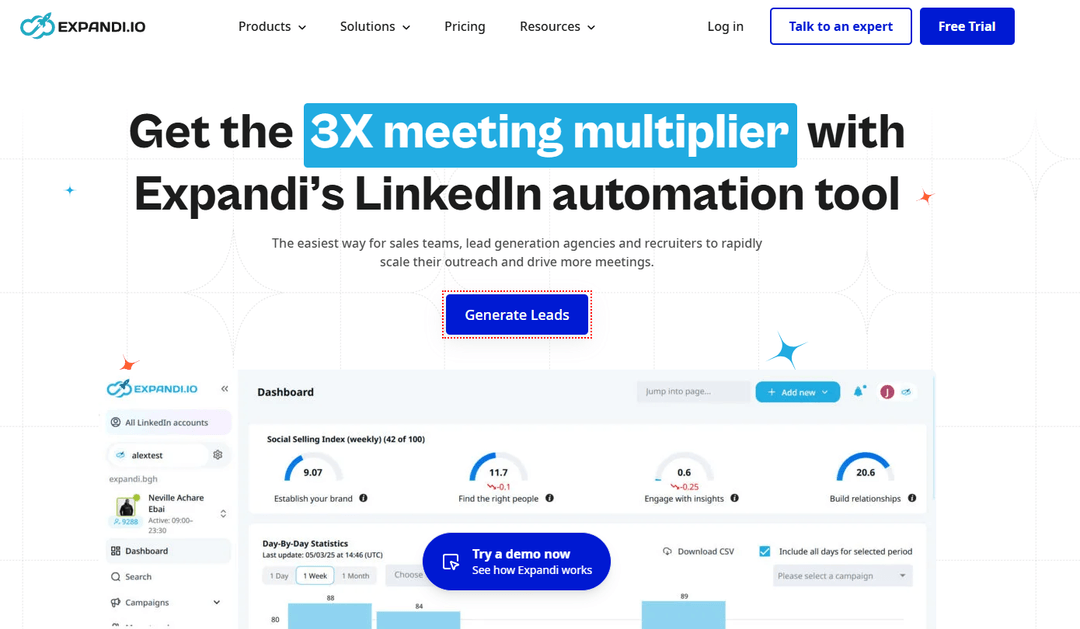
Expandi costs $99 a month per seat, closer to $79 on annual billing, with a 7-day trial and no free tier. Image and video personalization run through paid add-ons, so budget above the sticker if your sequences lean on them. We've gone deeper on the product in our full Expandi review.
At nine times what you pay today, it's a hard sell for one person sending thirty invites a day. For a team that already treats social as a revenue channel and has been burned by a restriction, it's the safest place to move that motion.
3. Waalaxy
Waalaxy is a French tool built around a friendly interface, and a free tier people stay on longer than they'd planned to. Of everything here, it asks you to relearn the least.
- 💬Free plan: 80 invitations a month give you enough to judge the sequencer.
- 📥Prebuilt sequences: templates you can launch the same afternoon.
- 🎨Shared inbox: replies in one place, though the deeper inbox is a paid add-on.
- 🧮Finder credits: you get 500 a month from the Advanced tier up.

Pro is €19 a month, Advanced €49 and Business €69, all per seat, with 50% off if you commit to a year. Business is where email steps join the social ones, so €69 is the number to plan around if you're both channels. We put the two products side by side in our Gojiberry vs Waalaxy comparison.
It hands you cloud reliability and a free tier for less than most of this article charges, and it hands you nothing that'll help you decide who belongs in the campaign to begin with.
4. Dripify
Dripify thinks in funnels. You build a drip sequence, watch conversion stage by stage, and manage a small team from the same dashboard. That reporting is why people pick it over something cheaper, and it's the part Dux-Soup never had.
Dripify splits its plans by what you're allowed to run rather than by volume, which catches people out:
- 🔀Drip builder: you chain steps with delays and conditions between them.
- 📅Team roles: Advanced adds seat management and shared campaign visibility.
- 🧪A/B testing: message variants scored against each other.
- 📁CSV export: your prospect data comes back out when you want it.
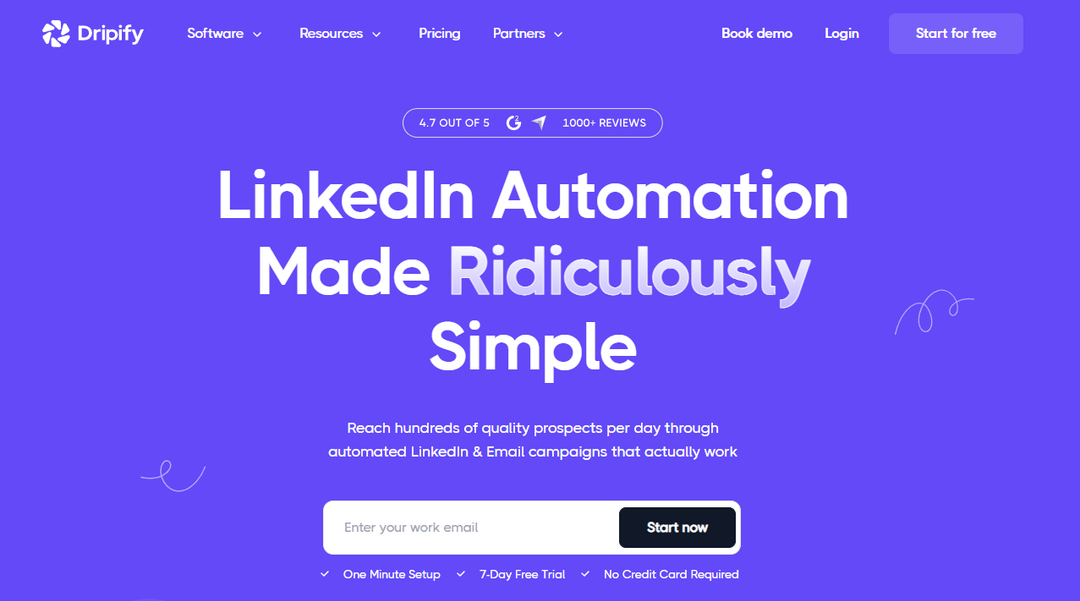
Basic is $59 a month per user, Pro $79 and Advanced $99, dropping to $39, $59 and $79 on annual billing. Basic caps you at one campaign, so you'll be on Pro inside two weeks. Our Dripify review walks through where that upgrade path bites.
The funnel view earns its money the first time it shows you exactly where people go quiet. Then the invoice arrives. Per user, per month, with a Sales Navigator subscription on top before the targeting's any good.
5. HeyReach
HeyReach exists for one job: running many sender accounts at once without losing track of the conversations. If you run outreach for clients, this is the tool the other nine aren't shaped for.
- 👥Sender rotation: volume spreads across accounts instead of stacking on one.
- 📬Unified inbox: every conversation from every account lands in one view.
- 🔗Native connections: Clay, Instantly and Smartlead plug in without middleware.
- 🏢Free teammates: you pay per sender, so VAs and clients cost nothing extra.
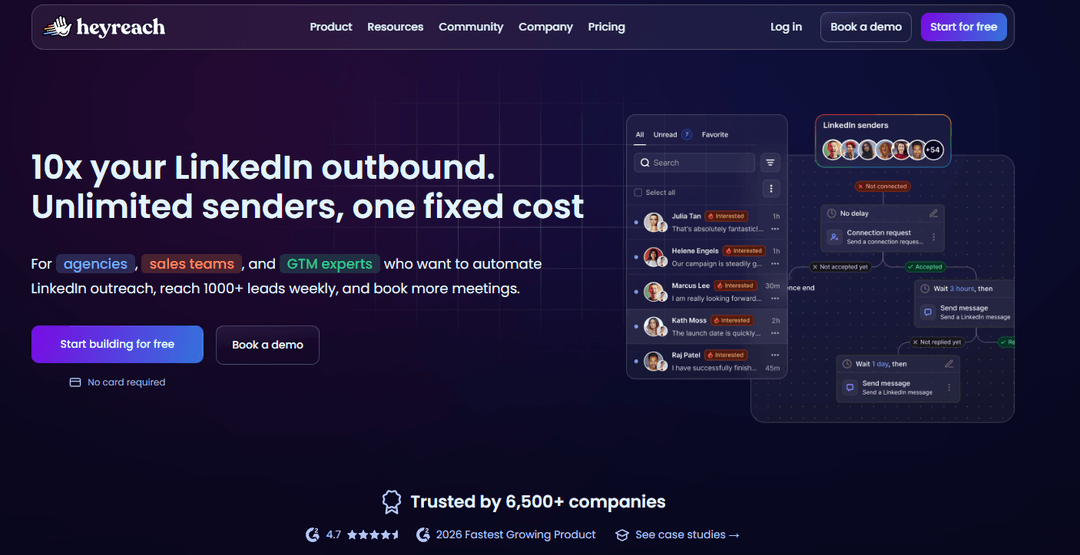
Growth runs about $79 a month per sender, closer to $59 on annual billing, with agency bundles above that. The per-sender rate's moved twice in the past year, so check their current pricing page before you model a team of five. Our Gojiberry vs HeyReach breakdown covers where the two overlap.
Nothing here handles ten accounts more calmly, and nothing here is worse value when you only have one.
6. SalesRobot
SalesRobot pairs cloud sending with AI-written openers, and markets itself hard against most of the names here. The personalization ships on every plan, and it isn't held back for the top tier.
- 🤖AI icebreakers: it drafts openers from the prospect's own profile.
- 📝Mixed sequences: social steps and email steps run inside one campaign.
- 🔎Reply detection: the sequence stops the moment someone answers.
- 🧵Hands-on onboarding: their team helps build the first campaign with you.
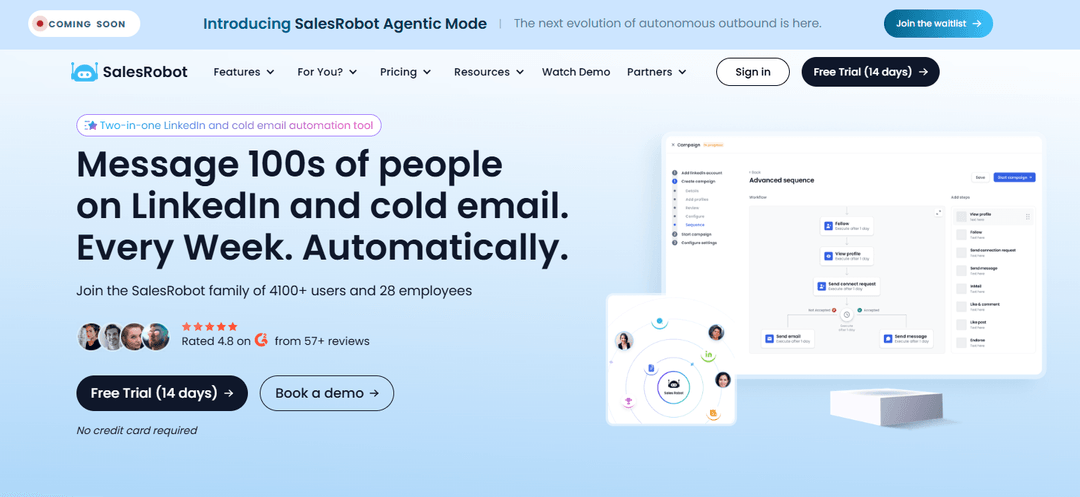
The entry plan sits around $59 a month per connected account, roughly $39 billed annually, rising to about $99 for the top tier. Per-account discounts start once you pass ten accounts. They've renamed the tiers more than once, so check their current pricing page rather than trusting a comparison table, including ours.
Volume decides this one. On a single account you're paying cloud prices for extension-sized output, and past ten accounts the discount finally makes the model add up.
7. Skylead
Skylead sells one plan with everything switched on, which is unusual in this category. Social automation, unlimited email accounts, warm-up, email finding and conditional sequences all arrive together. One price, no feature gates, nothing that's held back for an upsell.
- 🔄Smart sequences: branch on opens, replies and connection status.
- 📧Unlimited mailboxes: email accounts and warm-up cost nothing extra.
- 🧭Built-in finder: the tool finds and verifies addresses itself.
- 🔬Image personalization: the tool generates a different visual for each prospect.
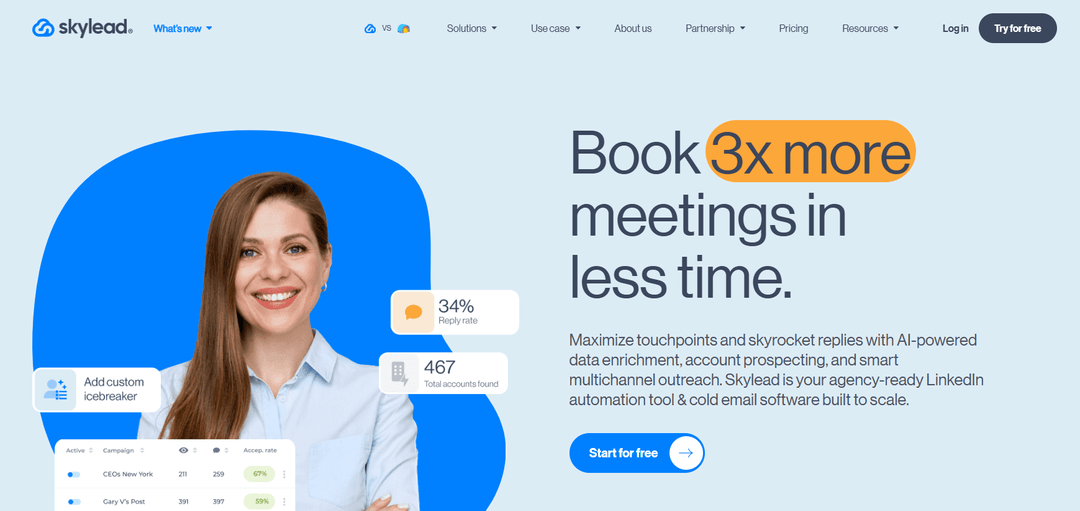
It costs $100 per seat a month, about $83 if you commit to a year, with a 7-day trial. One seat maps to one social account, so you're at $300 a month for a three-person team, before anything else.
Bundling is where it wins. Per-seat math is where it loses.
8. Octopus CRM
Octopus CRM is a browser extension with the same architecture as Dux-Soup, at a lower price. It's the only tool in this article that costs less than what you already pay.
- 💰Starter at $9.99: the entry plan undercuts Dux-Soup on monthly billing.
- 🔍Funnel builder: you chain visits, connection requests and messages.
- 📦Import and export: CSV moves both ways from the Advanced plan up.
- 🔧Activity control: a dashboard that flags odd patterns before the platform does.
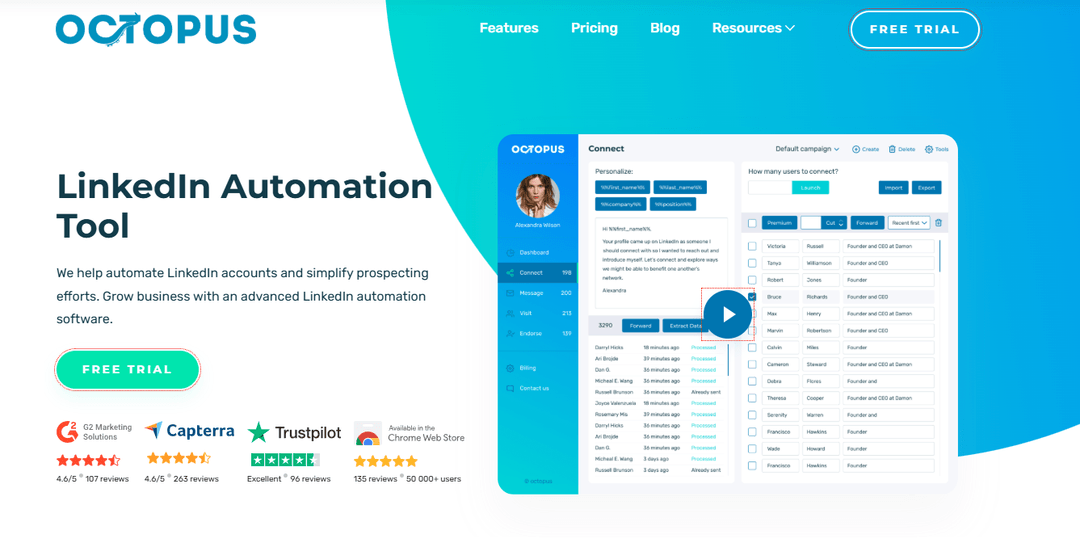
Starter is $9.99 a month, Pro $14.99, Advanced $21.99 and Unlimited $39.99, with 35% off annual billing and a 7-day trial. There's no free plan, and each account needs its own subscription.
Your laptop still has to be open, so the thing that sent you looking for alternatives hasn't gone anywhere. What changes is the invoice, and for a freelancer counting every euro that can be the entire decision.
9. Lemlist
Lemlist is an email platform first. Social steps exist and they work, but it's the deliverability tooling, the warm-up network and the personalization that people pay for. Buy it if email is your main channel and social is the supporting act.
- 📤Lemwarm: inbox warm-up included on every paid plan.
- 🎨Dynamic media: images and video thumbnails render per recipient.
- 🌍Contact database: lead data comes bundled with the multichannel tier.
- 🔥Sending health: you monitor deliverability from inside the tool.
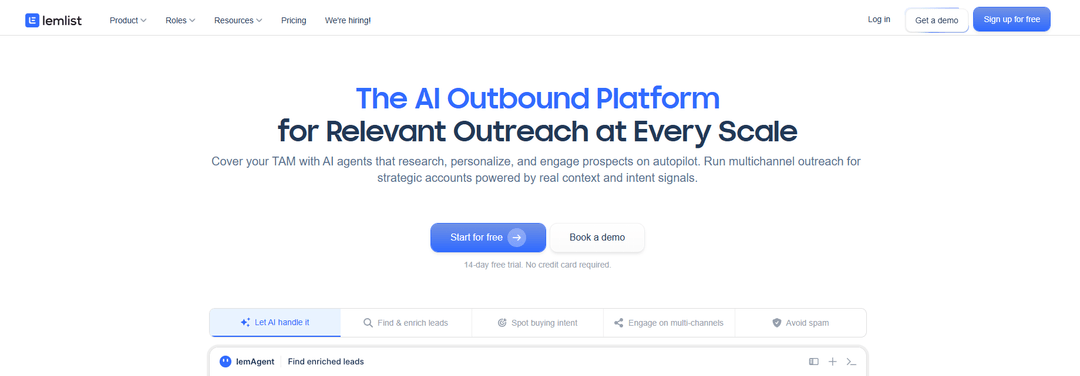
Email Pro is $79 a month per seat and Multichannel Expert is $109, which is the tier that adds social steps and calls. Annual billing takes roughly 20% off, and you'll pay extra for every sending address beyond the bundled ones.
It's the strongest email engine in this article and the weakest reason to leave Dux-Soup, since the channel you came here for sits behind its most expensive tier.
10. La Growth Machine
La Growth Machine hands you a canvas and expects you to design the workflow yourself, which isn't for everyone. Social, email and X steps weave together, with conditions on every branch. It rewards people who enjoy building the machine.
- 🧠Visual builder: workflows drawn rather than configured.
- 📞Voice messages: an audio step nothing else here has.
- 🔖Auto-enrichment: contacts enriched on entry.
- 🧰Unified inbox: every channel reports into one thread.
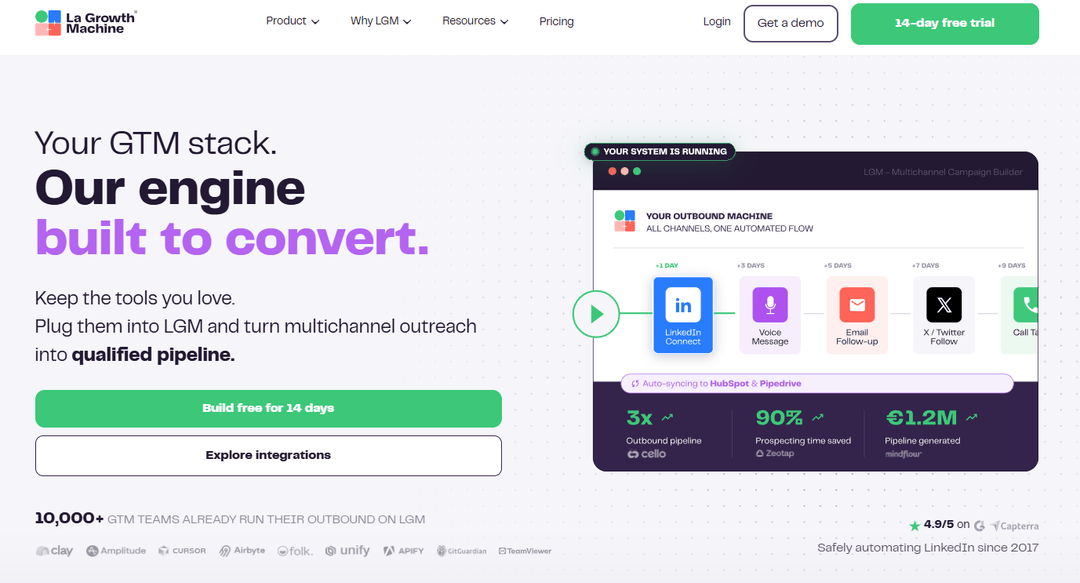
An identity is one sender profile. Basic is €60 a month per identity with 250 enriched leads, Pro €120 with 400, and annual billing gives two months free. Campaigns pause when the credits run dry, so that line matters as much as the plan.
The builder is the best thing in this category and it isn't close. Then you price three identities. €360 a month to design your own sequences, when sequence design was never what slowed you down.
You shouldn't have to guess who to contact
Gojiberry watches more than 30 buying signals across your own market, checks each account against your ICP, and sends you the ones worth writing to.
Start free on your marketWhat is Dux-Soup?
Dux-Soup is a Chrome extension that has automated social prospecting since 2015, and it's one of the oldest tools still standing in this category. It installs into your browser, drives your own account, and performs the actions you would otherwise do by hand. That design is both why it costs so little and why people eventually leave it.
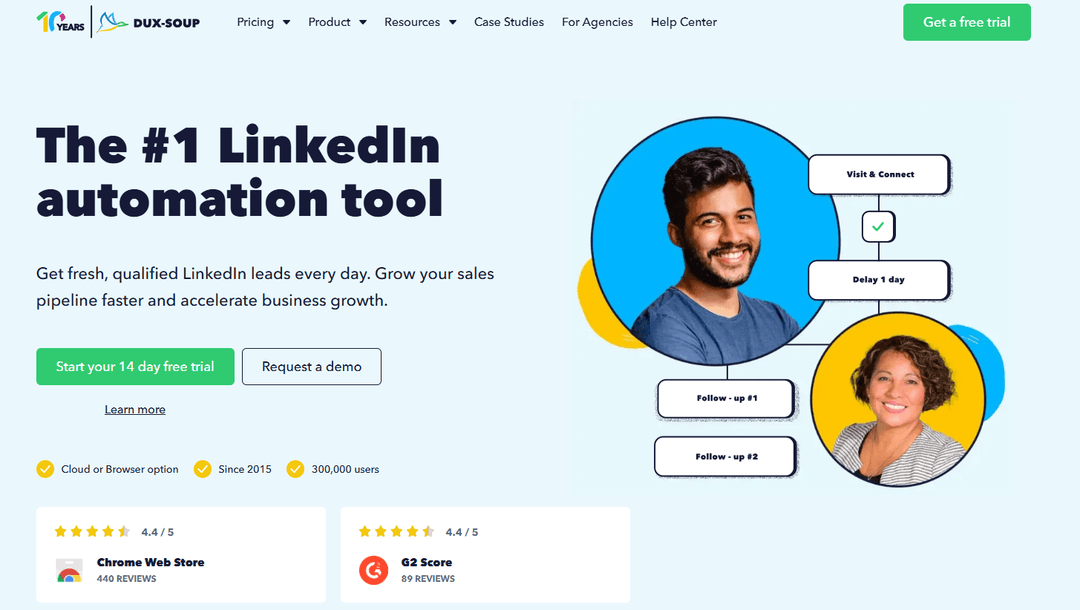
What can you do with Dux-Soup?
The core loop is profile visits, connection requests, follow-up messages and endorsements, run against a list you pull from a search or import as a CSV. Drip campaigns and CRM integration arrive on the Turbo plan, and the Cloud plan moves execution off your machine onto theirs. Email enrichment credits aren't bundled into any tier, they're sold separately.
It does that loop well. The tagging and note-taking are better than some products charging five times more, and the export's clean, which matters a great deal on the day you decide to move.
The pros and cons of Dux-Soup
Pros
- Cheapest name-brand tool in the category, by a wide margin
- Ten years of updates, so it's stable and well documented
- Five minutes from install to a running campaign
- Tagging, notes and CSV export are genuinely good
- Works on a free social account, no seat minimum
Cons
- Campaigns stop the moment your browser closes
- No team layer, so two reps can touch the same prospect
- Reporting is thin, which makes iteration guesswork
- Email credits are billed separately from every plan
- One subscription per account, so agencies pay repeatedly
How much does Dux-Soup cost?
Three individual tiers, and the annual discount is worth about a quarter. Pro Dux is $14.99 a month, or $11.25 billed annually. Turbo Dux is $55 a month, or $41.25 annually, and it's the first tier with drip campaigns and CRM integration. Cloud Dux is $99 a month, or $74.17 annually, and it's the tier where campaigns keep running with your computer off. Team plans price per seat at similar rates, and the Cloud Agency plan starts around $371 a month. There's a 14-day trial and no permanent free tier.
That $11.25 figure is the number every comparison on this subject quietly works around, so let's put it against the alternatives properly. Octopus CRM undercuts it at $9.99 monthly. Waalaxy's free tier costs nothing and its Pro plan is close. Everything else on this page is a multiple: Dripify about five times, Expandi and Skylead about nine, Gojiberry about nine on a per-workspace basis.
What the multiple buys is worth naming precisely. From roughly $59 you get cloud execution and reporting, so campaigns run overnight and you're learning something from them. From roughly $99 you get either safety infrastructure or, in our case, the targeting layer that decides who enters the campaign. Nobody should pay nine times more for a nicer interface. Paying it for a different job is a real decision, and paying it for the same job is not.
What do Dux-Soup users think?
The pattern across public reviews is consistent, and it's worth reading before you assume the grass is greener. People like the price, the stability and the fact that it does what it says. The complaints cluster in three places: the browser dependency, the email credits that arrive as a surprise line item, and support response times on the lower tiers.
What almost nobody complains about is the core automation, which tells you something. People don't leave Dux-Soup because it broke. They leave because they grew.
Which Dux-Soup alternative is right for you?
Six situations, six answers. Gojiberry is in the running for four of them and the wrong call in two, and we say which is which. We're first in the list because it's our article, so read our card knowing it opens by telling you when to skip us.
You're a team of 2 to 10 and the bottleneck is knowing who to contact → Gojiberry
Skip us if you're solo on a tight budget, the price gap is real and we'd rather you heard it here. With reps on the payroll, a pipeline to protect and a list nobody trusts, this is the one. Free plan to try it on your own market, then $99 per workspace each month, whoever you add. Wispra now sources 60% of their weekly demos from buying signals.
Solo, and price is the deciding factor → Octopus CRM or Waalaxy
Octopus CRM at $9.99 costs less than Dux-Soup. Waalaxy's free tier costs nothing and its interface is friendlier. Both keep you within a few euros of today's bill. Come back to Gojiberry when you hire your second rep, not before.
You want cloud reliability without changing much else → Dripify, Expandi or Gojiberry
Same mental model, campaigns that survive a closed laptop, and reporting worth reading. Dripify's cheaper, Expandi's safer. Pick Gojiberry instead when the weak link is the list you feed them rather than the machine running them.
You run many accounts for clients → HeyReach
Rotation, one inbox and free teammate seats make the per-sender price work above three accounts. It's the only tool here that's built around that shape of problem.
Email is your real channel → Lemlist or Gojiberry
Lemlist gives you warm-up, deliverability tooling and personalization past the first name, though the social steps sit on Multichannel Expert. Gojiberry sends the same email steps and adds the part Lemlist leaves to you: who deserves the message this week.
You want one subscription instead of four → Skylead or Gojiberry
Sending, warm-up, email finding and personalization under a single $100 seat. Fair value for one person. Multiply by three reps and the $99 Gojiberry workspace covers the same ground on one bill.
FAQ
What is the best Dux-Soup alternative?
There isn't one answer, and any article that gives you one is selling something. For a solo user watching the budget it's Octopus CRM or Waalaxy. For a team that wants the same motion off the laptop it's Dripify or Expandi. For an agency running client accounts it's HeyReach. For a team of two to ten whose real problem is knowing who to contact, that's where we'd argue for Gojiberry.
Is there a free Dux-Soup alternative?
Waalaxy has a genuine free plan at 80 invitations a month, which is enough to judge the product properly. Gojiberry has a free plan too, though it's doing a different job, surfacing in-market accounts rather than automating sends. Dux-Soup itself only offers a 14-day trial, so anything permanently free is already a change of model.
Is there anything cheaper than Dux-Soup?
Octopus CRM, at $9.99 a month on monthly billing against Dux-Soup's $14.99, or $6.99 against $11.25 if you both pay annually. It's the same browser-extension architecture, so you keep the limitation you already have and pay a little less for it. Waalaxy's free tier is the other route down.
Why is a cloud platform safer than a browser extension?
A cloud tool runs from dedicated infrastructure, often with a fixed IP per account, and paces actions with randomized delays and gradual ramp-up. That puts a layer between the automation and your own device. It also means campaigns don't stop overnight, or while you're away. No automation is risk-free, and anyone telling you otherwise is guessing, but the architecture is meaningfully different.
Can I migrate my lists and notes?
Yes, and this is one of the things Dux-Soup does well. Export your prospect lists, tags and notes as CSV before you cancel anything. Every tool here imports CSV, so you won't lose the work. Do the export first, keep the file somewhere safe, and only then start setting up the replacement.
How do I avoid account restrictions?
Volume discipline, mostly. Warm any new tool up slowly, stay inside daily limits, and write to people who've got a plausible reason to hear from you. The same logic applies to email, where Google now expects bulk senders to keep spam complaints below 0.3%. Relevance is the only thing that scales in either channel.
What's the best Dux-Soup alternative for a team?
Dripify if you want shared campaign management at a modest price. HeyReach if the team is really a set of client accounts. Gojiberry if the team keeps arguing about which accounts deserve attention, since per-workspace pricing means the bill doesn't grow with headcount, and everyone's working from the same list.
Is Gojiberry a replacement for Dux-Soup?
Partly, and it's worth being precise. Gojiberry sends across social and email from the cloud, so the outreach side is covered. What it adds is the layer above: which accounts went into buying mode this week, and why. If all you want is a cheaper way to fire connection requests, we're the wrong shape and Octopus CRM is the right one.
Your competitors' customers are moving right now
Someone in your market just changed jobs or started following a competitor. Gojiberry spots it, checks they match your ICP, and writes before anyone else does.
Catch the next one freeGojiberry vs Dux-Soup: which one brings you leads?
These two tools get compared constantly and they barely overlap. Dux-Soup automates how you send. Gojiberry decides who you send to. That's the sentence to keep if you keep nothing else from this article.
The price gap is nine to one and we're not going to pretend it away. What sits on the other side of it is a job Dux-Soup doesn't attempt. Consider that the median US employee has been in their role 3.9 years, with 22% there under a year. Every one of those moves is a new person with a new budget and no incumbent vendor. An extension can't see them. Watching for them is the whole product.
If you'd like the two side by side in more depth, we wrote a dedicated Gojiberry vs Dux-Soup comparison.
100+
meetings booked by GTE Localize after switching from email blasts to intent-led outreach.
Read the case study2x
network growth for Baur Software by scaling outreach that still reads as human.
Read the case studyHow to switch from Dux-Soup
Do this in phases and nothing breaks. The mistake we see most often is uninstalling the extension on day one, which leaves you with no fallback if the new tool doesn't behave the way the demo suggested.
- 📌Export first: pull your prospect lists, tags and notes out as CSV and keep the file. This is your backup and the foundation of everything below.
- 🎯Pick the replacement: use the six profiles above rather than the feature grid. The wrong tool at the right price is still the wrong tool.
- 📝Rebuild one or two sequences: only the ones that already earned replies. Copying all nine of your campaigns rebuilds your bad habits alongside the good ones.
- 🧪Pilot on 10 to 20 prospects: confirm the sending works, the replies land where you expect, and the reporting shows you something useful.
- 🔄Migrate the rest, then uninstall: and only in that order. Keep Dux-Soup running until the pilot has clearly worked.
Budget two weeks for the whole thing if you're careful, and a weekend if you're not. The export step is the one people skip, and the one that hurts, because a canceled subscription takes the notes with it.
Why we built this in the first place
Coco.ai taught us the ceiling the hard way
Before Gojiberry, our cofounders ran Coco.ai. Roman spent his days prospecting on the socials, and he did the intent research by hand: one tab per account, checking who had changed roles, who was hiring, who had started following a competitor. It worked. It also capped out at about thirty accounts a person can watch properly, and past that the research quietly stops happening while the sending carries on.
That gap is the whole reason this company exists. We'd already automated the sending, the way everyone reading this has. What nobody had automated was the part that decided whether the sending was worth doing. If you're running outreach off your own laptop right now, you already know the feeling of the list going stale faster than you can refresh it.
Which brings the article back to where it started. Leaving Dux-Soup is easy, the export takes five minutes. What replaces it depends entirely on whether your bottleneck's the sending, or the choosing.
Try it on your own market
Tell Gojiberry who you sell to, and it starts finding qualified prospects for you. Nothing to keep open, no laptop babysitting your campaigns.
Start for freeRead the case studies
More High-Intent Leads = Your New Growth Engine.
Start Now and Get New High Intent Leads Delivered Straight to Slack or Your Inbox.