
The Ultimate Guide to Building a LinkedIn Leads Generator That Actually Works


Is your LinkedIn outreach strategy just blasting out thousands of generic messages and hoping something sticks? If your calendar is still looking pretty empty, you're not alone. Sound familiar?
A powerful LinkedIn leads generator isn't a magic button; it's a strategic system. The secret sauce? Combining a client-obsessed profile with innovative, personalized outreach that keeps your pipeline consistently full of high-intent prospects who want to talk to you.
Why Your LinkedIn Outreach Is Falling Flat (And How to Fix It)
I've been there. My first attempts at LinkedIn outreach felt like shouting into a hurricane. I was using those tired, generic templates that litter everyone's inbox. "Hi {first_name}, I see you're a {job_title}..." Ugh.
The hard lesson I learned is that most people treat LinkedIn like a cold numbers game, but it's a platform built for genuine human connection. Your outreach fails when it's all about you, rather than about them.
From Pitch-Slap to Meaningful Connection
The single biggest mistake I see, and one I've made, is the immediate "pitch-slap." You connect with someone only to hit them with a sales message instantly. It feels slimy because it is. Nobody logs onto LinkedIn hoping to be sold to. They're there to learn, network, and find solutions to their problems.
The core mindset shift is simple but game-changing: stop trying to sell, and start trying to help. When your outreach provides value first, conversations naturally follow.
This is exactly why a personalized approach is non-negotiable. It's not just a nice-to-have; it's the whole damn game.
What to NEVER do: Send a connection request and immediately follow up with a novel about your company's history and a link to book a demo. It's the digital equivalent of a pushy door-to-door salesperson.
What to absolutely do: Find a genuine reason to connect. Reference a recent post they made, a shared connection, or a comment they left. Make it about them.
When you get this right, the results are staggering. Personalized campaigns can see a 45% acceptance rate on connection requests and a 48% positive reply ratio. That means almost half of your replies could turn into qualified sales conversations. That blows cold email out of the water.
So, how do we build a LinkedIn leads generator that actually works? We fix the foundation first. Let's ditch the spammy tactics and focus on building real relationships, one valuable conversation at a time. It's about being a resource, not just another salesperson.
Step 1: Craft a Profile That Attracts Your Ideal Clients
Before you send a single message, your LinkedIn profile needs to do the heavy lifting. Ask yourself this: Is your profile a boring digital resume, or is it a high-converting landing page for your dream clients? If you're hesitating, it's probably the former.
I'll admit, my old headline was literally just "Content Strategist." Huge mistake. It told prospects nothing about what I could do for them. It was a label, not a solution. Your profile is the first thing people see; it has to stop their scroll and immediately answer their unspoken question: "What's in it for me?"
From Bland Resume to Client Magnet: A Quick Tutorial
Alright, let's fix this, starting with the most visible parts of your profile. No more putting people to sleep.
1. Your Banner Image: Please, for the love of all that is holy, ditch the generic blue background. This is prime real estate!
- What to do: Use a tool like Canva to create a simple banner with a compelling tagline ("Helping B2B SaaS companies double their demo requests"), your company logo, or social proof like client logos you've worked with.
- What to NEVER do: Leave it blank or use a low-resolution, blurry photo. It screams, "I don't care."
2. Your Headline: This isn't just your job title. It's your value proposition in under 220 characters.
- A killer framework: "I help [Your Ideal Client] achieve [Their Desired Outcome] through [Your Unique Method]."
Example:
- Before: Founder at ABC Tech
- After: I help SaaS Founders cut customer churn by 30% with data-driven onboarding strategies.
See the difference? One is a label; the other is an irresistible hook.
3. Your 'About' Section: This is where you tell a story, not list skills. My first 'About' section was a dry, bulleted list of past jobs. It was boring and completely self-centered.
Follow this simple story structure:
Industry: Not just "tech," but "B2B SaaS" or "FinTech."
- Company Size: Scrappy startups (11-50 employees) or scale-ups (51-200)?
- Job Titles: Who holds the budget? "VP of Sales," "Head of Growth," "CMO"?
- Geography: Where are they located? Critical for aligning time zones.
Competitor Engagements: I look for prospects who have recently liked or commented on posts from my main competitors. This is a significant indication that they're in the market for a solution similar to mine.
Job Changes: Someone who just started a new role as "Head of Marketing" is often looking to make an immediate impact and bring in new tools. Gojiberry can flag these for you the moment they happen.
1) Choose a "Pillar" Idea: Select one significant issue your ideal client frequently struggles with. For me, a pillar might be "Mastering Cold Outreach Personalization."
2) Break it Down: Slice that pillar into five smaller, bite-sized "Posts."
- Text-Only Posts: These are amazing. They feel authentic and are quick to write. Use short sentences, lots of white space, and a killer first line to hook the reader.
- Simple Carousels: You don't need a design degree. Use a tool like Canva to create a simple 5-7 slide carousel that teaches one specific thing. They're highly shareable and position you as an expert.
It shows you're paying attention.
It opens a loop with a thoughtful question.
It shifts the focus entirely to their world.
- Monday: A text-only post about the #1 personalization mistake people make.
- Tuesday: A simple carousel showing 3 surprising places to find personal details.
- Wednesday: A personal story about a disastrous outreach attempt and the lesson I learned.
- Thursday: A poll asking, "What's your biggest personalization challenge?"
- Friday: A video tip sharing a template for a great opening line.
- One pillar, five pieces of micro-content. You're not reinventing the wheel; you're just exploring different angles of a single, valuable topic. Your content's job isn't to go viral. Its job is to consistently prove to your ideal clients that you understand their world and have the answers they're looking for.
- Post Formats That Actually Get Engagement
- You can forget about fancy, overproduced videos. Some of the most effective post formats on LinkedIn are shockingly simple. My own engagement skyrocketed when I stopped overthinking it.
- What to NEVER do: Don't just post a link to your blog with no context. LinkedIn's algorithm hates it, and it's lazy. Instead, write a native post summarizing the key takeaways and then put the link in the first comment.
- What to absolutely do: Write like you talk! Ask questions. And always end your posts with a clear call to engagement, like, "What's one tip you'd add to this list? Drop it in the comments below!"
- When you pair smart automation from a tool like Gojiberry with consistent, valuable content, you create a powerful flywheel. The automation brings people to your profile, and your content convinces them to stay, connect, and eventually, become a client. This is how you get your ideal customers coming to you.
- Step 4: Turning Connections Into Real Conversations
- So, you got a new connection. Awesome! Now what?
- This is the moment where 90% of people fumble the ball. I used to be one of them. My signature moves were either the instant, cringe-worthy sales pitch or just… letting the connection gather digital dust. Both are terrible for business.
- Let's not do that. This playbook is designed to turn that "accept" click into a genuine, meaningful conversation. The goal is to start a relationship, not force a transaction. This is the final, critical function of any effective LinkedIn leads generator.
- Hook: Begin with a bold question that addresses your client's most significant pain point. "Tired of spending thousands on ads that don't convert?"
- Empathize: Show them you get it. "I know how frustrating it is to see your acquisition costs skyrocket while your pipeline dries up."
- Introduce the Solution: Briefly explain how you solve that problem.
- Show Proof: Add a mini case study or a key result. "We helped one client reduce their CPA by 40% in 60 days."
- Call to Action: Clearly instruct them on the following steps to take. "DM me for a free audit" or "Book a 15-minute discovery call here."

Your LinkedIn profile is your 24/7 salesperson. If it’s not actively working to convert visitors into leads, you're leaving money on the table.
Finally, use the Featured section to showcase your best stuff: a killer case study, a popular article you wrote, or a link to your website. Give prospects a real taste of the value you provide.
Ready to turn your profile into a lead-generating machine? Take 30 minutes right now to implement these three changes. You'll be amazed at the difference it makes.
Step 2: Automate Warm Outreach with Gojiberry
We've refined your profile and repositioned your thinking. Now, it's time to build the engine. This is where a true LinkedIn leads generator works its magic, turning that soul-crushing manual prospecting into an automated system that delivers warm leads. At the same time, you're busy with other things.
I still remember my early days: endless hours scrolling through Sales Navigator, copying names into a spreadsheet, and then manually sending the same stale connection request. It was a massive time-suck, and the results were mediocre at best. That all changed when I discovered tools like Gojiberry, which showed me how to automate the right parts of the process.
This isn't about blasting a generic message to thousands of people. It's about using smart automation to engage a particular audience with personalized messages at scale. It's about spending your precious time on actual conversations, not on the grunt work of finding people to talk to.
Defining Your Ideal Customer with Laser Precision
First things first: you absolutely must know who you're talking to. A vague idea like "SaaS founders" won't suffice. Any decent LinkedIn leads generator thrives on specificity.
I made this exact mistake early on, targeting way too broadly. My connection rates were pitiful. Things only clicked once I created a crystal-clear Ideal Customer Profile (ICP). Ask yourself: What problem do I solve, and who feels that pain most intensely?
Get granular:
Once you have this ICP, a tool like Gojiberry becomes your superpower. You set up search filters that automatically pinpoint prospects who perfectly match your criteria. The guesswork is gone.
Finding High-Intent Leads Who Are Ready to Talk.
Now for the real game-changer. Instead of just finding people who fit your ICP, Gojiberry helps you find people who are showing buying intent. They are actively looking for solutions right now. This is how you generate a large number of warm leads to contact on LinkedIn.
Here's how I set up my own campaigns to spot these golden opportunities:
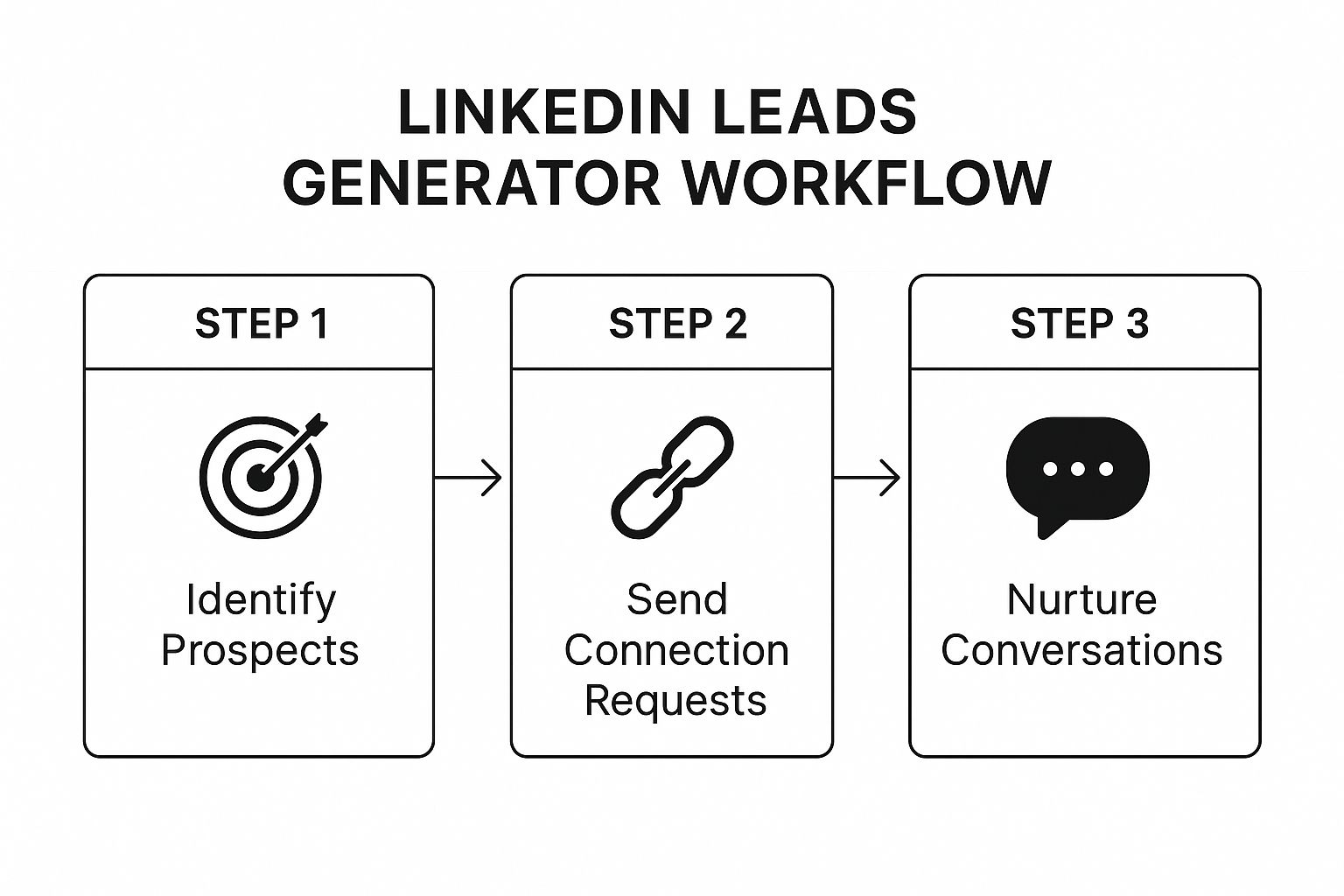
This automated workflow shifts your outreach from cold to warm by focusing on timely, relevant triggers. You're no longer a random stranger; you're someone showing up at the perfect time.
Building Your Automated Outreach Sequence
Let's create an outreach sequence that feels human, not robotic.
What to NEVER do:
Please, don't send a generic, self-serving pitch right from the start. We've all seen them: "Hi {first_name}, I saw you're a {job_title} and wanted to connect. My company does X, Y, and Z. Free for a demo?" This will get you ignored 99% of the time.
What to do instead:
Lead with value and context. Your connection request should be straightforward and reference a shared interest or commonality.
My Go-To Connection Request Template:
"Hi {first_name}, saw you engaged with [Competitor's] post on lead gen. I’ve been exploring similar strategies and would love to connect and follow your insights."
Once they accept, your automated sequence kicks in. However, your first message is still not a sales pitch. It should be a conversation starter. Ask a thoughtful question or share a genuinely helpful resource.
The goal is to build a predictable pipeline. To round out your strategy, you can explore our guide on the top free LinkedIn lead generation tools. By automating the very top of your sales funnel with a tool like Gojiberry, you free yourself up to do what really matters: building relationships and closing deals.
Step 3: Create Content That Fuels Your Lead Generation Engine
Automation is a significant piece of the puzzle, but it's only half the equation for a successful LinkedIn lead generator. The real magic happens when a prospect receives your message from Gojiberry, clicks over to your profile, and discovers a treasure trove of valuable content waiting for them.
Let's be honest: is your profile a ghost town or a thriving hub of expertise? I made this mistake for years. I was so fixated on outreach that I completely neglected what people saw when they actually checked me out. Big mistake. Your content is what builds trust and authority before you even start a one-on-one conversation.
My "Pillar and Post" Strategy for Endless Content Ideas
Coming up with new content ideas every day can feel like a total grind. That's why I developed my "Pillar and Post" strategy. It's a simple system to turn one great idea into a full week of content without the burnout.
Here's how it works:
1. Choose a "Pillar" Idea: Select one significant issue your ideal client frequently struggles with. For me, a pillar might be "Mastering Cold Outreach Personalization."
2. Break it Down: Slice that pillar into five smaller, bite-sized "Posts."
- Monday: A text-only post about the #1 personalization mistake people make.
- Tuesday: A simple carousel showing 3 surprising places to find personal details.
- Wednesday: A personal story about a disastrous outreach attempt and the lesson I learned.
- Thursday: A poll asking, "What's your biggest personalization challenge?"
- Friday: A video tip sharing a template for a great opening line.
One pillar, five pieces of micro-content. You're not reinventing the wheel; you're just exploring different angles of a single, valuable topic.
Your content's job isn't to go viral. Its job is to consistently prove to your ideal clients that you understand their world and have the answers they're looking for.
Post Formats That Actually Get Engagement
You can forget about fancy, overproduced videos. Some of the most effective post formats on LinkedIn are shockingly simple. My own engagement skyrocketed when I stopped overthinking it.
- Text-Only Posts: These are amazing. They feel authentic and are quick to write. Use short sentences, lots of white space, and a killer first line to hook the reader.
- Simple Carousels: You don't need a design degree. Use a tool like Canva to create a simple 5-7 slide carousel that teaches one specific thing. They're highly shareable and position you as an expert.
What to NEVER do: Don't just post a link to your blog with no context. LinkedIn's algorithm hates it, and it's lazy. Instead, write a native post summarizing the key takeaways and then put the link in the first comment.
What to absolutely do: Write like you talk! Ask questions. And always end your posts with a clear call to engagement, like, "What's one tip you'd add to this list? Drop it in the comments below!"
When you pair smart automation from a tool like Gojiberry with consistent, valuable content, you create a powerful flywheel. The automation brings people to your profile, and your content convinces them to stay, connect, and eventually, become a client. This is how you get your ideal customers coming to you.
Step 4: Turning Connections Into Real Conversations
So, you got a new connection. Awesome! Now what?
This is the moment where 90% of people fumble the ball. I used to be one of them. My signature moves were either the instant, cringe-worthy sales pitch or just… letting the connection gather digital dust. Both are terrible for business.
Let's not do that. This playbook is designed to turn that "accept" click into a genuine, meaningful conversation. The goal is to start a relationship, not force a transaction. This is the final, critical function of any effective LinkedIn leads generator.
The Follow-Up That Actually Works
The golden rule is simple: delay the pitch. Your first message after connecting should never be about you. Make it about them. Reference the reason you connected.
Example message that gets replies:
"Hey [First Name], thanks for connecting! Really enjoyed that post you shared on [Topic] the other day. Curious to know, what's been your biggest challenge with [related pain point] lately?"
This message does three things beautifully:
- It shows you're paying attention.
- It opens a loop with a thoughtful question.
- It shifts the focus entirely to their world.
When and How to Make The Ask
After a few back-and-forth messages, you'll feel if there's a real need. If they're describing a problem you can solve, that's your cue to pivot gracefully.
Don't say: "Want to hop on a quick call?"
Do say: "Based on what you're saying about [their challenge], I have a few ideas that might help. Would you be open to a 15-minute chat next week to explore them? No strings attached."
See the difference? It's framed around value for them, not a sales call for you.
The key takeaway is to always lead with value, not with a sense of neediness. It keeps the door open and positions you as a helpful resource rather than just another salesperson. Once you've built that rapport, you can explore some strategies for sustainable lead generation that will take your business to the next level.
Your Path to a Full Pipeline Starts Now
You now have the exact four-step playbook to transform your LinkedIn from a dusty resume into a predictable, high-performance lead generation engine. We've covered everything from optimizing your profile to automating smart outreach and creating content that attracts clients.
This isn't just theory; it's the step-by-step process that took me from shouting into the void to having a calendar filled with qualified prospects. The old way of spamming and praying is dead. The future is about building genuine connections at a large scale.
Your ideal clients are on LinkedIn right now, actively looking for the solution you provide. The only question is, will they find you, or will they find your competitor who is already using this system?
The choice is yours. You can keep doing what you've been doing, or you can take action today and build a LinkedIn leads generator that fills your pipeline while you sleep.
Ready to stop prospecting and start having conversations? GojiberryAI is your AI-powered copilot for identifying high-intent leads and automating personalized outreach on LinkedIn. Stop guessing and begin generating a pipeline on autopilot.
Get started with GojiberryAI today!
Frequently Asked Questions
How long will it take to see results from my LinkedIn leads generator?
This isn't an overnight fix, but you can see meaningful progress fast. Within your first 30 days, a key goal is to see your connection acceptance rate rise above 40% and schedule your first few qualified sales meetings. The real magic starts picking up steam in month two and beyond as your system gains momentum. Be patient, trust the process, and focus on those early wins!
Will using an automation tool like Gojiberry result in my account being banned?
A valid concern! The key lies in the distinction between "mart" and "pammy" automation. Spam tools that blast out hundreds of generic requests at inhuman speeds are a surefire way to get flagged. An innovative tool like Gojiberry is built to act like a human. It sends out personalized messages at a natural, safe pace, keeping your activity well within LinkedIn's acceptable use guidelines. When you use automation to initiate genuine conversations, the risk significantly decreases.
How much time do I realistically need to invest each day?
When you're first setting up your system, polishing your profile, and launching your first campaign, plan on about an hour a day for the first week. However, the most beautiful part is that once your system is running, maintenance should only require about 20-30 minutes a day. That time is purely for replying to warm messages and engaging with interested prospects. The primary goal of a reliable LinkedIn automation system is to give you time back, not create more work.

More High-Intent Leads = Your New Growth Engine.
Start Now and Get New High Intent Leads Delivered Straight to Slack or Your Inbox.