
AI Agent Implementation: From Planning to Launch

So, you're hearing all the buzz about AI agents. It's not just hype—teams that implement AI agents properly see up to 4x productivity gains. 🚀 They're offloading the grunt work and spending more time on what actually matters: closing deals.
But here's the reality check. A lot of companies dive in headfirst, mesmerized by flashy demos, and end up with expensive software nobody uses. Poor implementation leads to low adoption, wasted investment, and a team that’s more frustrated than productive. Sound familiar?
This guide is the structured roadmap you need to get it right. We'll walk you through a proven process for AI agent implementation, from initial planning to a successful launch and beyond. You'll learn how to define your goals, choose the right tool, and roll it out in a way that gets your whole team on board.
Ready to make this happen? Let's dive in.
Pre-Implementation Planning: Your Blueprint for Success
It’s so tempting to skip this part and jump straight into product demos, right? But trust me, a few hours of planning now will save you months of headaches later. A successful AI agent implementation isn't magic; it's the result of a solid blueprint.
First, what does "success" actually look like for your team? Get specific. Are you trying to:
- -Book 20% more qualified meetings?
- -Reduce the time spent on lead research by 10 hours a week per rep?
- -Automate the soul-crushing data entry that everyone hates?
Define your goals and the success metrics you'll use to track them. This clarity is everything.
Next, take an honest look at your current state.
- -Tools & Processes: What’s in your current tech stack (CRM, email, etc.)? Where are the real bottlenecks slowing everyone down?
- -Team Readiness: Is your team excited, skeptical, or just plain burned out? Understanding their mindset is key for change management.
- -Use Cases: Identify the top 2-3 tasks where an AI agent could deliver the biggest, fastest impact. Don't try to boil the ocean.
- -Budget & Resources: What's a realistic budget? Who will lead this project?
- -Timeline: Set achievable milestones. A 4-week rollout is a great starting point.
Doing this homework ensures you’re not just buying a cool piece of tech, but a solution to a real business problem. For a broader view, a practical AI implementation roadmap can help frame this for leadership.
Choosing the Right AI Agent for Your Team
It feels like a new AI sales tool pops up every single week, doesn't it? It's easy to get distracted by shiny features that don't solve your core problems. Let's cut through the noise.
Before you look at a single platform, get crystal clear on your non-negotiables. What do you really need?
- -Features: What specific tasks must it automate (e.g., lead scoring, personalized outreach, data enrichment)?
- -Integrations: Does it need to play nicely with your CRM, email provider, and other key tools? Based on user feedback, this is where many projects succeed or fail.
- -Pricing: What's a realistic price-per-seat you can afford?
With this checklist in hand, you can start evaluating the top 3-5 platforms. Look for tools built for your specific needs. For example, B2B sales teams often look for agents that can find buyer intent signals and automate initial outreach. Platforms like GojiberryAI are built for this specific use case. Our guide on the best AI tools for sales teams is a great place to start your research.
Pro Tip: Never buy without a trial. Request live demos and, if possible, run a small pilot. This is your chance to ask the tough questions.
- -How do you handle data privacy and security (e.g., GDPR)?
- -What does your customer support model look like?
- -Can you show me how the integration with our specific CRM works?
A little due diligence now saves a world of pain later.
Implementation Phases: Your 4-Week Rollout Plan
Alright, you've chosen your tool. Now, how do you roll it out without causing chaos? The answer is a phased approach. A big-bang launch is a recipe for disaster. Instead, think of this as a four-week sprint to build momentum and prove value.
Phase 1: Setup & Configuration (Week 1)
This week is all about laying the groundwork. It's the behind-the-scenes technical work that makes everything else possible.
- -Tool Installation & Account Setup: Get the platform installed and create user accounts.
- -Integration with Existing Systems: This is crucial. Connect the agent to your CRM, email, and any other essential tools. For the tech-savvy, this includes verifying things like the Chat Completions API endpoints.
- -User Access & Permissions: Define who can see and do what.
- -Basic Configuration: Set up the initial rules and settings.
- -Testing Connections: Make sure data is flowing correctly between systems. No data silos!
Phase 2: Customization & Training (Week 2)
Now it's time to tailor the agent to your team's specific needs.
- -Customize Workflows: Build out the processes for your primary use cases (e.g., a workflow for prospecting on LinkedIn).
- -Create Templates & Processes: Develop the initial outreach templates and agent policies. You might even build a custom agent like the Skool Scraper Agent for niche tasks.
- -Train Team: Hold an initial training session with your pilot group.
- -Document Procedures: Create simple, clear documentation your team can reference.
- -Establish Support System: Who does the team go to with questions?
Phase 3: Pilot Launch (Week 3)
Don't go live to the whole company yet. Start with a small, hand-picked group of 2-5 enthusiastic reps.
- -Launch with Small Group: Go live with your pilot team.
- -Monitor Closely: Hold daily check-ins. What’s working? What's clunky?
- -Collect Feedback: This is gold. Use their real-world experience to find friction points.
- -Identify Issues & Solutions: Work with the vendor or your internal team to fix bugs and refine workflows.
- -Optimize Based on Learnings: Tweak the agent's instructions and policies based on pilot feedback.
Phase 4: Full Rollout (Week 4+)
With the kinks ironed out and a few success stories from your pilot, you're ready for the big launch.
- -Expand to Full Team: Onboard the rest of the team, using your pilot users as internal champions.
- -Ongoing Monitoring & Support: The work isn't done. Keep an eye on performance and be available for questions.
- -Regular Optimization: Continuously refine processes based on data.
- -Performance Tracking: Keep your KPIs front and center.
- -Continuous Improvement: Celebrate wins and look for the next opportunity to automate.
Key Implementation Considerations
As you move through the phases, a few critical factors will determine your success. Keep these on your radar.
- -Data Quality: An AI agent can't work magic with bad data. If your CRM is a mess ("garbage in, garbage out"), the results will be disappointing. Plan a data cleanup initiative if needed.
- -Integration Complexity: How many systems need to talk to each other? A simple CRM and email integration is straightforward. Connecting to five custom-built internal tools is another story. Be realistic.
- -Team Readiness: Change is hard. A great AI agent deployment includes solid training and a clear explanation of "What's in it for me?" for every single rep.
- -Compliance & Security: Is the agent handling sensitive customer data? Ensure the platform meets all your security standards (GDPR, CCPA, etc.). This is non-negotiable.
- -Support & Maintenance: Who will own the agent long-term? Who provides support when things break? Have a plan for ongoing maintenance.
Common Implementation Mistakes (And How to Dodge Them)
We've seen enough AI agent rollout projects to know where the landmines are. Here are the most common mistakes—learn them now so you can avoid them.
- Skipping the Planning Phase: This is the #1 killer. Teams get excited by a demo, buy the tool, and then try to figure out what to do with it. Don't: Jump straight to setup. Do: Define your goals and use cases before you even look at a vendor.
- Inadequate Training: Handing reps a login and expecting them to figure it out is a recipe for low adoption. Don't: Assume a one-hour training is enough. Do: Provide ongoing support, documentation, and celebrate early adopters.
- Poor Data Quality: We said it before, and we'll say it again. Don't: Feed the agent messy, outdated data from your CRM. Do: Invest time in cleaning your core data sources first.
- Ignoring Integrations: An AI agent that works in a silo just creates more work. Don't: Choose a tool that doesn't seamlessly connect to your team's daily workflow. Do: Make deep AI agent integration a key criterion in your selection process.
- No Performance Tracking: If you can't measure it, you can't manage it (or justify its cost). Don't: Launch without clear KPIs. Do: Set up a dashboard to track success metrics from day one.
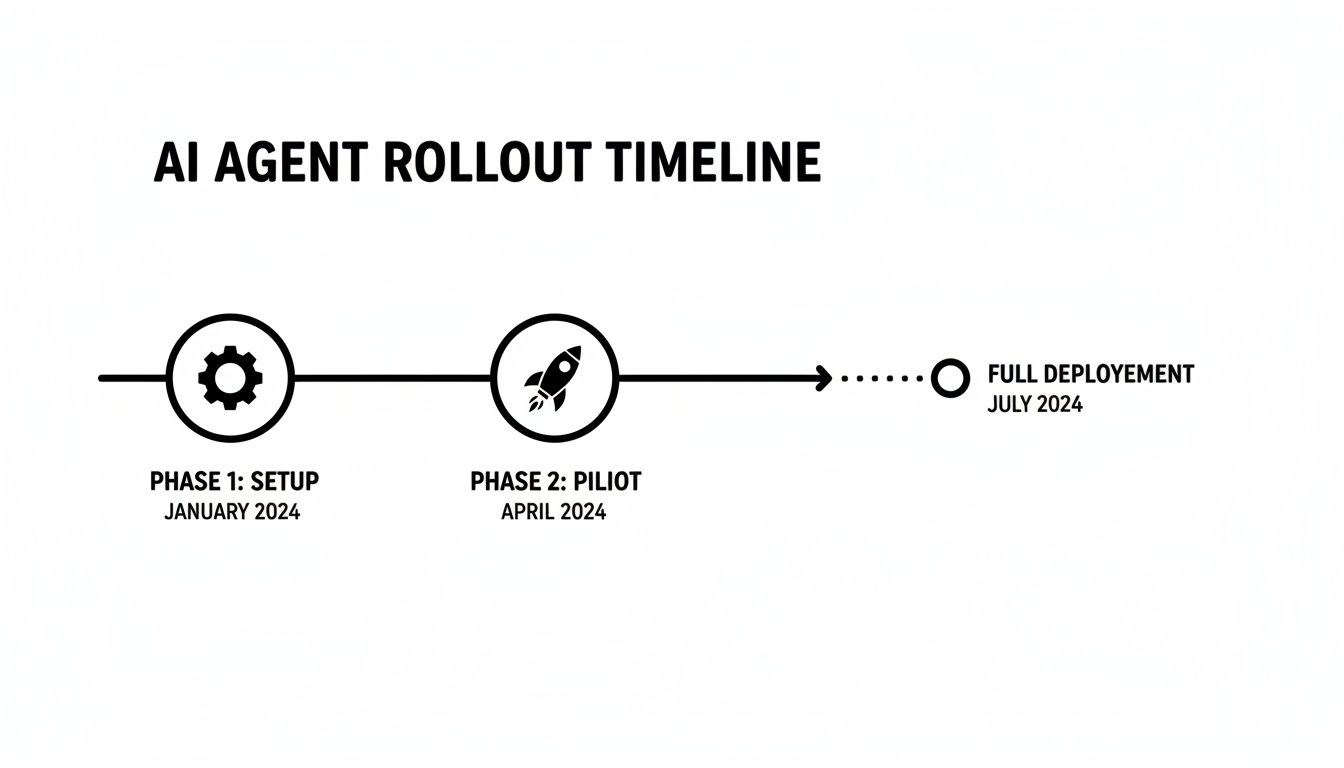
Your Implementation Timeline at a Glance
To keep things simple, here’s a high-level view of your first month.
Real-World Implementation Case Studies
Theory is great, but what does this look like in practice? Here’s how different types of companies are winning with AI agent implementation.
- -Case Study 1: The Scrappy SaaS Startup: A 10-person sales team was drowning in manual lead research. They implemented an AI agent to automatically identify prospects matching their ICP on LinkedIn, enrich the data, and draft personalized outreach emails. Result: Reps saved 8+ hours per week, and qualified meetings increased by 30% in the first quarter.
- -Case Study 2: The B2B Services Firm: A consulting firm needed to find companies that were actively hiring for roles their services could support. They deployed an AI agent to scan job boards and company career pages daily. When a match was found, the agent would identify the hiring manager and tee up an introduction for the sales team. Result: They gained a massive first-mover advantage, connecting with decision-makers weeks before competitors even knew the opportunity existed.
- -Case Study 3: The Enterprise Deployment: A Fortune 500 company needed to standardize its prospecting process across a 200-person global sales team. They used a phased AI agent rollout, starting with a pilot in one region. They focused heavily on change management, creating internal champions and sharing success stories widely. Result: After a six-month rollout, they saw a 15% lift in pipeline generation and a significant improvement in CRM data quality.
Measuring Implementation Success
How do you know if your AI agent implementation is actually working? Don't get lost in a sea of data. Focus on the metrics that truly matter.
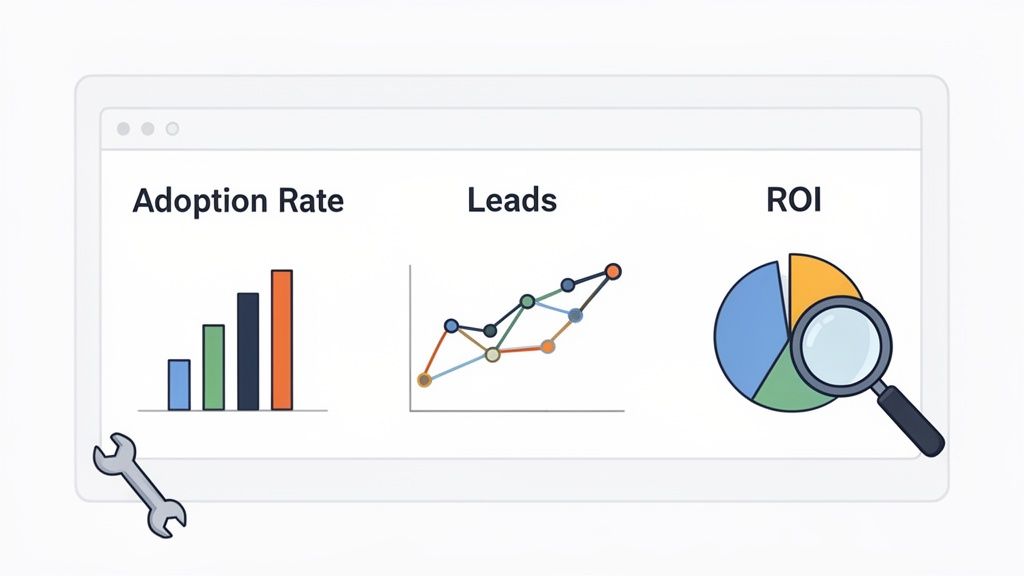
- -Adoption Rate: What percentage of your team is actively using the agent daily or weekly? If this number is low, you need to find out why—fast.
- -Time to Productivity: How long does it take for a new rep to start getting value from the agent? A good implementation shortens this ramp time.
- -Performance Metrics: This is the big one. Are you hitting the goals you set in the planning phase? Look at leads generated, meetings booked, and revenue influenced.
- -User Satisfaction: Numbers don't tell the whole story. Talk to your team. Are they happy? Do they feel more productive? Their qualitative feedback is invaluable.
- -Return on Investment (ROI): Ultimately, does the value gained (new revenue, time saved) outweigh the cost of the tool? You should be able to show a clear, positive ROI within 3-6 months.
The AI agent market is projected to hit $48.3 billion by 2030 for a reason: when implemented correctly, the ROI is undeniable. Check out the full market forecast to see the data behind the momentum.
Ready to see how an AI agent could generate pipeline for your team? A quick consultation with our experts can show you exactly what’s possible.
Post-Implementation Optimization: The Real Work Begins
Getting your AI agent live is the starting line, not the finish line. The most successful teams treat this as a continuous improvement cycle.
- -Weekly Performance Reviews: Briefly check your KPI dashboard. Are there any red flags or big wins to discuss?
- -Monthly Strategy Adjustments: Look at what's working and double down. Are there underperforming workflows that need to be tweaked or cut?
- -Quarterly Planning: Revisit your high-level goals. What's the next big challenge the agent can help you solve?
- -Continuous Training & Enablement: As you add new features or reps, keep your training materials fresh.
- -Regular Tool Updates: Stay on top of platform updates from your vendor. A new feature could unlock massive value.
This commitment to data-driven improvement is what separates the top 1% from everyone else. You've built the engine; now it's time to fine-tune it for maximum performance.
You Have a Roadmap—Now It's Time to Act
You now have the complete playbook for a successful AI agent implementation. We’ve covered everything from building a solid plan and choosing the right tool to a phased rollout and a framework for measuring success.
The key takeaway? A structured approach is everything. By moving deliberately through planning, setup, a pilot launch, and full rollout, you turn a risky tech project into a predictable strategic win.
The question is, what's your next step? Don't let this just be another article you read. Take one action right now. Schedule a 30-minute meeting with your team to discuss your top 3 prospecting bottlenecks. That's the first step on your implementation journey.
FAQs: Your Questions Answered
How technical do I need to be to implement an AI agent?
Probably less than you think! Many modern platforms, especially those designed for sales teams like GojiberryAI, are built to be low-code or no-code. If you can map out a sales process on a whiteboard, you can likely configure the basics through a visual interface. It’s more about understanding your workflow than knowing how to code. For complex custom integrations, you might need a technical resource, but for 80% of use cases, a tech-savvy sales or ops leader can drive the implementation.
What is the biggest hurdle in an AI agent rollout?
It's almost never the technology itself. The biggest hurdle, based on feedback from hundreds of teams, is change management. Getting experienced reps to trust a new process and let go of old habits is the real challenge. Success comes from a clear "why," strong leadership buy-in, and celebrating early wins to build momentum. If your team sees the agent as "more work" or a "black box," adoption will fail. That's why the pilot phase is so critical—it creates internal champions.
How soon can we expect to see an ROI from an AI agent?
With a well-planned AI agent setup, you should see leading indicators of success—like time saved on manual tasks—within the first 30 days. A measurable impact on lagging indicators, like a tangible increase in booked meetings and pipeline, typically becomes clear within the first 90 days. Companies are prioritizing internal agents because they directly accelerate core processes, with 88% of execs boosting AI budgets to capture this efficiency. You can explore more AI agent statistics to see the trends.
Ready to stop talking about AI and start seeing a real return? With GojiberryAI, you can begin generating high-intent pipeline on autopilot.

More High-Intent Leads = Your New Growth Engine.
Start Now and Get New High Intent Leads DeliveredStraight to Slack or Your Inbox.