E-commerce Growth Hacking: 7 Proven Strategies to Scale in 2026
January 9, 2026
2026-01-08T06:30:04.613Z
How did an e-commerce startup 10x its revenue in just 6 months? It wasn't magic, and it definitely wasn't a massive ad budget. It was a completely different way of thinking.
Welcome to the world of ecommerce growth hacking. In a market where customer acquisition costs are soaring and margins are shrinking, the old playbook just doesn't cut it anymore. You need to be smarter, faster, and more creative. This guide is your new playbook. We're going to break down 7 proven growth hacking strategies specifically designed for e-commerce, packed with real examples and actionable steps you can use today. No fluff, just results.
What Is Growth Hacking for E-commerce?
So, what’s the big deal with "growth hacking" anyway? Isn't it just a buzzword for marketing? Not quite.
Think of traditional marketing as following a well-worn map—it’s reliable, but often slow and expensive. Growth hacking is about forging a new, faster path through the wilderness. It's a mindset focused on one thing: rapid growth using limited resources.
The core difference lies in the process:
Traditional Marketing: Big campaigns, long planning cycles, and a focus on brand awareness.
Growth Hacking: Small, rapid experiments, data-driven decisions, and a relentless focus on measurable growth.
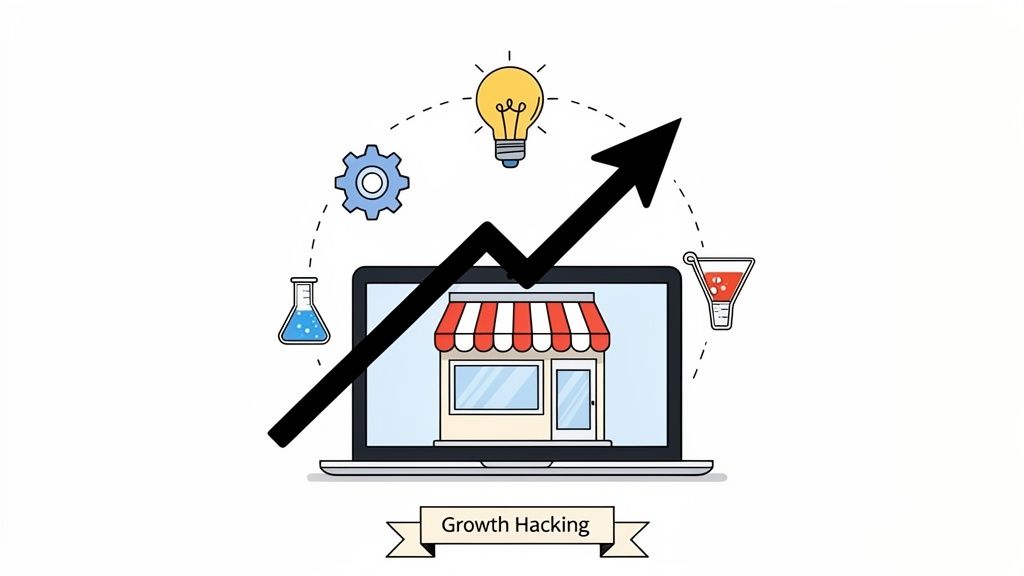
This approach is built on a simple but powerful loop: Test → Measure → Iterate. Instead of launching one huge campaign and hoping for the best, a growth hacker runs dozens of small experiments. They might test a new headline, a different button color, or a unique discount offer. They measure the results obsessively, kill what doesn't work, and pour resources into what does.
For online stores with razor-thin margins, this mindset isn't just a nice-to-have; it's a survival strategy. It forces you to ask one question over and over: “What’s the most efficient way to get more customers right now?”
Ready to see how it works? Let's dive in.
Strategy #1: Viral Loops
What if every new customer brought you at least one more for free? That's the holy grail of ecommerce growth hacking: the viral loop. You're not just acquiring a customer; you're acquiring their entire network. 🤩
This isn't about just hoping people share your products. It's about engineering a system where sharing is a natural, rewarding, and frictionless part of the customer experience.
Take Warby Parker. Their "Home Try-On" program was a stroke of genius. It turned a solo decision into a social event. Customers would post photos of the different frames, asking friends, "Which one should I get?" Each customer became a walking advertisement, creating a powerful viral loop that fueled their explosive growth.
How to Implement a Viral Loop
Ready to build your own growth engine?
Build a Referral Program: This is the most direct way. Create an offer that benefits both the sharer and their friend. The classic "Give €10, Get €10" works because it feels generous, not selfish.
Offer a Strong Incentive: A weak 5% discount won't cut it. The reward needs to be compelling enough to make someone stop and share. Think free products, significant store credit, or exclusive access.
Make Sharing Frictionless: Give every customer a unique, one-click referral link on their order confirmation page and in their account dashboard. Add pre-populated sharing buttons for email, WhatsApp, and social media.
Don't: Hide your program. Promote it on your homepage, in post-purchase emails, and on social media.
ROI Benchmark: A well-oiled referral program can easily see a return where €5 spent in rewards generates €50 in new sales.
Strategy #2: Content Marketing + SEO
Paid ads give you a quick spike. Content gives you an evergreen asset. This growth hack is about acquiring customers for free by becoming the most helpful voice in your niche.
Instead of interrupting people with ads, you attract them with high-value content that solves their problems. Selling running shoes? Don't just show them a picture of your product. Write the "Complete Guide: How to Choose the Right Running Shoes for Your Foot Type." You build trust first, and the sale follows naturally.
The giant retailer Decathlon is a master of this. Their blog is a powerhouse of expert advice and buying guides. Based on industry reports, this content machine is responsible for around 40% of their total traffic and contributes to 20% of their sales. That's not just a blog; it's a 24/7 customer acquisition engine running on a €0 ad spend.
How to Implement a Content + SEO Strategy
Ready to turn your blog into a lead magnet?
Find "Buying Intent" Keywords: Use tools like Ahrefs or Semrush to find the questions your ideal customers are typing into Google. Focus on phrases that signal they are close to making a purchase, like "best..." or "how to choose..."
Publish 1 High-Value Article Per Week: Consistency is key. Commit to publishing at least one genuinely helpful article every week. This tells Google you're an active authority in your space.
Optimize Every Post for SEO: Make sure your main keyword is in your title, headings, and sprinkled naturally throughout the text. Add internal links to your product pages and other relevant blog posts to keep readers on your site.
Link Content Directly to Products: An article about choosing running shoes should have clear, helpful links pointing to the exact shoes you sell. Make the transition from learning to shopping seamless. For more inspiration on creating engaging content, check out our guide on how to create a viral LinkedIn post.
ROI Benchmark: While it takes time, the long-term ROI is massive: €0 ad spend for a continuous stream of high-quality organic traffic.
Strategy #3: Automated Email Marketing
Your email list is your most valuable asset. Period. It's a direct line to your audience that you own, and with smart automation, it becomes your hardest-working salesperson. 😴
This isn't about sending a weekly newsletter. It's about setting up intelligent, automated email sequences that trigger based on customer behavior.
The classic example? The abandoned cart recovery email. A shopper adds an item to their cart but gets distracted. An hour later, an automated email lands in their inbox with a friendly reminder. Data shows this simple flow can recover up to 30% of otherwise lost sales. For many top Shopify stores, email marketing is so powerful it accounts for nearly 40% of their total revenue.
How to Implement Email Automation
Ready to put your revenue on autopilot?
Capture Emails Everywhere: You can't nurture a list you don't have. Use pop-ups offering a first-timer discount, add an email field at checkout, and place a signup form in your website footer.
Build Your Core Sequences: Start with the "big three" every e-commerce store needs:
Welcome Series: Introduce your brand and offer a small incentive for the first purchase.
Abandoned Cart Series: A 2-3 email sequence to gently nudge shoppers back to complete their purchase.
Post-Purchase Series: Thank the customer, ask for a review, and suggest complementary products.
Automate with the Right Tools: Don't even think about doing this manually. Tools like Klaviyo, Brevo, or Mailchimp are designed for this. Users report that Klaviyo's deep integration with Shopify is a game-changer. For more advanced strategies, this comprehensive guide to ecommerce marketing automation is a great read, and many B2B email marketing best practices can be adapted for B2C with great success.
Identify Niche Micro-Influencers: Search Instagram, TikTok, and YouTube for creators whose audience perfectly matches your ideal customer. Look for high engagement rates (likes and comments relative to followers)—it’s a sign of a real community.
Offer a Win-Win Partnership: You don't always need a big upfront budget. Many micro-influencers are open to collaborations based on free products + a commission on sales. This performance-based model minimizes your risk.
Track Results with Unique Promo Codes: This is non-negotiable. Give each influencer their own discount code (e.g., "SARA15"). This not only incentivizes their followers but also allows you to track every single sale they generate.
Do: Look for creators who genuinely align with your brand's values for a more authentic partnership.
Don't: Focus only on follower count. A smaller, highly engaged audience is far more valuable. As you scale, you can dig into more social commerce stats to see which platforms are driving the best conversions for your niche.
Install the Facebook and Google Pixels: This is step one. These tiny snippets of code track visitor behavior on your site, allowing you to build audiences for your campaigns. Get your pixels from Meta and Google Ads.
Create Custom Audiences: Segment your visitors based on their actions. Create lists for "all site visitors," "viewed specific products," and the ultra-valuable "cart abandoners."
Launch Campaigns with Tailored Offers: Don't show the same ad to everyone.
Site Visitors: Show them your best-sellers or brand story.
Cart Abandoners: Show them the exact product they left behind, perhaps with a free shipping offer.
Create a Dedicated Space: A private Facebook Group or a Discord server is a great starting point. Both are free and easy to set up.
Share Exclusive Content, Tips, and Offers: Give your community members a reason to be there. Offer early access to new products, exclusive discounts, or behind-the-scenes content they can't get anywhere else.
Encourage User-Generated Content (UGC): Run contests asking members to share photos of them using your product. Feature the best posts on your main social channels. This not only provides you with free marketing content but also makes your community feel valued.
Do: Engage personally. Answer questions and participate in discussions to show you're listening.
Don't: Make it all about selling. The community should be 90% value, 10% promotion.
The headline on your homepage
The color of your "Add to Cart" button
Your product descriptions
Your pricing
The images you use
Test One Thing at a Time: If you change the headline and the image at the same time, you'll never know which one was responsible for the change in results. Isolate your variables.
Measure the Right KPIs: For a product page, your key KPI is conversion rate. For a homepage, it might be bounce rate or time on site. For an email, it's open rate and click-through rate.
Iterate: Once you have a statistically significant result, keep the winning variation and then test something new against it. The goal is continuous improvement.
Do: Use tools like Google Optimize (free), VWO, or Optimizely to run your tests.
Don't: Stop a test too early. You need enough data to be confident in the results.
Strategies Applied: They went all-in on Content Marketing (publishing two high-value blog posts a week) and aggressive Email Capture (offering a 10% discount to new subscribers).
Result:€5k/month. Traffic started to trickle in from Google, and their email list became their first reliable sales channel.
Strategies Applied: They layered on an Influencer Partnership program (gifting products to 20 micro-influencers) and a Viral Referral Program ("Give €15, Get €15").
Result:€25k/month. Word-of-mouth and social proof kicked in, creating a surge in new customers.
Strategies Applied: With proven traction, they turned on paid ads with Retargeting Campaigns targeting cart abandoners. Simultaneously, they became obsessed with A/B Testing their product pages and checkout process.
Result:€100k/month. They were now efficiently converting their traffic and maximizing the value of every visitor.
Automate your email marketing sequences
Manage influencer partnerships and track their ROI
Set up and track A/B tests without code
Measure the true ROI for each growth strategy in one dashboard
If you have traffic but low sales: You have a conversion problem. Start with A/B Testing your product pages or implementing an Abandoned Cart Email Sequence. These directly impact revenue from the visitors you already have.
If you have a great product but no traffic: You have an awareness problem. Start with Content Marketing + SEO to build a long-term organic traffic engine, or use Micro-Influencer Partnerships for a quick injection of targeted traffic.
As this data suggests, certain platforms can be more effective. For an even more advanced approach, you can learn about the 13 intent signals to find high-intent leads to refine your targeting.
ROI Benchmark: Retargeting campaigns are incredibly efficient, often yielding a return of €5 in sales for every €1 spent.
Strategy #6: Community Building
What's better than a customer? A customer who becomes a brand ambassador. Building a community is a powerful long-term growth hack that turns your buyers into a loyal tribe.
This is about creating a space—like a private Facebook Group or a Discord server—where your customers can connect with each other and with your brand. It's a place to share tips, ask questions, and celebrate their passion for your products. When you build a community, you're not just selling a product; you're selling a sense of belonging.
The ultimate case study? Peloton. Their rabidly loyal community is built around Facebook groups where members share their progress and cheer each other on. This sense of community is a massive driver of their nearly 80% retention rate.
How to Implement Community Building
Ready to build your tribe?
ROI Benchmark: While harder to track directly, the ROI is massive in terms of customer lifetime value and word-of-mouth growth. All for €0 ad spend.
Strategy #7: A/B Testing Obsession
The most successful e-commerce brands don't guess. They test. An A/B testing obsession is the engine that drives all other growth hacking strategies. It’s the commitment to continuously optimize every single part of your customer journey.
What should you test? Everything.
A simple CTA button color test—say, red vs. blue—can lead to a +15% lift in conversions. It sounds small, but these gains compound over time. Amazon is famous for its culture of experimentation, reportedly running over 1,000 A/B tests per year. This relentless optimization is a key reason for their estimated +30% annual conversion lift.
How to Implement A/B Testing
Ready to let data guide your decisions?
ROI Benchmark: This isn't about one-off wins. A culture of A/B testing can lead to compounding gains of +30% in conversions per year.
Full Case Study: From €0 to €100k/month
Theory is great, but a real-world roadmap is better. Let's break down how an e-commerce startup went from zero to six figures in monthly revenue in just six months by stacking these strategies.
Initial Situation: A new e-commerce startup with a great product, a tiny budget, and €0 in revenue.
Months 1–2: Building the Foundation
Months 3–4: Adding Fuel to the Fire
Months 5–6: Scaling with Precision
Key Lesson: No single strategy created this growth. It was the combination of strategies, each one building on the last, that created an unstoppable, exponential growth curve.
Ready to Scale Your E-commerce Business?
You've seen the strategies. You know they work. But let's be honest—managing all of this manually is a recipe for burnout.
Email marketing, retargeting ads, influencer outreach, A/B testing… to truly scale, everything must be streamlined and, wherever possible, automated.
These 7 strategies require automation to truly work. Gojiberry helps you:
You now have a proven framework for explosive e-commerce growth. We’ve covered everything from building viral loops that turn customers into marketers, to using content and SEO for free, long-term traffic, to deploying smart automation that puts your revenue on autopilot.
The core takeaway is simple: Growth hacking = relentless experimentation + smart automation.
Don't get overwhelmed. Just start. Pick one strategy from this list and commit to implementing it this week. The journey from zero to €100k/month starts with that first step. What will yours be?
Frequently Asked Questions
What's the real difference between growth hacking and digital marketing?
It's a great question, and it really comes down to mindset and speed. Traditional digital marketing often follows a well-established playbook, focusing on long-term brand building. Think of it as paving a solid, reliable highway. Ecommerce growth hacking, on the other hand, is like off-roading to find a shortcut. It’s defined by rapid, data-driven experiments across the entire customer journey, with a relentless focus on finding the most efficient, scalable path to growth, often on a tight budget.
How much budget do I really need to start growth hacking?
This is one of the biggest misconceptions. The beauty of growth hacking is that it was born from a need to grow without a huge budget. Many of the most powerful strategies—like content marketing, community building, and basic referral programs—cost more in time and creativity than in cash. For paid tactics like retargeting, you can start incredibly small (€5-€10 a day) to validate your approach before scaling up. The goal is to let data prove ROI first, then invest more.
Which growth hack should my store try first?
Don't just pick one at random. Let your data guide you. The best first move depends on solving your biggest bottleneck right now. Here's a simple framework:
Analyze your store's performance, identify the biggest leak in your funnel, and apply the strategy that will plug it most effectively. That's the essence of ecommerce growth hacking.
ROI Benchmark: Email marketing consistently delivers one of the highest ROIs in digital marketing, with an industry average of €40 in sales for every €1 spent.
Strategy #4: Influencer Partnerships
Forget chasing celebrities. The real power for ecommerce growth hacking lies with micro-influencers—creators with 10k–100k followers who have built deep trust with a niche audience.
Think about the math: partnering with 10 micro-influencers who each have 10,000 engaged followers gives you a potential reach of 100,000 people. These aren't just random impressions; they are warm introductions from a trusted source. Fast-fashion giants like Shein and Zara built their online empires on this model, with influencers reportedly generating around 30% of their traffic.
How to Implement an Influencer Program
Ready to tap into authentic reach?
ROI Benchmark: A well-run micro-influencer campaign can easily turn a €500 investment (in products and commission) into €5,000 in sales.
Strategy #5: Retargeting Ads
Did you know that 97% of people who visit your site for the first time leave without buying? That’s a lot of missed opportunity. Retargeting is your second chance to make a first impression.
This strategy involves showing targeted ads to people who have already interacted with your site. They visited a product page? Show them an ad for that exact product. They abandoned their cart? Show them an ad with a 20% off coupon to bring them back. It’s one of the highest-converting ad strategies because you’re talking to a warm audience.
E-commerce giants like Amazon and Zalando are masters of this. Their retargeting efforts are so effective that they are believed to drive around 50% of their total conversions.