
12 best Amplemarket alternatives to fill your pipeline in 2026

Quiz · 60 seconds
Which outbound tool fits a team like yours?
No email required.
QUESTION 1 / 3
What is slowing your outbound down right now?
QUESTION 2 / 3
How big is the team doing outbound?
QUESTION 3 / 3
What would you rather buy this week?
🎯
Your match
Gojiberry is the fit
You want the accounts picked for you and you want to start this week. Gojiberry watches for buying signals, scores each account against the buyer profile you describe, then writes first. Nothing sits between you and the product.
- Signals checked against your ideal customer before anyone gets a message
- Email and socials handled by the agent, no sequence to build
- $99 a month, self-serve, cancel whenever you like
🏢
Your match
Amplemarket is the fit
Ten reps, a process, someone who owns the tooling: that’s the shape the product was designed for, and it does that job well. Come back to us when you’d rather spend $99 a month than $600, or when you want the targeting layer without the annual contract.
- A 200-million-contact database with sequences attached
- Over 100 signals at the contact level
- Deliverability tooling that separate senders charge extra for
📤
Your match
A sending tool is the fit
Your list is already built and the bottleneck is throughput. Instantly or Lemlist will move more messages for less money than any platform here. Once the volume is running and the replies stay thin, the problem moves upstream to targeting, and that’s our half of the job.
- Unlimited mailboxes and warmup from around $47 a month
- Workspace pricing on email, so extra teammates cost nothing
- Add a targeting layer later without changing your sender
Amplemarket is a full outbound platform. One contract buys a database of more than 200 million contacts, over 100 contact-level buying signals, multichannel sequences and a deliverability suite. It’s a good product, and the reviews say so.
Then you ask the price. Six hundred dollars a month for two seats, billed annually, after a sales call. For three people who want to start on Tuesday, that’s a wall. Here are twelve alternatives, what they cost, and who each one suits.
Gojiberry finds your prospects for you
Same idea as the enterprise platforms, without the demo call and the annual contract. $99 a month, running from day one.
Get your first leads for freeTable of contents
- 12 Amplemarket alternatives compared
- How we tested these 12 tools
- The 12 best alternatives to Amplemarket
- Amplemarket is built for bigger sales teams
- Why do people leave Amplemarket?
- Pick the tool that matches your team size
- Why pay enterprise prices for intent?
- Why we built Gojiberry
- Common questions before switching
12 Amplemarket alternatives compared
Amplemarket sells a platform to teams that already run a process. The twelve tools below split the same job differently: four replace the whole motion, four sell you data, and four move messages once you know who to write to. Prices below were read on the vendors’ own pages on August 10, 2026, so they’re current as of today.
How we tested these 12 tools
Every price on this page comes from the vendor, read on August 10, 2026. Published tiers were taken from the pricing page or the vendor documentation. For the tools that publish nothing, the figures are buyer-reported contract data, labeled as such in the section, because a quote isn’t a price list. We opened self-serve accounts where one exists, and for the sales-gated platforms we worked from vendor documentation and public reviews.
We pay for every plan ourselves, no vendor read a word of this before publication, and Gojiberry is our product. That’s exactly why its limits are written the same way as everyone else's, in the same place in the card.
One thing you won’t find here: a scorecard of reply rates by tool. We haven’t run twelve tools against one identical list under controlled conditions, and an invented percentage would be worth less than this sentence admitting it. When we run that test, the numbers go up here.
The 12 best alternatives to Amplemarket
The order runs from the closest replacements for a small team toward the pieces you’d assemble yourself. Every card is capped at the same length, including ours, so the comparison stays readable.
1. Gojiberry
Gojiberry is an AI-powered multichannel prospecting platform. It tracks more than 30 buying-intent signals across socials and the web and runs personalized outreach on several channels. It’s built for a team with no ops person and no plan to hire one.
- 🔔Signals: It watches competitor engagement, job changes and category activity every day, and it flags the accounts that moved this week.
- 🎯ICP scoring: Every account is scored against your ideal buyer before a message goes out, so nobody hears from you by accident.
- 📨Outreach: The agent writes email and social messages per prospect and coordinates the timing, so there’s no sequence for you to build.
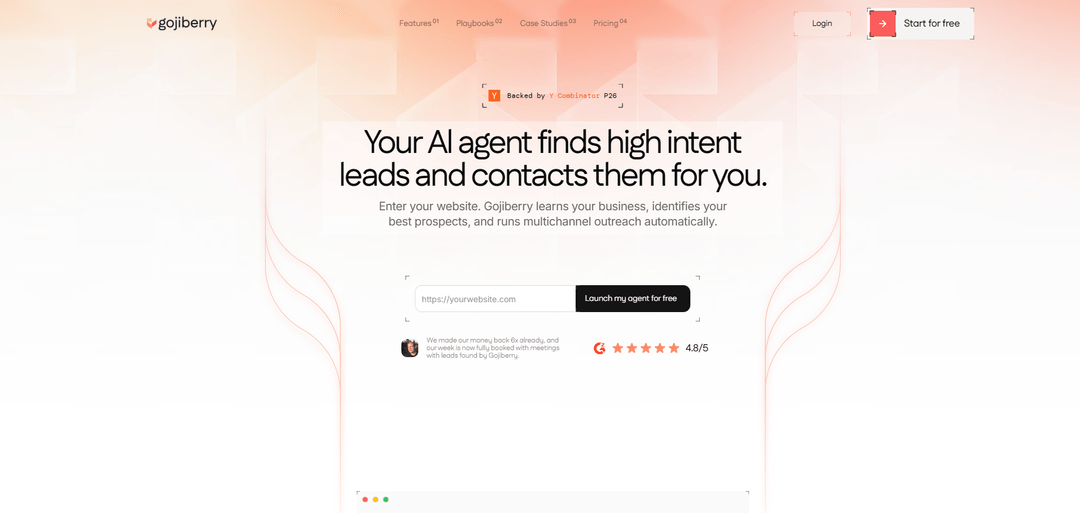
Pro is $99 a month, self-serve, with two agents and up to 1,800 prospects contacted a month. Teams of five and up move to a Custom plan. That’s $1,188 a year for three people, on one bill. Wispra sources 60% of its weekly demos this way, read the case study.
Few tools start finding accounts this fast for this little. Then you notice the trade. There’s no 200-million-row database to browse, because the product decides who is worth contacting instead of handing you a search bar.
2. Apollo.io
Apollo puts a 210-million-contact database and a sequencer behind one login, which is why it’s the first purchase for most small teams. You can find someone, reveal the email and drop them into a sequence without leaving the tab.
- 📚Database: The database holds 210 million contacts and you filter it by title, technology or hiring activity before exporting anything.
- 🔧Extension: The browser extension reveals a contact from a company page and drops that person straight into a sequence.
- 🧮Credit meter: An email costs one credit and a phone number costs eight, so a month of dialing empties an allocation quickly.
Basic is $49 per user a month on annual billing, Professional $79, Organization $119 with a three-seat minimum. Monthly billing adds roughly 20%, so you’re better off annual. Three reps on Professional is $2,844 a year before any credit top-up.
Few tools pack this much into a low seat price, and few will have you watching a credit balance you didn’t budget for.
3. Clay
Clay is a workbench rather than a product you switch on. You build a table, wire in providers, run a waterfall until an address comes back, then push the row somewhere else. The output is worth exactly what you’re able to build.
- 🧩Waterfall: Clay queries more than a hundred providers in order and stops as soon as one of them returns a usable address.
- 🤖Claygent: An AI researcher reads pages on your behalf and fills a column with whatever it finds, one row at a time.
- 🧠Learning curve: You should budget a couple of weeks before your first table earns its keep, because nothing here configures itself.
Clay replaced Starter, Explorer and Pro in March 2026. New accounts get Free, Launch at $185 a month or Growth at $495, all with unlimited seats and a split between Data Credits and Actions. Failed lookups still spend credits, so a stale input list costs you before it’s enriched.
Flexibility is where it wins. Time to first result is where it loses.
4. UserGems
UserGems watches the contacts you already have. When a champion changes jobs or an account shows contact-level intent, it alerts the rep and drafts the follow-up. Amplemarket runs a dedicated comparison page against it, which tells you how directly they’re competing.
- 🔁Job changes: It follows your closed-won and closed-lost contacts into their new companies and tells the rep who owned the relationship.
- 📊Signal set: More than twenty signals feed the same view, from hiring and funding rounds through tech changes and website visits.
- 📝Gem-E: Its agent drafts the email, the call script and the social message from the signal that triggered the alert.
UserGems now publishes its tiers. Core is $2,750 a month, or $33,000 a year, covering 3 admins, 20 end users and 30,000 records, plus a one-time implementation fee you’ll negotiate separately. Advanced and Elite list at $69,000 and $120,000.
The contract decides this one. Below twenty reps with a thin CRM, you’re buying a signal layer with nothing to feed it. Above that line, few tools work a customer list harder.
5. Cognism
Cognism sells numbers you can dial. Its Diamond Data set is human-verified and screened against do-not-call lists, and its European coverage is why teams pick it over US-first databases. It enriches people you can already name, and it won’t discover a market for you.
- 📞Verified mobiles: A human checks the mobile numbers before they reach you, and that verification is what lifts connect rates on cold calls.
- 🌍EMEA coverage: European data is the single strongest reason to choose Cognism over a database built first for the United States.
- 🔒Compliance: GDPR handling and dialing compliance sit inside the workflow rather than in a policy document nobody opens.

Cognism publishes no price. Its two prospecting packages, Standard and Pro, are shown with five seats in the starting configuration, and every deal is an annual quote. Buyers report a platform fee before any seat cost, so check their current pricing page and ask about that fee first, because it doesn’t scale down for a small team.
The five-seat shape ends the conversation for most teams of three. For the ones it doesn’t end, no phone data here lands as reliably in Europe.
6. ZoomInfo
ZoomInfo holds the deepest record of US companies and the people inside them: org charts, technologies, funding history, web visitors, intent topics. It’s a database first, with the sending tools bolted on later.
- 🏢Company depth: The record carries org charts and technology stacks that most databases never attempt, which is what the price is buying.
- 🔎Intent topics: Account-level intent comes from a research panel and is sold as an add-on rather than included in the base contract.
- 📅Contract terms: Every plan is annual, and the renewal notice window is worth putting in a calendar the day you sign.
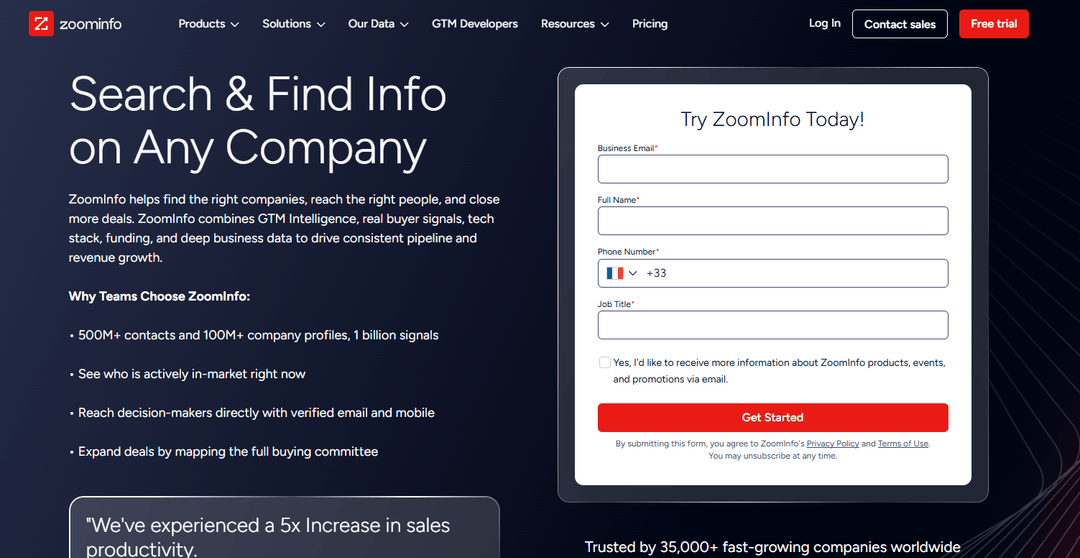
Nothing is published. Buyers report entry contracts near $15,000 a year, with a median around $32,000 once seats, credits and intent stack up. A free Lite tier exists if you’d like to see the data before any of that.
Start with the budget question. Under $15,000 a year for data alone, this isn’t a conversation you can have. Above it, nobody knows the US market better.
7. Lusha
Lusha is a lookup tool. You’re on a company page or a profile, you click, and you get an address and sometimes a mobile. It makes no attempt to run your outbound.
- 🔍Lookups: You reveal contact details on the page you were already reading, which is why reps adopt it without any training.
- 💰Credit slider: An email costs one credit and a phone number costs five, so a calling motion drains the pool five times faster.
- 📦Bulk enrichment: CSV lists get enriched in batches, though the row cap per upload changes with the plan you’re on.
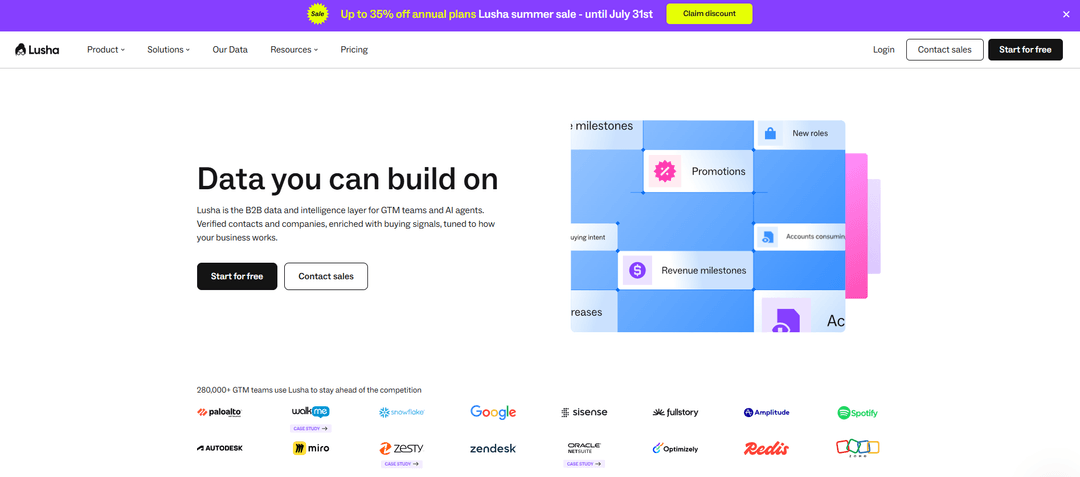
A free tier gives a few dozen credits a month. Paid plans sat around $50 a month on annual billing when we looked, with a promotion running on the page, so check their current pricing page before you build a budget on it.
It collapses contact research into two clicks, at the cost of leaving you to work out who’s worth those clicks.
8. Outreach
Outreach runs the whole revenue cycle for large sales organizations: sequences, a dialer, conversation intelligence, deal management and forecasting, with the governance you’d expect at fifty reps. The 2026 Amplify packaging adds AI agents metered on credits.
- 🔀Sequencing: Multichannel steps come with the controls a manager needs to hold everyone to the same process week after week.
- 🎧Call intelligence: Conversations are transcribed and analyzed inside the platform, so coaching happens against recordings instead of memory.
- 🧰Implementation: You should expect onboarding fees and several weeks of configuration before the team is running on it properly.
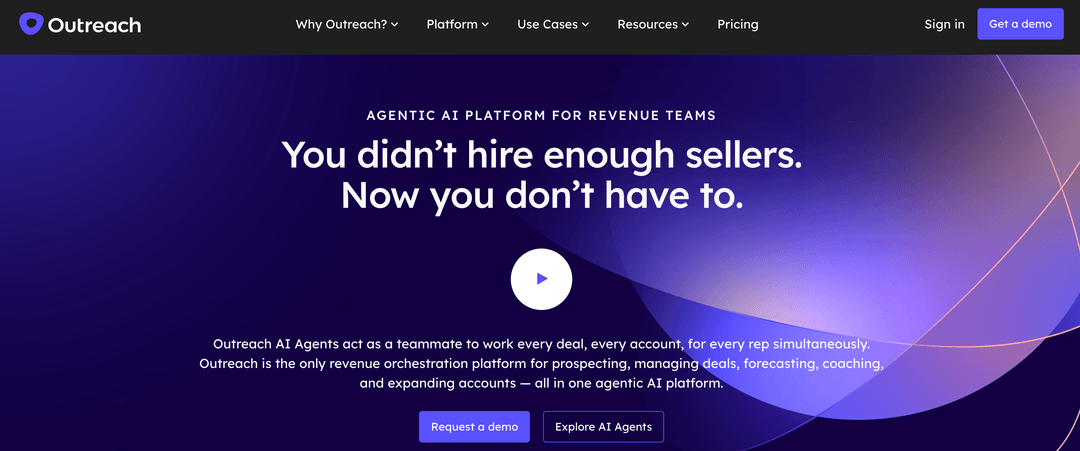
Nothing is published. Buyers report roughly $100 to $160 per user a month on annual contracts, plus implementation and a consumption layer for the AI agents. Check their current pricing page for the tier list.
Onboarding alone costs more than most teams of three spend on software in a year, and that’s before a single seat is billed. At fifty reps with someone owning the process, that same rigor is the thing you are paying for.
9. Salesloft
Salesloft covers similar ground from a coaching angle, now bundled with Clari's forecasting stack after the 2025 merger. Cadences, call recording, deal management and analytics live in one workspace for managers who run to a number.
- 🔖Cadences: Structured multi-step plays keep a whole team working the same way, and that consistency is the point of buying at this level.
- 💡Coaching: Recorded calls are scored and shared across the team, and that review loop is where the platform earns its keep.
- 📌Dialer add-on: Calling is billed separately from the base plan, so the quote you receive first is rarely the one you pay.
Quote only, annual only. Reported list pricing runs $125 to $180 per user a month, negotiated down at volume, with the dialer on top. Vendr puts the median contract near $31,000 a year, and you won’t see a number without asking.
Managers who spend the week coaching get real value here. Then you count the seats. Under ten reps, you’re paying for work nobody has the hours to consume.
10. Lemlist
Lemlist built its name on personalization people notice: custom images, dynamic landing pages, video. The socials, the dialer and a lead database came later, along with lemwarm for deliverability. The email plan is now priced per workspace rather than per seat.
- 🎨Personalization: Image and page personalization go further here than anywhere else, and recipients notice the difference on a first touch.
- 📤Warmup: Every paid plan includes lemwarm and unlimited campaigns, so deliverability isn’t a second subscription on top.
- 👥Workspace pricing: The email plan carries unlimited users against a fifty-thousand-message monthly ceiling, which changes the math for a small team.
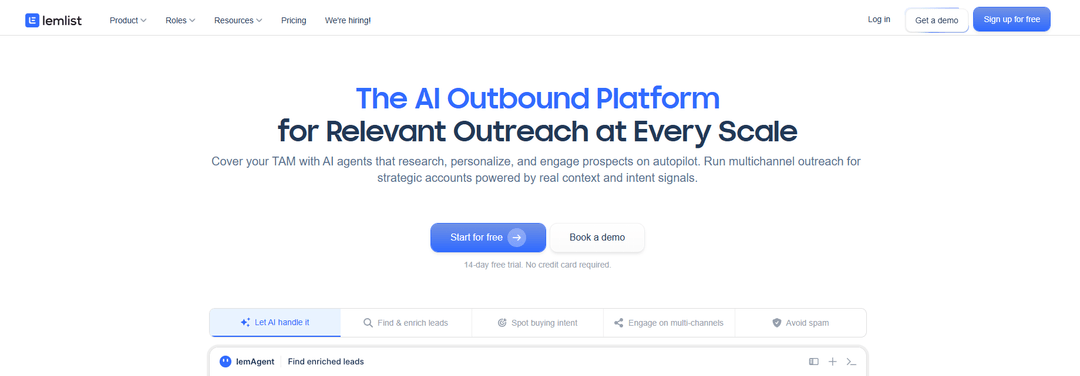
The email plan is $69 a month for the whole workspace, $55 on annual billing, with a 650-million lead database and credit-based finding. Multichannel is $109 per user a month, $87 annual. Three people sending email only won’t pay less anywhere else in this comparison.
Nothing sends a warmer first message for a smaller bill, and nothing does less to tell you who’s on the other end.
11. Instantly
Instantly is sending infrastructure. Unlimited mailboxes, unlimited warmup, one inbox for every reply, and rotation logic that keeps volume off a single domain. The leads and the CRM aren’t included, they’re separate subscriptions.
- 🚀Unlimited inboxes: Every plan connects as many sending accounts as you can buy, and that ceiling is why agencies live inside this tool.
- 🔥Warmup: Warmup is included at no extra cost, and it matters while Google holds bulk senders under a 0.3% spam complaint rate.
- 🧪Modular billing: Sending, leads and the CRM are sold as three products, so the advertised price covers roughly a third of the job.
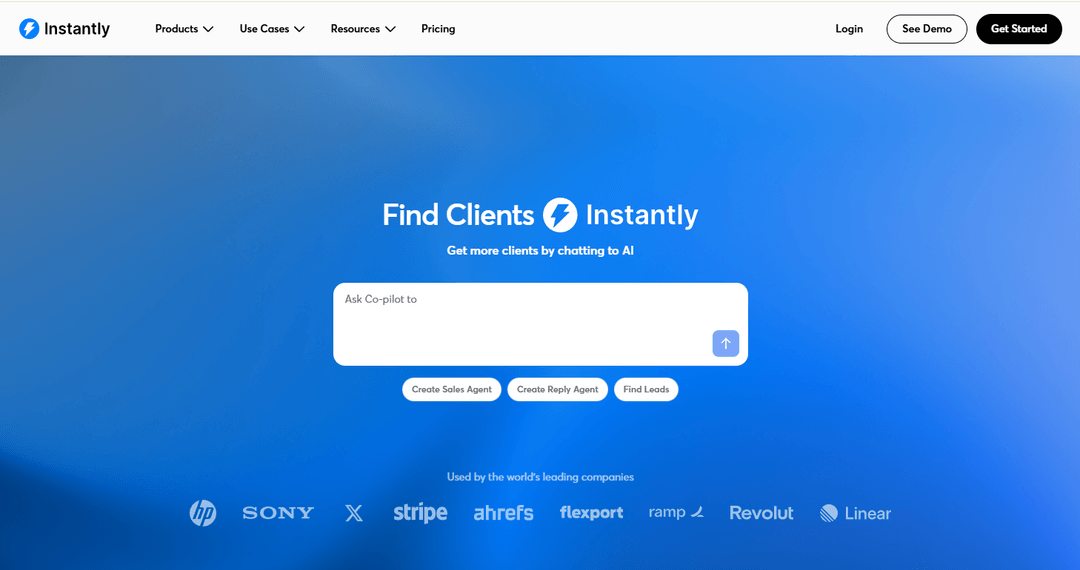
Growth is $47 a month, $37.60 on annual billing, capped at 5,000 sends and 1,000 active contacts. Hypergrowth is $97. Add lead credits and the CRM and you’re nearer $120 to $210 a month.
It moves more email per dollar than anything else in this comparison, and it’s assuming you arrived with the list already built.
12. Reply.io
Reply.io puts email, socials, calls and SMS into one sequence builder, and sells Jason, an AI sales rep, as a separate product on top. It’s the cheapest route into genuine multichannel if you buy only the channels you’ll use.
- 🌐Channel mix: Four channels run inside a single sequence, which very few tools at this price manage without a second subscription.
- 🧵Jason: The AI agent builds lists and writes first touches, and it’s billed apart from the seats you already pay for.
- 🔬Reporting: Step-level analytics show exactly where a sequence loses people, which makes the copy easy to fix between batches.
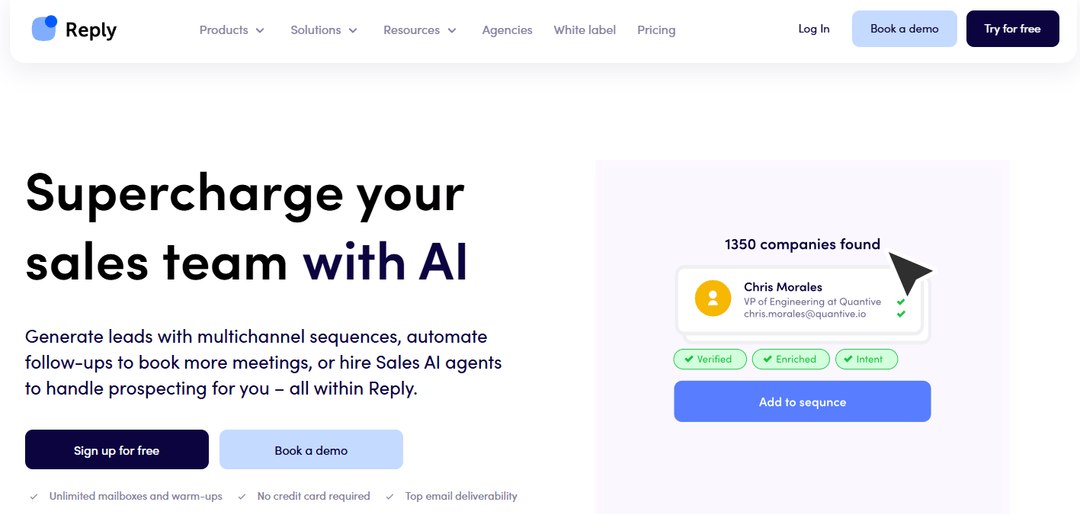
The email plan starts near $49 per user a month on annual billing and multichannel is $89, with channels billed as add-ons. Jason is priced separately and starts in the hundreds. Check their current pricing page, because the seat price isn’t the bill.
Breadth is where it wins. The add-on line of the invoice is where it loses.
You shouldn't have to guess who to contact
Gojiberry watches more than 30 buying signals across socials and the web, checks each account against your ICP, and sends you the ones worth writing to.
Start free on your marketAmplemarket is built for bigger sales teams
Nothing here is a knock on the product. Amplemarket consolidates five purchases into one contract, and the customers who use all five parts say the math works. The catch is the shape of the buyer it was designed around: a sales organization with reps, a process and someone whose job includes the tooling. If that isn’t you, the mismatch starts at the invoice.
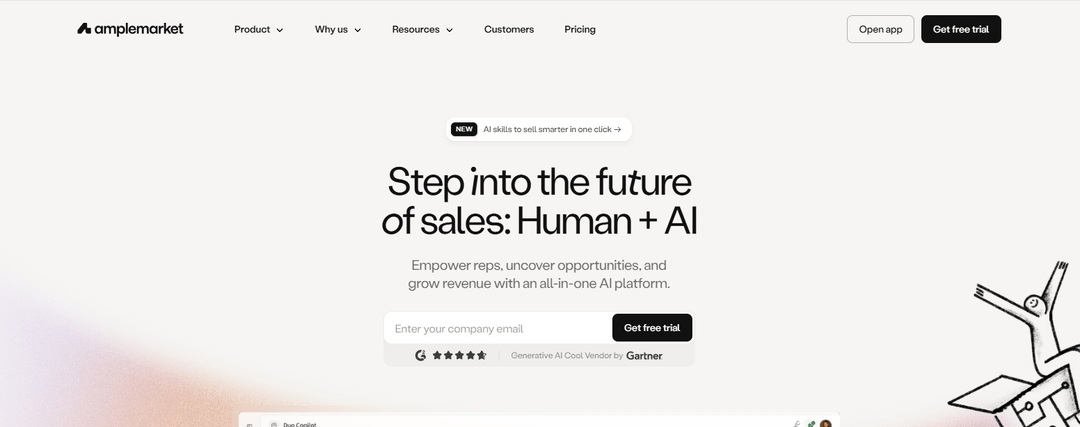
What can you do with Amplemarket?
More than most of its competitors, which is what the price buys. The database carries over 200 million AI-verified contacts across 20 million companies, with more than 70 million records refreshed weekly, under 3% bounce rates and 96.5% phone accuracy on the vendor's own numbers.
- 📈Buying signals: More than a hundred contact-level signals feed the platform, covering job changes, competitor activity, funding rounds and website visits.
- 💬Duo agents: Copilot surfaces leads and prepares sequences while Copywriter drafts the first touch, and Voice and Inbox sit on the upper tiers.
- 📬Multichannel: Email, phone and social steps live in one sequence, with a native dialer instead of a separate calling subscription.
- 🔗Deliverability: Warmup, domain health monitoring, spam checking and mailbox selection are bundled in rather than bought from a third party.
Assembled separately, that list is three to five subscriptions. For a team already paying for a data provider, a sequencer, a warmup service and a signals tool, consolidation is a real argument, and it’s the one the vendor leads with.
What are the pros and cons of Amplemarket?
What works
- 📧Contact-level signals, not just account-level guesses
- 🧪Data quality that holds up: under 3% bounce on the vendor's figures
- 📁One contract instead of four, with one support team behind it
- 📥Deliverability tooling included rather than sold as an add-on
- 📅A 14-day trial before the annual commitment
What hurts
- 💰$600 a month minimum, and only the Startup tier shows a number
- 🔄Annual billing at every tier, with no monthly path
- 👥Two seats included, so a third person is a quote
- 🧮Credit pools for email and phone that need watching
- 🧭Depth that a small team will never finish using
How much does Amplemarket cost?
The Startup plan is $600 a month on an annual term and includes two users, which works out at $300 per seat, or $7,200 for the year. Growth covers four users and Elite ten, both priced on request. Every tier carries the same database, the same signals and the same deliverability suite, so you’re buying seats and volume rather than features.
Credits meter the usage: 15,000 email credits and 480 phone credits per user per year, renewing annually instead of monthly, with extra phone credits at $0.50 each. Revealing a contact you already revealed costs nothing, so you’re not paying twice for the same person.
Run the math for a team of three
Amplemarket Startup covers two of your three people. The year costs $7,200 before the third seat, which is quoted, and before any credit top-up. Gojiberry Pro is $99 a month, so the same year costs $1,188, on a card, cancellable, with the whole team working from one workspace.
The two numbers don’t buy the same thing, and pretending otherwise would be useless to you. Amplemarket includes a contact database and a dialer we don’t sell. What $1,188 buys is the part a small team runs day to day: who to contact this week, and the messages going out to them. Mindflow lifted reply rates 31% on that basis, the numbers are here.
What do Amplemarket users think?
The public reviews split along a predictable line. Teams that use the whole platform rate it highly and talk about dropping three or four other subscriptions. The recurring complaint, cited by roughly a quarter of reviewers on aggregator sites, is that the cost doesn’t match the value for smaller companies.
Two other themes come up often enough to plan around. There’s a learning curve, with most teams describing a few weeks before they’re fully running, and onboarding is community-based on Startup while Growth and Elite get a dedicated contact. Gartner named it a Cool Vendor in generative AI for sales in 2024, which tells you the product is taken seriously by people who look at these things for a living.
Why do people leave Amplemarket?
Four reasons come up again and again, and none of them is that the product doesn’t work.
The floor is too high
$7,200 committed before the first email goes out is a real number for a company with three salespeople. Most of them have a total tooling budget below that.
You can’t try it on a Tuesday
A trial exists, but the plans are annual and the two upper tiers need a call. Teams that want to test something this week go elsewhere and never come back.
It expects a process
Sequences, workflows, analytics and governance pay off when somebody owns them. Without someone owning them, half the platform sits unused and still shows up on the invoice.
The seats don’t match
Two users included means a third person costs extra, and a founder who sells part-time is a full seat like everyone else.
There’s a fifth reason that has nothing to do with any vendor. B2B contact data goes stale at roughly 2.1% a month, about 22% over a year, so the list you paid to build in January is measurably worse by December. Buying a bigger database doesn’t fix that. Watching for the moment someone moves does.
Pick the tool that matches your team size
Six situations, six answers. Find yours and skip the rest.
I sell on my own and I’m starting
Gojiberry. The agent does the part you have no hours for, which is deciding who to write to. Apollo's free tier is the alternative if you’d rather search a database by hand.
We’re three and nobody owns ops
Gojiberry. One $99 subscription against $7,200 committed, and the workflow assumes nobody is available to maintain it. This is the situation the product was built around.
We’re ten and we have a budget
Gojiberry. At that headcount the consolidation argument holds, the seats are used, and the depth stops being decoration. We’d rather say so than lose you on a claim you can check in a minute.
I need European phone numbers
Cognism. Verified mobiles, compliance-screened before they reach a rep, with EMEA coverage nothing here matches. Expect a five-seat starting package and an annual quote.
I want to build my own enrichment
Clay. Providers in a waterfall, an AI researcher on every row, and results pushed anywhere. You’re buying a workbench and the time to learn it.
My problem is sending, not targeting
Instantly or Lemlist for the volume, then Gojiberry above them once the replies stay thin. More sending against a weak list gets you to a spam complaint threshold faster, nothing more.
One number worth keeping in mind while you choose. Median job tenure in the United States is 3.9 years, and 22% of employed people have been in their role under a year. Your buyers are moving constantly, and each move is a reason to write. Any tool that only searches a static database is answering a question you didn’t ask.
Your competitors' customers are moving right now
Someone in your market just changed jobs or started following a competitor. Gojiberry spots it, checks they match your ICP, and writes before anyone else does.
Start free, no sales callWhy pay enterprise prices for intent?
Both products work from signals, so this isn’t a comparison between a tool that sees intent and one that does not. Amplemarket advertises more than 100 signals and we advertise more than 30. The difference is who each product was priced and shaped for.
Same idea, without the sales call and the annual commitment. That’s the whole pitch, and it only matters to you if your team is the size this page keeps describing. Four clients have put numbers on what the signal-first approach does for them.
GTE Localize
More than 100 meetings booked after switching from email blasts to timing-based outreach.
Read the case studyFive other pages here go deeper on the comparisons this one only touches:
- Gojiberry against Amplemarket, the full head-to-head on price and scope.
- Amplemarket against ZoomInfo, if the choice is between the two big platforms.
- Apollo alternatives, for teams who keep hitting the credit ceiling.
- Clay alternatives, for anyone weighing a workbench against a finished product.
- Lusha alternatives, when the job is contact lookup rather than targeting.
Why we built Gojiberry
Roman, one of our cofounders, spent his days prospecting on socials before Gojiberry existed. He did intent research by hand at Coco.ai: who had just changed roles, who had started following a competitor, who had begun asking about the category in public. It worked, and it did not scale. One person can follow about thirty accounts properly. Past that the method falls apart, and you go back to blasting a list.
Gojiberry is that manual routine running on its own. It’s also why the product targets a team of two to ten rather than a sales floor. We built the thing we needed when we were three people and nobody owned the tooling, and the pricing reflects who was in the room.
Common questions before switching
What is the best Amplemarket alternative?
There’s no single answer, and any page that gives you one is selling something. For a team of two to ten with no ops person, Gojiberry is the closest replacement for what Amplemarket does at a price that fits. For phone outbound in Europe, Cognism. For US data depth, ZoomInfo. For raw sending volume, Instantly.
Is there a free Amplemarket alternative?
Several tools here have free tiers: Apollo, Clay, Lusha and ZoomInfo Lite all let you look before paying. None of them runs an outbound motion for free. Gojiberry has a free start with no card required, which is the closest you’ll get to testing the full workflow at no cost.
How much does Amplemarket cost?
The Startup plan is $600 a month on an annual term and includes two users, so $7,200 for the year. Growth includes four users and Elite ten, both quoted on request, so you won’t see a number without a call. Each seat carries 15,000 email credits and 480 phone credits a year, and extra phone credits cost $0.50 each.
Amplemarket or Apollo, which one?
Apollo if budget is the constraint and you’ll accept watching a credit balance. Amplemarket if you are consolidating three or four tools and the deliverability suite and signals matter more than the seat price. Apollo starts at $49 per user a month annually against $600 a month for two seats, so the decision is rarely close for a small team.
Which alternative is cheapest for a team of three?
On a strict monthly total, Instantly at $47 and Lemlist at $69 for the whole workspace come in lowest, but they’re both senders, and neither one decides who gets the message. Counting the full job, Gojiberry at $99 a month covers targeting and outreach together, which is where a three-person team loses most of its time.
Do the alternatives have buying intent signals too?
Some do. UserGems is built entirely on signals, ZoomInfo and Cognism price intent separately, and Gojiberry tracks over 30 signals of its own. The senders don’t, which is the dividing line between the two halves of the list.
How do I switch without losing my sequences?
Export your contacts and your sequence copy before you cancel anything, because access usually ends on the renewal date and you won’t get it back. Then run both tools in parallel for two weeks on separate segments. Watch reply rates, not open rates, and only cut the old contract once the new one is producing meetings.
Can I run Gojiberry alongside my current tool?
Yes, and plenty of teams do. Gojiberry finds the accounts and can hand them to a sender you already pay for, or run the outreach itself. If your sending setup works, don’t replace it, put the targeting layer above it.
Want us to find the prospects too?
Tell Gojiberry who you sell to and it starts finding prospects who are already looking. No demo call, no annual contract.
Launch your agent freeSee the client results
More High-Intent Leads = Your New Growth Engine.
Start Now and Get New High Intent Leads Delivered Straight to Slack or Your Inbox.