
10 Best Outreach.io Alternatives in 2026 (Real Prices)

60-second quiz
Which Outreach.io alternative fits your team?
No email required.
Question 1 / 3
What pushed you to look?
The price per seat
The contract and the renewal date
Nobody has time to run it
We need a real dialer
Question 2 / 3
Where do your leads come from today?
We buy a list and load it
We export from a data tool
We don't have a reliable source
Salesforce, and it stays there
Question 3 / 3
How many people send?
Just me
Two or three
Four to ten
More than ten
🎯
Your match
Gojiberry
Your bottleneck sits before the sending. You're paying platform money to schedule emails to a list somebody still has to build by hand. Gojiberry watches the buying signals, scores the accounts against your profile, and contacts the ones that are moving. Nothing to load, nothing to sign for a year.
Start free📤
Your match
Smartlead
You already have data and your problem is throughput. Smartlead sends from unlimited mailboxes for a flat fee and it'll cost you a fraction of an Outreach seat. Smartlead is your fit. If the list turns out to be the broken part, that's the half we handle.
See what we add📞
Your match
Klenty
Calls belong inside the sequence for you, and that rules out most of the cheaper options here. Klenty puts the dialer next to the email steps and syncs both back to your CRM. Klenty is your fit. We'd handle the part that decides who gets dialed first.
See the other half🏢
Your match
Salesloft
You're staying on Salesforce and somebody on the team forecasts for a living. That combination keeps you in enterprise territory, and Salesloft covers it. Salesloft is your fit. If the seat count is what hurts, there's a lighter way to fill the top of the pipeline.
Try the cheaper routeOutreach.io is a sales execution platform built for revenue teams with thirty or more reps, a Salesforce admin and somebody in RevOps to keep it running. Small teams buy it anyway, then find they're paying enterprise seat prices for what turns out to be an email scheduler with a dialer attached.
Below are ten alternatives sized for a team of two to ten, with prices pulled from each vendor's own page and a section on the renewal clause that every other comparison skips.
The leads are out there signalling right now. Let an agent bring them in.
Start free on your marketTable of contents
- The 10 best Outreach.io alternatives
- How we tested
- The 10 alternatives in detail
- What is Outreach.io?
- Why do people look for an Outreach.io alternative?
- How do you get out of an Outreach.io contract?
- Which Outreach.io alternative is right for you?
- Gojiberry vs Outreach.io: what a team of five pays
- What our customers got out of it
- Your questions about Outreach.io alternatives
The 10 best Outreach.io alternatives
For a team of two to ten, start with Gojiberry: it finds the leads instead of asking you to load them, and it doesn't ask you to sign a year. The nine below each win a case Gojiberry doesn't. Seven of them replace Outreach outright. Two are sending engines you'd pair with a data source. And the last one is Outreach with a different logo.
Prices are the published entry tier, checked on each vendor's own pricing page on September 7, 2026. Where a vendor keeps its rate card private, the table says so rather than guessing.
How we tested
Across the first week of September 2026, we opened every vendor pricing page on this list, signed up for the products that let you in without a call, and read Outreach's own Terms of Service line by line for the contract section further down. Every price here comes straight from the vendor rather than a roundup, and each one was checked on September 7, 2026. For the two vendors that publish nothing, we label the ranges as buyer-reported and say where they come from.
We pay for every plan ourselves and no vendor read a word of this before publication. Gojiberry is our product and it sits first on the list, so weigh the rest of the page accordingly.
One thing you won't find here: a scorecard of measured reply rates. We haven't run the same sequence to the same list across all ten tools, and an invented percentage would be worth less than this sentence admitting it. When we run that test, the numbers land here.
The 10 alternatives in detail
1. Gojiberry
Gojiberry is an AI-powered multichannel prospecting platform. It tracks more than 30 buying intent signals across socials and the web, surfaces the leads who are searching right now, and fires personalized outreach across several channels. You don't build the list.
- 🔔Signals before contacts: the agent watches buying and social activity, then scores each account against your profile before anyone hears from you.
- 🤖Two agents running around the clock: they prospect while you sleep and hand over leads that are already warm.
- 📨Email and socials in one workspace: both run in one coordinated motion, with no cadence builder to learn.
- 🧠It gets sharper weekly: the agent tracks what converts and retunes its own targeting.
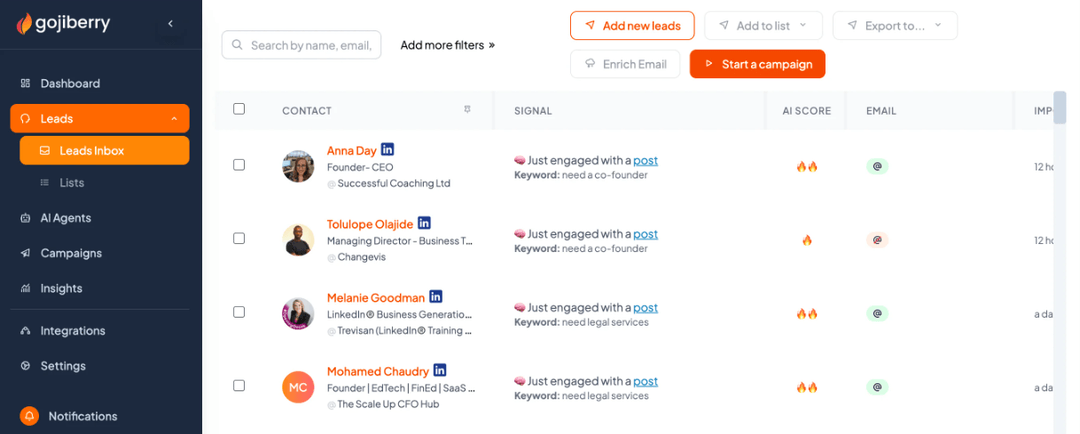
Pro costs $99 a month, flat, with two AI agents, 2 social senders and up to 1,800 prospects contacted. It isn't per seat, so a colleague doesn't change the invoice. Teams of five and up get quoted on the Custom tier.
It folds the list-building tool and the sequencer into one subscription, with no term to sign, and the cost is that you're handing your targeting to an agent instead of a spreadsheet.
2. Lemlist
Lemlist is a multichannel sequencer from the French company lempire, built for teams who want email, social steps and calls in one flow. Its 2026 repricing is the interesting part. The Email plan now bills per workspace instead of per seat.
- 📧Email plan, unlimited users: $69 a month covers the whole workspace and 50,000 sends.
- 🔀Multichannel steps: the upper tier adds social automation, SMS, WhatsApp and a built-in dialer.
- 🧩650M lead database: included on both plans, with email and phone lookup billed in credits.
- 🔥Deliverability hub: warmup, inbox rotation and DNS checks ship on every tier.
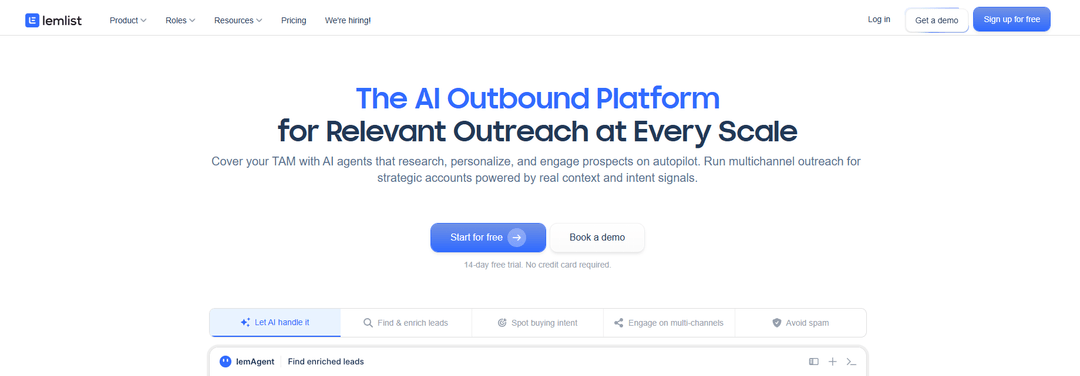
The Email plan is $69 a month on monthly billing, or $55 annually. Multichannel goes back to per user at $109, or $87 annually. Credits are pay-per-success at $10 per thousand.
The moment you want social steps in the sequence, the per-workspace pricing disappears and you're back to paying by the head. Below that line it's the cheapest way for three people to share a sending workspace.
3. Smartlead
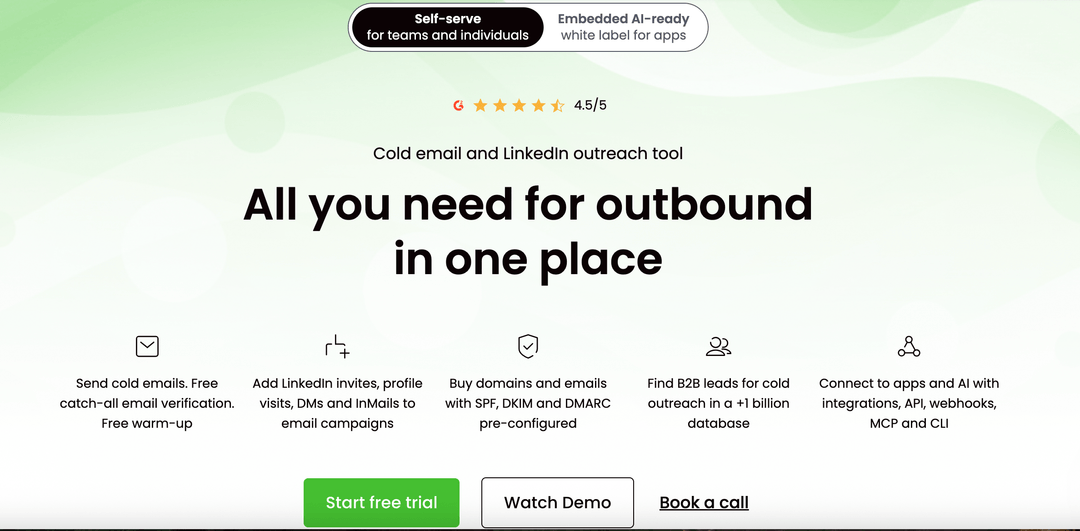
Smartlead is a cold email platform built around one idea: send from as many mailboxes as you like without paying per mailbox or per seat. It's the volume play here.
- 📤Unlimited mailboxes: every tier includes unlimited email accounts and unlimited warmup.
- 🔄Automatic rotation: sending spreads across your connected inboxes so no single sender carries the load.
- 📊Per-mailbox deliverability data: you see which inbox is degrading before the campaign does.
- 🏢Client workspaces: agencies get white-label portals from Pro up at $29 per client.
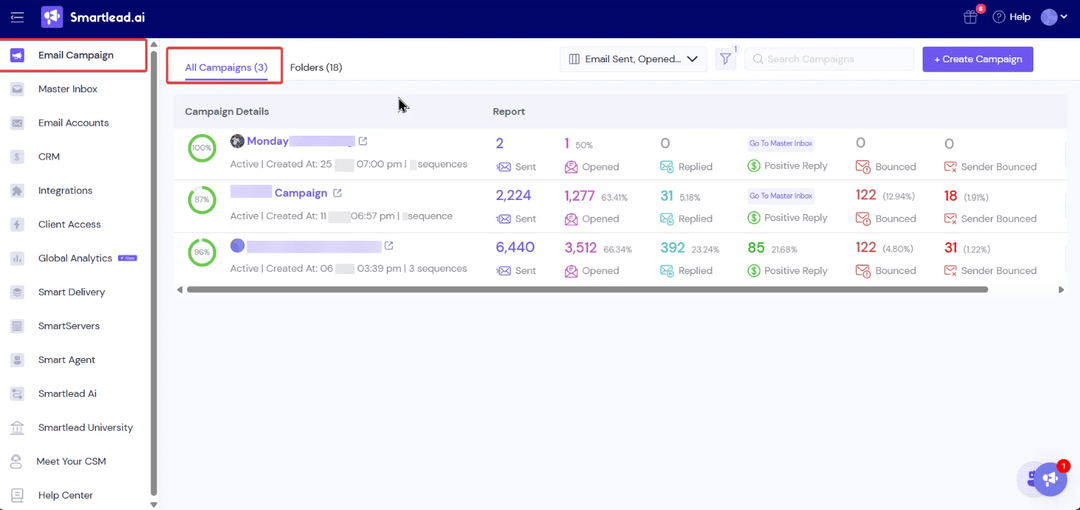
Base is $39 a month for 2,000 contacts and 6,000 sends. Pro at $94 raises that to 30,000 contacts and 90,000 sends. Annual billing takes 17% off and there's no lock-in on any tier.
Nothing here sends more for a flat fee, and nothing here does less to help you work out who's worth receiving it.
4. Instantly
Instantly is Smartlead's closest rival and the name most people reach for when they say cold email software. The catch is that it's three separate products.
- 📥Unlimited inboxes: the sending plans charge nothing per mailbox and nothing per seat.
- 🔬Private routing at the top tier: dedicated servers and IP blocks rotate on their own.
- 📁450M lead database: sold as a second subscription called Credits, separate from sending.
- 🧭Unibox: replies from every connected mailbox land in one screen.
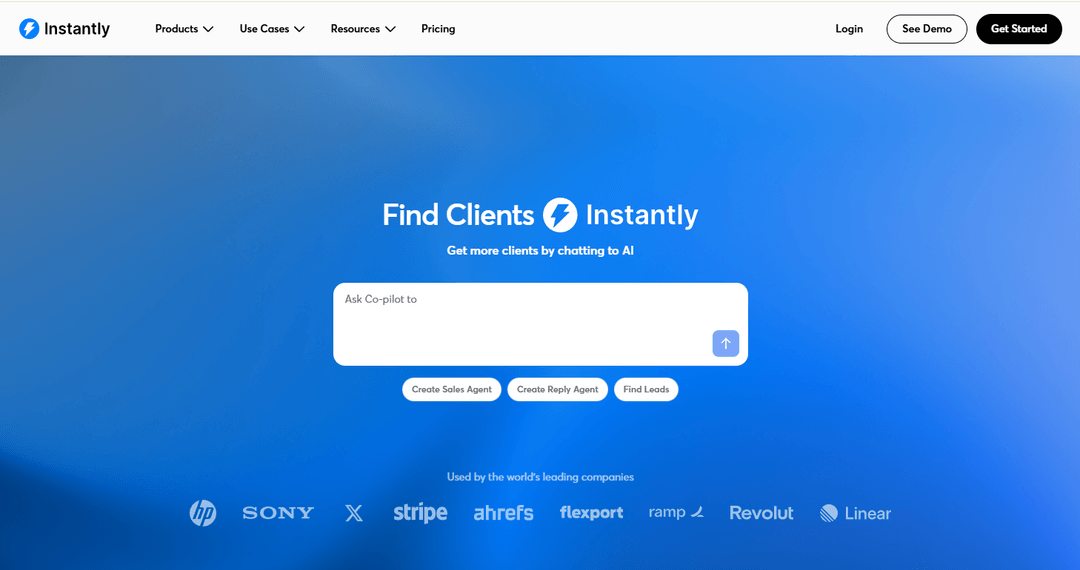
The Growth sending plan is $47 a month for 5,000 sends, and Hypergrowth is $97. Adding the database means a second line: Growth Credits at $47, Supersonic at $97. Bundles start at $94.
The sending engine's excellent and it's fairly priced. Then you read the invoice. Two subscriptions, and the one you came for was the data.
5. Klenty
Klenty is a sales engagement platform for SDR teams who want CRM-synced cadences without an enterprise agreement. It's the closest thing here to a small-team Outreach.
- 📞Dialer inside the cadence: calls sit as real steps alongside email and social touches.
- 🔗Two-way CRM sync: HubSpot, Pipedrive and Salesforce stages update from the cadence itself.
- 📅Cadence playbooks: prebuilt sequences you edit instead of starting from an empty screen.
- 📌Intent scoring: site visits and engagement push a prospect up the call queue.
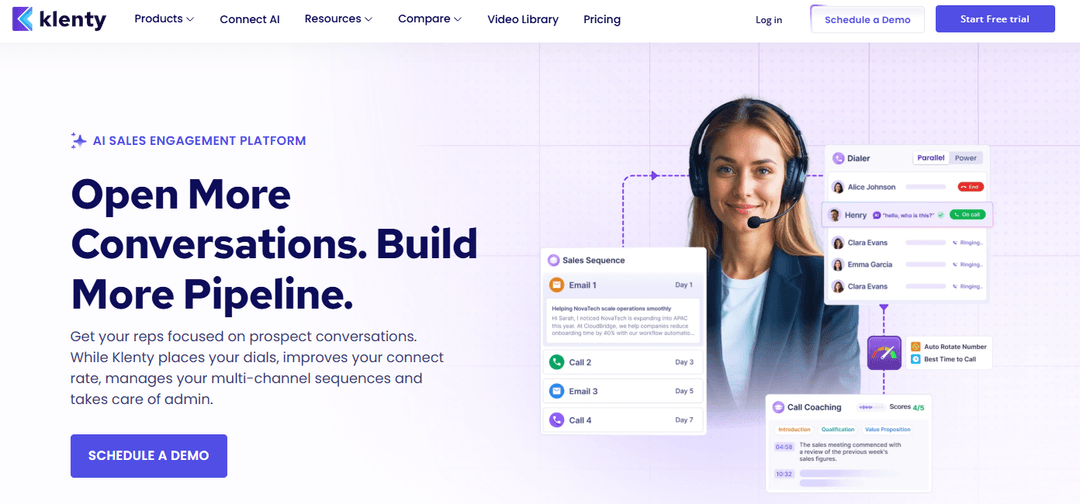
Startup is $50 per user a month billed annually, Growth $70 and Plus around $99, per Klenty's own help center. Multichannel starts at Growth, so that's where most teams land. There's no warmup built in, so budget for a separate tool.
Per seat is the whole story here. Three reps on Growth costs $210 a month, which is fair for what it does. Five reps costs $350, and at that number you're paying platform money for a sequencer.
6. Reply.io
Reply.io has been in this category longer than most and covers more channels than any of them: email, socials, calls, SMS and WhatsApp inside one sequence. The channel coverage is real. The pricing takes work.
- 🌐Five channels in one flow: few tools here get past three.
- 🧪Variant testing: subject lines and bodies are tracked separately with detailed reporting.
- 🎧Jason, the AI SDR: a separate product that starts around $500 a month.
- 🔧Documented API: solid if you're wiring outbound into something you built.
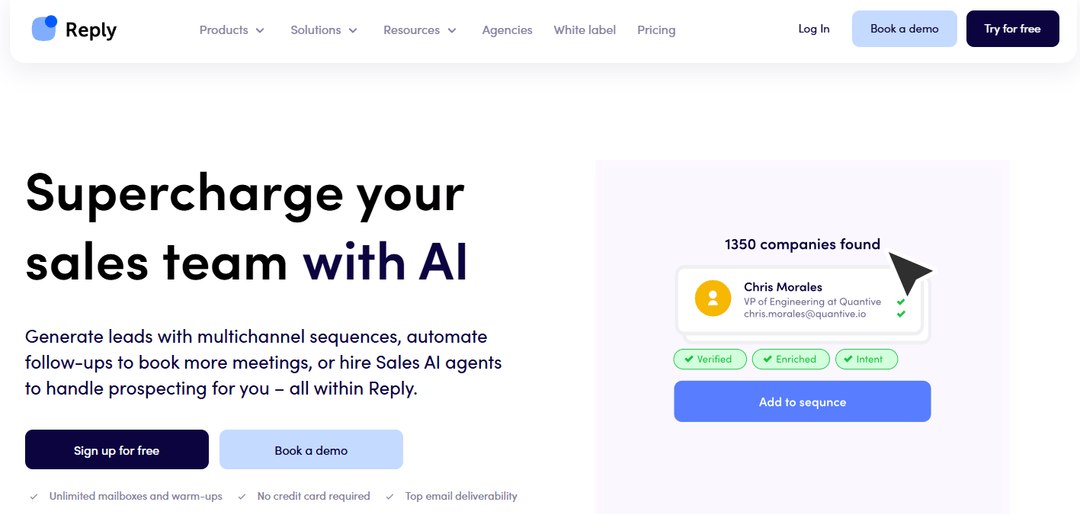
Email Volume starts around $49 a month for 1,000 active contacts. Multichannel is $89 per user annually, and that price covers email only. Social automation adds roughly $69 per connected account, calling roughly $29 per user.
Channel coverage is where it wins. Add-on math is where it loses.
7. Woodpecker
Woodpecker is a Polish cold email tool with a pricing model nobody else here uses. You don't pay for seats and you don't pay for mailboxes. You pay for the people you contact.
- 🧮Priced by reach: $7 per 100 contacted prospects a month, on a slider that runs from 500 to unlimited.
- 👥Free seats: team members and email accounts cost nothing, which is rare in this category.
- 🔒Bounce shield: campaigns pause on their own when the bounce rate climbs.
- 💬Agency panel: $27 a month per active client, with a $5 white-label add-on.
500 contacted prospects costs $35 a month. Annual billing cuts the per-prospect rate by 25%. Social automation runs $29 per connected account and API access is a $20 add-on.
The per-prospect model rewards a short, well-chosen list and punishes a long one, which inverts how everything else here is priced, and it's the right incentive for a team of three.
8. Apollo.io
Apollo bundles a 270-million contact database with sequences and a dialer, and it publishes real prices, which most of its peers don't. For a small team the data is usually the reason to be here.
- 🔎Database and filters: search, enrich and push straight into a sequence without leaving the tool.
- 💰Credits as currency: a verified email costs one credit, a phone number costs eight.
- 🎯Intent topics: six on Basic, twelve on Organization.
- 📈Dialer with recording: US calling from Professional, international from Organization.
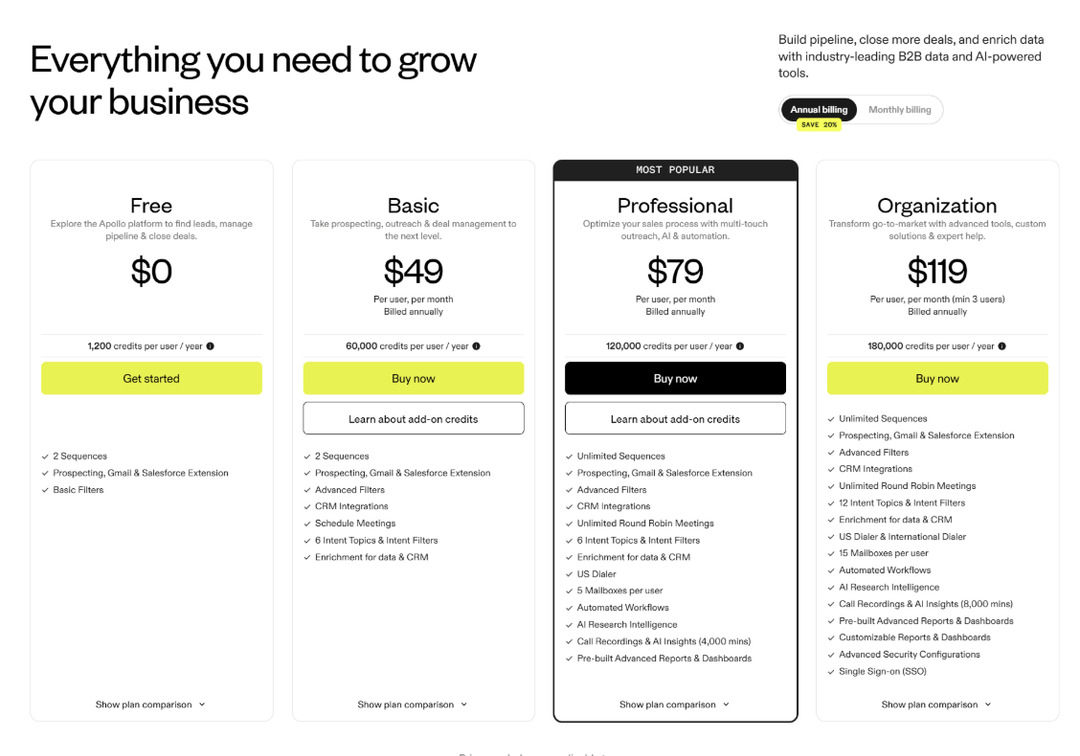
Basic is $49 per user a month on annual billing, Professional $79 and Organization $119 with a three-seat minimum. Monthly billing runs $59, $99 and $149. Annual plans release the whole year of credits up front.
Credits are where the budget leaks, and the exchange rate on phone numbers catches everyone out in month one. For a team that needs a list more than it needs a platform, it's still the cheapest place to start.
9. Overloop
Overloop started life as a CRM and grew into an AI prospecting tool. It bundles a database, email and social automation into one per-seat price, which keeps the stack small.
- 🎨AI writes the first draft: it reads a prospect's site and profile before generating the email.
- 📦450M contacts included: sourcing and email lookup both draw on the same credit pool.
- 🧵Visual workflow builder: stage changes and follow-ups fire without a third-party automation.
- 🚀Agent Frank: an AI SDR sold separately at around $599 a month.
Starter is $69 per user a month with 250 credits, Growth $99 with 500. Credits burn on sourcing and on email lookup, so 500 credits works out closer to 250 usable contacts. There's no annual discount.
One subscription instead of three is a real argument for a two-person team. Then you count the credits. Two hundred and fifty enriched contacts is a week's work for one rep, not a month.
10. Salesloft
Salesloft is Outreach's direct competitor, sold the same way to the same buyer, and it merged with Clari in December 2025. That makes it the closest match on the list and, for a team of five, the least useful answer.
- 🎧Conversation intelligence: call recording, transcription and coaching scorecards.
- 🔖Deal and forecast management: pipeline review built for a sales manager who runs a quota team.
- 🤝Deep Salesforce sync: the reason most enterprise teams pick it over the cheaper options.
- 🧰Cadence governance: shared templates and controls across a large rep population.
Salesloft doesn't publish prices. Procurement data and buyer reports put the Advanced and Premier tiers between $125 and $165 per user a month, with the dialer as a separate add-on and renewal increases of 8 to 12% a year. Implementation is quoted on top.
Swapping Outreach for Salesloft means signing the same shape of contract with a different logo on it. If the platform was the problem, this doesn't fix it.
Thirty buying signals, watched around the clock, and a shortlist waiting when you log in.
Gojiberry scores every account against your profile, then opens the conversation with the ones that are moving. There's nothing to load, and nothing to sign.
See who's in market this weekWhat is Outreach.io?
Outreach is a sales execution platform. It sits between your CRM and your reps and runs the daily motion: sequences, calls, meeting booking, deal reviews and forecasts. Founded in Seattle in 2014, it now sells itself as an agentic AI platform for revenue teams, and the buyer it's built for is a VP of Sales with a rep population to govern.
That framing explains most of what small teams run into. The features that justify the price tag are the ones a founder never opens, and the feature they use every day is the sequence builder.
What can you do with Outreach.io?
- 📝Sequences across channels: email, calls and social steps run from one queue with branching logic.
- 📉Deal and pipeline management: managers review deal health, risk flags and mutual action plans in the platform.
- 🗣Conversation intelligence: calls and meetings are recorded, transcribed and scored against coaching cards.
- 🔮Forecasting: the top package adds scenario planning, rollups and AI forecast projections.
- 🧱AI agents and credits: the 2026 packaging bundles agents for research, personalization and deal work, metered in AI credits.
The four packages are Amplify Essentials, Core, Plus and Pro, carrying 10,000, 25,000, 50,000 and 100,000 AI credits. Every one of them says Request pricing, so you can't compare a package against a rival without booking a call.
The pros and cons of Outreach.io
What works
- 🔁Sequence engine is mature and handles branching properly
- 💬Call recording and coaching are useful once a team is big enough
- 📊Forecast and deal tooling that a sales manager will open
- 🔗Deep integrations with Salesforce, Dynamics and Microsoft tooling
- 🤝Support is included rather than sold as a tier
What hurts a small team
- 🔍No published price, so you can't compare before a sales call
- 🧮Seat pricing plus consumption credits makes budgeting a guess
- 📅Auto-renewal for successive twelve-month terms
- 📬Two email accounts per user unless your order says otherwise
- 📁No contact database, so data lands on a separate invoice
- 📚Weeks of setup before anyone sends anything
How much does Outreach.io cost?
Outreach doesn't publish its prices. Every package on its pricing page carries a Request pricing button, and the company describes the model as seat-based access plus consumption-based AI credits. That second half is new and it matters: an action such as generating a message or running a search draws down a credit balance, and extra credit packs are sold on top.
Buyers report contracts landing around $100 to $175 per seat per month, and closer to $200 to $250 once add-ons stack up. Treat those as reported figures rather than facts, because the only number Outreach will confirm is the one in your own order form. Outreach Voice is billed separately, with normal commercial use defined as 3,000 call minutes per user per month and overage charged above that.
What do Outreach.io users think?
The pattern in public reviews doesn't move much. Reps praise the sequence engine and the call tooling. Admins praise the depth of the Salesforce integration. The complaints cluster around commercial terms rather than the product: opaque pricing, pressure at renewal, and the size of the platform relative to what a smaller team ends up using.
That last one shows up in a specific way. Teams describe buying the full platform, rolling out sequences, and never switching on the forecasting or coaching modules that carry most of the cost.
Why do people look for an Outreach.io alternative?
Five reasons come up over and over.
- 💵The price per seat. At reported rates, five seats runs $6,000 to $10,500 over twelve months before add-ons, and a team of five rarely uses half the platform.
- 📆The renewal clause. Terms auto-renew for another twelve months, and the notice window is short enough to miss.
- 🔁The HubSpot sync. Teams that run HubSpot rather than Salesforce report field mapping breaking and records duplicating.
- 📪Support goes quiet, then loud. A common story is slow responses through the year and a sudden burst of attention six weeks before renewal.
- 👥A team of five doesn't need a platform built for thirty. Coaching scorecards and forecast rollups need a rep population to make sense of.
There's a sixth reason nobody puts in a review, and it's the one that decides whether any of this matters: the platform assumes you already know who to contact. Outreach schedules the message. It doesn't find the person. Meanwhile your list decays at roughly 2.1% a month, which works out near 22.5% a year, and median job tenure in the United States sits at 3.9 years with 22% of employees in post for under twelve months.
How do you get out of an Outreach.io contract?
This is the section every other comparison skips, so here it is in plain terms. The facts below come from Outreach's published Terms of Service, last updated April 12, 2024. Your own order form takes precedence wherever the two conflict, so read that first.
The initial term
The Terms don't set one. Your order form does, which is why buyers report anything from twelve to twenty-four months depending on the discount they took.
The renewal
After the initial term the agreement renews automatically for successive twelve-month periods unless one side ends it.
The window
Either party can stop the auto-renewal, provided written notice lands at least thirty days before the current term ends. There's no shorter route written into the document.
Miss that window, and the Terms are explicit: the subscriptions renew under the existing conditions. There's no grace period written into the document. Thirty days and one day out, you're free to leave. Twenty-nine days out, you have another year.
Three more clauses catch teams out. Orders are non-cancelable and non-refundable except where the agreement says otherwise, so paying to leave early isn't a route. Changing what you're subscribed to for the next term needs the same thirty days of notice, which means dropping from eight seats to four is subject to the same deadline as leaving altogether. And after the initial term, Outreach can change the fees for a renewal term by giving you at least sixty days of notice before it starts.
Put three dates in a shared calendar the week you sign. Renewal date. Renewal date minus thirty days, which is your notice deadline. Renewal date minus ninety days, which is when you start the internal conversation about whether to stay.
Send the notice in writing to the legal notices address in the agreement, keep the confirmation, and don't rely on telling your account executive.
On negotiation, buyers consistently report three levers that move. Seat reductions handled at renewal rather than mid-term, because mid-term reductions aren't provided for. Multi-year terms traded for a locked rate, which caps the annual increase. And timing: quarter-end and year-end give a rep a reason to protect the renewal. Naming a live evaluation of a competitor is the single lever buyers report moving price the most.
Which Outreach.io alternative is right for you?
A team of 2 to 10 doing outbound
Gojiberry. At this size, the constraint is never sending capacity. It's knowing who's worth contacting this week, and that's the half we automate. One flat subscription, no seat math, no term.
Cold email at real volume
Smartlead, or Instantly if you prefer the interface. Both give you unlimited mailboxes for a flat fee. You'll bring your own data, and you'll want to watch the 0.3% spam complaint threshold Google applies to bulk senders.
You need a real dialer
Klenty. Calls sit inside the cadence and sync back to the CRM, at roughly a third of an Outreach seat. Add a warmup tool, because Klenty doesn't ship one.
Staying on Salesforce
Salesloft. If the Salesforce dependency and the forecasting are genuine requirements, this is the like-for-like swap. Expect a like-for-like contract to go with it.
An agency with client accounts
Woodpecker or Smartlead. Woodpecker charges $27 per active client, and the seats are free. Smartlead charges $29 per client workspace on a flat plan. Neither one's billed per rep.
You need the data more than the sending
Apollo. Published prices, 270 million contacts and a sequencer thrown in. Model the credit burn before you commit, because that's where the bill grows.
Two of those recommendations point away from us and one of them is the direct competitor to our own product. That's deliberate. A team that needs forecast rollups shouldn't buy a prospecting agent, and telling you otherwise would cost us more than the click is worth.
Twelve months is long enough to regret a seat you never used.
Find leads with no contractGojiberry vs Outreach.io: what a team of five pays
Take a five-person sales team at a European SMB. They send a few hundred messages a month, nobody owns RevOps, and the founder still runs half the pipeline herself. Here's the same twelve months priced two ways.
Run the math for a team of five. At the low end of reported Outreach seat pricing, five seats costs $500 a month, or $6,000 across a year. At the high end it's $875 a month and $10,500 a year. Gojiberry Pro is $99 a month whatever the headcount, which puts twelve months at $1,188.
The gap runs from $4,812 to $9,312, and that's before the data subscription Outreach doesn't include. One caveat we'd rather state than bury: five people is exactly where our Custom tier begins, so a five-seat team gets quoted rather than self-serving at $99. The $1,188 is the published floor, not a promise.
Ease of use splits the same way. Outreach earns its complexity when a manager is coaching twelve reps against scorecards. At five people, that machinery is overhead, and the thing you'd want automated instead is the part Outreach leaves to you: deciding who goes into the sequence.
What our customers got out of it
+31%
Mindflow lifted outbound reply rate by 31% after switching to intent-based targeting.
100+
GTE Localize booked more than 100 meetings after moving off plain email outbound.
Why we built this in the first place
Before Gojiberry, Roman ran outbound for Coco.ai. He spent his days on socials looking for the accounts that were about to move, and he did the intent research by hand: who just raised, who just hired a head of sales, who was complaining about a competitor in public. It worked, and it ate the week.
Coco.ai turned into the testing ground. The signals that predicted a reply were the ones that showed something had changed at the account this month, and no tool on the market watched them. So we built the thing Roman had been doing by hand, and pointed it at the teams that don't have a spare day a week to do it themselves.
If your renewal date is more than thirty days out, you've still got time to test something in parallel before you decide.
Your questions about Outreach.io alternatives
What's the cheapest Outreach.io alternative?
Woodpecker at $35 a month for 500 contacted prospects, or Smartlead at $39 a month if you want unlimited mailboxes. Both are sending tools, so you'll need a data source alongside them. If you count the whole job rather than just the sending, Gojiberry at $99 a month covers finding the leads and contacting them in one line.
Which Outreach.io alternative works best without Salesforce?
Nearly all of them, since Salesforce depth is exactly what the enterprise platforms charge for. Klenty syncs two ways with HubSpot and Pipedrive and is the closest match on features. Gojiberry connects to HubSpot and Pipedrive through native integrations plus an API, and it works fine with no CRM at all, which is where a lot of five-person teams actually are.
How do I switch from Outreach.io to another tool?
Work backward from the renewal date. Give written notice at least thirty days before the current term ends, then export your sequences, prospect records and activity history while the account is still live. Run the new tool in parallel for two to three weeks on one segment before you cut over, and keep the old mailbox connections warm until the new sequences are sending cleanly.
Does Outreach.io publish its prices?
No. Its pricing page lists four packages, Amplify Essentials, Core, Plus and Pro, and every one carries a Request pricing button. The model combines seat-based access with consumption-based AI credits, at 10,000, 25,000, 50,000 and 100,000 credits per package, and extra credit packs can be bought at any point. Buyers report seat rates of roughly $100 to $175 a month, rising toward $200 to $250 with add-ons.
How long is an Outreach.io contract?
The initial term is whatever your order form says, which is why reported terms range from twelve to twenty-four months. After that, the agreement renews automatically for successive twelve-month periods unless either side gives written notice at least thirty days before the current term ends. Orders are non-cancelable and non-refundable except where the agreement provides otherwise.
Can a team of five negotiate a discount on Outreach.io?
Some room exists, though less than a larger buyer gets. What buyers report working: committing to a multi-year term in exchange for a locked rate, timing the conversation to quarter-end, and naming a live evaluation of a competitor. Seat reductions are a renewal conversation rather than a mid-term one, so raise them inside the same thirty-day window you'd use to leave.
Still weighing it up? We've gone deeper on each of those tools in our breakdowns of Salesloft alternatives, Klenty alternatives, Smartlead alternatives and Apollo.io alternatives, with the same pricing checks and the same contract questions.
Ten qualified conversations a week, without a single list to build.

More High-Intent Leads = Your New Growth Engine.
Start Now and Get New High Intent Leads Delivered Straight to Slack or Your Inbox.