
Unlocking Your Sales Pipeline with AI Lead Generation


Let's get real for a second. What on earth is AI-powered lead generation? Is it just another buzzword consultants throw around?
Think of it as your most intelligent, most tireless research assistant. It's the tech that automates and supercharges how you find, qualify, and connect with potential customers. Instead of your team manually sifting through endless, soul-crushing data, AI does the heavy lifting. It analyzes patterns to pinpoint prospects who are actually likely to buy, freeing up your sales team to focus on what they do best: closing deals. The result? A much healthier pipeline filled with high-quality leads, not dead ends.
My Wake-Up Call from Lead Generation Hell

I need to be honest with you. Before I found a better approach, my lead generation efforts were a five-figure dumpster fire. I was literally burning through thousands of dollars on lead lists where 40% of the contacts were either outdated or completely wrong. Sound familiar?
My team and I would spend weeks building what we thought were killer email campaigns, only to see them get sucked into a black hole. The open rates were abysmally low, the reply rates were even worse, and my sales reps were essentially chasing ghosts. It was an expensive and morale-crushing nightmare that nearly derailed a significant product launch. I felt like I was failing my team, and honestly, I was.
The Pitfall of Outdated Tactics
The breaking point came during our big Q3 push. We had sunk a considerable chunk of our budget into a list of supposedly "qualified" leads, banking on it to fill our sales pipeline for the quarter. The reality was a gut punch.
We were drowning in:
- Dead-End Data: With so many emails bouncing, our domain's reputation was starting to suffer. People had moved on to new jobs, companies had been acquired, and the data was stale the moment we bought it.
- Generic Outreach: We were blasting the same generic message to everyone. We didn't have the time or tools to personalize our outreach at scale, so it sounded robotic and was immediately deleted.
- Brute Force Prospecting: Our sales team was spending over 60% of their day trying to find the right person to talk to, rather than actually selling. It was a colossal waste of their talent and our money.
That campaign was my wake-up call. I realized we weren't just failing at one campaign; our entire old-school approach was fundamentally broken. We were throwing money and manpower at a system built for a world that no longer exists.
The Real Cost of Inefficiency
What's the actual cost of clinging to these old methods? It's not just about the money you waste on insufficient data. It's the demoralized sales team, the missed revenue targets, and that nagging feeling of a stagnant pipeline that keeps you up at night. You're spinning your wheels, working harder than ever, while your competitors are speeding past.
You might be thinking, "But this is just how sales is done, right?" I felt so, too. That painful failure forced me to search for a genuine solution, something that could bring us not just more leads, but the right leads. That's when I stumbled into the world of AI lead generation and discovered tools like Gojiberry, which promised to fix this broken process from the ground up. It was time for a change.
What Exactly Is AI Lead Generation?

So, what is this "AI lead generation" everyone's talking about? Is it just a fancy way to spam inboxes? I get the skepticism; I was right there with you. But the reality is way more exciting.
Think of it this way: AI is like your most brilliant research assistant, working 24/7 to find your perfect customers. It's the difference between shouting a sales pitch into a crowded stadium and having a quiet, insightful conversation with someone who's already leaning in to hear what you have to say. It's about precision, not just volume.
Instead of your team manually digging through endless LinkedIn profiles or cleaning up outdated spreadsheets, AI does the heavy lifting. It meticulously analyzes customer behavior, website interactions, and social media signals to pinpoint people who are genuinely interested in what you offer. It filters out the noise to find the signal.
Beyond the Buzzwords: How It Actually Works
Let's pull back the curtain, shall we? No confusing tech jargon, I promise. At its core, AI-powered lead generation leverages a few key technologies that work together to identify your next best customers.
- Predictive Lead Scoring: Forget the old guesswork of deciding which leads are "hot." AI analyzes the characteristics of your best existing customers, including their industry, company size, and the technology they use, and then scans the market for lookalikes. It assigns a score to each new prospect, so your sales team knows exactly who to call first.
- Machine Learning: This is the "learning" part of the equation. The AI gets smarter with every single interaction. When a lead converts to a customer, the system analyzes what worked. When a prospect goes cold, it learns from that, too. It continually refines its search criteria to become increasingly effective at identifying your ideal customer profile (ICP). It's not static; it evolves with your business.
- Natural Language Processing (NLP): This is what allows AI to understand human language. It can scan news articles, social media posts, and even job descriptions for buying signals. Think of it as finding a company that just announced a new round of funding or a key executive posting online about a problem your product solves.
It's not magic; it’s just incredibly smart pattern recognition. The AI connects dots that a human could never see, turning massive amounts of public data into a short, actionable list of high-intent leads.
This data-first approach is quickly becoming the new standard. Since the early 2020s, the AI market has experienced significant growth, with businesses reporting revenue increases of 3% to 15% after adopting AI-powered lead scoring. The numbers clearly show the impact of more intelligent automation.
What AI Lead Generation Is—and What It Is NOT
It's crucial to get this distinction right. Early on, I made the mistake of thinking AI was some "set it and forget it" magic button. It's not.
What you should absolutely DO:
- DO give it a crystal-clear Ideal Customer Profile. The AI is only as good as the instructions you provide. Garbage in, garbage out.
- DO treat it as a powerful tool to empower your sales team, not replace them. It handles the monotonous research, allowing them to focus on building genuine relationships.
What you should NEVER do:
- NEVER forget the human touch. The AI finds the lead; your team still needs to build a genuine connection to close the deal.
- NEVER rely on insufficient data. Seriously. Clean your data before you even think about plugging it into an AI system. It's the most essential first step.
Ultimately, utilizing AI for lead generation gives your team a significant advantage. While your competitors are stuck cold-calling from stale lists, you're engaging with prospects who have already signaled their interest. To gain a broader perspective, consider exploring these proven strategies for generating leads through automation.
This is how you stop chasing and start attracting. And while there are other tools available, platforms like Gojiberry are explicitly designed for this mission, to identify high-intent signals and deliver warm leads directly to your doorstep.
The Unfair Advantage of AI in Sales
Let's get to the good stuff. Bringing AI into your sales process isn't just a minor tweak; it's like giving your team a whole new set of superpowers. We're talking about a significant boost in efficiency and a substantial reduction in the cost of acquiring a new customer.
How does that even work? Just think about all the tedious, soul-crushing tasks your team secretly (or not-so-secretly) hates. Manual data entry, cleaning up messy contact lists, sending that first wave of outreach emails; AI takes all of that off their plate. This frees up your reps to do what they're actually great at: building relationships, understanding customer needs, and closing deals.
More Qualified Leads for Less Money
Let's dive into the numbers, because that's where the story really gets interesting. For years, the prevailing wisdom was that getting more leads meant spending more money. More ads, bigger email lists, more software subscriptions. It felt like a never-ending cycle. But AI completely flips that script.
The financial impact is pretty staggering. Companies using AI are seeing a 50% increase in the number of truly sales-ready leads they generate. At the very same time, they're cutting their lead acquisition costs by a massive 60%. This isn't just a slight improvement; it's a total game-changer for the economics of your sales operation. You can dig deeper into these industry-defining lead generation statistics to see the full breakdown.
Before we brought in AI, my team was easily spending 20 hours a week just on manual prospecting. After we implemented Gojiberry, that dropped to less than five hours. And the best part? The quality of the leads we were getting was night and day. We went from chasing ghosts to having meaningful conversations.
This shift isn't just about saving time; it's also about enhancing productivity. It's about reallocating your most precious resources: your team's focus and your budget, to activities that actually drive revenue. Just think about what your team could accomplish with an extra 15 hours every single week.
The infographic below effectively highlights the compelling metrics behind AI adoption, from improved lead conversion to a substantial ROI increase.
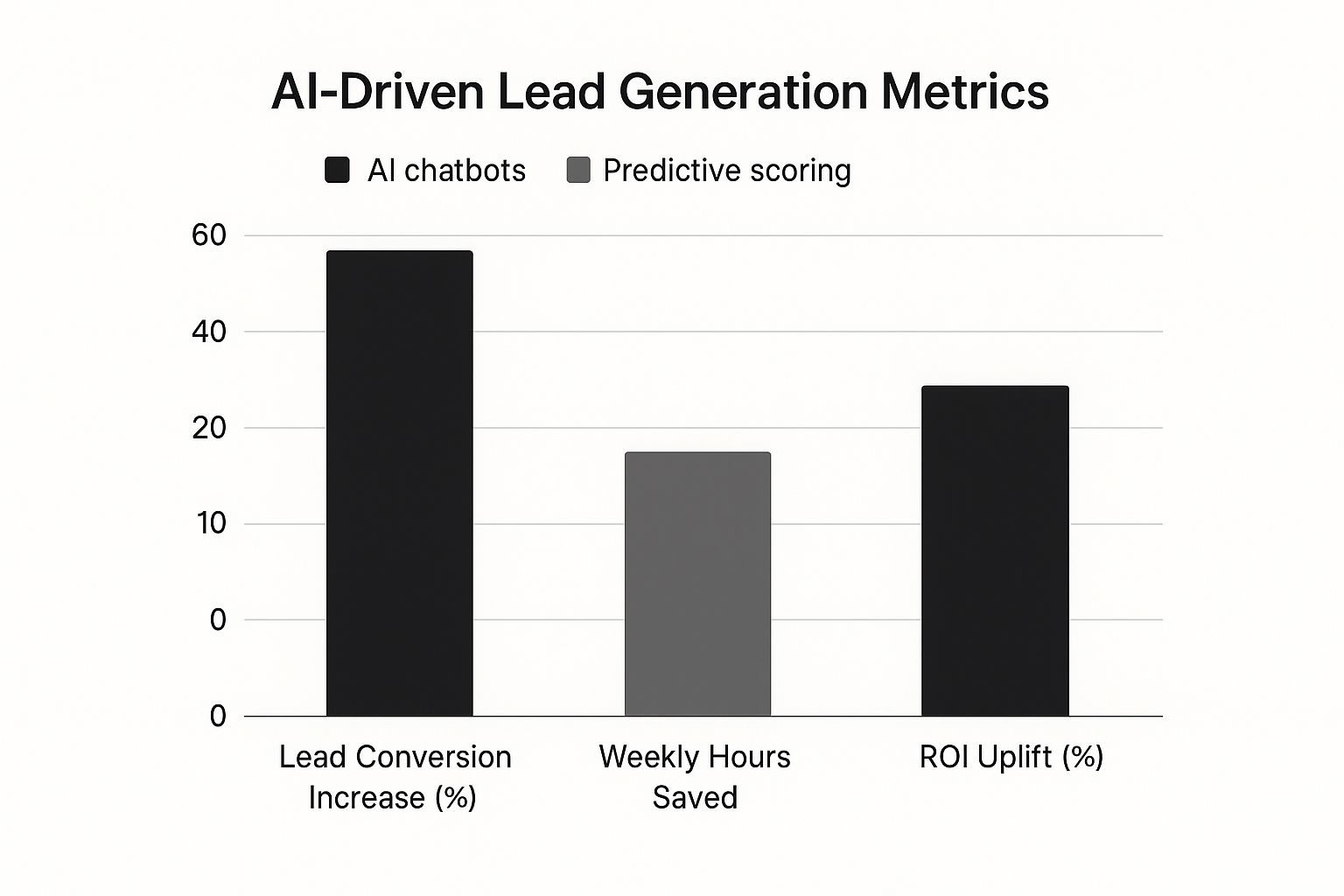
As you can see, the benefits hit from all angles, boosting everything from your team's day-to-day productivity to the company's bottom line.
A Tale of Two Sales Teams
To make this crystal clear, let's compare the old way of doing things with the new, more innovative approach.
Traditional vs AI-Powered Lead Generation: A Head-to-Head Comparison
This table breaks down the key differences in process, cost, and results between old-school manual methods and a modern AI-driven approach.
The contrast is stark. One path is marked by manual labor and guesswork, while the other is founded on precision and intelligence.
This isn't just about small gains. It's about fundamentally changing how you approach sales, moving from a volume-based numbers game to a strategy based on precision. You end up with better leads, a happier and more effective sales team, and a much healthier pipeline. For more on this, you can explore our breakdown of the best AI tools for sales to see how platforms like Gojiberry fit into this new reality.
Achieving Personalization at Scale

Remember those generic "Dear Sir/Madam" emails? Yeah, they belong in a museum. Today, personalization is king. But let's be real, manually crafting a unique message for hundreds of leads is a surefire recipe for burnout. This is precisely where AI lead generation becomes your secret weapon.
It's about going beyond just using a {first_name} tag. True personalization means understanding what motivates each lead. What problems are they trying to solve right now? AI is the only way to answer that question at scale. It digs deep into a lead's digital footprint, including their website visits, the whitepapers they download, and their LinkedIn activity, to build a vivid picture of their needs.
This is how you stop being just another email in a crowded inbox and start being a solution provider.
My "Impossible" Client Story
I'll never forget this one account. They were a mid-sized tech firm, a perfect fit for our services, but they were completely cold. We had tried everything the old-school way: generic emails, LinkedIn connection requests, and got nothing but radio silence for months. They were the definition of an impossible nut to crack.
So, we decided to try something new with an AI-powered approach. Instead of guessing, we let the AI analyze their digital behavior. It picked up on a key signal: their Head of Engineering had just shared an article on LinkedIn about the challenges of scaling their infrastructure.
Boom. 💥 That was our "in."
We leveraged that specific insight to craft a highly personalized message. It wasn't about our product; it was about his problem. The subject line was literally, "Saw your post on scaling challenges." He replied in under an hour. That single, AI-identified insight opened a door that had been slammed shut for half a year. Today, they're one of our biggest clients.
Beyond Guesswork: The AI Advantage
This story isn't a fluke; it's the new standard. Buyers now expect you to understand their specific pain points before you even reach out. Machine learning is what makes it possible, analyzing individual behaviors to deliver messages that actually resonate.
So, how do you put this into practice? AI helps you achieve personalization at scale in a few critical ways:
- Dynamic Email Content: AI can automatically replace entire paragraphs or case studies in your emails with content tailored to a lead's industry or job title. An email to a CMO will highlight marketing ROI, while the same campaign sent to a CTO will focus on technical integration.
- Real-Time Lead Qualification: AI-powered chatbots on your website can do more than answer basic questions. They can ask qualifying questions, understand the user's intent based on their responses, and route high-value leads directly to a sales rep's calendar.
- Identifying High-Intent Signals: This is the game-changer. AI tools actively monitor for buying signals. Did a target account receive new funding? Did a key decision-maker engage with a competitor's post? To truly master this, check out our guide on 13 intent signals to find high-intent leads without cold outreach.
This isn't just about making your outreach feel personal. It's about using data to make it genuinely relevant. AI gives you the insights to start a conversation about what your prospect actually cares about.
Ultimately, this is how you build genuine connections and stop being ignored. You shift from a generic, high-volume approach to a precise, high-impact one.
Your Step-by-Step Guide to Launching with Gojiberry
Alright, enough with the theory, let's get our hands dirty and actually build something. This is your step-by-step playbook for launching an AI lead generation machine using Gojiberry.
I'm focusing on Gojiberry because, frankly, it's the tool that finally cracked the code for my team. While other tools excel in specific tasks, Gojiberry is the all-in-one platform that combines intent data, lead discovery, and outreach into a seamless workflow. It hits that sweet spot between raw power and not needing a data science degree to make it work.
This isn't just a list of features. It's the exact process we followed to go from a standing start to a pipeline brimming with high-intent leads. I'll walk you through the setup, launch, and ongoing tweaks, sharing the lessons we've learned the hard way.
Step 1: Nail Your Ideal Customer Profile
This is the most critical step. If you get this wrong, you're just using a sophisticated tool to find the wrong people, only faster. The AI is brilliant, but it can't read your mind. Your job is to hand it a crystal-clear map of who to hunt for.
What to absolutely DO:
- Be hyper-specific. Don't just say "tech companies." Say, "Series A SaaS companies in North America with 50-200 employees that have recently hired a VP of Sales." The more detailed your instructions, the better the AI can perform.
- Focus on buying signals. What triggers someone to need what you sell? For us, it was seeing companies post jobs for a "Head of Growth" or mention "scaling challenges" in a press release. These are the golden nuggets Gojiberry is built to unearth.
What to NEVER do:
- NEVER be vague. "Small businesses" isn't an ICP. It's a black hole that will devour your budget.
- NEVER set it and forget it. Your ideal customer profile will evolve. Revisit it every quarter to ensure the AI's targeting remains perfectly aligned with your business goals.
Step 2: Connect Your Data Sources
For the AI to work its magic, it needs context. That means plugging it into the tools where your customer data already lives. Connecting your CRM is non-negotiable; it's how the AI learns what your best customers actually look like in the wild.
Think of it like giving a detective access to all the case files. Without that background info, they're just guessing. Gojiberry makes this part simple with direct integrations, so you're not stuck wrestling with APIs. With just a few clicks, your CRM, such as HubSpot or Salesforce, is connected, providing the AI with a complete picture.
Here's a glimpse of the Gojiberry interface, designed for clarity and action.
The dashboard immediately flags the high-intent signals and leads the AI has surfaced, making it easy to see the value from day one.
Step 3: Configure Your First AI Campaign
Now for the fun part. This is where you instruct Gojiberry on how to utilize all that valuable data. Inside the campaign builder, you'll set up your lead scoring rules and filters to sift the gold from the gravel.
Here are the exact settings we use for our initial campaigns:
- Prioritize Intent Signals: We assign the highest scores to leads whose company just announced a new funding round or who have engaged with a competitor's content on LinkedIn. These are red-hot indicators that they're in-market.
- Filter by Job Title and Seniority: We filter for Director-level and above. This ensures that our sales team is speaking with decision-makers, not interns.
- Automate the Workflow: We set up Gojiberry to automatically enrich these high-scoring leads with verified email addresses and push them directly into a specific sequence in our outreach tool. This runs on autopilot, every single day.
My biggest mistake here: When I first started, I made the filters way too broad because I had a fear of missing out. The result? The sales team got buried in low-quality prospects. It's far better to start with a narrow, super-qualified filter and then expand it later. Quality over quantity, always.
Step 4: Analyze and Optimize Your Results
Your first campaign is live! But the job isn't done. The Gojiberry dashboard is your new command center. Check it daily to see which signals are producing the most qualified leads. Are the leads from "funding announcements" converting better than those from "job changes"?
Double down on what's working and hit pause on what isn't. This constant feedback loop is what enables the AI to become smarter over time. It learns from your team's wins and losses, continuously refining its aim. For more inspiration on launching a product, check out this fantastic review of an AI B2B SaaS product's Appsumo launch, which is full of practical lessons on market entry.
This whole process, from defining your ICP to optimizing campaigns, is meant to be straightforward. The goal is to get you from manual, soul-crushing prospecting to an intelligent, automated system that delivers warm leads every single day.
Ready to discover how this could benefit your business? You can see the platform in action and get your questions answered by booking a personalized Gojiberry demo. It's the fastest way to really grasp what this technology can do.
This isn't just another tool; it's a fundamental shift in how you build a pipeline. By following these steps, you're not just launching a campaign; you're building a scalable, predictable revenue engine. Time to get started!
Common Mistakes to Avoid with AI (And How to Dodge Them)
It's easy to get excited about the potential of AI for lead generation. That energy is great, but let's pause for a second before you dive in headfirst. I want to help you sidestep some of the common traps and costly mistakes that are all too easy to fall into. Consider this a friendly warning from someone who has already learned these lessons the hard way.
The single biggest mistake? Treating AI like a magic bullet. It's a powerful tool, not a miracle worker. My first attempt at this was a complete mess because I fed the system a large amount of outdated, disorganized data from our CRM. The result? Garbage in, garbage out. The AI was incredibly efficient at finding more of the exact wrong type of leads. It was an expensive lesson, but one I'll never forget: your AI is only as good as the data you give it.
The Pitfalls I Stepped In (So You Don't Have To)
Another classic blunder is trying to automate the human touch out of the process altogether. I once set up a follow-up sequence that was so automated it sounded like a soulless robot wrote it. The responses I got were chilly, to say the least. People connect with and buy from other people. Your AI should be the brilliant assistant that tees up the conversation, not the one trying to have it.
So, with that in mind, here are a few hard-and-fast rules to follow.
MUST DO
- Continuously Train Your Model: This is non-negotiable. After a campaign, you have to feed the results back into the system. Inform the AI about which leads resulted in great conversations and which were dead ends. This feedback loop is precisely how platforms like Gojiberry learn and get sharper over time.
- Align Sales and Marketing: Your sales team has invaluable, real-world intel. They are the ones on the front lines, and they know what a truly qualified lead looks and sounds like. Ensure that their feedback is consistently used to refine your AI's Ideal Customer Profile.
NEVER DO
- NEVER "Set It and Forget It": Markets shift, customer needs evolve, and your own product changes. You can't just launch a campaign and walk away. You should review your AI's performance and target it at least once a month. What worked last quarter might be completely ineffective today.
- Never ignore the Human Touch: The AI is there to find the right people and create opportunities. But it's a genuine, personalized message from a real person that builds the trust needed to close a deal. Don't let your quest for efficiency overshadow genuine connection.
Getting this right from the beginning is the key. By avoiding these common missteps, you're not just implementing a new tool; you're building an innovative, scalable engine for predictable growth. It's all about working smarter, not just faster.
Your AI Questions, Answered
It's natural to have questions when considering a new approach. Let's explore some of the most common issues that arise in AI lead generation. Clearing up these issues can give you the confidence to move forward.
Is AI only helpful in finding new leads?
Not at all! While AI is a powerhouse for discovering new prospects, one of its most underrated superpowers is lead nurturing. It can monitor your existing leads and CRM contacts for new buying signals. For example, if a contact at a company that went cold six months ago suddenly starts visiting your pricing page, the AI can flag that as a re-engagement signal and prompt your sales team to reach out. It's like having a watchtower over your entire pipeline.
Can AI help with content for my outreach emails?
Yes, but with a big caveat. AI can be a fantastic brainstorming partner. It can generate various angles, subject lines, and even draft entire emails tailored to a prospect's specific pain points. However, you should NEVER copy and paste an AI-generated email without human review. Use it as a starting point to save time, then inject your own personality and expertise to make it authentic. The best outreach is a blend of AI efficiency and human creativity.
What's the difference between AI lead generation and regular marketing automation?
Think of it as the difference between a simple "if this, then that" rule and a system that can think and learn. Traditional marketing automation follows pre-set rules you create. For example, "If someone downloads an ebook, send them Email A." It's static. AI lead generation, especially with a platform like Gojiberry, is dynamic. It analyzes thousands of data points to predict who is most likely to become a customer, even if they haven't followed a specific path. It's proactive, not just reactive.
We've covered a lot of ground, from my own lead gen disasters to a step-by-step plan for success. The old way of prospecting: buying stale lists and sending generic emails, is officially dead. It's inefficient, expensive, and demoralizing for your team.
The future of sales is about precision, personalization, and intelligence. It's about empowering your team with tools that let them focus on what they do best: building relationships and closing deals. This isn't just about adopting new technology; it's about fundamentally changing your approach to growth. By embracing AI, you're not just generating more leads; you're building a more innovative and predictable revenue engine for your business.
Ready to stop chasing ghosts and start talking to genuinely interested prospects?

More High-Intent Leads = Your New Growth Engine.
Start Now and Get New High Intent Leads Delivered Straight to Slack or Your Inbox.