
AI Agents for Crypto: Complete Guide to Automated Trading & Portfolio Management

Tired of staring at charts until 3 AM? Feeling the sting of emotional trades or missed opportunities in a market that never sleeps? 😩 You’re not alone. Manual crypto trading is a brutal game of speed, discipline, and emotional control—a game humans are poorly equipped to win.
But what if you had a tireless, data-driven assistant executing your strategy 24/7 with machine precision? This isn't a futuristic dream anymore; it’s the reality of AI agents for crypto. These aren't just simple bots. They are sophisticated systems that can analyze, strategize, and execute with a level of consistency that's impossible to achieve manually.
What You Will Learn in This Guide
This is your complete playbook for gaining a real, sustainable edge. We're cutting through the hype to give you a practical guide on:
- -How AI Agents Actually Work: We’ll break down the tech—from the LLM "brain" to the execution layer—in simple terms.
- -The Best Tools & Platforms: An unbiased look at the top agent platforms to help you find the right fit for your goals.
- -How to Build Your Own Agent: A step-by-step framework for developers who want ultimate control and customization.
- -Safety & Risk Management: Actionable steps to secure your assets and trade with discipline, not delusion.
Let’s be crystal clear: this isn't a "get rich quick" fantasy. There are no "guaranteed returns" here. This guide is about leveraging powerful technology to build a trading process founded on solid strategy and ruthless risk management. By understanding how these tools work, you can fundamentally upgrade your approach to the market.
Ready to see how an ai agent crypto strategy can transform your trading? Let's dive in. 🤖
What Are AI Agents in Crypto?
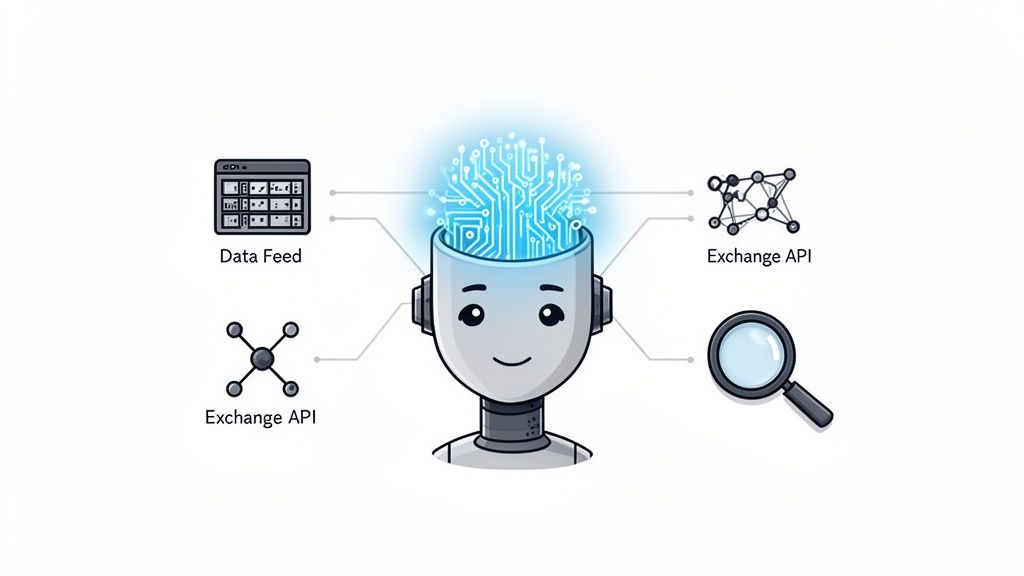
It’s easy to lump AI agents in with the simple trading bots we’ve known for years, but that’s like comparing a calculator to a supercomputer. A basic bot is a one-trick pony; it follows a rigid "if-this-then-that" command, like "sell if BTC hits $70k." It's purely reactive.
An AI agent, on the other hand, is a proactive decision-maker. It’s a multi-layered system:
- -The Brain (LLM/ML Model): This is the cognitive core, often a Large Language Model (LLM) or a machine learning model. It can interpret data, identify patterns, and even formulate complex plans.
- -Tools & Data Feeds: The agent connects to the outside world through APIs for exchanges, real-time market data (like order books), and even news or social media sentiment feeds.
- -Execution Layer: Once the "brain" makes a decision, this layer translates it into a concrete action, like placing a buy or sell order on an exchange.
Types of Crypto Agents
Not all agents are created equal. They exist on a spectrum of intelligence:
- -Rule-Based Execution Bots: The simplest form. They follow strict, pre-programmed logic. Highly reliable for basic automation but lack adaptability.
- -ML Signal Agents: A significant step up. These agents analyze historical data to uncover subtle patterns and generate trading signals that humans would miss. Their strength is in probability, not certainty.
- -LLM Orchestration Agents: The current state-of-the-art. These agents can perform research, interpret news, manage multi-step workflows, and provide sophisticated decision support.
The core advantage over manual trading is clear: speed, consistency, and scale. An agent can monitor hundreds of pairs simultaneously and react in milliseconds. But they aren't flawless. They can suffer from overfitting (a strategy that worked perfectly on past data but fails in the live market) and are vulnerable to sudden regime shifts (like a "black swan" event) that their historical data never prepared them for.
AI Agent Use Cases in Crypto
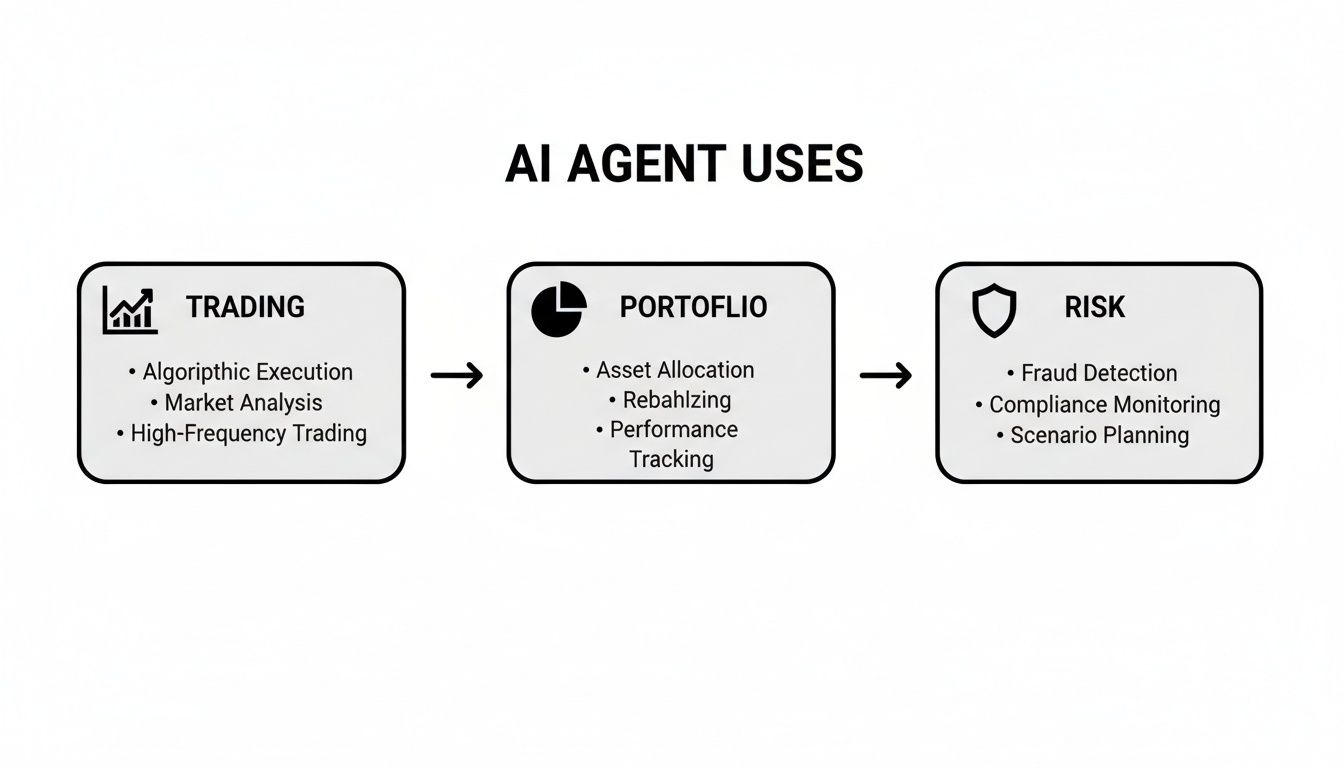
So, how are savvy traders actually using these agents to gain an edge? It’s not about handing over the keys and hoping for the best. It’s about deploying specialized agents to execute specific, high-value tasks with superhuman efficiency.
Automated Trading
This is the most common use case, where agents act as tireless executors of your trading plan. They monitor markets 24/7 for specific triggers and act instantly.
- -What it does: Executes trades based on pre-defined signals, manages orders, and runs continuous automation loops.
- -Arbitrage: Exploiting price differences across exchanges.
- -Grid Trading: Profiting from volatility in range-bound markets.
- -Trend/Momentum: Identifying and riding strong market moves.
- -Mean Reversion: Betting on prices returning to their historical average.
Portfolio Management
Beyond individual trades, AI agents are phenomenal at maintaining portfolio discipline.
- -Rebalancing Strategies: Agents can automatically execute time-based rebalancing (e.g., reset allocations on the first of every month) or threshold-based rebalancing (e.g., rebalance only when an asset deviates by more than 5% from its target weight).
- -Allocation Frameworks: More advanced agents can implement frameworks like risk parity or volatility targeting to create more resilient portfolios.
- -Expected Outcomes: The goal here is stability and consistent growth, not chasing parabolic "moonshots." It’s about systematically buying low and selling high.
Risk Management
This is arguably the most valuable role for an ai agent crypto system. They act as your unemotional risk manager, protecting your capital when you’re not watching.
- -Stop-Loss / Take-Profit Automation: Dynamically place and adjust stop-losses based on real-time volatility (e.g., using the Average True Range indicator).
- -Position Sizing: Automatically calculate the correct position size for a trade based on your risk tolerance and market conditions (e.g., fixed fractional or volatility-based sizing).
- -Drawdown Protection: Program a "circuit breaker" agent that automatically liquidates positions and pauses all trading if your portfolio value drops by a critical percentage in a day.
Market Analysis
AI agents can process and interpret vast amounts of data far beyond human capacity.
- -Sentiment Analysis: Scan Twitter, Telegram, and news feeds to gauge real-time market sentiment, spotting fear or greed spikes.
- -Pattern Recognition: Use machine learning to identify complex chart patterns or correlations between assets that are invisible to the human eye.
- -Decision Support: The agent doesn’t have to execute trades. It can act as an analyst, feeding you high-probability signals and research so you can make the final call.
Yield / DeFi Optimization
In the complex world of DeFi, agents are relentless yield hunters.
- -APY Monitoring: Constantly scan hundreds of liquidity pools and lending protocols to find the highest yields.
- -Risk Assessment: An agent can be programmed to check smart contract audit scores or liquidity depth before allocating capital, helping you avoid risky protocols.
- -Automated Routing: Automatically move your capital between different pools or farms as yields change, ensuring your funds are always working as efficiently as possible.
Top AI Agents & Platforms for Crypto Trading
Choosing the right platform is like picking a co-pilot. You need one that matches your skill level, strategy, and goals. Some are built for plug-and-play simplicity, while others offer near-infinite customization for pros.
So, which one is right for you? Let's break down the industry leaders.
#1 3Commas
3Commas is a heavyweight in the crypto automation space, known for its polished user experience and powerful features. It serves as a central dashboard connecting to your various exchange accounts.
- -What it does: Offers robust DCA and Grid bots, a SmartTrade terminal for semi-automated trading, and a marketplace for pre-built strategies.
- -Key Features: Visual trading interface, comprehensive bot analytics, paper trading, and a massive community.
- -Pricing: Subscription-based, with free and paid tiers.
- -Pros/Cons: Pros: Extremely versatile, great UI, strong reputation. Cons: Can be overwhelming for new users; advanced features require a pricier plan.
- -Best for: Traders who want a powerful, all-in-one platform with a proven track record.
#2 TradingView
TradingView is not a trading bot platform itself—it's the undisputed king of charting and technical analysis. Its power comes from Pine Script, a language that lets you design, code, and backtest any strategy imaginable. You then use its webhooks to send alerts to an execution platform like 3Commas.
- -What it does: Provides world-class charting tools and a framework for creating custom trading signals.
- -Key Features: Pine Script editor, advanced backtesting engine, massive library of community-built indicators.
- -Pricing: Freemium model; webhook alerts require a paid plan.
- -Pros/Cons: Pros: Unmatched flexibility for strategy design, superior charting. Cons: It’s a signal generator only, requiring a separate tool for execution.
- -Best for: Technical traders and quants who want to build their own unique signals from scratch.
#3 Gunbot
Gunbot is for those who value control and privacy. It's software you purchase with a one-time license and run on your own hardware (your computer or a private server). No monthly fees, no cloud—just your code running your strategy.
- -What it does: Provides a self-hosted trading bot with a huge library of pre-built strategies and extensive customization options.
- -Key Features: Supports 100+ exchanges, includes a visual editor and a coding environment, active community support.
- -Pricing: One-time license fee.
- -Pros/Cons: Pros: Total control, no recurring fees, enhanced privacy. Cons: Steep learning curve; you are responsible for server maintenance and security.
- -Best for: Experienced traders and developers who are comfortable managing their own infrastructure.
#4 Cryptohopper
Cryptohopper is designed with beginners in mind. Its user-friendly interface, visual strategy builder, and social trading features make it one of the most accessible platforms on the market.
- -What it does: A cloud-based platform focused on ease of use, copy trading, and paper trading.
- -Key Features: Drag-and-drop strategy builder, signals marketplace, AI-driven strategy optimization.
- -Pricing: Subscription-based monthly plans.
- -Pros/Cons: Pros: Very beginner-friendly, great for learning without risk. Cons: Advanced users may find the strategy builder limiting compared to coding.
- -Best for: Newcomers to automated trading and those interested in social/copy trading.
#5 Pionex
Pionex offers a unique model: it’s an exchange with built-in trading bots. This eliminates the need for API keys and complex setup, making it incredibly simple to get started.
- -What it does: An exchange with 16+ free, pre-configured trading bots ready to use.
- -Key Features: Integrated Grid, DCA, and Arbitrage bots; mobile-first design; low trading fees.
- -Pricing: Bots are free; you only pay standard trading fees.
- -Pros/Cons: Pros: Extremely easy to set up, no subscription fees. Cons: You are limited to the Pionex exchange and its pre-built bots with limited customization.
- -Best for: Traders looking for the absolute simplest "plug-and-play" bot experience.
AI Crypto Trading Strategies
A powerful AI agent is useless without a sound strategy. The agent is the engine; the strategy is the GPS guiding it. 🗺️ A winning strategy is logical, well-defined, and tested against different market conditions.
Let’s explore five battle-tested strategies that are perfectly suited for automation.
Arbitrage
Arbitrage is a game of speed, exploiting tiny price differences of the same asset across multiple exchanges. If BTC is $70,000 on Exchange A and $70,050 on Exchange B, an agent buys on A and sells on B simultaneously, capturing the difference.
- -How it works: Buy low on one exchange, sell high on another, instantly.
- -When it breaks: High trading/withdrawal fees can erase profits. Latency can cause the price gap to close before the trade executes. Low liquidity can lead to slippage.
- -Do: Pre-position funds on multiple exchanges.
- -Do: Account for all fees in your profit calculation.
- -Don't: Run this strategy without a high-speed, low-latency server.
Grid Trading
Perfect for sideways, range-bound markets. An agent sets up a "grid" of buy and sell orders at fixed intervals above and below the current price. As the price bounces within the range, it automatically buys low and sells high, collecting small profits from the volatility.
- -Best Market Regimes: Consolidating or sideways markets with defined support and resistance.
- -Parameter Selection: Grid width, number of levels, and total capital allocation are key.
- -Risk Controls: A strong price breakout in either direction can be costly. Always set a stop-loss outside the grid's range to protect against a trend change.
DCA (Smart DCA)
Dollar-Cost Averaging (DCA) is a classic. Smart DCA enhances it by using an agent to time the buys based on data, not just the calendar. Instead of buying $100 of ETH every Friday, an agent buys when specific conditions are met.
- -Conditional Triggers: Buy when the RSI enters "oversold" territory, when the price drops 10% below the 50-day moving average, or when social sentiment hits extreme fear.
- -Risk Framing: This is an accumulation strategy, not a get-rich-quick scheme. The goal is to lower your average entry price over time. It performs poorly if the asset enters a long-term downtrend without recovery.
Momentum
This strategy is about identifying an asset moving strongly in one direction and jumping aboard. An agent can detect early breakout signals without emotional hesitation.
- -Signal Design: A price breakout above a key resistance level on high volume, a moving average "golden cross," or a sudden surge in positive news sentiment.
- -False Signals: The biggest risk is a "fakeout," where the price breaks out only to immediately reverse.
- -Do: Use volume confirmation to validate a breakout.
- -Don't: Trade without a tight trailing stop-loss to lock in profits and protect against reversals.
Mean Reversion
Built on the idea that prices tend to revert to their historical average after extreme moves. An agent identifies a normal trading range and bets against significant deviations from it.
- -Range Detection: Use statistical measures like Bollinger Bands or Keltner Channels to define the "normal" range.
- -Stop Conditions: When the price moves far outside the average (e.g., above the upper Bollinger Band), the agent sells (shorts). When it falls far below, it buys. This strategy fails miserably in a strong, trending market, so a hard stop-loss is non-negotiable.
Building Your Own Crypto AI Agent
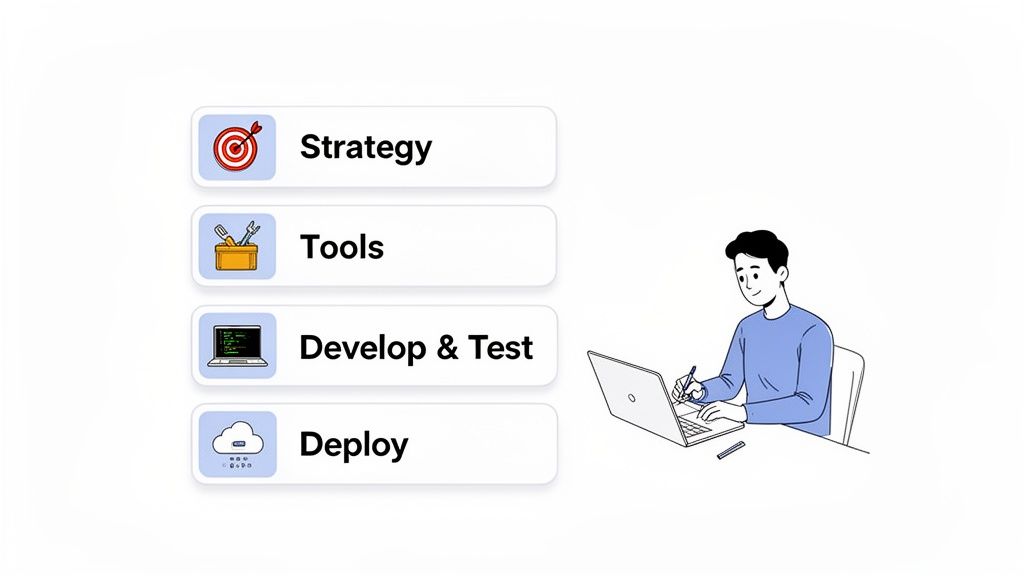
Ready to take full control? Building your own ai agent crypto system is the ultimate path to customization. Thanks to modern APIs and open-source libraries, it's more accessible than ever. Let's walk through the essential steps.
Step 1 — Define the Strategy
Before writing a single line of code, you must define the logic with absolute precision. This is the brain of your operation.
- -Entry/Exit Rules: What specific, non-negotiable conditions trigger a buy or sell? (e.g., "When the 12-hour EMA crosses above the 26-hour EMA on volume greater than X, buy.")
- -Risk Limits: Define your maximum risk per trade, maximum concurrent positions, and a daily drawdown limit that triggers an automatic shutdown.
- -Backtesting Plan: How will you validate the strategy? Run it on historical data, but also perform walk-forward testing to ensure it's robust across different market periods, not just a fluke.
Step 2 — Choose Tools
With a clear plan, you can assemble your tech stack.
- -Exchange APIs: Choose an exchange with a reliable, well-documented API. Based on region, popular choices include Binance, Kraken, and Coinbase.
- -Data Feeds: You can use the exchange's real-time data or integrate third-party feeds for OHLCV, order book depth, or even sentiment analysis.
- -Backtesting Framework: Don’t reinvent the wheel. Python libraries like Backtrader or Zipline can save you hundreds of hours.
Step 3 — Develop & Test
Now it’s time to build. Your mantra during this phase is: paper trade first. Never test a new agent with real money.
- -Sandbox Keys: Use your exchange's testnet environment and sandbox API keys to simulate trades without risking any capital.
- -Monitoring & Logging: Your first goal isn't profit; it's reliability. Log every decision, API call, and error. If something breaks, you need a clear audit trail to diagnose the problem.
Step 4 — Deploy & Optimize
Once your agent performs flawlessly in a simulated environment, you can consider a cautious live deployment.
- -Start Small: Begin with a minimal amount of capital—an amount you are genuinely prepared to lose.
- -Circuit Breakers: Implement hard-coded daily risk limits. If your agent loses a certain percentage in a day, it should automatically stop all trading.
- -Continuous Improvement: The market evolves, and so should your agent. Regularly review its performance and optimize its parameters.
Suggested Stack
- -Frameworks: TensorFlow / PyTorch (for ML-based strategies)
- -APIs: Binance / Kraken / Coinbase
- -Backtesting: Backtrader / Zipline
- -Deployment: A cloud server like AWS or GCP for 24/7 uptime.
Risks & Safety Considerations
Let's get real. Using an AI agent in a market as volatile as crypto introduces unique risks. Ignoring them is a recipe for disaster. This is your pre-flight checklist for staying safe. 🛡️
Market Risks
The market itself is your biggest adversary. Volatility can be your best friend or your worst enemy.
- -Volatility & Flash Crashes: A sudden market crash can cause the price to blow past your stop-loss order, leading to a much larger loss than anticipated, especially in low-liquidity conditions.
- -Slippage & Fee Drag: In high-frequency strategies, the small difference between your expected trade price and the actual execution price (slippage), combined with trading fees, can bleed a profitable strategy dry.
- -Mitigation: Favor limit orders over market orders. Build slippage and fees directly into your backtesting models to get a realistic performance estimate.
Technical Risks
Your agent is only as reliable as the technology it runs on. A single point of failure can be catastrophic.
- -API Failures & Rate Limits: During peak volatility, exchange APIs can become slow or unresponsive. Your agent might fail to place or cancel an order at a critical moment.
- -Websocket Drops: The real-time data feed powering your agent can disconnect without warning, leaving your agent "blind" to the market.
- -Mitigation: Implement robust monitoring and fallback logic. Your code must include a "heartbeat" check to ensure all connections are live. If a connection drops, a pre-programmed emergency protocol (like canceling all open orders) must trigger instantly.
Security Risks
A profitable agent is a prime target. Secure your setup like a fortress.
- -NEVER grant withdrawal permissions to your API keys.
- -ALWAYS use IP whitelisting to restrict API key access to your server's IP address only.
Regulatory & Tax Risks
The rules of the game are constantly changing and vary by jurisdiction.
- -Compliance Awareness: Be aware of the specific regulations governing automated trading and crypto in your country.
- -Recordkeeping: Keep meticulous, automated logs of every single trade for tax purposes. An un-auditable trading history is a nightmare waiting to happen.
AI Agents for Crypto Growth Hacking
Think AI agents are just for trading? Think again. The same principles of automation, data analysis, and execution can be a secret weapon for crypto projects focused on growth. For operators—marketers, community managers, and business developers—agents can automate the tedious tasks that drive user acquisition and engagement.
Instead of executing trades, these agents execute growth experiments. They create powerful automation loops for:
- -Monitoring & Alerts: An agent can watch for brand mentions on Twitter, track key community metrics in Discord, or alert the team when a competitor launches a new campaign.
- -Reporting: Automatically compile daily reports on social media engagement, user onboarding funnels, or token volume and send them to the team via Slack.
- -Experimentation Logs: Systematically track the performance of different marketing campaigns, ensuring every growth experiment is data-driven and properly documented.
Platforms like gojiberry.ai are built for this kind of operational automation. They provide the workflow and execution layer to connect different data sources (like social media APIs or on-chain data) and trigger actions, helping teams execute with the same discipline as an automated trading system.
This approach bridges the gap between strategy and execution, which is the core of effective growth. To learn more, check out this comprehensive growth hacking guide.
The Path Forward: Discipline Over Magic
We’ve covered a lot of ground—from core concepts and top tools to specific strategies and critical safety protocols. The key takeaway should be clear: returns in automated trading come from process and risk management, not a magic algorithm. 🧙♂️
The true power of an ai agent crypto system is its ability to execute your plan flawlessly, 24/7, without fear, greed, or fatigue. It’s the ultimate tool for enforcing discipline. Your strategy provides the intelligence; the agent provides the relentless execution.
So, what’s your next step?
- Start Small. Pick one simple strategy and learn it inside out.
- Backtest Rigorously. Test your idea against historical data until you understand its strengths and weaknesses in different market conditions.
- Paper Trade. Run your agent in a simulated environment for an extended period. Prove its reliability before you risk a single dollar.
- Deploy with Guardrails. When you go live, start with minimal capital and use hard-coded circuit breakers and daily loss limits.
This technology offers a profound advantage, but only if you approach it with the mindset of an engineer, not a gambler. Master the process, respect the risk, and you'll be on the right path to leveraging AI for a real edge in the crypto markets.
Ready to see how these automation principles can transform your business operations? Dive deeper with our complete growth hacking guide and unlock the power of systematic execution.
FAQ
Are crypto AI agents profitable?
They can be, but profitability depends entirely on the strategy, risk management, and market conditions. An agent is a tool for executing a plan; it does not guarantee profits. Success comes from a well-researched and backtested strategy, not the agent itself.
How much can AI trading make?
There is no fixed answer. Realistic expectations are crucial. Returns are highly variable and depend on the strategy's risk profile (e.g., low-risk grid trading vs. high-risk momentum trading). Beware of any service promising specific or guaranteed monthly returns; they are almost always unrealistic.
Is AI trading safe?
AI trading is as safe as you make it. The primary risks are market volatility, technical failures (like API downtime), and security breaches (like compromised API keys). Implementing robust risk controls, kill switches, and following security best practices (no withdrawal permissions, IP whitelisting) is essential to mitigate these dangers.
What is the best AI agent for crypto beginners?
Platforms like Cryptohopper and Pionex are often recommended for beginners. Cryptohopper has a user-friendly interface and copy trading features, while Pionex offers pre-built bots integrated directly into the exchange, removing the need for complex setup.
Can I build my own crypto AI agent?
Yes, if you have programming skills (Python is most common). Using libraries like Backtrader and exchange APIs from Binance or Kraken, you can build a custom agent. However, it requires a deep understanding of strategy development, testing, and server management.

More High-Intent Leads = Your New Growth Engine.
Start Now and Get New High Intent Leads Delivered Straight to Slack or Your Inbox.