
What Is an AI SDR? A Complete Definition + 5 Real-World Examples

AI SDRs are replacing human sales development reps. But what exactly are they? 🤔
If you’re in sales, you’ve probably heard the buzz. The adoption of AI SDR tools has exploded in 2024-2025, but so has the confusion. Is it just a fancy chatbot? Is it another automation script? Or is it something… more?
The truth is, most people get it wrong. They lump AI SDRs in with basic tools that can’t think, learn, or adapt.
Let's clear the air. This guide gives a complete definition of what an AI Sales Development Representative is, with 5 real-world examples to show you how they actually work. By the end, you'll know exactly what this tech is and what it can do for you.
What Is an AI SDR? (The Real Definition)
Let’s cut through the jargon. An AI SDR is an artificial intelligence system that automates the entire sales development process, from finding prospects and sending outreach to qualifying leads and booking meetings.
Think of it as an autonomous digital teammate. Its key characteristics are what set it apart:
- 🧠 Autonomous: It operates 24/7 without needing a human to press "go" every time.
- 💡 Intelligent: It learns from every interaction, getting smarter about what messaging works and who to talk to.
- 🚀 Scalable: It can handle hundreds of conversations a day, a volume that would burn out an entire human team.
- 📊 Measurable: Every single action is tracked, giving you crystal-clear data on what’s driving results.
So, how does it stack up against a human SDR or a simple chatbot?
AI SDR vs. Human SDR
A human SDR is a rockstar, but they're still human. They work ~8 hours a day, can manage maybe 50 leads, and cost around $50k/year. An AI SDR works 24/7, can handle 500+ leads a day, and costs between $100–$500 a month. It’s a game of scale.
AI SDR vs. Chatbot
Here's the biggest misconception. A chatbot is reactive—it sits on your website and waits for someone to ask a question. An AI SDR is proactive. It goes out into the world (think LinkedIn and email) to find leads, start conversations, and generate opportunities from scratch.
The best analogy? An AI SDR is like having 10 human SDRs working 24/7 for less than the cost of one.
Ready to see how the engine actually runs?
How Does an AI SDR Work?
So, what’s happening behind the curtain? It’s not magic, but it’s a pretty smart, five-step process that turns a name on a list into a booked demo on your calendar.
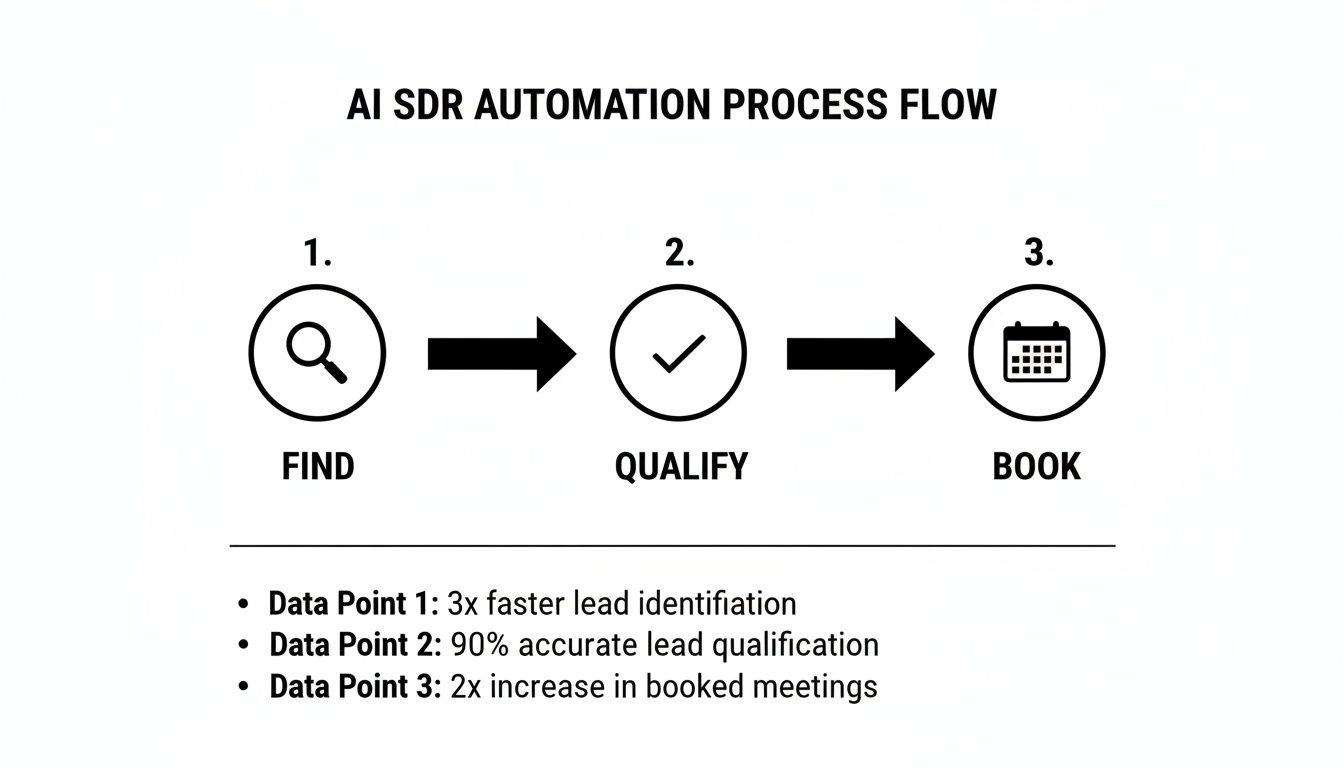
Here's the step-by-step breakdown:
- Prospecting: The AI scours databases and platforms like LinkedIn to find contacts that perfectly match your Ideal Customer Profile (ICP). It’s not just grabbing names; it’s looking for buying signals.
- Outreach: It crafts and sends hyper-personalized messages via email, LinkedIn, or even phone calls. No generic templates here—it uses prospect data to make the outreach feel human.
- Engagement: When a prospect replies, the AI uses Large Language Models (LLMs) like those from ChatGPT or Claude to understand the context and carry on a natural conversation.
- Qualification: The AI asks smart questions to figure out if the lead is a good fit. Are they the decision-maker? Do they have the budget? Is now the right time?
- Handoff: Once a lead is qualified and ready to talk, the AI seamlessly books a meeting directly on a human sales rep’s calendar.
A Real-World B2B SaaS Example
Imagine you sell project management software. Here’s how your AI SDR would work:
- It finds VPs of Operations at mid-sized tech companies in North America.
- It sends a personalized LinkedIn message mentioning a recent company achievement it found online.
- The VP replies, asking how it's different from Asana. The AI responds with key differentiators.
- The VP shows interest, so the AI qualifies them by asking about their team size and current challenges.
- It hands off by sending a calendar link to book a demo with a human Account Executive.
All of this happens automatically, powered by a tech stack of LLMs, automation tools (like Make or Zapier), and APIs connected to your CRM. Best of all? It’s a constant learning loop. Every reply makes the AI better at its job.
5 Real-World Examples of AI SDRs in Action
Theory is great, but let's see how this actually plays out. Here are five concrete examples of AI SDRs generating real ROI for businesses.
Use CaseHow It WorksExpected ResultsExample ToolsROI Logic1. LinkedIn ProspectingSends ~50 personalized connection requests & messages daily on LinkedIn.15% response rate, generating **50 leads/month**.Gojiberry at $99/mo (or paired with Piper for ~$300/mo total). If 1 deal is worth $2k, closing just one lead delivers **500%+ ROI**.2. Cold Email ProspectingSends ~100 hyper-personalized emails daily to a targeted list.25% open rate, generating **100 leads/month**.Lemlist, OutreachCost: $400/mo. Higher volume means more at-bats. Closing 2 deals delivers **600%+ ROI**.3. Phone Call ProspectingUses AI to generate scripts, make outbound calls, and record/analyze conversations.20% answer rate, generating **30 leads/month**.Aircall, GongCost: $500/mo. Phone leads are often higher intent. One good deal can yield **400%+ ROI**.4. Multi-Channel ProspectingCombines LinkedIn, email, and phone into a coordinated sequence.30% conversion rate, generating **100 leads/month**.Gojiberry ($99/mo) + Salesloft: combined cost around $600/mo. The surround-sound approach boosts conversions. A massive **800%+ ROI** is possible.5. Industry-Specific (SaaS)An AI trained specifically on SaaS pain points and language.40% conversion rate, generating **150 leads/month**.Custom AI SDRCost: $1,000/mo. Deep expertise = higher quality leads. This can drive **1000%+ ROI**.
Types of AI SDRs
Not all AI SDRs are created equal. They can be categorized based on the job you need them to do. Which one sounds like the right fit for your team?
Inbound AI SDR
This AI is your digital receptionist. It lives on your website or in your inbox and engages with leads who come to you. Its main job is to instantly qualify inbound inquiries so your sales team only talks to the best-fit prospects. Think of a super-smart chatbot that doesn't just answer questions but actively qualifies leads.
Outbound AI SDR
This is the hunter. An outbound AI SDR proactively seeks out new opportunities. It's the engine behind the LinkedIn and cold email campaigns we talked about, built to start conversations and generate leads from scratch.
Multi-channel AI SDR
Why choose one channel when you can use them all? A multi-channel AI SDR coordinates outreach across LinkedIn, email, and sometimes even phone calls. This creates a powerful "surround sound" effect, dramatically increasing the odds of getting a response. Platforms like Outreach and Salesloft specialize in this.
Industry-specific AI SDR
This is the specialist. It's an AI that has been trained on the specific language, pain points, and buyer personas of a single industry (like FinTech or Healthcare). Because it "speaks the language," it's incredibly effective at building rapport and qualifying leads within that niche.
Benefits of Using an AI SDR
Still on the fence? Let's break down the undeniable advantages. Adopting an AI SDR isn't just about cool tech; it's a strategic move with massive bottom-line benefits. ✅

- Generate 10x More Leads: Seriously. One AI can do the work of a whole team, handling massive outreach volume without breaking a sweat.
- Work 24/7: Your prospecting engine never sleeps. Leads get an intelligent response instantly, no matter the time zone.
- Slash Costs: Swap a ~$50k annual salary for a monthly subscription that’s often under $500. The math is a no-brainer.
- Ensure Consistent Quality: Every message is perfectly on-brand and follows your playbook to the letter. No typos, no missed follow-ups.
- Scale Up (or Down) Instantly: Need more pipeline? Just increase the AI's activity. No hiring, no training.
- Optimize with Data: The AI constantly learns from what’s working, refining its approach to get you better and better leads over time. For more tips on this, check out these lead generation best practices.
- Improve Lead Quality: Over time, the learning loop ensures the AI gets laser-focused on leads who are most likely to convert.
Challenges and Limitations (The Reality Check)
Alright, let's be real. An AI SDR is powerful, but it’s not a magic button. Going in with your eyes open is key to success. Here’s what you need to watch out for:
- Initial Setup Time: Don't expect to launch in an hour. You'll need to invest 1-2 weeks upfront to define your ICP, craft your messaging, and train the AI.
- High-Quality Data is a Must: Garbage in, garbage out. The AI is only as good as the prospect list you feed it. Clean data is non-negotiable.
- Limited Creativity: An AI can't replicate the spontaneous creativity or deep empathy of a human. For complex, nuanced conversations, humans still win.
- Compliance Constraints: You have to play by the rules. Be mindful of LinkedIn's Terms of Service and data privacy laws like GDPR to avoid getting into hot water.
- Reduced Human Touch: Over-automation can feel... robotic. The best strategies use AI for the initial outreach and bring in a human as soon as real interest is shown.
- Ongoing Monitoring: This isn't a "set it and forget it" tool. You need to keep an eye on performance, tweak campaigns, and make sure the AI is hitting its goals.
Case Study: Launching an AI SDR for a B2B SaaS Startup
Let's look at a quick, real-world scenario.
- The Situation: A brand new B2B SaaS startup had a great product but zero leads. They had one human SDR who was overwhelmed with building lists and sending cold emails manually.
- The Solution: They implemented an AI SDR focused on LinkedIn outreach. The goal was to automate the top of the funnel so their human SDR could focus only on qualified conversations.
- The Process: The AI was tasked with sending 50 personalized messages a day and handling the initial qualification questions.
- Month 1: 50 qualified leads booked.
- Month 2: 100 qualified leads booked.
- Month 3: 150 qualified leads booked.
Ready to deploy an AI SDR and see results like this for yourself?
Gojiberry is the best AI SDR for LinkedIn. Why? It’s built to be:
- Easy to use: No code or technical skills required. Get set up in minutes.
- Secure: It respects LinkedIn's rules to keep your account safe.
- Affordable: Plans are designed for startups and growing teams.
👉 Try Gojiberry free for 14 days — deploy your AI SDR now
You'll also get access to our proven AI SDR templates, a complete setup guide, and 24/7 support to ensure you hit the ground running.
AI SDRs are no longer a futuristic concept; they are the present and future of sales development. We've defined what they are, shown you five real-world examples of their power, and broken down how they work.
They aren't here to replace great salespeople. They're here to empower them, taking the repetitive grind off their plate so they can focus on what matters: building relationships and closing deals.
The only question left is, when will you start your AI SDR journey? Why not this week?
Frequently Asked Questions (FAQ)
What is the main difference between an AI SDR and sales automation?
Think of it as the difference between a self-driving car and cruise control. Sales automation (cruise control) follows a rigid, pre-set sequence. "If this, then that." An AI SDR (a self-driving car) is autonomous. It uses generative AI to understand context, make decisions, and have dynamic, two-way conversations. It can handle unexpected replies and qualify leads with human-like reasoning, which simple automation can't do.
Is using an AI SDR on LinkedIn safe?
It depends entirely on the tool. Many cheap automation tools violate LinkedIn's terms of service and can get your account banned. However, reputable AI SDR software like Gojiberry is designed with safety first. It mimics human behavior, operates within platform limits, and uses smart features to avoid detection. The key is to choose a provider that prioritizes compliance, not just a high volume of messages.
How much does an AI SDR cost?
The cost can vary, but you're typically looking at a monthly subscription model. Most AI SDR tools range from $100 to $500 per month. When you compare that to the average salary of a human SDR (around $4,000-$5,000 per month plus benefits), the cost savings are enormous. The ROI becomes clear very quickly when a single closed deal can pay for the software for a year or more.

More High-Intent Leads = Your New Growth Engine.
Start Now and Get New High Intent Leads Delivered Straight to Slack or Your Inbox.