
What Is an AI Agent and How Does It Work? A Complete Guide

Let's get straight to the point. Forget the hype for a moment and think of an AI agent as your most resourceful, proactive team member—one that can sense what's happening, think through a problem, and act on its own to hit a specific target. 🤖
This isn't just a chatbot waiting for a command. It's an autonomous problem-solver that gets things done for you. So, are you ready to see how it actually works?
So, What Is an AI Agent, Really?
Ever wish you could clone your best sales rep? That’s the core idea behind an AI agent. In simple terms, it's a piece of software built to operate independently and achieve a defined goal.
Unlike basic automation that’s stuck on rigid "if this, then that" rules, an AI agent is much more fluid. It works in a continuous cycle:
- Perceive: It pulls in data from its digital surroundings—maybe a new lead dropping into your CRM or a contact's job change popping up on LinkedIn.
- Reason: It then analyzes that information, figures out the best next step, and plots a course of action using its built-in intelligence.
- Act: Finally, it takes action. That could be anything from updating a lead’s record to sending a highly personalized email or connecting with a new prospect.
A Modern Evolution of AI
The concept of an "agent" isn't new. The idea of a system that can perceive, reason, and act has been around for decades, with roots tracing all the way back to Alan Turing's work in the 1950s.
So what's changed? The technology powering it. The deep learning breakthroughs of the last decade have supercharged this concept. Industry research shows that the 2020s marked a real turning point, moving us from simple automation to genuinely autonomous agents that can manage complex, multi-step tasks.
To truly see how these agents fit into the bigger picture, it helps to understand what artificial intelligence in business is as a whole.
AI Agents vs Other Automation at a Glance
It's easy to lump AI agents in with other tools, but they are fundamentally different. While basic automation and chatbots are great at handling single, repetitive tasks, AI agents are built for orchestrating complex, multi-step workflows with genuine decision-making.
This table breaks down the key differences based on common user feedback:
CapabilityBasic Automation (e.g., Zapier)Chatbot (e.g., Basic Support Bot)AI Agent (e.g., GojiberryAI)Decision-MakingFollows pre-set rules (If X, then Y)Scripted responses, limited decision treesAutonomous; makes dynamic, context-based decisionsTask ComplexitySingle-step, linear tasksSimple, conversational Q&AMulti-step, complex workflows across multiple systemsAdaptabilityRigid; requires manual changes to logicLimited; can't handle unexpected queries wellLearns and adapts based on new information and outcomesProactivityReactive; triggered by a specific eventReactive; responds only when a user initiatesProactive; can initiate tasks based on goals and dataGoal OrientationCompletes a defined actionAnswers a user's questionWorks toward a high-level objective (e.g., "book a meeting")
In short, while other tools execute commands, AI agents pursue objectives. This distinction is what makes them capable of handling high-value B2B tasks like sophisticated lead prospecting and outreach.
How AI Agents Perceive, Reason, and Act
So, how does an AI agent actually get things done? It’s not magic. It’s a straightforward, yet powerful, three-step cycle: Perceive, Reason, and Act.
The easiest way to think about it is to picture a highly effective sales development rep (SDR) working a new lead.
First, the agent has to sense what’s going on in its digital world. This is the Perceive step. Instead of eyes and ears, it uses data streams from APIs, webhooks, or user commands to gather information. This is just like an SDR spotting a notification that a key prospect just updated their job title on LinkedIn.
Next up is the "thinking" part—Reasoning. This is where the agent’s brain, usually a Large Language Model (LLM), makes sense of the new data. It analyzes the information, compares it to its assigned goals, and maps out a plan. Our SDR connects the dots: "This person just joined a company that's a perfect fit for our ideal customer profile. Now is a great time to connect."
Finally, the agent takes action. During the Act phase, it executes the plan it just created. This could mean updating a contact record in your CRM, sending a personalized email, or adding the prospect to a specific outreach sequence. For our SDR, this is the moment they hit "send" on that perfectly crafted message mentioning the new role.
This simple flow is the foundation of how every AI agent operates.
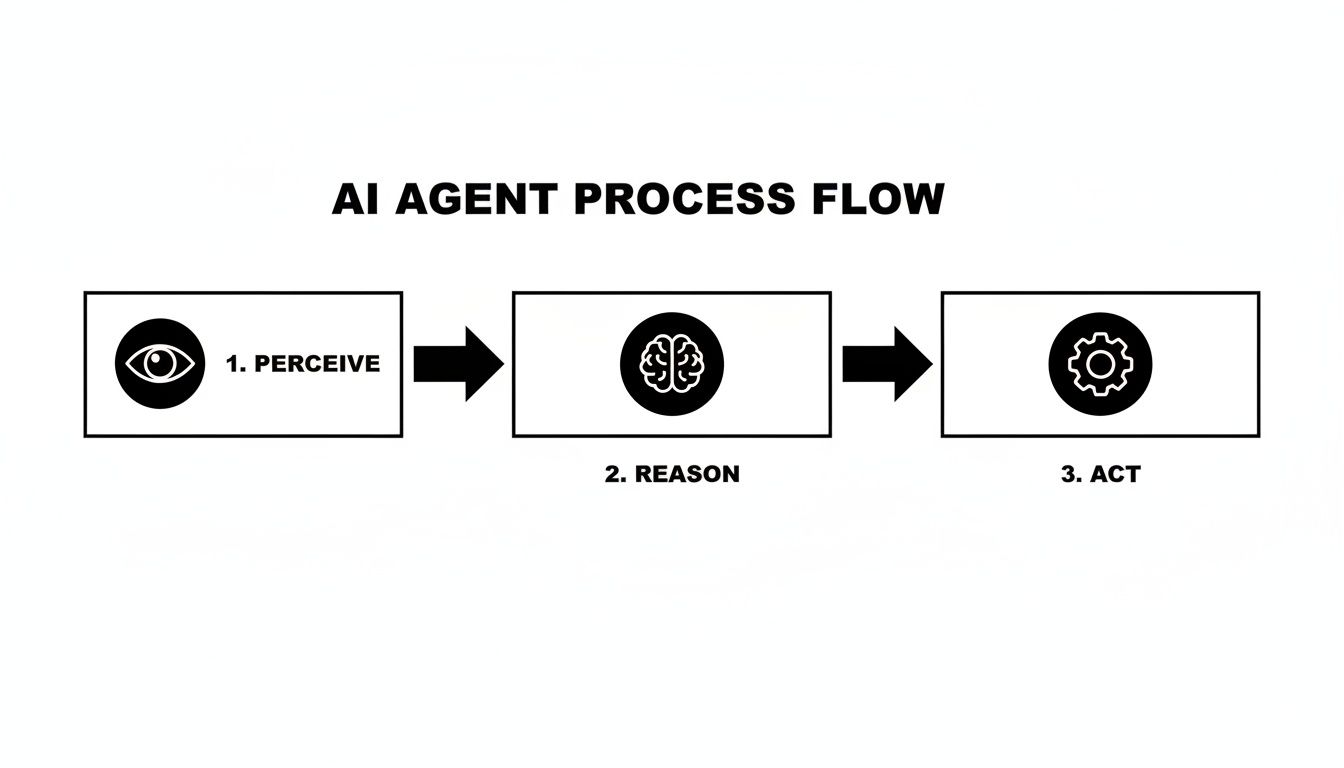
The key is that this isn't a one-time event. It’s a continuous loop. The agent is constantly perceiving, reasoning, and acting, allowing it to adapt in real-time as new information becomes available.
The Engine Behind the Agent
This constant cycle of perceiving, deciding, and acting is what separates a true AI agent from a simple automation script. Today’s agents are built on powerful LLMs like GPT-4 and advanced reasoning models that allow them to plan and adapt on the fly.
This isn’t just theoretical. Case studies from leading cloud providers show that the period from 2023–2024 marked a huge leap forward for agent platforms. They became capable of managing complex tasks, coordinating dozens of API calls, and orchestrating multiple systems all on their own.
A few core components make this possible:
- Sensors: These are the agent's digital inputs. Think APIs, webhooks, and database connections that feed it a constant stream of information.
- Reasoning Engine: This is the core LLM that acts as the brain. It processes all the incoming data, weighs it against its objectives, and determines the best course of action.
- Actuators: These are the tools the agent uses to carry out its decisions, like an email API for sending messages or a CRM integration for updating records.
If you want to get a better feel for the underlying tech, looking into systems like OpenAI's Whisper AI model is a great starting point. It offers a clear example of how sophisticated models can perceive and interpret complex inputs like human speech, which is a core part of the "Perceive" step for many agents.
Exploring the Different Types of AI Agents
Not all AI agents are created equal. Much like assembling a human team, you need different roles for different jobs. Understanding these agent archetypes is the key to choosing the right tool for the task at hand. 🛠️
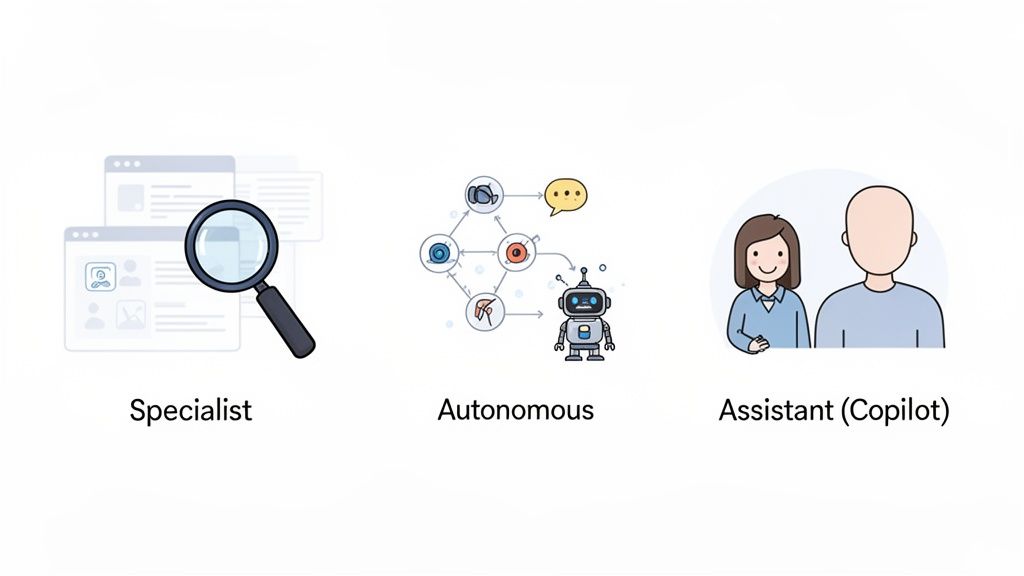
Think of them as falling into three main camps you'll run into in the business world. Each one has its own strengths and is designed to solve a specific kind of problem.
Specialist Agents
First up, you have Specialist Agents. These are your focused experts, built to do one thing and do it exceptionally well. They’re programmed for a very specific, often repetitive task and carry it out with incredible speed and accuracy.
- Ideal Use Case: Automating high-volume, repetitive tasks.
- Real-World Example: A lead enrichment agent. Its only job is to take a name and a company, then automatically track down and verify their contact info, job title, and other key details. It’s a high-volume, single-focus role that frees up human teams from thousands of hours of tedious manual work.
Autonomous Agents
Next are the Autonomous Agents. These are the strategic thinkers, capable of managing complex, multi-step projects from beginning to end. Unlike specialists, they don't just complete a single task; they orchestrate an entire process to hit a much bigger goal.
- Ideal Use Case: Managing end-to-end workflows like sales prospecting or market research.
- Real-World Example: An autonomous prospecting agent like GojiberryAI does more than just find an email address. It actively identifies buying signals, qualifies leads against your ideal customer profile (ICP), enriches their data, and can even kick off personalized outreach sequences. It manages the entire top-of-funnel process, essentially acting like a fully dedicated team member. This is the real power of a true AI SDR that can independently drive pipeline growth.
Assistant Agents
Finally, we have Assistant Agents, which you’ll often hear called Copilots. These agents are designed to work right alongside humans, acting as a force multiplier to boost our own skills rather than completely taking over a workflow.
- Ideal Use Case: Augmenting human capabilities in real-time.
- Real-World Example: Sales teams report using these to help draft emails, summarize long call transcripts, or suggest talking points during a live meeting. They excel at making the person in the driver's seat far more productive.
So, the real question is: are you looking to automate a single task, an entire workflow, or supercharge a team member? Knowing the answer will point you straight to the right type of agent for your needs.
Real B2B Use Cases Driving Growth
It's one thing to talk about what AI agents can do, but let's get into what they're actually doing for B2B teams right now. This isn't about saving a few minutes here and there. It's about building an independent engine that fuels your sales pipeline. 🚀
Let's look at three practical ways AI agents are changing the game.
Automated Prospecting
- The Old Way: Sales reps spend a huge portion of their day manually scouring LinkedIn, company announcements, and industry news. They're hunting for any hint of a buying signal, a process that’s slow, exhausting, and full of missed opportunities.
- The New Way: An autonomous agent, like the ones from GojiberryAI, works around the clock. Users report that it continuously scans thousands of data sources for high-intent signals—a company just raised a Series B, a key decision-maker posted about a new initiative, or a competitor's customer is unhappy. Once it finds a prospect that fits your Ideal Customer Profile (ICP), it surfaces them as a qualified, timely lead.
Intelligent Lead Enrichment
- The Old Way: A new lead comes in, but it's just a name and a company. Now the rep has to drop everything and go on a digital scavenger hunt for a verified email, direct dial, and any piece of relevant context to start a real conversation. It's a massive time sink.
- The New Way: The moment an AI agent identifies a good prospect, it starts building a complete profile. It pulls and cross-references data from multiple sources to give you the full picture: verified contact info, tech stack, company size, and recent news. All of this critical information gets pushed directly into your HubSpot or Salesforce, so your team can focus on selling, not searching.
Personalized Outreach at Scale
- The Old Way: Your team sends out hundreds of generic emails, hoping something sticks. Personalization rarely goes beyond a
{{first_name}}merge tag because customizing each one is impossible at scale. Unsurprisingly, response rates are low. - The New Way: The agent does more than just find and enrich leads—it helps you reach out intelligently. It uses the specific buying signal it found to draft a genuinely relevant message. For example, it might reference a recent funding announcement or a new job change, which marketers find immediately sets your outreach apart and dramatically boosts reply rates.
B2B Prospecting Workflow Before and After AI Agents
The shift from manual grunt work to intelligent automation completely changes the daily workflow for a sales team. The "before and after" is pretty stark.
TaskManual Process (The Old Way)AI Agent Process (The New Way)Finding LeadsHours of manual searching on multiple platforms.Continuous, 24/7 monitoring of thousands of buying signals.Enriching DataManual lookup for emails, phone numbers, and context.Automated data compilation from multiple sources in seconds.Initial OutreachGeneric, templated messages with low engagement.Personalized messages based on specific, timely triggers.Time to ActionDays or weeks, depending on manual capacity.Instantaneous, from signal detection to enriched lead.
Ultimately, AI agents free up your sales professionals to do what they do best: build relationships and close deals. The machine handles the repetitive, data-heavy tasks, while your team focuses on high-value human interaction.
How to Implement Your First AI Agent
Alright, let's move past the theory and get practical. Putting your first AI agent into action is probably more straightforward than you think. It's less about deep technical knowledge and more about making smart, strategic choices upfront.
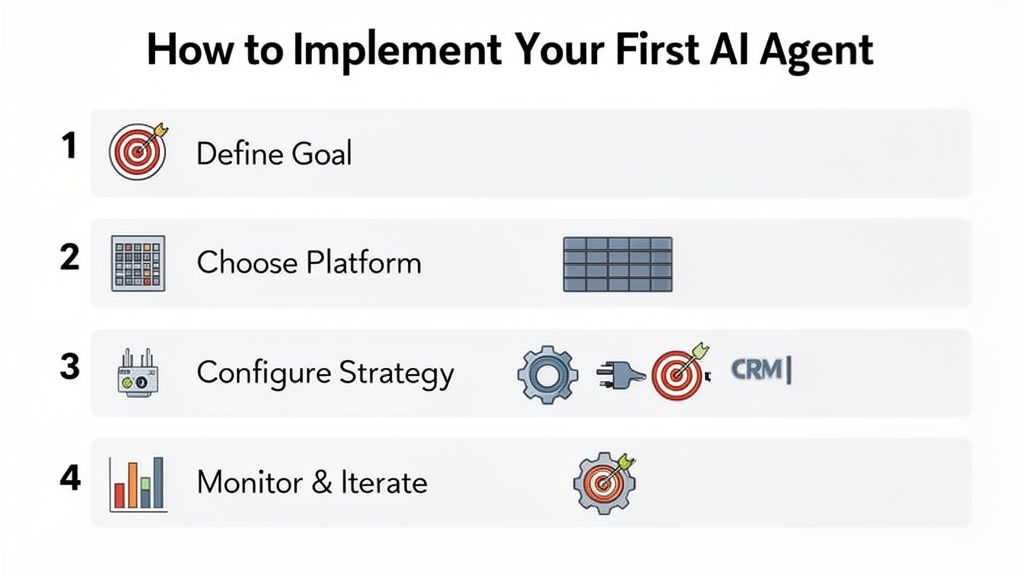
Here’s a step-by-step process to get it done right.
Step 1: Define Your Goal
First up, you need to be crystal clear on what you want the agent to accomplish. A vague wish like "get more leads" isn't a goal; it's a recipe for disappointment.
Get specific. A real goal sounds like this: "Identify 50 new, warm prospects who perfectly match our ICP every week." Or, "Automatically enrich every new inbound lead with a verified email and phone number within 60 seconds." A sharp, measurable goal is the foundation for everything that follows.
Step 2: Choose the Right Platform
Once you know the what, you can find the how. Your goal will dictate the right tool for the job. For B2B growth, you'll want a platform with features that actually matter, like native CRM integrations and the flexibility to customize workflows.
If your goal is prospecting, then the agent’s ability to comb through different data sources for real-time buying signals is absolutely essential. Don't settle for less.
Step 3: Connect Your Tech Stack
An AI agent can't work in a silo. It needs to communicate seamlessly with the tools you already use every day. Look for platforms that offer simple, one-click integrations with your CRM, whether that's HubSpot or Salesforce.
This part should feel easy. If connecting your systems involves a multi-week engineering project, you're probably looking at the wrong solution.
Step 4: Configure the Agent’s Strategy
This is where you hand the agent its playbook. You’ll define your Ideal Customer Profile (ICP) with precision, tell it which buying signals to hunt for (like recent funding announcements or key executive hires), and establish the rules of engagement.
For example, you could build a hyper-focused agent to find specific types of members in online communities, just like this Skool Scrapper Agent does. This is your chance to give it clear marching orders.
Step 5: Monitor and Iterate
Now, you set it live and watch. Pay close attention to the results. Are the leads high-quality? Are they converting into actual meetings? Keep an eye on your key performance indicators (KPIs) and use that data to refine your approach.
The first version is rarely the final one. The whole point is to learn from what the agent is doing and continuously tweak its strategy for better outcomes.
Quick Do’s and Don’ts for Implementation
- DO: Start small. Pick one well-defined, nagging problem to solve first.
- DON’T: Settle for vague, unmeasurable objectives.
- DO: Prioritize platforms that integrate easily with your core business tools.
- DON’T: Forget about data privacy and compliance—make sure the tool meets security standards.
- DO: Treat this as an ongoing process. Monitor, learn, and adjust as you go.
Ready to take the next step? Find the right tool for your specific needs.
Time to Put Your Growth on Autopilot
So, where does that leave us? The big idea to walk away with is that AI agents aren't some sci-fi concept anymore. They're here, they're practical, and they’re already giving B2B teams a real competitive advantage. ⚡
We've walked through how these agents can perceive the digital world, reason through complex data, and take action—automating the kind of work that used to eat up most of the day. They're changing the entire playbook for growth, from digging up high-intent leads to crafting outreach that actually feels personal.
Ultimately, the magic isn't in the tech itself, but in what it gives back to your team: the time and mental space to focus on building relationships, talking to customers, and actually closing deals.
The conversation has shifted. It’s no longer about if you should bring AI agents into your workflow, but how fast you can get them running to reclaim your team's time and start scaling your pipeline.
If you're ready to see how these pieces fit into a modern tech stack, take a look at our guide on the best AI tools for sales.
FAQs About AI Agents
Still have a few things rattling around in your head? You're not alone. Let's tackle some of the most common questions we hear about putting AI agents to work.
How is an AI agent different from a chatbot?
This is a great question, and the difference is huge. Think of a chatbot as reactive. It’s like a helpful librarian—it waits for you to ask for a specific book and then finds it on the shelf. It follows a script and pulls from a set knowledge base.
An AI agent, on the other hand, is proactive. It’s more like a dedicated research assistant. You give it a goal, and it doesn't just find the book; it reads it, synthesizes the important points, cross-references other sources, and then drafts a summary for you. It perceives, plans, and acts on its own to get the job done.
What kind of data do I need to run a sales AI agent?
You don’t need to be a data scientist to get started—far from it. Modern platforms like GojiberryAI are already connected to high-quality data sources that spot critical buying signals across the market.
The most important "data" you provide is your strategy. You'll need to define:
- Your Ideal Customer Profile (ICP).
- The buying signals that matter most to you (e.g., a company just raised a Series A, they’re hiring engineers, they posted a specific job).
- Your rules for engagement.
The agent takes your playbook and does all the heavy lifting, sifting through millions of data points to find the perfect opportunities.
Is it hard to integrate an AI agent with my CRM?
Not anymore. For modern agent platforms, it's usually a walk in the park. Most top-tier tools have pre-built, native integrations for major CRMs like HubSpot and Salesforce.
Based on feedback from numerous teams, the setup is typically a simple, one-time authentication process that takes just a few clicks. These systems are designed to slide right into your existing sales motion, pushing fully qualified and enriched leads directly into your pipeline without disrupting a thing.
Ready to stop prospecting and start selling? With GojiberryAI, you can put your B2B growth on autopilot. Find your next customer today.

More High-Intent Leads = Your New Growth Engine.
Start Now and Get New High Intent Leads Delivered Straight to Slack or Your Inbox.