
LinkedIn Automation Cold Outreach: Strategy, Tactics & Best Practices

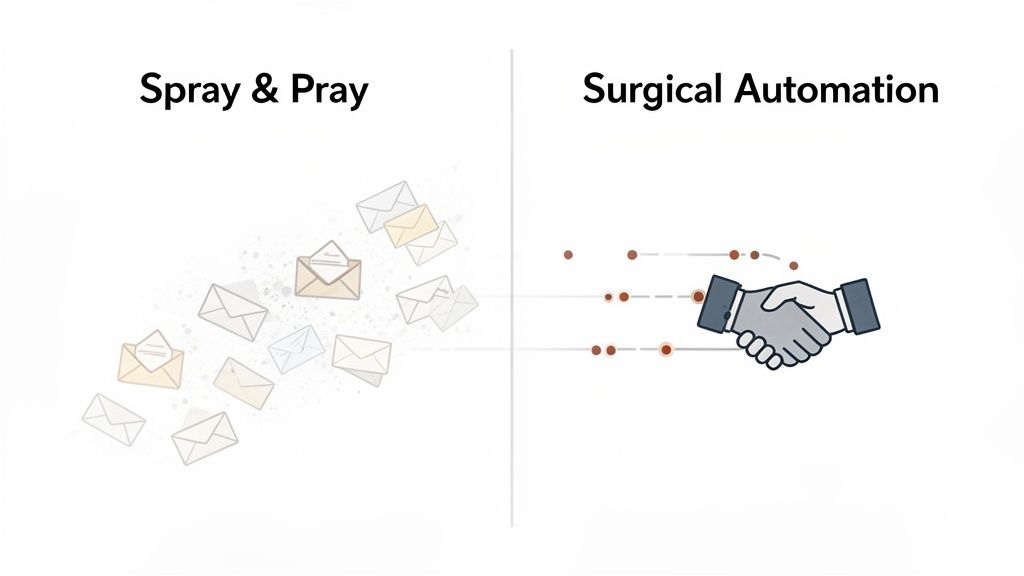
Ever tried scaling your LinkedIn outreach? You know the feeling. You want more leads, but the thought of a restricted account is terrifying. And let's be real, the old "spray and pray" automation method is a dead end—it's noisy, ineffective, and practically begs LinkedIn to flag your profile.
But what if you could get connection acceptance rates of 30-40% with automation? That's not a fantasy; it's what happens when you swap brute force for surgical precision.
The game has changed. Today, smart LinkedIn automation cold outreach is about blending intelligent automation with the kind of personalization that actually gets replies, all while keeping your account safe. This guide is your new playbook. We'll break down why doing everything by hand is a massive bottleneck and how the right strategy can turn LinkedIn into a predictable revenue engine.
Ready to build a system that works for you? Let's dive in.
What is LinkedIn Cold Outreach?
At its core, LinkedIn cold outreach is the process of initiating conversations with potential customers on LinkedIn who have no prior relationship with you or your brand. It’s the digital equivalent of a cold call, but way more effective.
Cold vs. Warm Outreach: What's the Difference?
- -Cold Outreach: You’re approaching a prospect for the first time. They don't know you. The goal is to establish relevance and trust quickly.
- -Warm Outreach: You have a pre-existing connection. Maybe they engaged with your content, you met at an event, or you have a mutual connection. The conversation starts with a foundation of familiarity.
LinkedIn is a goldmine for cold outreach because it's a professional network where business conversations are expected. You have access to detailed profiles, work history, and recent activity—all the intel you need to make a cold introduction feel surprisingly warm. Done right, you can expect to book qualified meetings and build a predictable sales pipeline. The key? Playing by the rules and respecting the platform's compliance guidelines.
Cold Outreach Strategy Framework
A great campaign doesn't happen by accident. It's built on a solid strategic framework. Think of these five pillars as your blueprint for success.
- Define Your Target Audience: Who are you trying to reach? Go beyond basic demographics. Develop a crystal-clear Ideal Customer Profile (ICP) and buyer personas.
- Research & List Building: Where will you find these people? This stage involves identifying data sources, finding buying signals, and building a high-quality, targeted list.
- Messaging Strategy: What will you say? Craft compelling copy for your connection request and follow-up messages that offers value and sparks curiosity.
- Sequence Design: How will you deliver your message? Plan a multi-touch sequence of messages and engagements spread out over time to stay top-of-mind without being annoying.
- Measurement & Optimization: Is it working? Track your key metrics (like acceptance and reply rates) and continuously A/B test to improve performance.
Nail these five steps, and you’ll have a scalable system for turning strangers into customers.
Building Your Cold Outreach List
Let's be honest, your entire outreach campaign lives or dies by the quality of your prospect list. You can craft the most compelling message in the world, but if it's going to the wrong audience, you’re just shouting into the void. 😅
It's time to stop treating list-building as a chore. It's the strategic foundation for everything that follows.
Simply filtering by job titles in Sales Navigator is table stakes. The real wins come from digging deeper to find buying signals—clues that a prospect is actively looking for a solution like yours right now.
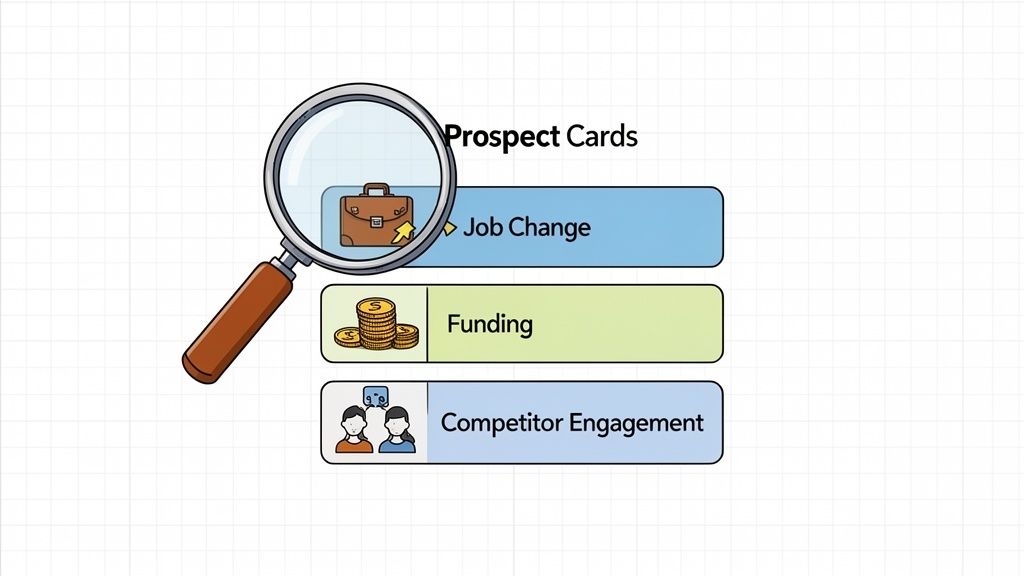
Here are the signals top performers look for:
- -Recent Job Changes: New leaders are under pressure to make an impact in their first 90 days. They have a fresh budget and a mandate to bring in new tools.
- -Company Funding Announcements: A company that just closed a new funding round has cash to invest in growth. This is a huge green light.
- -Hiring Sprees: A company suddenly posting ads for "5 new SDRs" is a dead giveaway they're scaling their sales function and will need tools to support them.
Do's & Don'ts of List Building:
- ✅ DO use enrichment tools to find verified emails for a multi-channel approach.
- ✅ DO segment your list by persona, industry, and the buying signal you identified.
- ❌ DON'T rely on a single data source. Combine LinkedIn data with other B2B databases.
- ❌ DON'T forget to clean your list and remove duplicates before launching.
Need some help getting started? Check out this guide on the top 8 free LinkedIn lead generation tools.
Cold Outreach Messaging Strategy
Great messaging is what separates a genuine opportunity from a deleted message. Automation gets it there, but your words have to connect. The goal is to be personal, valuable, and clear.
Connection Request Messaging
Your connection request is your first impression. The generic "I'd like to add you to my professional network" is a waste of an opportunity. Aim for a 30-40% acceptance rate by making it personal.
- -Bad Example: "Hi, I'd like to connect."
- -Good Example: "Hi Sarah, saw your post on scaling marketing teams at SaaS startups - great insights. I'm also in the B2B SaaS world and would love to connect and follow your work."
First Message Approach
Once they accept, don't immediately pitch. The best first messages offer value or start a conversation.
- -Bad Example: "Thanks for connecting! My company does X, Y, and Z. Are you free for a demo next week?"
- -Good Example: "Thanks for connecting, Sarah! Speaking of scaling marketing teams, we just published a case study on how [Similar Company] cut their cost per lead by 20%. No strings attached, just thought you might find it interesting."
Your goal is to be seen as a helpful resource, not just another salesperson. For more on this, it's worth digging into the principles behind creating engaging social media content.
Cold Outreach Sequences
A single message is easy to ignore. A thoughtfully planned sequence of messages and actions guides a prospect from "Who are you?" to "Okay, I'm listening." This isn't about spamming; it’s about being thoughtfully persistent.
Here are three proven sequences you can adapt.
Sequence 1: 2-Week Cold Outreach (4 Touches)
This sequence is a "gentle nudge," perfect for relationship-building in more traditional industries.
- -Day 1: Personalized connection request.
- -Day 4: Thank you message (no pitch). "Appreciate the connection! Looking forward to following your work."
- -Day 8: Engage with their content (a thoughtful comment on a post).
- -Day 12: Value-driven message. "Noticed you lead the marketing team at [Company]. Many leaders in your space are struggling with [pain point]. We put together a guide on this—mind if I share it?"
Sequence 2: 3-Week Aggressive (5 Touches)
This "value-driven play" is more direct and designed to qualify prospects faster. It's a go-to for SaaS and B2B services.
- -Day 1: Profile view + personalized connection request.
- -Day 5: First message (value). Share a relevant case study or article. No hard pitch.
- -Day 11: Second message (problem-aware). Gently introduce a common pain point and ask an insightful question.
- -Day 17: Third message (soft CTA). Briefly mention your solution and ask if they're open to learning more.
- -Day 21: Final "breakup" message. A polite closing to end the sequence and leave the door open.
Sequence 3: 4-Week Nurture (6 Touches)
This is the long game for high-value enterprise prospects. It blends automated messages with manual, high-touch engagement. Our warm DM playbook dives deep into this relationship-first mindset.
Personalization at Scale
How do you make automated messages feel like they were written one-to-one? You use dynamic variables and research-based customization.
- -Dynamic Variables: This is the basic level. Use fields like
{{firstName}},{{companyName}}, and{{jobTitle}}. Every modern tool does this. - -Research-Based Customization: This is where the magic happens. Weave in details that show you've done your homework. Reference a recent company achievement ("Congrats on the funding round!"), a piece of content they shared, or a mutual connection.
Authenticity is key. Write in a natural, human tone. Avoid overly formal or corporate jargon. The goal is for your message to read like it came from a real person, because behind the automation, it did.
Cold Outreach Compliance
Let's tackle the elephant in the room: getting your LinkedIn account restricted. It’s almost entirely avoidable if you’re smart about it. The secret isn't about gaming the system; it's about making your automation behave like a human.
LinkedIn Rate Limits (The Unofficial Rules)
LinkedIn doesn't publish official limits, but based on extensive user feedback, these are the safe zones:
- -Connection Requests: 100-150 per week. Pushing past 200 is risky. A steady 20 per day is safer than 100 on a Monday.
- -Profile Views: Keep automated views under 250-300 per day.
- -Message Frequency: Don't send hundreds of DMs in a short window, even to 1st-degree connections.
Key Takeaway: Consistency beats volume. A brand new or inactive account needs to be "warmed up." Start with 5-10 actions a day and gradually ramp up over a few weeks.
Always monitor your account health. Keep an eye on your Social Selling Index (SSI) score in Sales Navigator—a score of 75+ is a great sign of a healthy account. And obsess over your connection acceptance rate. A rate above 30% signals to LinkedIn that you're a valuable member, not a spammer. For those managing multiple profiles, it's critical to properly run a LinkedIn farm and automate several accounts.
Cold Outreach Tools & Automation
The right tech stack makes all the difference. You need tools that can handle list building, sequencing, and analytics seamlessly.
- -Third-Party Automation Platforms: This is the core of your stack. Platforms like GojiberryAI are built to find leads with buying signals and run safe, personalized multi-channel sequences.
- -CRM Integration: Your automation tool must talk to your CRM (like Salesforce or HubSpot). This ensures that when a lead replies, they’re automatically logged, preventing embarrassing duplicate outreach.
- -Email Integration: The most powerful campaigns combine LinkedIn outreach automation with cold email. Look for tools that can manage both in a single, unified sequence.
- -Analytics & Tracking: Your platform should provide a clear dashboard to track the key performance metrics we'll cover next.
Cold Outreach Performance Metrics
You can't improve what you don't measure. Forget vanity metrics like profile views and focus on the KPIs that actually drive revenue.
| Metric | Industry Benchmark | What It Tells You |
|---|---|---|
| Connection Acceptance Rate | 30-40% | Your targeting and initial hook are effective. A low rate means your list or connection message is off. |
| Message Response Rate | 5-10% | Your value proposition and follow-ups are compelling. Low rates mean your messaging isn't resonating. |
| Meeting Booked Rate | 1-3% (of total connections) | Your call-to-action is converting interest into action. This is the ultimate measure of ROI. |
Calculating your Cost Per Lead and Cost Per Meeting will give you a clear picture of campaign efficiency and help you justify your investment in automation tools.
Cold Outreach Optimization
Seeing the numbers is one thing; knowing what to do with them is another. This is how you turn a good campaign into a lead-gen machine.
- -A/B Testing Messaging: Create two versions of your connection request or first message. Send each to 100 prospects and see which one gets a better response. Let the data decide the winner.
- -Timing Optimization: Marketers often find that sending messages on Tuesday, Wednesday, and Thursday mornings yields the best results. Test different days and times to see what works for your audience.
- -Targeting Refinement: Is one persona responding better than another? Double down on what's working. If your acceptance rate is low, your targeting is likely too broad.
Treat your outreach like a series of small experiments. Hypothesize, test, analyze, and repeat.
Cold Outreach by Industry
Your approach should vary based on the industry you're targeting.
- -SaaS Companies: Lead with data, case studies, and ROI. They are tech-savvy and appreciate a direct, value-driven approach.
- -B2B Services (Agencies, Consulting): Focus on building credibility and trust. Share thought leadership, client testimonials, and offer free strategic advice.
- -Recruitment: Personalization is everything. Reference a candidate's specific experience and skills. Speed is also crucial in a competitive market.
- -Real Estate: Hyper-local targeting is key. Reference specific neighborhoods, market trends, or property types.
- -Financial Services: Compliance and professionalism are paramount. The tone should be more formal. Focus on security, trust, and long-term value.
Cold Outreach Mistakes to Avoid
Many campaigns fail for the same few reasons. Steer clear of these common pitfalls:
- Generic Messaging: Copy-pasting the same message to everyone is a recipe for failure.
- Poor Targeting: Sending your message to the wrong audience guarantees you'll be ignored.
- Excessive Frequency: Bombarding prospects with messages is the fastest way to get blocked.
- Ignoring Compliance: Pushing LinkedIn's limits will get your account restricted.
- No Follow-Up Strategy: Most replies come after the third or fourth touchpoint. Giving up after one message is leaving money on the table.
- Neglecting Account Health: A profile with no picture, a weak headline, and no recent activity looks like a bot.
When it comes to prospecting performance, this Lemlist vs Waalaxy for cold outreach guide highlights key differences in deliverability and scale.
Cold Outreach + Warm Outreach Hybrid
The most sophisticated teams don't see cold and warm outreach as separate channels. They blend them.
When a cold prospect engages with your content (a "like" or comment), they are no longer cold. That's a trigger to move them into a warmer, more personalized sequence. Use referrals and warm introductions whenever possible. Ask a happy customer, "Who else in your network might benefit from this?" A warm intro from a trusted connection has a conversion rate that cold outreach can't touch.
Real-World Cold Outreach Case Studies
Let's look at how this works in practice.
- -Case Study 1: SaaS Cold Outreach Success
- -Company: A B2B SaaS startup selling project management software.
- -Strategy: They targeted newly-hired VPs of Engineering at tech companies that had recently received funding. Their outreach sequence offered a guide on "The First 90 Days: How New Eng Leaders Drive Immediate Impact."
- -Results: Achieved a 42% connection acceptance rate and booked 15 qualified demos in the first month, leading to a 7x ROI on their automation software.
- -Company: A digital marketing agency.
- -Strategy: They built a list of CMOs who were actively engaging with their competitors' content on LinkedIn. Their first message was, "Saw you liked [Competitor]'s post on SEO. We actually just published a case study showing how we achieved a 150% traffic increase for a similar brand."
- -Results: Their response rate jumped from 4% to 11%, and they signed three new five-figure monthly retainers in one quarter.
- -Company: A technical recruiting firm.
- -Strategy: They targeted software engineers with specific skills (e.g., "React Native") at companies known for high turnover. They used a multi-channel approach of LinkedIn messages and emails.
- -Results: Increased their candidate pipeline by 30% and reduced their average time-to-fill for critical roles by 10 days.
Advanced Cold Outreach Tactics
Ready to level up? These advanced tactics can deliver outsized results.
- Multi-Channel Outreach (LinkedIn + Email): A prospect who sees your name on LinkedIn and in their inbox is far more likely to respond. It shows professional persistence.
- Account-Based Cold Outreach: Instead of targeting one person, build a coordinated outreach campaign to multiple stakeholders within a key target account (e.g., the decision-maker, an end-user, and an influencer).
- Content-Based Cold Outreach: Create valuable content (e.g., a blog post, webinar, or whitepaper) and use it as the centerpiece of your outreach. Lead with value, not a sales pitch.
- Engagement-Based Cold Outreach: Before you send a connection request, spend a week warming up the prospect by leaving thoughtful comments on their posts. When you finally reach out, they'll already recognize your name.
- Referral-Based Cold Outreach: Leverage your existing network. Ask happy clients or connections for introductions to relevant prospects.
You've got the strategy, the tactics, and the best practices. You know how to build lists, write compelling messages, and automate safely. The only thing left is to put it into action. Start by defining your ICP, build a small, targeted list of 50 prospects, and launch your first 2-week sequence. Track your results, learn from the data, and optimize. This is how you build a predictable pipeline.
Ready to stop guessing and start building? See how GojiberryAI can transform your outreach today.
FAQ
How do I warm up a new LinkedIn account for outreach?
Start slow and mimic human behavior. For the first two weeks, focus on manual activity: optimize your profile, connect with colleagues, engage with content in your feed, and join relevant groups. In week three, start sending 5-10 personalized connection requests per day. Gradually increase this number each week until you reach your target of 20-25 per day. This slow ramp-up builds trust with LinkedIn's algorithm.
What's the best way to handle negative replies?
Stay professional and courteous, always. If someone says "not interested," a simple "Thanks for the reply, I appreciate you letting me know. All the best." is perfect. Don't argue or try to push. A graceful exit leaves the door open for the future. Mark them in your CRM so you don't contact them again for the same offer.
Can AI write my outreach messages for me?
Yes, AI can be an incredibly powerful co-pilot for writing outreach messages, but it shouldn't be on full autopilot. Use AI tools to generate a strong first draft, brainstorm different angles, or personalize a message based on a prospect's profile. However, you should always review and edit the AI-generated copy to ensure it matches your brand voice, sounds authentic, and is 100% accurate. The best approach is human-led, AI-assisted.

More High-Intent Leads = Your New Growth Engine.
Start Now and Get New High Intent Leads Delivered Straight to Slack or Your Inbox.