
Growth Hacking LinkedIn Strategy: Rapid Growth Framework for 2026

Let's be real: traditional LinkedIn strategies often feel slow, expensive, and the results can be… underwhelming. But what if you could accelerate your growth by 3-5x? Growth hackers are using a different playbook, and it’s built on rapid experimentation, data-driven insights, and smart automation. This is how they’re seeing massive returns.
Forget the slow grind. This isn't about sending more spam or blindly connecting with thousands of people. An effective growth hacking LinkedIn strategy is about precision, timing, and delivering real value at every step. It’s the difference between guessing what works and building a predictable, scalable lead generation machine.
Ready to stop guessing and start growing? This guide breaks down the exact frameworks, tactics, and real-world examples you need to turn LinkedIn into your number one growth channel.
Here’s what you'll learn:
- -The 5-stage growth hacking funnel for LinkedIn.
- -Core growth hacking strategies: from viral content to account-based growth.
- -Actionable tactics for each stage of the funnel.
- -How to build a rapid experimentation framework to find what works—fast.
- -The essential tools and metrics to power your growth engine.
Let's dive in.
What is Growth Hacking on LinkedIn?
So, what exactly is growth hacking on LinkedIn? 🤔
It’s an approach focused on one thing: rapid, sustainable growth. Unlike traditional marketing, which often relies on long-term brand building and established budgets, growth hacking is about running quick, data-driven experiments to find the most efficient ways to acquire and retain customers.
Think of it as marketing meets the scientific method.
| Growth Hacking | Traditional Marketing |
|---|---|
| Focus: Rapid experimentation & scalability | Focus: Brand awareness & long-term campaigns |
| Process: Agile, iterative cycles (e.g., weekly sprints) | Process: Planned, linear campaigns (e.g., quarterly) |
| Metrics: Conversion rates, viral coefficient, activation | Metrics: Reach, impressions, brand sentiment |
| Mindset: “How can we test this for $100 before spending $10,000?” | Mindset: “What’s our budget for this campaign?” |
LinkedIn is uniquely suited for growth hacking because it provides a rich, structured dataset of professionals. You know who people are, where they work, what they care about, and who they know. This allows for hyper-targeted experiments with immediate feedback.
The Growth Hacking Mindset:
- -Data-Obsessed: Every decision is backed by data, not just gut feelings.
- -Creative & Scrappy: You look for leverage points and unconventional tactics.
- -Full-Funnel Focus: You optimize the entire customer journey, not just the top of the funnel.
Expected Outcomes & Timelines:
With a solid growth hacking strategy, teams often report seeing meaningful traction within 30-60 days (e.g., increased reply rates, more meetings booked). Significant, scalable growth, like a 3-5x increase in qualified leads, typically builds over 3-6 months as you find and scale winning experiments.
The Growth Hacking Funnel on LinkedIn
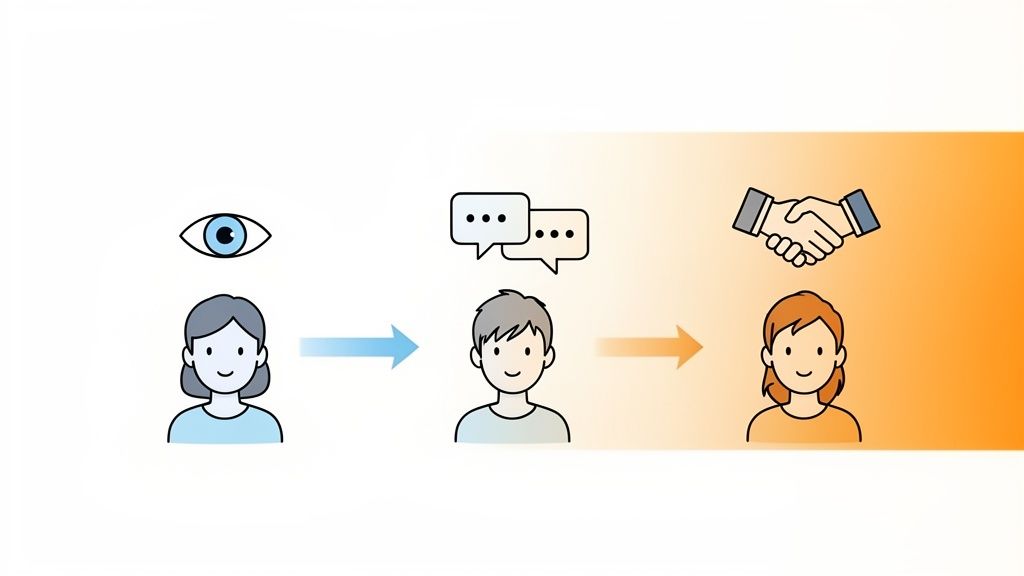
Forget the old, linear sales funnel. Growth hackers use the "Pirate Funnel" (AARRR), which is perfect for LinkedIn because it focuses on the entire customer lifecycle.
Here's how it breaks down:
- Awareness (Reach): How do potential customers find you? This is about making your profile and content visible to your target audience.
- Activation (Engagement): How do you get them to take a first meaningful action? This is about turning a passive viewer into an active connection or follower who engages with you.
- Retention (Relationships): How do you keep them engaged and build trust over time? This stage is about nurturing the relationship with valuable content and interaction, not just pitching.
- Revenue (Conversion): How do you turn a relationship into a sale? This is where nurtured leads become customers.
- Referral (Advocacy): How do you get happy customers to bring you more customers? This is the key to exponential growth—turning your client base into a marketing channel.
Your job as a growth hacker is to optimize each stage of this funnel. Ready to see how?
Core Growth Hacking Strategies for LinkedIn
To master the funnel, you need a set of core strategies. These are the high-level plays that drive everything else.
- -Strategy 1: Viral Content & Engagement: Creating content that your audience loves and shares, generating organic reach and inbound interest. It’s about becoming a go-to voice in your niche.
- -Strategy 2: Rapid Experimentation & A/B Testing: Systematically testing different messages, audiences, and offers to quickly discover what works and double down on the winners.
- -Strategy 3: Network Effects & Referrals: Leveraging your existing network and happy customers to generate new leads through social proof and word-of-mouth.
- -Strategy 4: Account-Based Growth: A hyper-focused approach where you treat high-value companies as individual markets, coordinating outreach across multiple stakeholders.
- -Strategy 5: Automation at Scale: Using tools to handle repetitive tasks like outreach and data collection, freeing you up to focus on strategy and building relationships. This is about being smart, not spammy.
Now, let's break down how to implement some of these.
Rapid Experimentation Framework
The heart of growth hacking is the experimentation loop. Don't guess—test.
Here's a step-by-step process for running weekly growth sprints:
- Bad: "Let's try a new message."
- Good: "We believe that referencing a prospect's recent LinkedIn post in the first line of our connection request will increase our acceptance rate from 20% to 35% because it shows genuine research."
- Run Quick Testing Cycles: Define a short test period, usually 1-2 weeks. Send a statistically significant number of messages (e.g., 100-200 per variation) to get reliable data.
- Collect & Analyze Data: Track your key metrics relentlessly. What was the connection rate? Reply rate? Positive reply rate?
- Iterate & Optimize: Did the new version win? If yes, make it your new baseline and come up with a new hypothesis to beat it. If not, what did you learn? Was the hypothesis wrong, or was the execution flawed?
- Scale Winners: Once you have a clear winner that has proven itself over a couple of cycles, it's time to scale it. Apply that messaging framework across the team or increase the volume.
- Contrarian Takes: Challenge a popular belief in your industry. Example: "Why 'hustle culture' is killing your sales team's productivity."
- Personal Stories & Failures: Authenticity builds trust. Share a lesson learned from a business mistake.
- Actionable Frameworks & Guides: Give away your knowledge. Post a simple 3-step guide to solving a common problem your customers face.
- Data-Driven Insights: Share a surprising statistic from your own research or a recent industry report.
- End with a question: Encourage comments and discussion.
- "Comment for the resource": Offer a valuable template or guide to people who comment, which dramatically boosts the post's visibility.
This cycle prevents you from wasting months on a strategy that isn't working. Fail fast, learn faster.
Content-Driven Growth Strategy
Stop broadcasting sales pitches. Start creating content that pulls your ideal customers toward you. 🧲
- Consistency & Frequency: You don't need to post daily, but aim for 2-3 high-quality posts per week. Consistency trains the algorithm and your audience to pay attention.
- Audience Building: It's not just about posting; it's about engaging. Spend 15 minutes a day leaving thoughtful comments on posts by your ideal customers and other industry leaders.
- Leveraging Mutual Connections: When you reach out to someone, mentioning a respected mutual connection can increase your reply rate by over 50%, based on user reports. It turns a cold outreach into a warm introduction.
- Do: Offer a clear incentive (e.g., a $200 gift card, one month free) for a successful referral. Make it easy for them with a pre-written email or message they can share.
- Don't: Just say "we'd appreciate any referrals." Be specific with your ask.
Network Effects & Referral Strategy
Your existing network is your biggest untapped growth channel.
- Incentive Structures: For high-value B2B, consider a tiered system. A simple introduction gets a small reward; a closed deal gets a significant commission.
- Viral Loops: A viral loop is when a user generates more users simply by using your product or engaging with your content. The "comment for the resource" tactic is a mini viral loop.
- Targeting High-Value Accounts: Identify a list of 20-50 companies that represent your biggest revenue opportunities.
- Multi-threaded Outreach: Don't just contact one person. Map out the buying committee (e.g., the economic buyer, the end-user, the champion) and engage 3-5 people within the account simultaneously.
- Coordinated Messaging: Sales and marketing must be aligned. While a sales rep sends a personalized connection request to a VP, marketing runs targeted ads to the C-suite of that same company, all referencing the same pain point.
- Account-Level Metrics: Success isn't measured by individual leads, but by account-wide engagement. Are multiple people at the target company responding, viewing your profile, or visiting your website?
- Win Rate Optimization: Marketers find that ABG can lead to significantly higher win rates and larger deal sizes because you're building consensus across the organization.
- Scaling Outreach with Automation: Use tools to automate connection requests and follow-ups. But the key is personalization.
- Example: "Saw your post on challenges with Q4 planning. We helped [Similar Company] automate their forecasting..." This feels researched, not robotic.
Account-Based Growth Strategy
Why fish with a net when you can fish with a spear? Account-based growth (ABG) is about focusing your resources on a small list of high-value dream clients.
Automation-Driven Growth Strategy
Automation isn't about spamming. It's about personalizing at scale and freeing up your time for high-value activities. For a deeper dive, exploring the benefits of dedicated AI sales agents can provide a significant competitive edge.
- Workflow Optimization: Build sequences that combine automated and manual steps. For example, an automated connection request, followed by a manual, hyper-personalized InMail if they accept.
- Data-Driven Targeting: Use automation to monitor for "intent signals," like a target account hiring a new executive or mentioning your competitor. Trigger outreach the moment a signal is detected.
- Optimize your LinkedIn profile with keywords your buyers search for.
- Post high-value content 2-3 times per week.
- Engage in comments on posts from industry leaders.
- Run low-cost LinkedIn ads targeting a hyper-specific audience to test messaging.
- Send personalized connection requests that reference a specific detail from their profile.
- Warm up leads by engaging with their content for a week before sending a connection request.
- Use "intent signals" (e.g., they viewed your profile) to time your outreach perfectly.
- Don't just connect and pitch. Follow up with valuable content, not just "checking in."
- Tag connections in relevant posts or discussions.
- Send a personalized message congratulating them on a work anniversary or promotion.
- Once you've built rapport, make a clear ask: "Would you be open to a brief 15-minute call next week to discuss how we might help with [specific problem]?"
- Use social proof in your pitch: "We recently helped [Similar Company] achieve [Result]."
- Move the conversation off LinkedIn to a call or demo once interest is confirmed.
- After a customer has a big win, ask them for a LinkedIn recommendation.
- Systematically ask happy clients if they know 1-2 other people who might benefit from your solution.
- Feature customer success stories in your content.
- Top of Funnel: Connection Acceptance Rate, Content Engagement Rate.
- Mid-Funnel: Reply Rate, Positive Reply Rate (this is crucial!).
- Bottom of Funnel: Meetings Booked, Opportunities Created, Close Rate.
Ready to see how these strategies apply in practice?
Growth Hacking Tactics by Stage
Here are specific, actionable tactics for each stage of the AARRR funnel.
Awareness Tactics (Visibility, Reach)
Activation Tactics (Engagement, Connection)
Growth Hacking Tools & Stack
You don't need a huge budget, but the right tools give you superpowers.
| Colonne 1 | Colonne 2 | Colonne 3 |
|---|---|---|
| Valeur 1 | Valeur 2 | Valeur 3 |
| Valeur 4 | Valeur 5 | Valeur 6 |
Tool CategoryWhat It's ForPopular ExamplesLinkedIn Automation & OutreachScaling connection requests and messaging sequences.Gojiberry.ai, Expandi, HeyReachData Enrichment & ProspectingFinding verified emails and personalizing outreach.Clay, Clearbit, Apollo.ioAnalytics & MeasurementTracking funnel metrics and campaign performance.Your CRM (HubSpot, Salesforce), Google SheetsContent & Engagement ToolsScheduling posts and analyzing content performance.Buffer, Shield Analytics, Taplio
When evaluating tools, look for ones that prioritize safety and personalization. Based on user feedback, platforms that mimic human behavior and offer deep personalization features tend to yield better results and carry lower risk.
Real-World Growth Hacking Case Studies
Theory is great, but results are better. Here’s how this works in the real world.
Common Growth Hacking Mistakes to Avoid
The path to growth is filled with traps. Watch out for these. ⚠️
Your First 30-Day Growth Sprint
Feeling inspired? Good. Now it's time for action. Don't try to do everything at once. Pick one strategy and run a 30-day sprint.
Here’s a simple roadmap:
This cycle is the engine of growth. It turns LinkedIn from a black box into a predictable system for generating pipeline. The tactics are proven. The tools are available. Your next move is to take that first step and start your first experiment. Go get it. 🚀
Ready to put these strategies into action without the manual busywork? GojiberryAI integrates directly with LinkedIn to automate intent-based targeting, AI-powered personalization, and omnichannel sequences. Stop guessing and start growing with a platform built to turn your growth hacking LinkedIn strategy into a reality. Learn more at GojiberryAI.
FAQs
How is a growth hacking LinkedIn strategy different from a regular LinkedIn marketing strategy?
A regular marketing strategy often focuses on broad brand awareness, content consistency, and long-term campaigns. A growth hacking strategy is laser-focused on rapid, measurable growth through experimentation. It prioritizes data-driven tests, full-funnel optimization (from awareness to referral), and scalable tactics to find the most efficient path to customer acquisition.
How much time should I dedicate to a LinkedIn growth hacking strategy each week?
Initially, expect to spend 3-5 hours per week setting up experiments, analyzing data, and engaging. Once you have a few winning systems in place, you can often maintain them with just 1-2 hours per week, especially if you leverage smart automation for tasks like outreach and data collection. The key is consistency, not just volume.
Can I get my LinkedIn account restricted for growth hacking?
Yes, if you do it wrong. The risk comes from using low-quality automation tools that send hundreds of generic messages a day or violate LinkedIn's terms of service. A smart growth hacking strategy prioritizes safety. This means using tools that mimic human behavior, keeping outreach volumes reasonable (e.g., 20-40 personalized requests per day), and focusing on genuine engagement over spam. It's about being effective, not aggressive.
What's a good "positive reply rate" to aim for on LinkedIn?
While benchmarks vary by industry, many experienced growth marketers report that a "good" positive reply rate (meaning someone agrees to a next step or expresses clear interest) for cold outreach is around 8-15%. By applying growth hacking tactics like pre-warming leads and hyper-personalization, it's possible to push this to 20-30% or even higher for highly targeted campaigns. Anything below 5% suggests a problem with your targeting or messaging.

More High-Intent Leads = Your New Growth Engine.
Start Now and Get New High Intent Leads Delivered Straight to Slack or Your Inbox.