
AI SDR Meaning: What You Need to Know in 2026

"AI SDR" is the hottest term in sales right now. But what does it really mean? 🤔
Everyone's talking about AI SDRs, but if you ask ten people for a clear definition, you’ll probably get ten different answers. Most people confuse AI SDRs with basic chatbots or simple automation tools, but the reality is way more powerful.
You’re in the right place. In this guide, you’ll get a clear explanation of the AI SDR meaning—and how to actually use one to supercharge your sales pipeline. Let's dive in.
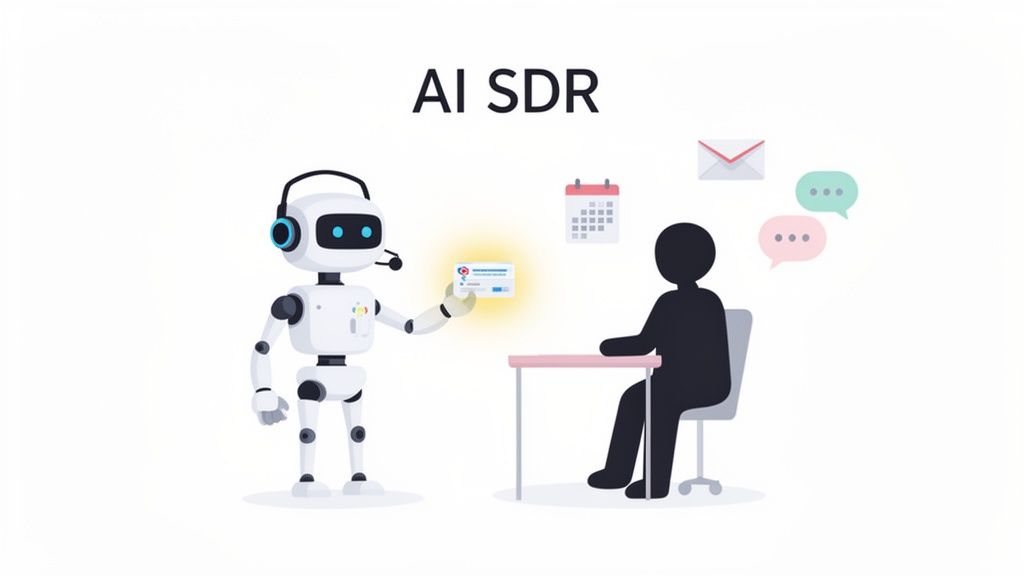
AI SDR Meaning: Breaking It Down
First things first, let's decode the acronym. It's simpler than it sounds.
- SDR stands for Sales Development Representative. This is the person on a sales team responsible for finding and qualifying new leads.
- AI stands for Artificial Intelligence. You know, the tech that powers everything from Netflix recommendations to self-driving cars.
So, the AI SDR meaning is pretty straightforward: it's an artificial intelligence system that performs the job of a Sales Development Representative.
A human SDR's job typically involves four key responsibilities:
- Prospecting: Finding potential customers who fit your ideal client profile.
- Outreach: Contacting those prospects with personalized messages.
- Qualification: Assessing their interest and figuring out if they're a good fit for your product or service.
- Handoff: Routing qualified leads to an Account Executive (AE) or sales rep to handle the demo and close the deal.
An AI SDR automates these steps from end-to-end, acting as a tireless digital team member that owns the entire top of your sales funnel.
AI SDR vs. Human SDR: What’s the Real Difference?
So, how does an AI Sales Development Representative really stack up against a human one? This isn't about replacement; it’s about giving your team superpowers. 💪
Human SDRs are brilliant at building genuine rapport, navigating tricky conversations, and using empathy to connect with prospects. You can't automate that kind of creativity. On the other hand, an AI SDR brings incredible scale, unwavering consistency, and 24/7 efficiency to the table.
The biggest differences come down to volume and cost. A human SDR works about 8 hours a day, can realistically manage around 50 leads, and has downtime for vacations and sick days. An AI SDR? It works 24/7, can handle 500+ leads daily, and never needs a coffee break.
The economics tell a similar story. A human SDR costs around $50,000 per year ($4,166/month). AI SDR software typically runs between $100 to $500 per month. This lets you scale prospecting exponentially without linear hiring costs.
How an AI SDR Works (Step by Step)
So you get the concept, but what does an AI SDR actually do all day? It's a surprisingly logical, five-step process that mimics what your best human SDRs do—just at a speed and scale that’s impossible to match manually.
Ready to see the operating model?
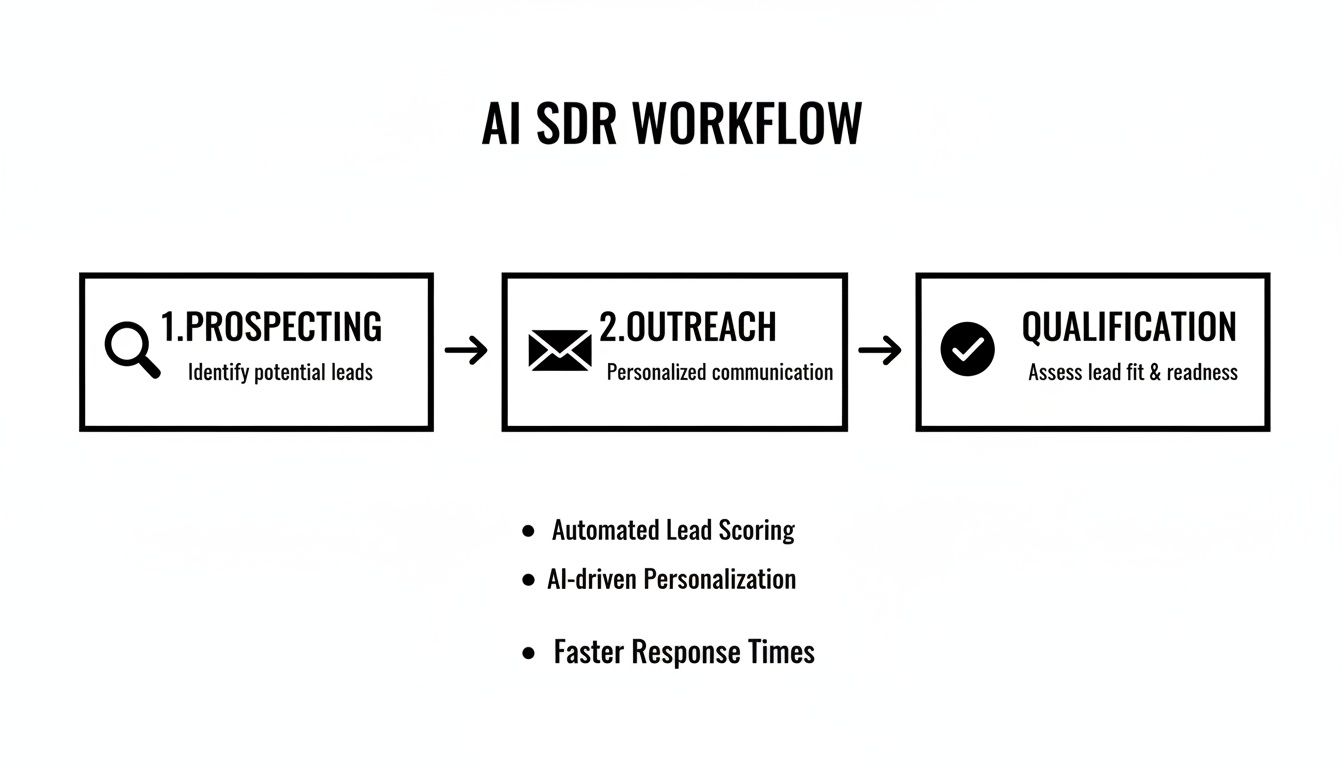
Let's break down each step.
Step 1: Prospecting
First, the AI SDR plays digital detective. You give it your Ideal Customer Profile (ICP)—for example, "VP Sales in Tech companies with 50–500 employees." The AI then scours data sources to build a laser-focused list.
- Output: 1,000 highly relevant prospects identified in minutes.
Step 2: Outreach
Next, the AI starts conversations. It generates personalized messages using variables like {{firstName}}, {{company}}, and {{role}}. A typical opener might be: “Hi {{firstName}}, I saw you’re {{role}} at {{company}} and thought it was worth reaching out…”
- Output: 50 personalized messages sent across LinkedIn or email.
Step 3: Engagement
This is where the real intelligence shines. When a prospect replies, the AI takes over the back-and-forth. It can answer common questions and keep the conversation moving. For example: “You asked about pricing—here’s the link and a quick summary…”
- Output: 80% of replies are answered instantly and intelligently.
Step 4: Qualification
The AI’s primary goal is to determine if a lead is qualified. It does this by asking key questions about their budget, timing, and needs. For instance, it might ask, “What’s your budget for a solution like this?” or “When are you hoping to get started?”
- Output: 20% of engaged prospects are identified as qualified leads.
Step 5: Handoff
Once a lead meets your criteria, the AI executes the final step: the handoff. It sends the qualified lead, along with the full conversation history and a neat summary, to a human sales rep. Example summary: “Interested, has a $50k budget, and wants to start in Q2.”
- Output: Your sales rep gets a warm, context-rich lead and can move straight to a demo or closing call.
Real-World Example: AI SDR in Action (Timeline)
Theory is great, but let's make this real. Imagine your company sells a SaaS project management tool and your target is VPs of Product in tech companies.
Here’s a day-by-day look at how an AI SDR could run a campaign for you.
- Day 1: The AI finds 100 VPs of Product who match your ideal customer profile.
- Day 2: It sends 50 personalized LinkedIn messages to the most promising prospects.
- Day 3: 8 people reply (a solid 16% response rate).
- Day 4: The AI instantly responds to all 8 replies, answering questions and gauging interest.
- Day 5: After a few exchanges, it qualifies 2 of the leads (a 25% qualification rate from replies).
- Day 6: The two qualified leads are seamlessly handed off to your sales rep to book a demo.
The Results
From a list of 100 prospects → 50 messages → 8 replies → 2 qualified leads. All in under a week.
The cost? Around $200/month for the AI SDR software. If each deal is worth $10,000, that’s a $20,000 pipeline created.
In this illustrative scenario, the ROI could be extremely high—because the marginal cost is low once configured. The key assumptions are a solid product-market fit and well-crafted messaging.
A human SDR might generate 5 qualified leads in a month for $4,166 in salary. The AI SDR proves to be dramatically more efficient in cost-per-lead terms.
Key Characteristics of AI SDRs
What really makes an AI SDR an AI SDR? It comes down to a few core traits that separate it from basic automation.
- Autonomous: It works end-to-end without needing constant human intervention.
- Intelligent: It learns from interactions and adapts its approach over time.
- Scalable: It can handle 100x the volume without a linear increase in cost.
- Personalized: It crafts unique and relevant messages for each prospect.
- Measurable: It tracks every metric, giving you clear insight into ROI.
- Compliant: It adheres to platform rules (like LinkedIn ToS) and data privacy laws (like GDPR).
- Affordable: It costs a fraction of a human SDR, typically $100–$500/month vs. $50k/year.
When to Use an AI SDR
Wondering if an AI SDR is the right move for your business? It’s a perfect fit if you check a few of these boxes:
- You have a large Total Addressable Market (TAM) with 1,000+ potential customers.
- You want to scale your lead generation efforts quickly (think 100+ new leads per month).
- You have a limited budget and can’t hire 2-3 more human SDRs right now.
- You want 24/7 prospecting so you never miss an opportunity.
- You need to A/B test different messages and approaches at scale.
- You want your human sales team focused on closing deals, not prospecting.
Checklist: Before Deploying an AI SDR
Ready to get started? A little prep work goes a long way. Use this checklist to ensure a smooth launch.
- Define Your Target Audience: Get crystal clear on your Ideal Customer Profile (ICP).
- Prepare Your Prospect List: Decide if the AI will build the list or work from one you provide.
- Create Message Templates: Write compelling, human-sounding copy for the AI to adapt.
- Set Up Your CRM: Ensure it’s ready to receive and track leads from the AI.
- Define Qualification Criteria: What makes a lead "sales-ready"? (Budget, timing, need, etc.)
- Plan the Handoff Process: Who gets the lead and what information do they need?
- Set Up Tracking and Reporting: Know your key metrics for success from day one.
- Test with a Small Batch First: Start with 50-100 prospects to iron out any kinks.
- Monitor and Optimize: Review performance weekly and tweak your strategy based on the data.
An AI SDR isn't a "set it and forget it" tool. It's an engine that needs fine-tuning to perform at its best.Now that you know the AI SDR meaning and how it works, it’s time to put it into practice. An AI SDR isn’t just a tool; it's the SDR job, automated—often at a fraction of the cost. Why not start your AI SDR journey this week?
Ready to Deploy an AI SDR?
Gojiberry makes it simple. We designed our platform for easy setup, so you can deploy your first AI sales agent in minutes and start seeing results. We've seen teams achieve incredible outcomes with this technology.
With GojiberryAI, you get:
- Easy Setup: Go live in minutes, not weeks.
- Proven Outcomes: Based on case studies, users report significant improvements in lead flow.
- Affordable: Scale your outreach without scaling your headcount.
This isn't just about understanding a new buzzword; it's about adopting a fundamentally better way to grow your business.
👉 Try Gojiberry free for 14 days — deploy your AI SDR now
We’ll even include an AI SDR template, a setup guide, and 24/7 support to ensure you succeed.
Frequently Asked Questions
Still got a few questions? Perfect. Let's tackle some of the most common ones.
Is an AI SDR just a fancy chatbot?
Not at all. A chatbot is reactive—it typically lives on a website and responds to user queries. An AI SDR is proactive. It actively prospects, initiates personalized outreach, engages in two-way conversations, and qualifies leads autonomously across multiple channels like email and LinkedIn. It’s a complete top-of-funnel sales engine, not just a customer service tool.
What kind of results can I realistically expect?
While results vary by industry and offer, users often report significant uplifts. Based on feedback and case studies, it’s common to see a 2-3x increase in qualified meetings booked within the first few months. The key is providing the AI with a strong Ideal Customer Profile and compelling messaging. The AI amplifies good strategy; it doesn't create it from scratch.
How does an AI SDR handle complex or unexpected questions?
This is where the best AI SDR software shines. Modern platforms use advanced Natural Language Processing (NLP) to understand the intent behind a question, even if it's phrased unusually. For common questions (pricing, features, etc.), it can provide instant, accurate answers. If it encounters a truly novel or highly strategic question, it's programmed to recognize its limits and seamlessly loop in a human team member for support. It never pretends to know something it doesn't.

More High-Intent Leads = Your New Growth Engine.
Start Now and Get New High Intent Leads Delivered Straight to Slack or Your Inbox.